


 Buy a Licensed Company
  Explore VASP Data
  Talk to an Expert

 Dren Hima
 is Head of Research at Coincub, leading research across digital asset regulation, licensing, market structure, tokenization and institutional adoption.
Dren Hima
Dren Hima is Head of Research at Coincub, leading research across digital asset regulation, licensing, market structure, tokenization and institutional adoption.
Can Governments Stop Bitcoin? – Fiat Strain and Bitcoin Resilience
- Fiat systems are strained. High sovereign debt, rising interest costs, and persistent deficits create real long-term pressure, but major fiat currencies remain functional and resilient right now.
- Bitcoin is hard to stop, but easy to pressure at the edges. Governments can’t easily dismantle the network itself, but they can and do regulate exchanges, custodians, stablecoin issuers, and tax reporting channels.
- Regulation has moved from uncertainty to enforcement. MiCA, TFR, and DAC8 show that states focus on licensing, wallet verification, and transaction reporting rather than banning the protocol.
- Bitcoin’s resilience is real, but some defenses remain niche. Satellite sync and radio-based routing demonstrate the network can withstand censorship, though these aren’t yet practical for mainstream daily use.
- The future is coexistence. The next decade is more likely to feature ongoing competition between state money and decentralized assets than a clean victory for either side.
The global financial system is under a kind of pressure it hasn’t felt since the Bretton Woods agreement fell apart. Sovereign debt keeps climbing. Central banks are caught between controlling inflation and accommodating government spending. And the long-term purchasing power of fiat currencies is being questioned by a growing number of serious investors. Into this environment steps Bitcoin: a fixed-supply, non-sovereign asset that doesn’t answer to any central bank and can’t be debased by a parliamentary vote.
The tension between state control over money and permissionless cryptographic networks has forced a genuine question onto the table, one that institutional investors and policymakers are now asking out loud. Can governments actually stop Bitcoin? Not regulate it around the edges, but stop it entirely?
This piece examines the macroeconomic pressures on fiat systems, the historical record of currency collapses, the economic logic behind Bitcoin adoption, and the practical tools governments have to manage decentralized financial networks.

The Macroeconomic Reality: Strained Rather Than Broken
Before talking about what Bitcoin is competing against, let’s be clear about what the fiat system actually looks like right now. Calling it a house on fire ignores the fact that people are still living in it just fine. The structural problems are real, though, and they keep getting harder to ignore.
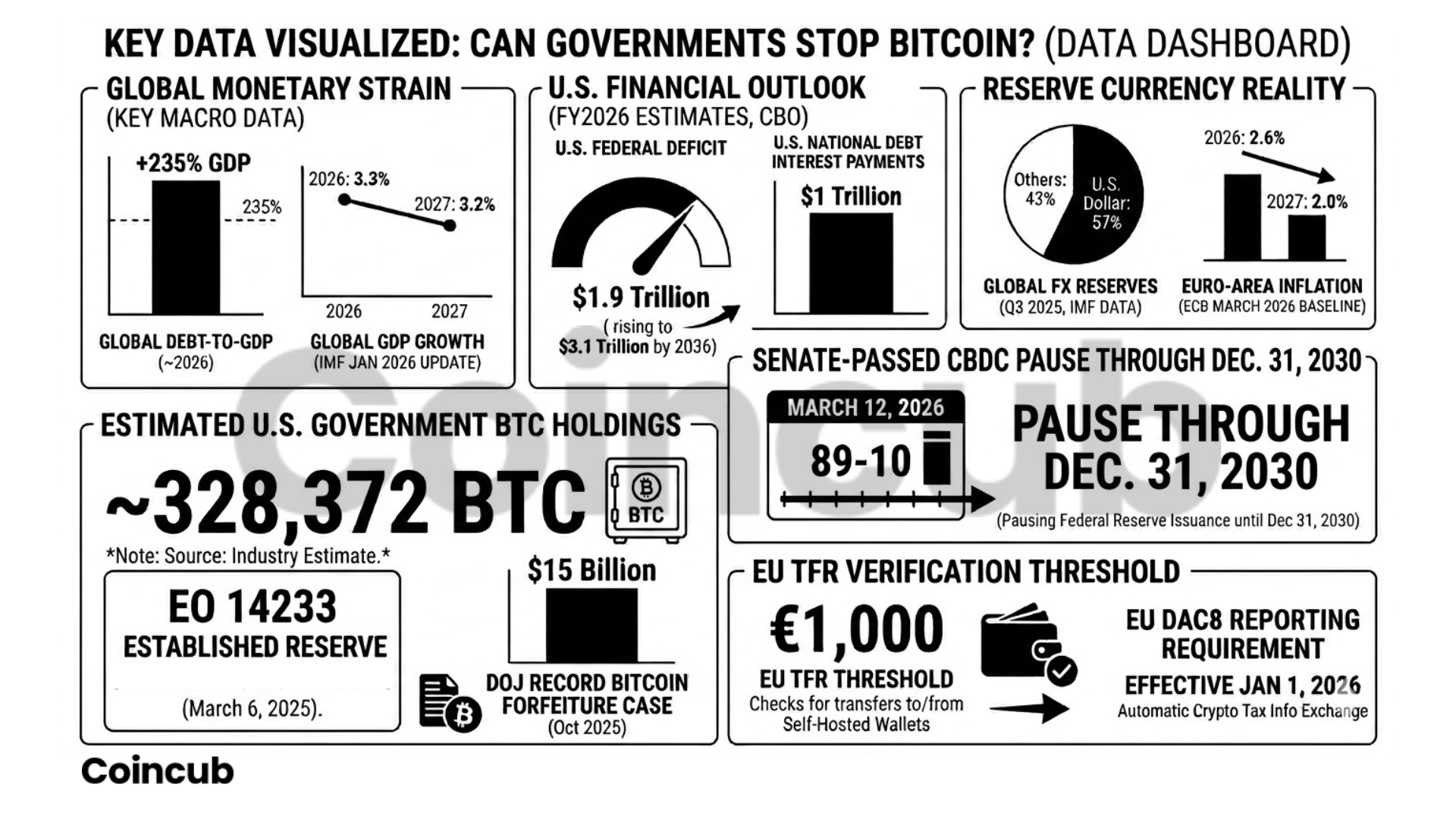
The IMF’s January 2026 World Economic Outlook projects global growth of 3.3% in 2026 and 3.2% in 2027. The AI investment wave is providing real economic tailwinds, and inflation is moving in the right direction, from an estimated 4.1% in 2025 down toward 3.8% in 2026. The system is functioning.
The problem lives underneath that surface. Global debt sits north of 235% of world GDP. The Congressional Budget Office projects a U.S. federal deficit of $1.9 trillion in fiscal year 2026, growing to $3.1 trillion by 2036. Net interest payments on U.S. debt are projected to top $1 trillion in FY2026 at 3.3% of GDP, and they’re on course to roughly double to $2.1 trillion within a decade.
That’s the slow-burn story. When bond yields rise because deficits keep expanding, central banks face sustained pressure to accommodate fiscal policy. Sophisticated capital has noticed. Bitcoin gets accumulated as a long-duration hedge against a system that keeps diluting its own currency to manage debt it can’t grow out of.
| Macroeconomic Indicator | 2025/2026 Actuals & Baselines | 2027 Projections | Systemic Implications |
| Global Real GDP Growth | 3.3% | 3.2% | Steady growth prevents immediate collapse but is insufficient to deleverage global debt rapidly. |
| U.S. Federal Deficit | $1.9 Trillion (2026) | Growing | Persistent deficits require continued debt issuance and eventual monetary accommodation. |
| U.S. Net Interest Costs | >$1.0 Trillion (2026) | Expanding | Interest payments now rival major discretionary spending, signaling long-term fiscal stress. |
Anatomy of Fiat Collapses: Edge Cases vs. Reserve Currencies
Weimar Germany in 1923. Zimbabwe in 2008. Venezuela today. These examples get thrown around whenever someone argues fiat currencies are inherently doomed. They’re legitimate examples, but applying them directly to the U.S. dollar or the euro is an analytical stretch that doesn’t survive scrutiny.
In each of those cases, there was a combination of institutional collapse, sovereign isolation, and money printing untethered from any foreign demand. Zimbabwe’s inflation reached into the billions of percent. People abandoned the local currency entirely, first for the U.S. dollar, then increasingly for digital assets. That’s what happens when a population completely loses faith in its institutions all at once.
The U.S. dollar still accounts for roughly 57% of global foreign exchange reserves and remains the primary unit of account for global commodities and trade. The more realistic scenario for major advanced economies is financial repression: a long, slow erosion of purchasing power where inflation runs slightly above interest rates, quietly liquidating the real value of sovereign debt over many years. Less dramatic, more insidious, and a far more credible forecast.
The Economic Frameworks That Explain Bitcoin’s Momentum
Gresham’s Law: People Hoard Good Money
Gresham’s Law gets summarized as “bad money drives out good.” The classic version goes like this: when governments mandate that two forms of money, one with high intrinsic value and one without, must be treated as equivalent, people hoard the good one and spend the bad one. Rational behavior.
In a modern context, fiat currencies subject to steady inflation are the bad money. Bitcoin, with its algorithmically enforced cap of 21 million units, is the good money. The behavior we actually see in the market tracks this perfectly. Bitcoin gets held in cold storage rather than spent at checkout. That’s textbook monetary economics playing out with a new asset.
The Cantillon Effect: New Money Lands Unevenly
The Cantillon Effect goes back to the 18th century but has never been more relevant. When a central bank expands the money supply, the newly created capital flows first to governments, commercial banks, and large asset holders. By the time that money reaches working people, asset and goods prices have already adjusted upward. The people furthest from the printing press absorb the inflation without the early access to appreciating assets.
Bitcoin doesn’t eliminate wealth inequality. Its fixed, transparent issuance schedule does remove the discretionary fiat creation that drives the Cantillon dynamic in the first place, though. No central authority can issue more Bitcoin to benefit a specific political class. Everyone participates on the same terms, and the schedule is written into open-source code.
How Governments Actually Try to Control Bitcoin
Shutting down the Bitcoin network itself is extraordinarily difficult, arguably impossible for any single nation-state, and very hard even for coordinated ones. What governments have figured out is that they don’t need to shut it down. They need to choke off its connection points to the traditional financial system.
Asset Seizure in the United States
U.S. federal authorities have developed a sophisticated toolkit. In 2025 alone, the government seized over $15 billion in cryptocurrency using three distinct legal mechanisms.
Asset Freezing is often the first move. A court order or OFAC directive prevents fund transfers. This works particularly well against centralized stablecoins like Tether and USDC, whose issuers maintain embedded backdoor controls and can execute a “burn and reissue,” destroying frozen tokens in a suspect’s wallet and reissuing them to a government-controlled address without ever needing the private keys.
Asset Seizure occurs when law enforcement demonstrates probable cause and takes physical or cryptographic custody of the assets. For funds sitting on centralized exchanges, this is essentially frictionless, since platforms like Coinbase are legally compelled to comply.
Asset Forfeiture is the permanent transfer. Under civil forfeiture laws, the government can seize Bitcoin by proceeding against the property itself, requiring only a preponderance of the evidence that the assets are connected to a predicate offense.
Following Executive Order 14233 in March 2025, the U.S. stopped auctioning seized Bitcoin and began funneling it into a Strategic Bitcoin Reserve.
The EU’s Regulatory Architecture: MiCA, TFR, and DAC8
The European Union has built the most comprehensive crypto regulatory framework in the world. Rather than banning anything outright, the EU has focused on squeezing the industry through compliance requirements that are expensive and difficult to meet.
MiCA (Markets in Crypto-Assets) establishes a unified licensing regime for exchanges and custodial wallet providers across the continent, replacing fragmented national regulations. Entities must obtain authorization as a Crypto-Asset Service Provider to operate. A transitional window allows legacy firms to continue until July 1, 2026, or until their authorization is granted or refused, but individual member states may shorten that window. Poland has seen hundreds of previously registered businesses racing against uneven domestic timelines as a result.
The Transfer of Funds Regulation (TFR) extends anti-money laundering travel rules to crypto. For transfers over €1,000 from an exchange to a self-custody wallet, the exchange must assess whether the customer actually controls that destination address. Acceptable verification includes requiring the user to sign a message with their private key or to complete a small test transaction.
DAC8 came into force on January 1, 2026, mandating the automatic exchange of transaction data between EU tax authorities. This applies even to service providers based outside the EU if they’re servicing European citizens, which fundamentally changes the privacy landscape for anyone operating in or for European markets.
Can the Network Actually Survive?
The obvious counterargument is “just shut down the internet.” That would cause problems, obviously. The Bitcoin community has put serious thought into off-grid routing, though.
Blockstream Satellite broadcasts the entire Bitcoin blockchain globally from space. A Ku-band receiver is all you need to sync a full node without any terrestrial internet. Mesh networking hardware like goTenna and Locha Mesh lets users route signed transactions over local radio frequencies until they reach an internet-connected exit node.
Worth saying clearly: these are proof-of-concept tools rather than consumer products ready for mass deployment. A significant portion of everyday commercial use would be disrupted under extreme censorship. The point they make is still important, though. There’s no single off switch, and the kill shot keeps getting harder to land.
CBDCs: More Contested Than the Headlines Suggest
Central Bank Digital Currencies are portrayed in much coverage as an inevitable surveillance-state outcome. The reality is more fractured than that.
Yes, a retail CBDC technically enables programmable money, including restrictions on spending, expiration dates, and transaction monitoring. The civil liberties concerns are genuine. But the policy landscape is genuinely divided.
Many central banks have stepped back from retail CBDCs entirely and are focusing on wholesale versions, meaning bank-to-bank settlement infrastructure that doesn’t touch ordinary consumers. In the United States, political pushback has been fierce. The House previously passed the Anti-CBDC Surveillance State Act. In March 2026, the Senate passed the 21st Century ROAD to Housing Act, a bipartisan housing package with a provision explicitly prohibiting the Federal Reserve from issuing a retail CBDC until at least 2030.
Treat the CBDC threat as contested and jurisdiction-specific.
The Quantum Threat: A Real Long-Term Risk
The most technically credible long-term threat to Bitcoin is a sufficiently powerful quantum computer that uses Shor’s Algorithm to derive a private key from an exposed public key, fast enough to steal funds before a transaction confirms.
We’re likely decades away from a machine capable of cracking a Bitcoin key within the 10-minute block window. Current quantum hardware is nowhere near that capability. NIST has already finalized post-quantum cryptographic standards, and Bitcoin developers are actively researching migration paths to quantum-resistant algorithms such as Dilithium and SPHINCS+.
The real governance challenge will be migrating billions of dollars’ worth of dormant UTXOs to new, secure address formats. That’s a monumental coordination problem, but it’s a known engineering problem with a long lead time. Not a surprise attack.
What This Means Going Forward
The global financial system isn’t collapsing, and Bitcoin isn’t replacing fiat currencies in the next cycle. The absolute state monopoly on money creation has been permanently fractured, though. That’s not a dramatic claim; the evidence supports it.
Sovereign debt isn’t going away. Rising interest costs aren’t going away. The gradual erosion of fiat purchasing power isn’t going away. Meanwhile, governments are erecting regulatory walls around Bitcoin’s touchpoints with traditional finance through licensing regimes, travel rules, tax-reporting mandates, and forfeiture arsenals.
The coming decade won’t be defined by a dramatic confrontation in which one side wins outright. It’ll be defined by coexistence, a persistent competition between the politically managed elasticity of sovereign money and the rigid mathematical scarcity of a network nobody controls.
Frequently Asked Questions (FAQ)
Can governments shut down Bitcoin completely?
Not easily. Bitcoin runs on a globally distributed network of nodes and miners, so no single government can flip a switch and turn it off. They can make access harder through regulation, taxation, and enforcement. Elimination is a different proposition.
What can governments actually control?
The places where Bitcoin touches traditional finance: centralized exchanges, custodians, payment providers, stablecoin issuers, banks, and tax reporting systems.
Can governments ban Bitcoin ownership?
They can try. In practice, bans tend to push activity underground, offshore, or into peer-to-peer channels rather than eliminating it.
Why is Bitcoin described as a hedge against fiat strain?
Because its supply is fixed and cannot be expanded by any central authority, supporters see it as a protection against the long-term erosion of purchasing power that comes with persistent fiscal expansion.
Does Bitcoin eliminate the Cantillon Effect?
Not completely. It removes discretionary monetary issuance by a central authority, but it doesn’t eliminate unequal ownership, unequal access, or unequal gains among participants.
What is MiCA and why does it matter?
MiCA is the EU’s core crypto regulatory framework. It pushes crypto firms into a formal licensing regime and raises compliance standards significantly across European markets.
What does the EU Travel Rule mean for self-custody wallets?
For transfers over €1,000 from an exchange to a self-hosted wallet, the firm may need to verify that the destination address is actually controlled by the customer, which adds friction to moving funds off-platform.
Can self-custodied Bitcoin be seized?
Only if authorities gain access to the private keys or compel disclosure through legal means. Self-custody is harder to seize than exchange-held assets, but it’s not immune to legal pressure.
Are CBDCs a direct replacement for Bitcoin?
No. CBDCs are centralized, state-issued digital money with programmable controls. Bitcoin is decentralized and supply-capped. They represent fundamentally different models of monetary control.
Will quantum computing destroy Bitcoin?
Not in the near term. It’s a serious long-term engineering and governance challenge, with timelines measured in decades, and the cryptographic community is already working on migration paths.