Buy a Licensed Company
  Explore VASP Data
  Talk to an Expert
 Buy a registered Canadian MSB
Beginner-focused keyless wallet offering simple crypto management without seed phrases or hardware devices.
| Founded | 2018 |
| Headquarters | Israel |
| Wallet Type | Hot Wallet |
| Models Available | iOS, Android, Desktop app |
| Chains Supported | Bitcoin, Ethereum, Tezos, Solana, BNB, Tron, Terra, 100+ tokens |
| Connectivity | Mobile app; cloud backup (Google Drive, iCloud); no hardware integration |
| Backup & Recovery | Multi-Party Computation (MPC) with social recovery (trusted contacts) and biometric login |
| Companion App | Native mobile app, desktop client available |
| Customer Support | Yes; live chat, email, multilingual support |
| Deposit/Receive Methods | On-chain transfers, in-app fiat purchase via credit card, Apple Pay, Google Pay, bank transfer |
| Price & Fees | Free basic version; Premium $19.99/month or $199.99/year; fiat purchase fees vary (1.99%-5.99%) |
Zengo Wallet launched in 2018 with a goal to simplify cryptocurrency management while maintaining security. It targets users who want full control over their digital assets but without the usual hassles tied to seed phrases. Zengo replaces traditional private key handling with a keyless security model, making it easier for people new to crypto to safely store and transact without memorizing or safeguarding complex recovery phrases.
The founders, Ouriel Ohayon and Ron Gura, combined expertise in blockchain and cryptography to tackle a major barrier to adoption: managing private keys securely. Their solution uses Multi-Party Computation (MPC) technology to split and protect keys, preventing any single point of failure. This approach removes seed phrase risks, a frequent cause of lost funds, while enabling quick recovery through biometric authentication and social recovery methods.
Seed phrases are essential to most wallets but pose serious risks. Users often lose or expose them, which leads to permanent loss or theft. By eliminating this step, Zengo addresses a pain point that has kept many from fully embracing crypto. Its clean, mobile-first interface focuses on ease of use while supporting over 100 cryptocurrencies, staking, NFT management, and a crypto card for real-world spending.
As of mid-2025, Zengo counts over a million active users worldwide. Its ecosystem includes native apps for iOS, Android, and desktop, alongside integrations with decentralized applications through WalletConnect. The wallet’s design balances user-friendly features with advanced security layers, positioning it as a leading option for beginners and those seeking secure, straightforward crypto custody without the complexity of hardware devices or seed phrases.
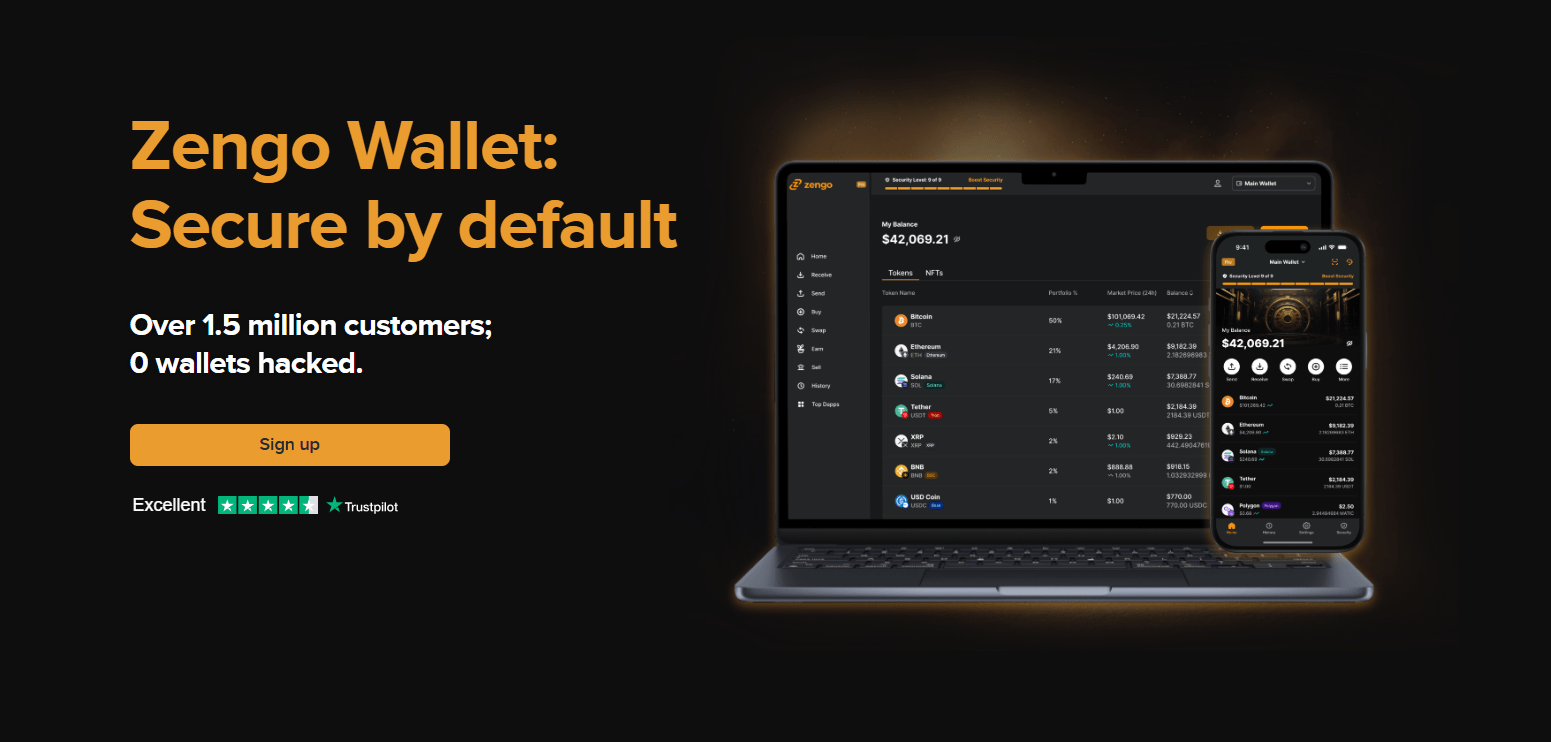
Zengo replaces traditional private keys with a keyless security model built on Multi-Party Computation (MPC). Instead of storing a single private key on your device, Zengo splits it into three encrypted pieces. One piece stays on your phone, another on Zengo’s servers, and a third with a trusted third-party custodian. No single party can access the full key alone.
When you initiate a transaction, your app and the server securely communicate to reconstruct the key just long enough to sign. This process happens in real time without ever exposing the complete key to either side. This cryptographic technique reduces the risk of theft or loss tied to seed phrases, which traditional wallets rely on.
To recover your wallet if you lose access, Zengo uses social recovery. You designate trusted contacts who receive a notification and approve your recovery request. Alongside encrypted cloud backups stored on services like iCloud or Google Drive, this system ensures you don’t permanently lose funds if your device breaks or is lost.
Biometric protections, such as Face ID or Touch ID, protect access to the app. A PIN code adds another verification layer for transactions. These safeguards prevent unauthorized use even if someone obtains physical access to your device.
While MPC and social recovery simplify security, Zengo’s reliance on its servers and third-party custodians introduces some centralized risk. Users must trust these parties to maintain uptime and security, though Zengo has mechanisms to ensure access even if servers go offline. Regular professional audits and a partially open-source codebase further enhance trust.
Zengo focuses on mobile-first wallet management, offering dedicated apps for both iOS and Android. It also provides a desktop client, allowing users to manage assets seamlessly across devices. The wallet’s interface is clean and uncluttered, designed for straightforward navigation without overwhelming users with technical jargon. Main functions such as sending, receiving, swapping, and staking are accessible within a few taps, making it accessible to beginners while remaining efficient for experienced users.
The wallet supports over 100 cryptocurrencies, including major assets like Bitcoin, Ethereum, Tezos, Solana, BNB, and many ERC-20 tokens. Users can stake supported tokens such as Tezos and Solana directly through the app to earn rewards. Staking setup requires minimal effort, and Zengo handles the delegation and reward collection behind the scenes. This feature encourages users to participate in network consensus without needing technical expertise.
NFT enthusiasts find value in Zengo’s ability to manage Ethereum-based NFTs. Users can view their collections and interact with NFT marketplaces through WalletConnect integration. This protocol enables connections to decentralized applications (dApps) without compromising security, facilitating access to platforms like OpenSea and others directly from the wallet.
In-app fiat onramps let users purchase cryptocurrency using credit and debit cards, Apple Pay, Google Pay, PayPal, and bank transfers. Fees vary depending on the method, with credit card purchases being the most expensive. Zengo displays all fees clearly before transactions complete. The wallet also supports crypto-to-crypto swaps within the app, allowing users to trade assets without leaving the interface.
Zengo recently introduced the Zengo Card, a Mastercard-linked debit card that enables spending crypto at physical and online merchants. Users convert crypto to fiat within the app and load funds onto the card. This feature simplifies everyday crypto spending and helps bridge the gap between digital assets and traditional payments.
Zengo charges standard blockchain network fees whenever users send or receive cryptocurrencies. These fees depend on network congestion and vary per asset. Users have no control over network fees, which go directly to miners or validators.
Fiat onramps within the app allow buying crypto via credit or debit cards, Apple Pay, Google Pay, PayPal, and bank transfers. Credit card purchases carry the highest fees, typically around 5.99%, while bank transfers cost about 1.99% but take one to two business days to process. Fees for crypto swaps within the wallet generally range from 0.75% to 2%, covering spreads and processing costs charged by third-party providers.
Zengo offers a premium subscription priced at $19.99 per month or $199.99 annually. Subscribers benefit from reduced fees on crypto purchases, access to advanced wallet features such as multiple segregated wallets, private transactions, time-locked Bitcoin vaults, and inheritance tools. The subscription also provides users with crypto research data and annual tax reporting assistance.
While Zengo operates primarily as a free application, it has structured its offerings into two distinct tiers to cater to both casual holders and serious Web3 participants.
Zengo Essential (Free) The foundational Zengo experience provides everything a standard user needs to custody their crypto securely. It includes the core MPC security model, multi-chain asset support, social recovery, and the ability to buy, sell, and swap tokens. Users also get access to the built-in WalletConnect integration for interacting with dApps, making it a highly capable daily driver for basic portfolio management.
Zengo Pro ($19.99/month or $199.99/year) Zengo Pro is tailored for users managing significant capital or interacting heavily with decentralized finance protocols. Upgrading unlocks a suite of advanced security and management tools:
Multi-factor authentication adds layers of protection. Additionally, encrypted backups stored on cloud services like iCloud or Google Drive provide secure recovery options.
Zengo’s codebase is partially open source, allowing external review of critical components, though some parts remain closed. The wallet undergoes regular security audits by reputable firms like Certik. These audits assess cryptographic implementations, app behavior, and network security, helping maintain trust and transparency.
A trade-off exists due to Zengo’s reliance on its servers and a third-party custodian to hold key shares. This introduces a degree of centralization that some users might find concerning. If these entities were compromised or unavailable, it could impact wallet access. However, Zengo has contingency plans to ensure recovery even if servers go offline.
Since its launch, Zengo has not reported any major breaches or losses. Its security innovations, combined with ongoing audits and layered defenses, make it one of the safest wallets for users who want to avoid seed phrase management without sacrificing control.
MetaMask focuses on Ethereum and compatible networks. It is non-custodial and open-source but depends on seed phrases and lacks built-in biometric security. MetaMask excels for users engaging with DeFi and dApps but demands careful key management.
Ledger represents hardware wallets offering offline key storage and secure elements. It supports over 5,500 assets with strong security guarantees. However, hardware wallets require physical devices and seed phrase backups, which can intimidate beginners.
Trust Wallet offers an open-source, mobile-only solution supporting millions of tokens. It requires users to manage seed phrases and lacks biometric login or multi-factor authentication. Trust Wallet is ideal for users comfortable with self-custody and seeking broad asset support but less focused on beginners.
Zengo fits best among beginners and mobile users who want secure custody without seed phrase management. Its MPC technology and social recovery simplify security while maintaining non-custodial control. It offers staking, NFT support, and a crypto card, features uncommon in beginner wallets.
Crypto spenders who want to use their assets in everyday life gain from the Zengo Card, which enables seamless fiat conversions and payments. NFT collectors also find value in the wallet’s NFT management features and dApp integrations via WalletConnect, supporting easy interaction with marketplaces.
Advanced traders who require deep asset coverage, low fees, or hardware wallet integration might find Zengo limiting. Users focused on maximum decentralization or privacy may hesitate due to its partially centralized infrastructure and mandatory email for recovery. Those needing large-scale portfolio management or complex multi-signature setups should look to more specialized wallets.
Zengo fits well for individuals prioritizing ease of use and security over advanced features. Its staking options, particularly for Tezos and Solana, attract users who want passive income without added complexity. Overall, it balances accessibility and safety, making it a good entry point into crypto custody and daily use.
Visit Zengo
Start by downloading the Zengo app from the official App Store or Google Play. Once installed, open the app and select “Create a New Wallet.” The setup process guides you through setting a PIN and enabling biometric login, such as Face ID or Touch ID, to secure access.
To prepare for account recovery, you’ll designate trusted contacts who can help restore access if you lose your device. The app prompts you to sync an encrypted recovery file to your cloud storage like Google Drive or iCloud. This setup prevents permanent loss without the risks tied to seed phrase management.
Funding your wallet is simple. You can receive crypto by sharing your address or purchase assets in-app via credit card, bank transfer, or Apple Pay. Fees and limits vary depending on payment methods.
Sending crypto involves selecting the asset, entering a recipient address or scanning a QR code, and confirming the transaction with your PIN and biometric verification. Zengo clearly displays all fees and transaction details before approval.
The Zengo Card links to your wallet balance. Use the app to convert crypto to fiat and load funds onto the card, which you can spend wherever Mastercard is accepted.
When evaluating software wallets, particularly those utilizing Multi-Party Computation (MPC), it is essential to look beyond basic asset storage and consider the following features:
Let’s examine how Zengo’s MPC approach stacks up against the most prominent traditional software wallets on the market:
Zengo and MetaMask both serve as gateways to Web3, but their fundamental architectures and target audiences differ sharply.
MetaMask is a traditional non-custodial wallet reliant entirely on a single private key and a standard seed phrase. If a user loses their seed phrase or stores it digitally where it can be compromised, their funds are irretrievable. Zengo uses MPC technology, meaning there is no seed phrase to steal or lose. Access is tied to the user’s biometric data, an encrypted cloud file, and Zengo’s server share. For users anxious about managing a piece of paper with their life savings, Zengo offers a much more forgiving security model.
MetaMask remains the industry standard for deep DeFi integration. Almost every decentralized application on Ethereum and compatible EVM networks supports MetaMask natively via browser extensions. Zengo relies on WalletConnect to bridge the mobile app to desktop dApps. While WalletConnect is highly effective, MetaMask’s native browser extension provides a smoother, faster experience for power users who are constantly yield farming, bridging assets, or executing complex multi-step smart contract interactions.
Both Zengo and Trust Wallet target mobile-first users looking for a clean interface to manage a diverse portfolio, but they approach custody very differently.
Trust Wallet, backed by Binance, boasts native support for dozens of blockchains and millions of custom tokens right out of the box, making it a favorite for users hunting micro-cap altcoins across obscure networks. Zengo takes a more curated approach. While it supports major ecosystems like Ethereum, Solana, and Bitcoin, its token list is more restricted to ensure compatibility with its complex MPC infrastructure.
Trust Wallet operates identically to a hardware wallet in software form: it generates a 12-word seed phrase upon setup. The burden of security rests 100% on the user. Zengo removes this burden entirely through its three-factor recovery system (email, cloud backup, and 3D face scan). If a Trust Wallet user drops their phone in a lake and forgot to write down their phrase, the crypto is gone forever. If a Zengo user suffers the same fate, they simply download the app on a new device, scan their face, and restore their balances instantly.
Zengo combines innovative keyless security with a clean, easy-to-use interface. Its MPC technology removes the need for seed phrases, reducing a common risk for crypto users. Social recovery and biometric login add layers of protection while keeping the process accessible. The wallet supports over 100 cryptocurrencies, staking, NFT management, and offers a crypto card for real-world spending.
However, the wallet relies on centralized servers and third-party custodians, which may concern users prioritizing full decentralization. Fees on fiat purchases tend to be higher than on major exchanges. The lack of hardware wallet integration and limited advanced trading features make it less suitable for professional or high-volume traders.
For anyone prioritizing simplicity and safety in 2025, Zengo presents a compelling option.
Visit Zengo
Yes. Zengo uses Multi-Party Computation (MPC) to split private keys into encrypted shares, eliminating seed phrase risks. Biometric login and PIN protections add extra security layers. The wallet undergoes regular third-party audits and has no reported major breaches.
You can. Zengo uses social recovery, allowing you to designate trusted contacts who approve your recovery request. Along with encrypted cloud backups, this ensures you regain access without seed phrases.
Network fees apply to all blockchain transactions. Fiat purchases through the app carry fees between 1.99% and 5.99%, depending on payment method. Crypto swaps have fees around 0.75% to 2%. Premium subscribers enjoy reduced fees.
Basic use requires only email verification. Larger transactions or fiat withdrawals may trigger KYC requirements. This balances privacy with regulatory compliance.
Zengo supports over 100 assets including Bitcoin, Ethereum, Tezos, Solana, BNB, and many ERC-20 tokens. Support for staking and NFTs covers select networks.
Yes. The wallet currently supports staking for Tezos and Solana. The app manages delegation and reward collection automatically.
No. Zengo’s keyless MPC design does not currently integrate with hardware wallets.
The Zengo Card is a Mastercard-linked crypto debit card. Users convert crypto to fiat in-app and load funds onto the card for spending at merchants that accept Mastercard.
Zengo offers stronger security by eliminating seed phrases and using MPC. Trust Wallet requires seed phrase management and lacks biometric login. Coinbase is custodial and holds users’ keys, while Zengo keeps users in control.
Visit ZengoSubscribe to our newsletter, you are in very good company










 Canada
  Australia