Buy a Licensed Company
 Explore VASP Data
 Talk to an Expert

 Atis Shala
Atis is a senior analyst and community lead with four years of experience in crypto. He has a bachelor from the Rochester Institute of Technology.
Akash Network (AKT) Price Prediction 2026-2030

- AKT traded near $0.67 on 26 October 2026, roughly 92% below its all-time high, with a market capitalisation of about $199 million.
- More leases have yet to translate into more revenue: Q1 2026 lease activity rose 27.1%, while lease revenue fell 45%.
- Compute spending now drives AKT burns through Burn-Mint Equilibrium, but burns remain too small to offset ongoing token issuance.
- Akash’s planned chain migration could bring new customers and liquidity, though the destination and implications for stakers remain unresolved.
- The base-case forecast puts AKT at $0.60–$0.80 by year-end 2026, $0.75–$1.10 in 2027 and $1.10–$2.00 by 2030, depending on revenue growth and migration progress.
Akash Network (AKT) traded at about $0.67 on 26 October 2026, giving it a circulating market capitalisation of roughly $199 million, according to CoinGecko. That is about 92% below the April 2021 high of $8.07. This forecast rests on fundamentals: what customers pay for compute, how much of it is burned as AKT, how fast supply grows, and what the planned chain migration means.
What Is Akash Network (AKT)?
Akash Network is a decentralised cloud computing marketplace. Developers, called tenants, rent CPU, GPU and storage capacity from independent providers, who range from data centres to individuals running hardware at home. Providers bid for each deployment, which lets Akash undercut traditional clouds on many workloads, especially AI GPUs.
The network has run as its own blockchain, built with the Cosmos SDK, since its first mainnet in September 2020. AKT is its native token. It secures the chain through staking, gives holders a vote in governance, and settles payments between tenants and providers. Since March 2026, compute spending has also been linked to AKT burns through a model called Burn-Mint Equilibrium (BME), explained below.

| Metric | Value (26 October 2026) |
|---|---|
| Price | About $0.67 |
| Circulating market cap | About $199 million |
| Circulating supply | About 299 million AKT |
| Max supply parameter | About 388.5 million AKT |
| All-time high | $8.07 (April 2021) |
Akash Network Price Prediction at a Glance
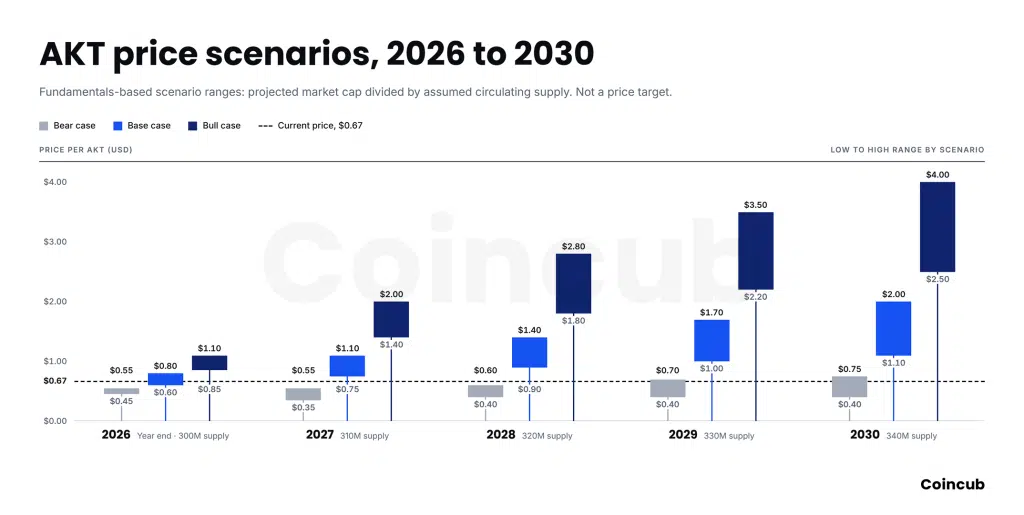
Akash Network Fundamentals in 2026
Messari’s Q1 2026 report shows lease activity rising while revenue fell.
| Fundamental (Q1 2026) | Value | Change on Q4 2025 |
|---|---|---|
| New leases | 43,540 | Up 27.1% |
| Lease revenue | About $253,000 | Down 45% |
| Total network fees | About $258,000 | Down 44% |
| Average active providers | 58 | Down 8.4% |
| AKT burned under BME (to 31 March) | 53,520 AKT | New metric |
Annualising Q1 fees gives roughly $1.03 million a year, so today’s $199 million market capitalisation equals about 190 times annual network fees. That multiple shows how much of the price rests on expected growth, and it anchors the scenarios below.
Akash Network (AKT) Price Prediction for 2026
The biggest fundamental change of 2026 is BME, which went live with Mainnet 17 on 23 March 2026. Tenants keep paying in dollar terms, the network converts that spending into AKT through market purchases, and the AKT is burned. Providers are paid through ACT, a non-transferable, dollar-denominated credit that they redeem for AKT at settlement at the prevailing market price. Messari described BME as the first explicit deflation mechanism in the network’s history.
The burn is still small next to supply. The 53,520 AKT burned by the end of March equals less than 0.02% of circulating supply, and BME only reduces net supply when AKT rises between the time a tenant funds a lease and the time a provider settles it. With staking still issuing new tokens, the table assumes supply edges up to about 300 million by year end.
With two months left, the base case of $0.60 to $0.80 assumes lease activity holds at its current pace. The bull case of $0.85 to $1.10 requires a confirmed migration partner or a clear rebound in lease revenue, while the bear case of $0.45 to $0.55 reflects revenue continuing to fall.
AKT Price Prediction for 2027
The year 2027 should be the first full year after the chain migration. In October 2025, founder Greg Osuri announced that Akash would retire its sovereign Cosmos SDK chain and move to a shared security provider, and the AEP-79 request for proposals targets completion by 31 December 2026. As of late October 2026, no destination chain had been publicly confirmed, although Solana has been named a strong contender.
The migration changes AKT’s economics. Today a large share of AKT stays staked to secure the chain, and the roadmap describes a pay-per-use security model that frees that capital for the marketplace. A host ecosystem with deep liquidity and developer activity could lift lease demand, which underpins the base case of $0.75 to $1.10 and a bull case of $1.40 to $2.00. A delayed migration, or an unclear outcome for stakers, points to the bear range of $0.35 to $0.55.
Akash Network Price Prediction 2030
The 2030 ranges depend on whether Akash becomes a meaningful supplier of AI compute, a market shaped by the data centre build-out covered in our analysis of AI and bitcoin competing for data centre capacity.
Holding today’s multiple of about 190 times fees constant shows what each case requires. The base case of $1.10 to $2.00 on 340 million AKT implies a market capitalisation of roughly $375 million to $680 million, which needs about $2 million to $3.5 million in annual fees, or two to three and a half times the Q1 2026 run rate. The bull case of $2.50 to $4.00, about $850 million to $1.36 billion, needs roughly $4.4 million to $7 million in fees. Multiples usually compress as networks mature, so real growth would likely need to exceed those figures. The bear case of $0.40 to $0.75 describes fees staying near current levels while centralised clouds and rival compute networks capture most of the growth.
What Could Drive AKT Higher?
Several fundamentals could lift AKT above the base case.
- Rising paid compute. BME links token demand directly to lease spending, so a sustained rise in revenue would make the burn material.
- A strong migration partner. Joining a large ecosystem could bring new tenants, providers and liquidity.
- Product expansion. Confidential compute arrived in July 2026, and roadmap items such as virtual machine support, reserved instances and preemptible instances target enterprise and AI workloads.
What Could Push AKT Lower?
The same fundamentals carry clear risks.
- Weak revenue. Lease revenue fell 45% in Q1 2026, and the burn stays small until that trend reverses.
- Ongoing issuance. Staking rewards keep adding supply while burns are modest, which dilutes holders who do not stake.
- Shrinking supply side. Active providers fell to 58 in Q1 2026, limiting the capacity Akash can sell.
- Competition. Centralised clouds and other GPU networks compete on price and reliability.
Akash Network Price Prediction Methodology
The ranges come entirely from network fundamentals. Each scenario projects a market capitalisation from assumptions about lease revenue, network fees, burn volume and the success of the migration, then divides it by an assumed circulating supply. The supply path rises from about 300 million to 340 million AKT by 2030, reflecting staking issuance partly offset by burns, and stays below the 388.5 million maximum supply parameter. Supply figures differ between data providers, so the ranges are approximate.
Is AKT a Good Investment?
AKT offers direct exposure to decentralised AI compute, and BME links the token more closely to network usage. Against that, revenue fell sharply in early 2026, the migration is unresolved, and the valuation already prices in substantial growth. Staking rewards offset dilution, a trade-off explained in our guide to vetting crypto staking platforms. AKT suits investors comfortable with high volatility and execution risk.
Frequently Asked Questions (FAQ)
Can AKT reach $1? +
AKT reaches $1 within the base case during 2027, which implies a market capitalisation of about $310 million and requires network fees to grow from their early 2026 level.
What is Burn-Mint Equilibrium? +
Burn-Mint Equilibrium is Akash's token model, live since 23 March 2026, in which compute spending is used to buy and burn AKT while providers are paid through a dollar-denominated credit that converts into AKT at settlement.
Is Akash leaving Cosmos? +
Akash plans to retire its sovereign Cosmos SDK chain and move to a shared security network, with completion targeted by the end of 2026. No destination chain had been confirmed as of late October 2026.