Buy a Licensed Company
  Explore VASP Data
  Talk to an Expert

 Atis Shala
Atis is a senior analyst and community lead with four years of experience in crypto. He has a bachelor from the Rochester Institute of Technology.
Atis Shala
Atis is a senior analyst and community lead with four years of experience in crypto. He has a bachelor from the Rochester Institute of Technology.
How Smart Contracts Guarantee Charity Transparency

- Trust in giving erodes through opacity far more than through fraud. Donors rarely lose money to theft; they lose the ability to connect a gift to an outcome.
- Blockchain donation systems improve transparency through four capabilities: immutable records, traceable fund flows, programmable release conditions and near real time visibility.
- A milestone smart contract can lock funds until a defined condition is met, then release them automatically, with every step visible to donors and auditors.
- The oracle problem is the hard limit. A blockchain cannot see the physical world, so it depends on whoever reports that a milestone was completed.
- Smart contracts guarantee that funds moved by the rules, not that the inputs to those rules were truthful. They move the trust requirement rather than removing it.
- Real limits remain: pseudonymity, the last mile off chain, token volatility, technical barriers and contract code risk.
- Before donating onchain, verify the contract address, its audit, the independence of verifiers, and whether you can actually trace a real disbursement.
Smart Contract Transparency for Charity
To understand what smart contracts fix, you first have to understand what breaks. The failure in charitable giving is rarely outright fraud. It is opacity. Imagine a donor who gives $100 to a water project. Somewhere along the chain, that $100 dissolves into a percentage of a budget line, inside a programme, inside an annual report published fourteen months later. Nothing was stolen, and yet the donor cannot connect their specific contribution to any specific outcome.
Opacity produces a predictable and damaging result. Donors default to giving to the organisations with the strongest brands rather than the strongest outcomes, simply because brand is the only signal available to them. As a consequence, smaller and often more effective organisations lose out to better known ones, and the whole sector allocates money on reputation instead of evidence. Blockchain based donation systems attack this visibility problem head on, and they do so through four distinct capabilities that the rest of this guide unpacks in turn.
What a Smart Contract Is, in Donation Terms
A smart contract is a program stored on a blockchain that runs automatically when specific conditions are met. Nobody needs to approve the execution once it is deployed, and nobody can quietly prevent it. Applied to charity, this means donation rules can be written directly into code, fund releases can be automated, and spending conditions become visible to donors and auditors alike.

A concrete example makes the idea tangible. Suppose a charity establishes a scholarship fund as a smart contract. The rule states that when a student meets defined eligibility criteria, such as maintaining a required grade average, the contract automatically releases the scholarship payment. Donors can then verify that this process ran exactly as specified, without asking the charity to confirm it and without waiting for an annual report. The verification is open to anyone, which is a meaningful shift in who holds the power to check.
Old Model vs. New Model
The contrast between the two models is worth laying out directly, because it shows precisely where the improvement lives and where it does not.
| Dimension | Traditional donation | Smart contract donation |
|---|---|---|
| Time to visibility | Months, via annual reporting | Seconds to minutes, onchain |
| Who verifies | The charity and its auditor | Anyone with a block explorer |
| Record permanence | Editable internal systems | Immutable ledger entries |
| Release control | Staff discretion | Coded conditions |
| Granularity | Aggregated by programme | Traceable per donation |
| Cross border transfer time | Days, via correspondent banks | Minutes |
| Cross border cost | Wire fees plus FX spread | Network fee, often cents |
| Proof of real world delivery | Charity attestation | Still charity attestation |
That final row is the honest one, and the rest of this article keeps returning to it, because it is where the marketing and the reality part ways.
The Cost Layer of Using Smart Contracts for Charity
Transparency is the headline benefit, but cost is the one donors feel most directly, and it is worth pricing out because the comparison is more nuanced than either side of the debate usually admits. A traditional online donation passes through several toll booths before it reaches a programme budget, and each one takes a slice that rarely appears on the donor’s receipt.
What Each Route Actually Costs
The figures below are typical ranges rather than fixed prices, and they vary by country, provider and chain, but the shape of the comparison holds.
| Cost component | Traditional route | Onchain route |
|---|---|---|
| Payment processing | Roughly 2 to 3 percent plus a fixed per-transaction fee | None |
| Fundraising platform fee | 0 to 5 percent, depending on provider | 0 to 2 percent, or none for direct contracts |
| Cross border transfer | Flat wire charge plus an FX spread of roughly 1 to 3 percent | Network fee, from cents to a few dollars |
| Currency conversion | Bank or provider spread at the receiving end | Off-ramp fee, commonly 0.5 to 2 percent |
| Reconciliation and reporting | Staff time, absorbed into overhead | Largely automated by the ledger itself |
The honest reading is that onchain giving removes the middle of the chain but not the ends. Buying crypto in the first place and converting it back to local currency at the other end both carry fees, so the saving is real but smaller than a headline “network fee of a few cents” suggests. Where the advantage becomes decisive is in high-value cross border transfers, recurring micro-donations that traditional processors price out of existence, and emergency response, where a settlement time of minutes rather than days is not a cost saving at all but an operational capability.
The Four Mechanisms That Create Transparency
Transparency here is not a single feature but a stack of four, and each one closes a different kind of opacity. Taken together, they explain why blockchain donation systems can rebuild trust that traditional reporting has steadily lost.
The first mechanism is immutable records. Once a transaction is confirmed, it cannot be edited or deleted, so a charity cannot restate last year’s flows to look better, which removes an entire category of accounting revision.
The second is traceable fund flows, because every transfer links to the one before it, letting a donor follow their contribution from wallet, to pooled fund, to disbursement address using ordinary block explorers.
The third is programmable conditions, where funds can be locked until a defined condition is satisfied, so a milestone contract might hold 60% of a project budget until a verifier confirms the first phase is complete, and donors can actually see that lock.
The fourth is near real time visibility, meaning donors receive updates as disbursements occur rather than at the end of a reporting cycle. Platforms such as GiveTrack have demonstrated that donations, allocations and project updates can all sit in a single interface a donor checks whenever they wish.
How a Milestone Based Donation Flows
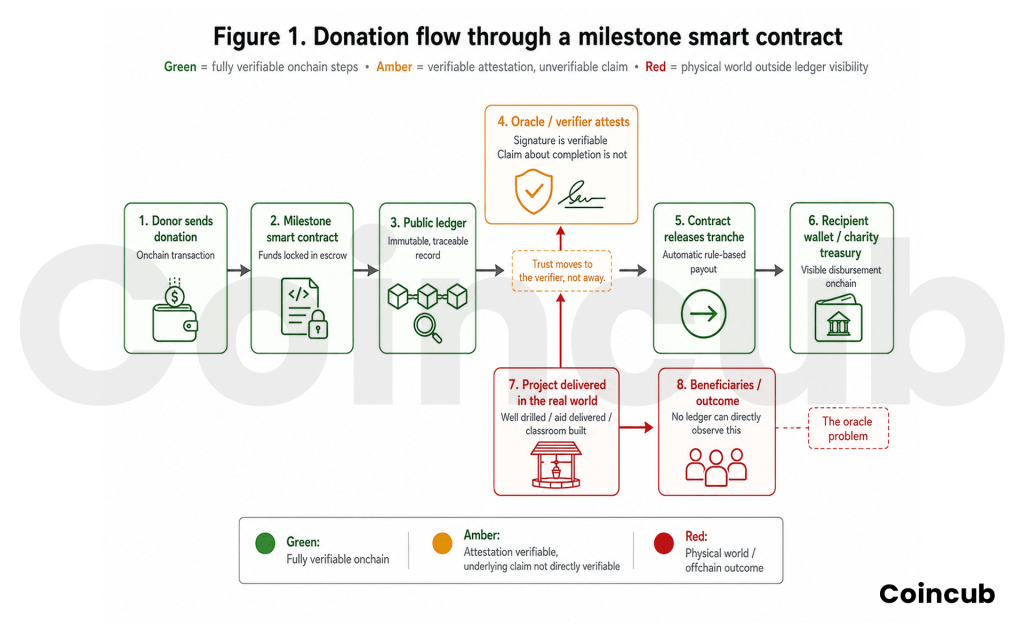
Theory becomes clearer when you trace a single donation through the system. The figure below follows one gift through a milestone contract and marks exactly where verifiability holds and where it quietly gives way.
Three Architectures: Three Levels of Proof
A point that most introductory coverage glosses over is that “blockchain charity” is not one design. Organisations choose between three broad architectures, and the choice determines how much a donor can actually verify. Knowing which one you are looking at is the single most useful piece of technical literacy a donor can acquire.
Direct Pass-Through
The simplest model is a published wallet address that accepts donations and forwards them onward. It is cheap, easy to deploy and requires no custom code, but its transparency is thin. You can prove that funds arrived and that they left, and nothing more. Once the money reaches an exchange address or an unlabelled wallet, the trail effectively ends. Treat direct pass-through as a payment rail with a public receipt, not as an accountability system.
Pooled Treasury With Multisignature Control
The middle model holds donations in a shared treasury wallet that requires several authorised signatures before any withdrawal executes. This is a genuine governance improvement, because no single staff member can move funds alone, and every approval is recorded on chain. What it does not provide is any link between a specific donation and a specific outcome. Spending is still discretionary, merely discretionary under multiple signatures, so donors gain protection against unilateral misuse while remaining dependent on the organisation’s judgement about allocation.
Milestone Escrow With Oracle Attestation
The strongest model locks funds in a contract that releases them in tranches only when a defined condition is attested. This is the architecture that delivers the transparency claims made for the technology as a whole. It is also the most expensive to build, the slowest to disburse, and the only one that depends heavily on the oracle problem described below. In practice most credible programmes mix models, using milestone escrow for large capital projects and a pooled treasury for recurring operational costs, and a charity that explains which model it uses where is telling you something meaningful about its seriousness.
The Oracle Problem for Charity Smart Contracts
Here is the limit, and any article that skips it is selling something. A blockchain knows only what is written to it. It has no senses. It cannot see whether a well was drilled, whether a classroom was built, or whether food actually reached the people it was intended for. Someone has to tell it, and that someone is always a human being or an organisation.
Where the Trust Actually Moves
This is the oracle problem, and it bites the moment a smart contract depends on real world information. The practical consequence is precise: smart contracts guarantee that funds moved according to the rules and that the rules were followed exactly, but they do not guarantee that the inputs to those rules were truthful. If a verifier signs off on a milestone that was never completed, the contract will still release the funds correctly, on schedule, with a flawless audit trail, straight to the wrong outcome. In other words, the technology moves the trust requirement rather than eliminating it. Instead of trusting a charity’s entire accounting department, you now trust its verification process, which is narrower and easier to scrutinise. That is a real improvement, but it is not the same thing as trustlessness.
How Serious Projects Reduce the Risk
Well built implementations shrink this risk in several ways, even though none of them achieve certainty. They use multiple independent verifiers rather than one, they require geotagged and timestamped evidence, they place signing keys with third party auditors, and they stage releases so that exposure is limited if a milestone later proves false. Each measure is better than an annual report, and stacking them is better still, but the honest framing remains that they manage the oracle problem rather than solving it.
What a Strong Verification Design Looks Like
If you want to judge a programme rather than take its word, look for four specific design features, because they are the ones that separate serious verification from decorative verification.
- An attestation quorum, meaning a milestone requires sign-off from several parties with no shared employer, rather than one trusted signer.
- A challenge window, a fixed delay between attestation and release during which any party can dispute the claim and freeze the tranche, which converts verification from a single moment into a contestable process.
- Evidence anchoring, where the photographs, GPS coordinates and inspection reports supporting a claim are hashed on chain, so the evidence cannot be quietly swapped later even though the ledger itself never inspects it.
- Random sampling, in which an independent auditor physically visits a small unannounced share of completed milestones, which makes systematic falsification expensive rather than merely dishonest. A programme with all four is not trustless, but it is meaningfully harder to defraud than one with none.
Real Limitations Donors Should Weigh
Beyond the oracle problem, several practical limits shape what these systems can deliver, and a serious donor should hold all of them in view before assuming onchain giving is automatically superior.
Pseudonymity: the Last Mile and Volatility
Pseudonymity cuts both ways, because you can see that an address received funds but cannot always confirm who controls it, and address labelling depends on disclosure by the organisation, which reintroduces exactly the kind of trust assumption the system claims to remove. The last mile also leaves the chain, since beneficiaries usually need local currency, and at the point of conversion to cash the transparency ends and conventional record keeping takes over. Volatility adds another hazard, because a donation made in a volatile asset can lose a meaningful share of its value before deployment, and charities holding crypto face treasury risk they are rarely equipped to manage. Stablecoin denominated donations address this last problem, though they introduce issuer risk in exchange.
Technical Barriers, Regulation and Code Risk
Three further limits deserve attention. Technical barriers exclude people, since wallet setup, gas fees and key management remain real obstacles for both donors and small organisations, and a transparency system only sophisticated users can operate has a narrow reach. Regulatory obligations also remain fully in force, because charities still face reporting requirements, tax rules and jurisdiction specific compliance duties, and onchain records supplement those obligations rather than replacing them. Finally, contract code itself carries risk, as a flawed contract can lock funds permanently or expose them to exploitation, and immutability means that bugs, like everything else, are permanent. Audited code is therefore not optional.
What to Check Before Donating Onchain
If you want to use these systems as a donor rather than just admire them, a short due diligence checklist will protect you from most of the common traps.
A Six Point Donor Checklist
- Start by confirming that the contract address is published and consistent, appearing on the charity’s official site and matching whatever you were given elsewhere, since address substitution is a common scam.
- Next, check whether the contract has been audited by a recognised firm, because the absence of an audit on a contract handling donations is a meaningful warning sign.
- Then ask who the verifiers are and whether they are independent, because an organisation that verifies its own milestones offers a weaker guarantee than it appears to.
- After that, test whether you can actually trace a disbursement by following one real payment on a block explorer before committing significant funds, since a trail that breaks immediately into an unlabelled pooled address is largely presentational.
- You should also read the failure clause to learn whether funds are refunded, redirected or held if milestones are not met.
- Finally, confirm that conventional audited reporting exists alongside the onchain flows, because the strongest organisations pair both and that combination is more credible than either alone.
The Red Flags That Should Stop a Donation
Some signals are serious enough to end the conversation. Be wary of a donation address circulated only through social media, direct messages or a livestream comment, since legitimate organisations publish addresses on their own verified domain and repeat them consistently. Be equally wary of urgency framing, because a campaign insisting funds must arrive within hours is applying pressure precisely where careful verification is most needed.
Treat a promised financial return, token allocation or appreciation upside as disqualifying, as that is an investment pitch wearing charitable clothing. And treat a refusal or inability to name the verifying party as a hard stop, because a milestone system with an anonymous verifier is an unaudited system with extra steps.
The near term direction is integration rather than reinvention. Research and industry commentary point toward stronger links between blockchain donation systems and digital identity, verifiable credentials, impact reporting and automated compliance tooling. Rather than replacing the charitable sector’s infrastructure, these systems are gradually threading themselves into it.
The Prize Is Comparability
The most consequential possibility is comparability. If charities publish fund flows, milestone completion and administrative costs in a standardised, machine readable format, donors could finally compare organisations on evidence rather than brand recognition. That would represent a structural change in how giving is allocated, and it would benefit small, effective organisations the most. Two conditions must be met first, however. Standards have to be agreed so that data from different organisations can be compared meaningfully, and the verification layer has to become robust enough that the published data is worth comparing at all. Neither condition is solved today, though both are being actively worked on.
So here is the balanced conclusion. Smart contracts make charitable finance auditable in a way it has never been before, giving donors a live, verifiable view of where money moves. What they do not do is make charitable outcomes verifiable, because that still requires a person to walk into a field and confirm the well produces water. Anyone claiming otherwise has quietly skipped the hardest step. Used with clear eyes, though, this technology is a genuine advance, and clear eyes are exactly what this guide is meant to give you.
Frequently Asked Questions (FAQ)
Can smart contracts stop charity fraud? +
They prevent one category of fraud, the misdirection of funds after receipt, by making every movement traceable and rule bound. They cannot prevent fraud at the reporting layer, where false milestone data is submitted to an otherwise honest contract.
How do I track my crypto donation? +
Take the transaction hash from your donation and enter it into a block explorer for the relevant chain. You can then follow subsequent transfers from the receiving address, provided the organisation publishes its disbursement addresses.
What is the oracle problem in charity smart contracts? +
It is the fact that blockchains cannot observe real world events. Any contract that depends on off chain outcomes must rely on a human or organisational source, which reintroduces a trust requirement.
Are blockchain donations tax deductible? +
That depends on the jurisdiction and the recipient organisation's registered status, not on the payment method. Check the organisation's registration and your local rules before assuming deductibility.
Which platforms use blockchain for charity transparency? +
GiveTrack is among the best documented examples, allowing donors to monitor donations, allocations and project updates in one interface. Research systems such as DonateBlocks demonstrate similar tracking models.
Are crypto donations actually cheaper than card donations? +
Usually, but less dramatically than advertised. Onchain transfers avoid payment processing fees and correspondent bank charges, while the costs of buying crypto and converting it to local currency remain. The saving is largest for high-value cross border transfers and for recurring small gifts that card processors price inefficiently.
What happens to my donation if a milestone is never completed? +
That depends entirely on the failure clause written into the contract, which may refund donors, redirect funds to an alternative project, or hold them indefinitely. Because the clause is code rather than policy, it will execute exactly as written, so read it before donating rather than after.
Can a smart contract donation be reversed? +
No. Blockchain transactions are final once confirmed, and there is no chargeback mechanism equivalent to a card payment. This is precisely why address verification matters more in on-chain giving than in traditional giving, and why testing with a small amount first is sensible practice.