Buy a Licensed Company
 Explore VASP Data
 Talk to an Expert


 Dren Hima
 is Head of Research at Coincub, leading research across digital asset regulation, licensing, market structure, tokenization and institutional adoption.
Prophet Margins in Crypto Oracle Manipulation

- In most of the largest oracle exploits, the oracle reported its market accurately after the attacker had moved that market.
- A lending protocol stays safe only while the cheapest way to create and hold a harmful price costs more than the value that price can unlock.
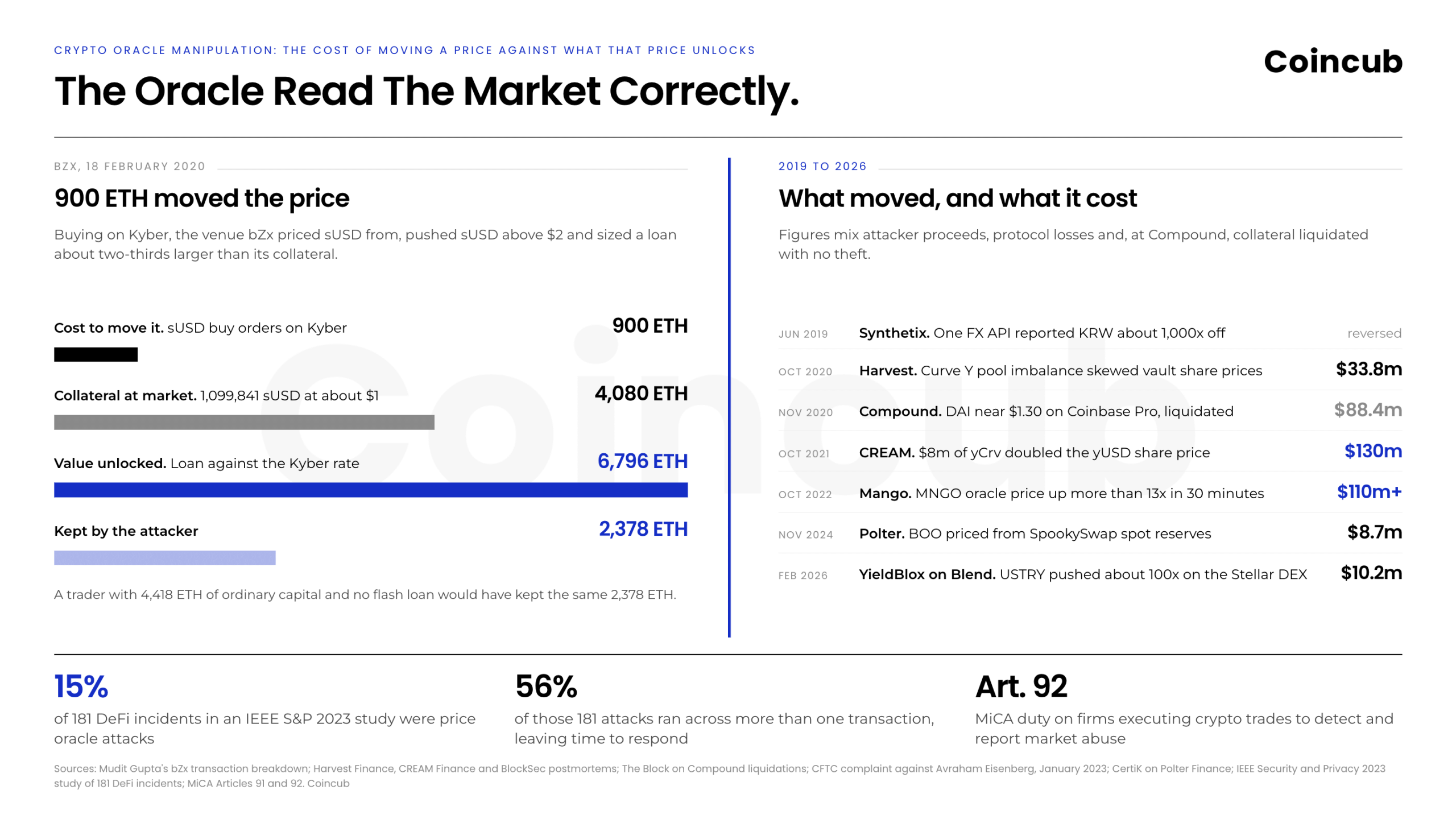
- The 2020 bZx exploit would have paid the same 2,378 ETH to a trader using 4,418 ETH of ordinary capital and no flash loan.
- Borrow and supply caps sized to executable depth bound the loss.
- Mango Markets produced the CFTC’s first oracle manipulation case, and MiCA now requires firms executing crypto trades to detect and report market abuse.
On 22 February 2026, an attacker pushed USTRY, a thinly traded tokenized Treasury asset on the Stellar DEX, from about $1.05 to about $106.73. The YieldBlox DAO lending pool on Blend accepted the new price as collateral value, and the attacker borrowed 61.2 million XLM and 1.0 million USDC, about $10.2 million in all. Reflector, the oracle, had reported the market exactly as it printed. BlockSec’s postmortem traced the loss to the pool operator’s oracle configuration and found no flaw in Blend v2’s core contracts.
The oracle reads a venue, the venue is cheap to move, and the consuming protocol lets the moved price unlock assets worth far more than the move cost. The 2020 bZx exploit and Mango Markets in 2022 fit it too, and in both the data pipeline delivered the number it was built to deliver.
Oracle security belongs to the whole economic path, from price discovery on some venue to the largest amount a protocol will release on that price. The working test is an inequality. The cheapest way to create and hold a harmful price error has to cost more than the most value the protocol lets anyone extract with it. Signatures, node counts, medians, and averaging windows push up the left side, and collateral caps hold down the right. An IEEE Security and Privacy 2023 study of 181 DeFi incidents put price oracle attacks at 15% of its sample, among the most frequent incident types it recorded.

Types of crypto oracle manipulation
Oracle manipulation, in the economic sense used here, is any path by which a protocol consumes a valuation far from the defensible value for the action it is about to take. The failure can start at a trading venue, a data vendor, the consuming contract, or the governance layer that configures all three.
| Failure class | What breaks | Where it has shown up |
| Source-market manipulation | Trades move the venue the oracle reads | bZx 2020, Mango 2022, Polter 2024, YieldBlox 2026 |
| Upstream data failure | A vendor or publisher reports a bad quote | Synthetix KRW feed, 2019 |
| Accounting-derived price | A transfer or donation inflates a vault’s share price | CREAM yUSD, 2021 |
| Aggregation failure | Averaging passes one bad input, or one trade dominates a window | Synthetix 2019, YieldBlox 2026 |
| Temporal manipulation | A stale or selectively submitted update gets consumed | Pull-oracle update selection, oracle front-running |
| Integration failure | Missing staleness checks, wrong decimals, unsafe fallbacks, loose LTVs | Consumers that skip integrator-side checks |
| Control-plane change | Governance or an admin key repoints a feed or loosens a risk parameter | Protocols that change feeds outside a timelock |
| Liveness failure | A feed stops updating while positions stay open | Feed outages and halted delivery |
An oracle can be accurate as a sensor and unsafe as a valuation source. Mango’s feed tracked exchanges an attacker had just bought up, and Reflector tracked a Stellar market with almost no depth. Compound’s DAI liquidations in 2020 came from a venue dislocation with no manipulator involved.
How the bZx flash loan oracle attack worked
bZx’s second exploit, on 18 February 2020, is the cleanest worked example in the record, and every step settled inside a single transaction. Mudit Gupta’s transaction breakdown gives the sequence.
- Flash-borrow 7,500 ETH.
- Convert 3,518 ETH into sUSD through Synthetix’s depot at roughly $1 per token, until the depot runs out.
- Place 900 ETH of sUSD buy orders on Kyber, the venue bZx priced from, pushing sUSD above $2 there.
- Deposit 1,099,841 sUSD as collateral and borrow 6,796 ETH against the inflated Kyber rate.
- Repay the 7,500 ETH flash loan.
At market prices the collateral was worth about 4,080 ETH, and the protocol lent 2,716 ETH beyond that. Buying worth 900 ETH on a thin venue had produced a loan about two-thirds larger than its collateral, and the attacker kept 2,378 ETH.
The flash loan enters and leaves the profit arithmetic at the same 7,500 ETH. A trader holding 4,418 ETH of ordinary capital could have bought the same sUSD, taken the same loan, and walked away with the same 2,378 ETH. The flash loan widened the set of people able to run the trade. The mispricing came from bZx sizing a 6,796 ETH loan off a quote that 900 ETH could move.
Euler shows the limit of the label. Its 13 March 2023 exploit used a 30 million DAI flash loan from Aave and took about $197 million. The root cause was a donateToReserves() function that skipped the liquidity check a normal eToken transfer runs, which let the attacker build an insolvent position and liquidate it themselves. No price feed was involved, and Euler Labs said all recoverable funds had come back by early April 2023.
Oracle manipulation incidents from 2019 to 2026
The figures below measure different things. Some are attacker proceeds, some are protocol losses, and Compound’s is collateral liquidated with no theft involved.
| Incident | Date | Failure | Loss or impact |
| Synthetix sKRW | 25 June 2019 | One FX API reported KRW about 1,000x off after redundancy had already degraded | Over $1 billion in nominal bot profit, reversal agreed |
| bZx | 18 February 2020 | Kyber sUSD price pushed with 900 ETH | 2,378 ETH to the attacker |
| Harvest Finance | 26 October 2020 | Curve Y pool imbalance skewed vault share prices | About $33.8 million |
| Compound | 26 November 2020 | DAI near $1.30 on Coinbase Pro | $88.4 million of collateral liquidated |
| CREAM Finance | 27 October 2021 | $8 million of yCrv sent to the yUSD vault doubled its share price | About $130 million |
| Mango Markets | 11 October 2022 | MNGO oracle price up more than 13x in 30 minutes | Over $110 million withdrawn |
| Euler, non-oracle comparator | 13 March 2023 | No health check in donateToReserves() | About $197 million |
| Polter Finance | 16 November 2024 | BOO priced from SpookySwap spot reserves | About $8.7 million |
| YieldBlox pool on Blend | 22 February 2026 | USTRY pushed about 100x on the Stellar DEX | About $10.2 million |
At Synthetix, an earlier outage had already cut the KRW feed to two APIs, and exception reporting missed it. When one commercial source began reporting the won about 1,000 times too high, the oracle averaged the two and passed the error through. A bot traded into the bad rate for over $1 billion in profit in under an hour, and its owner agreed to reverse the trades in exchange for a bug bounty.
Harvest’s own postmortem puts the October 2020 loss at about $33.8 million. The attacker swung Curve’s Y pool by about 1% per cycle, under the 3% arbitrage check in Harvest’s strategy, and looped deposits and withdrawals 30 times across two vaults. The $24 million figure in some coverage matches the 13 million USDC and 11 million USDT the attacker moved to a separate address, and about $2.48 million came back.
At Compound, DAI printed near $1.30 on Coinbase Pro, the venue its oracle read, and The Block’s on-chain count put the resulting liquidations at $88.4 million. Ten months later, governance passed Proposal 59, which paid 6,817,798 DAI to affected users, equal to the 8% liquidation penalty on the 85,222,475 DAI repaid on 26 November 2020.
CREAM priced yUSD off the vault’s own pricePerShare. The attacker transferred $8 million of yCrv straight into the yUSD contract, lifting pricePerShare from about 1 to about 2 and doubling the attacker’s collateral to an apparent $3 billion. That collateral borrowed out roughly $130 million from CREAM’s Ethereum v1 markets. CREAM’s postmortem located the key vulnerability in “the price calculation of a wrappable token” and halted supply and borrowing of wrappable tokens.
Polter Finance wrapped spot reserves in an oracle interface. Its AaveOracle took BOO prices from SpookySwap pair reserves, and the adapter meant to supply a previous-round price ran the same logic as latestRoundData(). After the attacker flash-borrowed nearly all the BOO in both pairs, CertiK’s analysis found that one deposited BOO was valued at about $1.37 quintillion, and Polter paused the platform with about $8.7 million gone.
TWAP, median, and pull oracle trade-offs
Uniswap v2 records each pool’s price before the first trade in a block and lets consumers average it over any window. The v2 whitepaper says a longer window makes the average more expensive to manipulate and less current. A protocol that copies another protocol’s window inherits a cost assumption calibrated to a different pool’s depth.
Proposers know in advance when they hold consecutive blocks, and they can push a price and back-run their own trade with no arbitrage in between. Uniswap Labs’ October 2022 analysis put a 20% two-block move on the USDC/WETH 5 bps pool at about 709 billion USDC and a three-block move at about $978 million. A validator with 10% of stake would expect three consecutive blocks about 181 times a month. The study named time-weighted medians as a design that would make these manipulations impossibly expensive.
Those figures describe one of the deepest pools on Ethereum. A TWAP over a thin pool has the same structure at a far lower price.
Reflector aggregated USTRY over 300-second windows, and the attacker’s trade dominated two consecutive updates. Blend’s deviation check compared each price only with the previous window, and a move that held across two windows cleared it.
Pyth’s integration guidance says letting users submit updates gives them some ability to choose which price lands, an ability it calls “functionally equivalent to latency.” Its countermeasures are staleness limits through getPriceNoOlderThan(), delayed settlement until the confidence interval narrows, minimum holding periods, and exposure caps on per-trade notional, per-block volume, and open interest.
An oracle network’s signed report shows that an authorized set of reporters attested to a number. Whether that number was cheap to create on the reporters’ venues is a separate property, and Chainlink’s developer responsibilities page says assets “with low liquidity, are the most vulnerable to market manipulation.” The same page leaves data quality checks, circuit breakers, and contingency logic to the integrator.
Sizing collateral limits to manipulation cost
Every useful control acts on one side of the inequality. Raising manipulation cost takes economically independent venues, medians over means, windows long enough for the pool’s depth, and confidence checks. Capping extractable value takes borrow caps, supply caps, isolated markets, and open-interest limits set against the asset’s executable depth.
Source diversity counts only when the sources are independent. Ten vendors reading the same thin exchange report the same manipulated print, and a median of correlated inputs inherits their shared venue. Mango’s oracle drew on three exchanges, and Eisenberg bought on all three.
Caps survive a manipulation that succeeds. An asset with a few million dollars of two-sided depth cannot safely unlock tens of millions in liquid assets, whatever the aggregation method. YieldBlox let USTRY collateral support about $10.2 million of borrowing on a market where the attacker’s orders moved the price roughly 100x. A borrow cap sized to USTRY’s depth would have bounded the loss at the cap.
Freshness thresholds belong to each asset. Feeds run different heartbeats and deviation triggers, and Chainlink recommends using its ETF and forex feeds only during their specified market hours. Tokenized Treasury and equity collateral carries the same constraint, since its reference market closes while on-chain lending keeps running.
Fallback oracles fail when they downgrade security. A protocol that drops from a decentralized feed to an instantaneous pool price during an outage gives attackers a reason to target the primary feed’s liveness first. The safer pattern uses an independent methodology for the fallback and moves the protocol into a reduced-risk mode when primary and fallback disagree.
Feed addresses, signer sets, quorums, heartbeats, LTVs, borrow caps, and liquidation bonuses all change an oracle’s effective trust model. Each belongs behind a timelock, with alerts that fire before execution, and new collateral deserves a probation period with tight caps.
Detecting oracle attacks and responding in time
The IEEE study found that 103 of its 181 attacks, or 56%, were not executed atomically, which left defenders time to act before the exploit completed. Monitoring that fires inside that window has to watch the feed, the market under it, and the protocol actions that depend on both.
| Layer | High-signal patterns |
| Feed | Deviation from an independent reference, stale timestamps, missed heartbeats, falling signer or publisher participation, widening confidence |
| Source market | Reserves draining, price impact for a standard trade jumping, one trade dominating an averaging window, cross-venue basis blowing out |
| Protocol | A flash loan followed by a large swap or donation, a vault share price jump, a health factor rising with no new external wealth, one borrow taking most of a market’s liquidity |
Large temporary financing, a reference-price change, credit expansion, and a large outbound transfer inside one transaction or a short block window describe bZx, CREAM, and Polter. That sequence warrants top severity whether or not it matches a known exploit signature.
SMARTCAT, presented at USENIX Security 2025, flags price manipulation attack contracts before they execute, with 91.6% recall and about 100% precision in its evaluation. In a live run it raised alarms an average of 99 seconds after the attack contracts were deployed. Its signal depends on attackers deploying a dedicated contract first.
Incident mode should be asymmetric. A suspect price should block new borrowing, leverage, minting, and withdrawals against the suspect collateral, while repayments, collateral top-ups, and deleveraging keep working. A blanket freeze can push users who wanted to cut risk into insolvency.
Tier-1 validators quarantined about 48 million XLM, roughly $7.3 million of the $10.2 million taken. A validator quorum freezing one account’s balance is a network-level decision, and the Stellar Development Foundation has since proposed CAP-77, a Quorum Freeze mechanism that needs validator consensus before any freeze takes effect.
Oracle extractable value and Chainlink SVR
Every oracle update that makes an account liquidatable starts a race to back-run it. Chainlink’s Smart Value Recapturefeeds send each report down two routes, the standard public aggregator and a private path such as Flashbots MEV-Share. On the private path, searchers bid for the right to back-run the update with a liquidation, and the winning bundle updates the SVR feed and liquidates in the same block. The integrating protocol and the Chainlink Network split the recaptured value, and Aave runs dedicated SVR feeds.
When the private route fails or times out, the SVR feed reverts to the standard price after a configurable delay, a latency parameter that belongs in the protocol’s risk model. Chainlink’s documentation also says SVR feeds do not eliminate sandwich or front-running attacks. OEV auctions decide who captures benign liquidation value, and source-market manipulation sits outside their reach.
Oracle manipulation under US and EU market abuse law
In the United States, Mango Markets tied oracle mechanics to manipulation law. On 11 October 2022, Avraham Eisenberg used one account to sell MNGO perpetuals and a second to buy them, then bought the thinly traded MNGO token on the three exchanges that fed Mango’s oracle. The CFTC’s January 2023 action, its first involving a scheme “sometimes called oracle manipulation,” says the oracle price jumped more than 13-fold in 30 minutes. Eisenberg withdrew over $110 million, returned about $67 million, and kept about $47 million, although the SEC’s parallel complaint counts the withdrawals at about $116 million.
A jury in the Southern District of New York convicted Eisenberg on 18 April 2024 of commodities fraud, commodities manipulation, and wire fraud. Judge Arun Subramanian set the verdict aside on 23 May 2025. He vacated the commodities counts for lack of venue and acquitted on wire fraud for insufficient evidence of falsity, noting that Mango had no terms, policies, or rules on manipulation or borrowing. The opinion still found the trial record “replete with evidence” that Eisenberg intended to and did manipulate the price.
Eisenberg ran the scheme from Puerto Rico, and the opinion held that preparatory acts could not anchor venue in Manhattan. The government appealed to the Second Circuit as No. 25-1782 and filed its opening brief on 22 December 2025, with Eisenberg’s brief due 23 March 2026 and no appellate decision reported by mid-October 2026.
The CFTC’s Ooki DAO complaint, filed in September 2022, had already reached back to bZx. It describes the February 2020 incidents as a user “manipulating pricing ‘oracles'” and says bZeroX used its administrator keys to pause trading and withdrawals and to fix the contract code.
Article 91 bars engaging or attempting to engage in market manipulation, including orders and transactions that give false or misleading signals about a crypto-asset’s price or secure it at an abnormal or artificial level. Under Article 92, anyone professionally arranging or executing crypto-asset transactions needs effective arrangements to prevent and detect market abuse. Suspicions go to the regulator without delay, and the duty extends to aspects of distributed ledger functioning such as the consensus mechanism.
Delegated Regulation 2025/885, in force since 9 September 2025, requires surveillance systems that produce alerts. Those systems analyze orders and transactions on or off a trading platform, on the distributed ledger or away from it. ESMA’s July 2025 supervisory guidelines list “abusive MEV strategies” among crypto-specific manipulation risks. An exchange holding CASP authorization whose order book feeds a lending protocol’s oracle has to flag the buying spree that precedes an oracle attack, even when the loss lands in a contract outside its perimeter.
A compromised signer, a vendor API error, a coding defect like Euler’s, and open-market buying like Eisenberg’s involve different actors and elements, and the manipulation provisions fit the last most cleanly. For protocol designers the inequality holds in every case. A lending limit set below the cost of moving its price caps the damage whoever moves it.
Frequently Asked Questions (FAQ)
What is crypto oracle manipulation? +
Oracle manipulation is any attack or failure that makes a protocol act on a price far from the defensible value for that action. Most large cases moved the market an oracle reads, as at bZx, Mango Markets, and YieldBlox. Others came from bad vendor data, inflated vault share prices, stale updates, or governance changes to feeds and risk parameters.
How do flash loans enable oracle attacks? +
A flash loan supplies a large balance for one transaction. An attacker can use it to move a thin market, borrow against the moved price, and repay before the transaction ends. The loan only finances the trade. At bZx in 2020, a trader with 4,418 ETH of ordinary capital could have earned the same 2,378 ETH.
Is a TWAP oracle safe from manipulation? +
A TWAP raises the cost of manipulation by forcing an attacker to hold a distorted price across the averaging window. Longer windows cost more to attack and react more slowly to genuine moves. Under proof of stake, a proposer holding consecutive blocks can manipulate with no arbitrage in between, and a thin pool keeps the attack affordable.
What happened in the Mango Markets exploit? +
On 11 October 2022, Avraham Eisenberg took offsetting MNGO perpetual positions, then bought MNGO on the three exchanges behind Mango's oracle. The oracle price rose more than 13-fold in 30 minutes, and he withdrew over $110 million. A jury convicted him in April 2024, and the judge set the verdict aside in May 2025. The government has appealed.
Was the Euler Finance hack an oracle attack? +
No price feed was involved in Euler's 13 March 2023 exploit. The flaw sat in a donateToReserves() function that skipped the liquidity check, letting the attacker create and then liquidate an insolvent position, and a flash loan funded the roughly $197 million theft.
How can DeFi protocols prevent oracle manipulation? +
Protocols cut the risk by raising manipulation cost and capping what a bad price can unlock. The toolkit includes economically independent sources, medians, staleness and confidence checks, borrow and supply caps sized to executable depth, independent fallbacks, timelocked oracle changes, and an incident mode that blocks new risk while repayment continues.
Is oracle manipulation illegal under MiCA? +
MiCA Article 91 bans market manipulation, including transactions that secure a crypto-asset's price at an abnormal or artificial level, and deliberately moving the market an oracle reads fits that description. Article 92 requires firms arranging or executing crypto trades to detect and report suspected abuse, and Delegated Regulation 2025/885 extends surveillance to on-chain and off-platform activity.