Buy a Licensed Company
 Explore VASP Data
 Talk to an Expert


 Dren Hima
 is Head of Research at Coincub, leading research across digital asset regulation, licensing, market structure, tokenization and institutional adoption.
Chain Abstraction Is Buy Now, Settle Later

- Chain abstraction hands network, bridge, and gas decisions to solvers, relayers, verifiers, and signing committees.
- An Across relayer delivers funds in about two seconds and then waits on a settlement bundle cycle of roughly 1.5 hours.
- ERC-4337, EIP-7702, and EIP-5792 are Final, while the cross-chain intent standard ERC-7683 is still a Draft.
- The largest 2026 losses hit layers no user chose, including Kelp DAO’s single-verifier LayerZero setup and Across’s relayer software.
- FATF’s July 2026 DeFi report ties obligations to control or sufficient influence, a test that points at solver operators and allocator key holders.
A one-click cross-chain swap is a loan. When a wallet shows 1,000 USDC landing on Base two seconds after the user signed on Arbitrum, the deposit on Arbitrum is nowhere near settled. A solver has sent its own inventory on the destination chain and will be repaid later, once a settlement system accepts that the deposit was real. Chain abstraction is the industry’s name for making that sequence feel like one transaction.
The label covers more than intent bridges. Smart accounts that sign across chains, paymasters that remove the need for native gas, unified balances, and messaging layers that carry state between networks all sit under it. Each layer takes a decision away from the user and gives it to someone holding keys, capital, or code. The user stops choosing a bridge, and a solver, a relayer, or a verifier committee chooses it, configures it, and decides who absorbs the loss when it breaks.
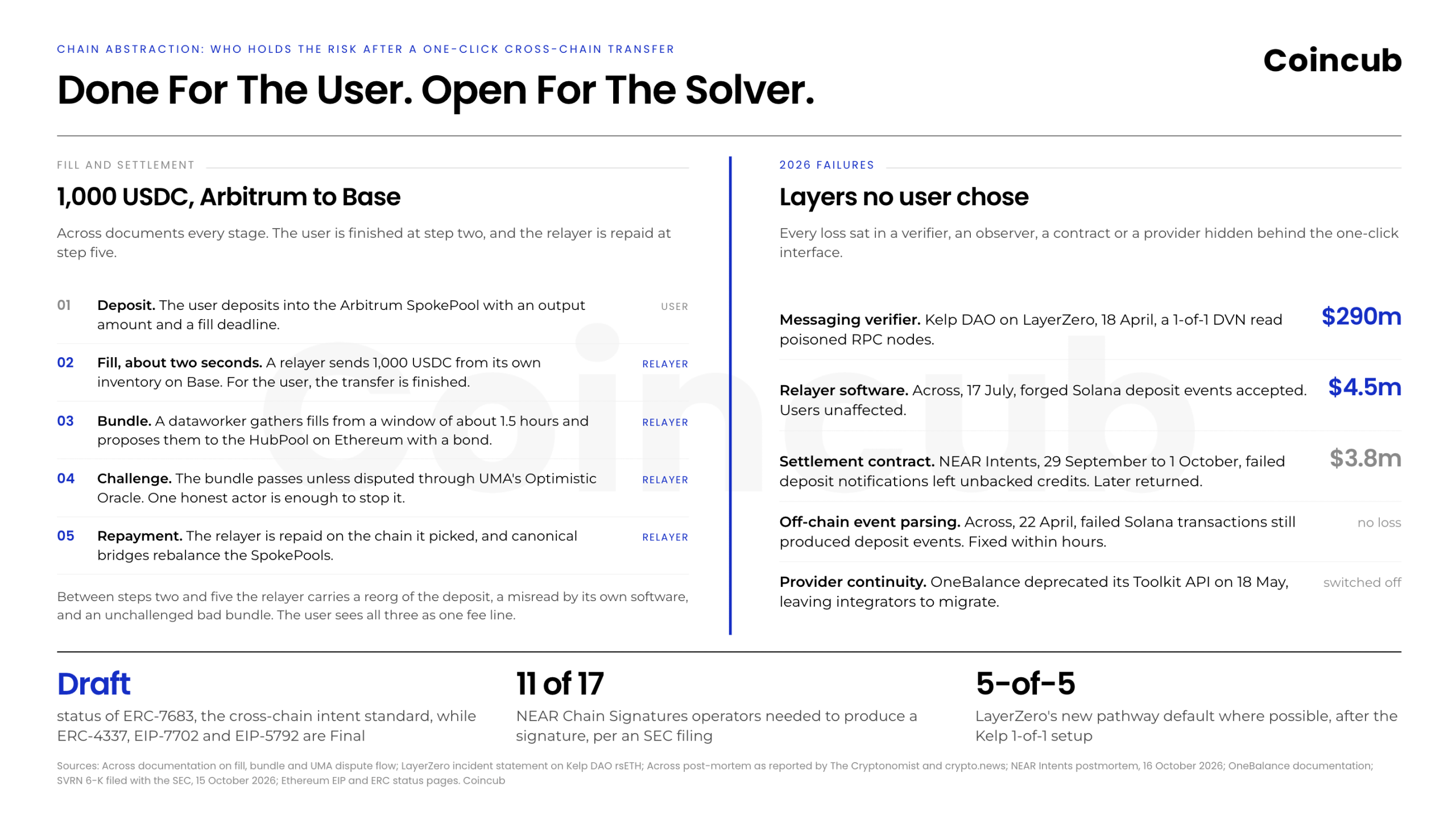
The 2026 incident record shows where those losses land, and every failure sat in a component no user had picked. Kelp DAO lost about $290 million in April through a messaging setup with a single verifier. Across’s relayer paid out roughly $4.5 million in July against forged Solana deposits its own software accepted. NEAR Intents saw about $3.8 million drained through a deposit-handling bug at the turn of October, and OneBalance switched off its chain abstraction API in May.

What chain abstraction means
Frontier Research’s CAKE framework, published on 15 February 2024 by Ankit Chiplunkar and Stephane Gosselin, describes chain abstraction as a vision in which chain information is abstracted away from the user. It splits the infrastructure beneath the application into three layers. A permission layer holds signing authority and requests quotes, a solver layer prices execution across chains, and a settlement layer bridges assets and completes the transaction.
Products shipping in 2026 add gas sponsorship, unified balances, and RPC routing to that model.
| Layer | What the user stops managing | Typical mechanism | What still runs underneath |
| Account and keys | Separate accounts and repeated approvals | ERC-4337 smart accounts, EIP-7702 delegation, MPC signing | Root signing authority, delegate code, recovery |
| Gas | Native gas on every chain | Paymasters, relayers, solver-paid destination gas | A sponsor who pays and prices the gas |
| Liquidity | Manual bridging and split balances | Unified balances, solver inventory, resource locks | Solver capital, settlement risk, wrapped representations |
| Execution | Route, DEX, and bridge selection | Signed intents, RFQ auctions, solvers | Solver choice, pricing, censorship, inventory limits |
| Messaging | Choice of verification system | Light clients, DVNs, oracle committees, ZK proofs | A verifier set with its own threshold |
| Network access | RPC endpoints and network switching | Multi-chain RPC routers and middleware | Node operators who see and shape what the wallet reads |
Interoperability protocols such as IBC, Hyperlane, LayerZero, and Chainlink CCIP occupy the messaging row, and on their own they still leave the user facing a network selector. A wallet hides the chain only by stacking the other rows on top, and each row adds an operator with its own failure modes.
ERC-4337, EIP-7702, EIP-5792, and ERC-7683 in 2026
Ethereum’s account and wallet standards have largely settled. ERC-4337 is Final and delivers account abstraction through UserOperations, bundlers, and an EntryPoint contract, with paymasters able to sponsor gas. Its current text includes support for EIP-7702 authorizations. EIP-7702, also Final, adds a transaction type that sets contract code for an existing externally owned account.
For chain abstraction, 7702 removes the migration step. Particle Network shipped EIP-7702 support for Universal Accounts on 24 March 2026, letting developers upgrade accounts already generated through Privy, Dynamic, and Magic without a new address or an asset transfer. Balances on Ethereum, Base, Solana, BNB Chain, and other supported networks then act as one pool. The delegate code then sits inside the account’s security perimeter, and a flawed delegate governs every later transaction from that address.
EIP-5792 is Final and standardizes wallet_sendCalls, call status queries, and capability discovery, including an atomic capability for batches. The specification says that capability is expressed per chain and guarantees atomicity only for batches on that chain. A wallet that batches an approval and a bridge deposit under one signature has made the origin leg atomic. The destination leg is still a separate event on a separate ledger.
ERC-7683, the cross-chain intent standard created in April 2024, is still a Draft as of October 2026. It defines a solver-facing interface in which a resolver contract translates protocol-specific orders into a common representation. The text states that protocols need no common escrow, settlement contract, or fill function. Two protocols can both support ERC-7683 and settle under unrelated trust models, and teams building storage formats around the interface should pin a version.
Fill and settlement in an Across intent transfer
Across documents each stage of its settlement, which makes it the clearest worked example. Take a user holding USDC on Arbitrum who wants 1,000 USDC on Base.
- The user deposits into the Arbitrum SpokePool and sets an output amount and a fill deadline.
- A relayer sends 1,000 USDC from its own inventory to the user on Base. For the user, the transfer is finished.
- An off-chain dataworker gathers every fill from a window of about 1.5 hours into one bundle and proposes it to the HubPool on Ethereum with a bond.
- The bundle passes unless someone disputes it through UMA’s Optimistic Oracle within the challenge window. Across says a single honest actor is enough to stop an invalid proposal.
- The relayer is repaid on the chain it picked, and canonical bridges rebalance the SpokePools.
Between steps two and five the relayer carries three risks. The Arbitrum deposit could be reorganized out, its own software could have misread the deposit, or a wrong bundle could go unchallenged. It prices all three into the spread it quotes, and the user sees that spread as one fee line.
Across V4 changes how settlement is verified and leaves the fill untouched. Settlement data is anchored on Ethereum, the system waits roughly 12 to 15 minutes for Ethereum finality, and Succinct’s SP1 proving network produces a proof that a ZK light client on the destination chain verifies. The docs say users still get fills of about two seconds. A two-second fill can sit on top of a fifteen-minute proof because a solver’s balance sheet absorbs the gap.
Solver inventory is also an attack surface. A February 2026 paper on liquidity exhaustion replayed 3.5 million intents moving $9.24 billion between June and November 2025 through Mayan Swift, Across, and deBridge on nine chains. Under current parameters deBridge was open to profitable attacks, with 80.5% of 210 historical attack instances turning a profit at a mean of $286.14. Across held up in every configuration tested, which the authors credit to low solver margins and very deep liquidity. Attackers willing to lose money could still suppress availability on all three, causing dozens of failed intents and solver losses of up to $978 roughly every 16 minutes.
NEAR, Particle, Relay, and Across compared
| System | What it abstracts | Who can sign or release funds | Trust assumption to test |
| NEAR Chain Signatures and Intents | Keys on foreign chains, plus intent execution | 11 of 17 MPC operators for signatures, the Intents contract for balances | Operator set, enclave security, contract logic, bridges in and out |
| Particle Universal Accounts | Account, balance, and gas | The user’s signer, through ERC-4337 account code delegated via EIP-7702 | Delegate code and Particle’s routing infrastructure |
| Relay | Execution and payments | An allocator signature releases depository funds | Relay-operated solvers, oracle, allocator governance |
| Across | Execution and bridging | Relayers front funds, and the HubPool settles after optimistic verification | One honest disputer, relayer software, canonical bridges |
A 6-K submitted to the SEC on 15 October 2026 by SVRN, one of the operators, says at least 11 of the 17 independent operators must cooperate to produce a Chain Signatures signature. Each operator’s key share now runs in a sealed hardware enclave built on Intel TDX. That gives an integrator a threshold and a named operator set to check, along with the enclave dependency that comes with them.
Chain abstraction exploits and failures, 2024 to 2026
| Date | System | Layer | What failed | Who absorbed it |
| 16 Jan 2024 | Socket Gateway | Router and approvals | A new route passed user data to an unvalidated call | About 230 user wallets, roughly $3.3 million |
| 18 Apr 2026 | Kelp DAO on LayerZero | Messaging verifier | A 1-of-1 DVN read poisoned RPC nodes | Kelp’s rsETH bridge, about $290 million |
| 22 Apr 2026 | Across | Off-chain event parsing | Failed Solana transactions still produced deposit events | No loss, fixed within hours |
| 18 May 2026 | OneBalance | Provider continuity | Toolkit API deprecated | Integrators |
| 17 Jul 2026 | Across | Relayer software | Forged Solana deposit events accepted | Risk Labs relayer, about $4.5 million paid out |
| 29 Sep to 1 Oct 2026 | NEAR Intents | Settlement contract | Failed deposit notifications left unbacked credits | NEAR Intents, about $3.8 million, later returned |
LayerZero’s incident statement says Kelp’s rsETH bridge ran a 1-of-1 DVN setup with LayerZero Labs as the sole verifier. The attacker compromised two RPC nodes that DVN relied on, swapped the op-geth binaries, and used DDoS attacks on healthy RPCs to force failover onto the poisoned ones. The DVN then confirmed transactions that never took place. Kelp said LayerZero personnel had approved the configuration, and in May LayerZero said it made a mistake by letting its DVN act as a 1-of-1 for high-value transactions, moving pathway defaults to 5-of-5 where possible. Chainlink’s CCIP 2.0, launched on 28 September, lets institutions require their own Cross-Chain Verifier to co-sign alongside its 16-operator committee.
Across’s two Solana events put the off-chain observer inside the authorization path. In April, Asymmetric Research showed that Across’s SDK decoded Solana deposit events from inner instructions without checking whether the transaction succeeded. A reverted deposit could still look real to relayers, and Across fixed it within hours. The July attack reached the same layer by a different route. According to The Cryptonomist’s account of the post-mortem, the relayer’s event client skipped the 8-byte Anchor discriminator check on inner instructions routed through Solana’s event authority account, and forged FundsDeposited payloads got through. Across’s figures, reported by crypto.news, show 1,627 forged deposits worth about $41.7 million, of which the Risk Labs relayer paid roughly $4.5 million, for a net loss under $4 million after about $500,000 of attacker funds stayed trapped. Users were unaffected, and Across restored Solana transfers in about 12 hours by routing them through Circle’s CCTP.
NEAR Intents paused its contract on 1 October. The postmortem that general manager Alex Shevchenko published on 16 October, summarized by The Crypto Times, traces about $3.8 million to the deposit-notification feature of the Intents contract. The attacker deployed a NEAR contract built to make notification calls fail. The token contract refunded each deposit while the Intents ledger kept the credit. Twenty-three failed deposits produced unbacked balances that the attacker withdrew and moved to other chains through Omni. Shevchenko placed the flaw in the Intents contract itself, with Omni serving as the exit route. Monitoring compared origin-chain assets with total NEAR-side balances and never reconciled user balances against contract holdings. All funds came back within 36 hours of detection, and the feature was removed on 7 October after a second critical report.
OneBalance failed on continuity. Its documentation states that the OneBalance Toolkit API was deprecated on 18 May 2026. Zerion’s migration guide replaces the data reads, says its API does not cover OneBalance’s chain-abstracted execution, and recommends Relay for swaps and contract calls.
CertiK’s analysis of Socket’s January 2024 exploit found that a route added three days earlier passed user-supplied data into an unvalidated call, letting the attacker pull tokens from about 230 wallets that had approved SocketGateway.
Relay’s allocator in the documentation and on Base
Relay’s security documentation says user deposits stay in non-upgradable Depository contracts until an authorized withdrawal. The Allocator uses MPC so that no single entity holds the full key, withdrawals are capped at a solver’s Hub balance, and replacing the Allocator requires a supermajority of a Security Council.
L2BEAT’s review, dated 14 August 2026, reads the same system from the deposit chain. On Base, the contracts are immutable and the allocator is a plain address with no contract code. The Depository owner is also an EOA and can replace the allocator at any time and without delay, taking direct control of escrowed funds. L2BEAT says the threshold-MPC claims cannot be verified or enforced by the Depository, that filling is not permissionless, and that the flows have no onchain refund path.
Both descriptions can hold at once. MPC signing and the Council’s controls sit off-chain or on Relay’s own chain, and the Base contract checks one signature from one key that another key can swap. A reviewer who reads only the documentation sees a governed system, and one who reads only the Base contracts sees two EOAs.
The release signature has been attacked before. In September 2025 Asymmetric Research described a critical bug in Relay’s Solana depository. The validation code read the allocator’s key from a hardcoded position and ignored the offsets the Ed25519 program used. An attacker could leave the real key in place to pass the check while the program verified a signature from the attacker’s own key. Relay patched it before any funds were lost, and the exposure would have fallen on the relayers and solvers supplying liquidity.
Unified balances and user privacy
A unified balance needs a provider that knows which addresses belong to one person. The account layer links an Ethereum address, a Solana address, and every other account into one profile, and the quote service learns trade size and destination before execution. Solvers that receive the order flow see part of that profile too.
The TRAP paper shows that a passive observer at border routers or internet exchange points can link an RPC user’s IP address to a pseudonymous account by matching transaction confirmations with status-polling traffic. It reports success above 95% on Ethereum mainnet and on Ethereum, Bitcoin, and Solana testnets once a user sends three or four transactions. Kelp exposed the integrity side of the same dependency, since its verifier trusted RPC nodes an attacker controlled.
One middleware stack now reads every chain for the wallet. Privacy-preserving RPC and encrypted solver order flow reduce that exposure, and each adds an operator to trust.
Travel Rule, MiCA, and money transmission obligations
FATF’s seventh targeted update, published on 16 July 2026, found progress on Recommendation 15 and the Travel Rule alongside significant gaps in licensing, supervision, and identifying people who conduct VASP activity. It flagged stablecoin misuse, unhosted wallets, offshore VASPs, and DeFi. Five days later FATF’s DeFi report said an arrangement falls under Recommendation 15 where a natural or legal person exercises control or sufficient influence over it. It found that governance token concentration, administrative privileges, and upgrade control frequently persist behind decentralized branding. An EOA that can replace the key releasing escrowed funds, and a solver set operated by one company, are the kind of indicators that test was written to find.
In the EU, Regulation (EU) 2023/1113 has required originator and beneficiary information to accompany crypto-asset transfers since 30 December 2024, the date MiCA’s CASP regime also began to apply. A wallet or solver operator serving EU clients needs to know which CASP service it performs, since execution, reception and transmission, and custody carry different permissions. The Travel Rule data it must send follows from that classification.
FinCEN’s 2019 guidance says a DApp developer is not a money transmitter for the mere act of creating the application. An owner or operator that uses a DApp to accept and transmit value generally qualifies under the Bank Secrecy Act. Federal registration for that activity sits on top of state money transmitter licensing.
- Who receives or controls user funds at any point, including inside a depository?
- Who admits solvers and can exclude a counterparty?
- Who can pause execution or replace a signing key?
- Who collects the fee?
- Who holds enough data to screen a transfer or send Travel Rule information?
The wallet vendor, the solver, the bridge operator, and the API provider can each give a different answer, from a different jurisdiction.
Due diligence checklist for a chain abstraction provider
- Release authority. State it the way L2BEAT does, naming the key, the chain, the holder, and the delay before replacement.
- Verifier configuration. Record DVN or committee counts, thresholds, and the RPC sources those verifiers read, route by route.
- Off-chain observers. Put event parsers, indexers, and relayer code in the security review, since both Across incidents sat there.
- Audit scope. Map each report to a commit, a component, and deployed addresses, and list what it left out.
- Latency. Ask for fill, finality, and refund times at p50, p95, and p99 by chain pair and transfer size.
- Refund path. Confirm whether refunds are enforced onchain or depend on the provider’s own process.
- Solver market. Check admission rules, concentration, and whether solvers post slashable collateral.
- State model. Track quoted, filled, settlement pending, settled, expired, and refunded as separate states, since a success flag loses track of funds when a chain halts mid-route.
- Exit plan. Keep provider SDKs behind an internal quote, execute, and status interface, with a native-chain fallback and revocable allowances.
Solver concentration, atomicity, and agent permissions
Solver markets may concentrate, and L2BEAT already classes Relay’s filling as Relay-operated infrastructure. Cross-chain atomicity is still engineered case by case, and production systems settle for eventual completion with bounded refunds, since independent chains cannot roll one another back. Session keys for AI agents raise the stakes at the account layer. An agent holding a persistent cross-chain session key can repeat a bad transfer until a spending cap, a revocation, or a contract allowlist halts it. Those limits belong in the account design from the first release.
The network can vanish from the screen as long as every key, verifier, and solver stays visible to the people answerable for the funds.
Frequently Asked Questions (FAQ)
What is chain abstraction in crypto? +
Chain abstraction lets a user state an outcome, such as receiving 1,000 USDC on Base, without choosing a network, a bridge, or a gas token. Smart accounts, paymasters, solvers, and messaging protocols make those choices underneath. Frontier Research's CAKE framework splits the work into permission, solver, and settlement layers.
How is chain abstraction different from account abstraction? +
Account abstraction makes an account programmable through standards such as ERC-4337 and EIP-7702, using bundlers, paymasters, and delegated code. Chain abstraction is the end-to-end goal of hiding the network, and it treats account abstraction as one layer alongside gas, liquidity, execution, and messaging.
Does chain abstraction remove bridging? +
It removes the user's choice of bridge. Settlement still runs through bridges, messaging protocols, or proofs, and Across repays relayers in bundles on a cycle of about 1.5 hours before canonical bridges rebalance its pools.
Who carries the risk when a chain-abstracted transfer fails? +
It depends on which layer fails. In Across's July 2026 Solana incident the Risk Labs relayer paid out roughly $4.5 million and users were unaffected. In the Kelp DAO exploit, a single-verifier LayerZero configuration cost Kelp's rsETH bridge about $290 million.
Is ERC-7683 a finished standard? +
ERC-7683 is still a Draft as of October 2026. It standardizes how solvers read cross-chain orders and leaves escrow, settlement, and fill mechanics to each protocol, so two compliant protocols can carry different trust models.
Are chain abstraction providers regulated? +
Obligations follow function. FATF's July 2026 DeFi report brings arrangements into scope where a person holds control or sufficient influence, and EU transfer information rules have covered CASP transfers since 30 December 2024. FinCEN generally treats an operator that uses a DApp to accept and transmit value as a money transmitter. Which crypto license a provider needs depends on the services it performs in each market.
What should a team ask a chain abstraction provider before integrating? +
Ask who can release or redirect escrowed funds and with what delay, which verifiers secure each route, whether off-chain observers were audited, and what the p95 and p99 refund times are. Then ask how an integration would migrate if the provider shut down, as OneBalance's toolkit did in May 2026.