Buy a Licensed Company
  Explore VASP Data
  Talk to an Expert

 Dren Hima
 is Head of Research at Coincub, leading research across digital asset regulation, licensing, market structure, tokenization and institutional adoption.
Dren Hima
Dren Hima is Head of Research at Coincub, leading research across digital asset regulation, licensing, market structure, tokenization and institutional adoption.
Brazil Crypto Tax Guide 2026: DeCripto, IN 2.291 & IRPF Rules
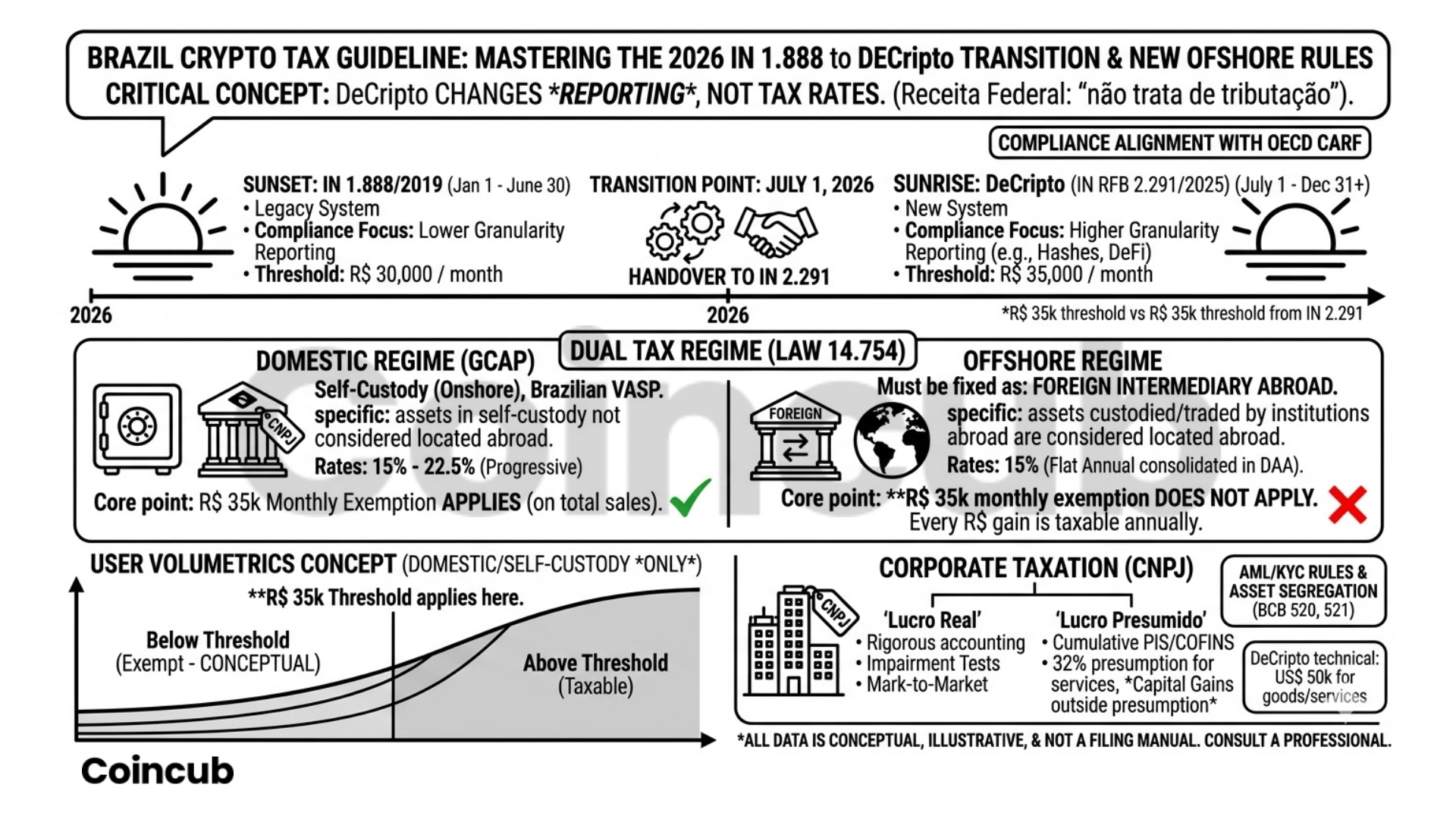
- 2026 is a transition year for crypto reporting in Brazil. IN RFB 1.888 remains in force through June 30, 2026. DeCripto under IN RFB 2.291/2025 becomes mandatory starting July 1, 2026.
- DeCripto changes reporting depth. The new framework expands granularity and offshore visibility, but the substantive tax split between domestic and foreign intermediaries comes from Law 14.754/2023.
- Self-custody and foreign exchanges face different tax treatment. Crypto held in self-custody is generally not treated as located abroad. In contrast, assets held through foreign intermediaries fall under a different regime with no exemption threshold and a flat 15% rate.
- The R$ 35,000 number applies in two distinct legal contexts. One threshold governs reporting under DeCripto for non-intermediated operations. A separate threshold determines when domestic capital gains become taxable. They are not interchangeable.
- DeFi remains one of the least settled areas. Swaps are clearly taxable alienations, but staking rewards, airdrops, and smart contract interactions remain highly fact-dependent and require individual analysis.
Digital assets and sovereign taxation don’t mix cleanly anywhere in the world, but Brazil has built one of the more elaborate and fast-moving regulatory architectures for managing that friction. The country was early by global standards, introducing mandatory crypto reporting in 2019. Since then, frameworks have layered on top of each other in ways that create genuine complexity for retail investors, traders, and corporate entities alike.
2026 is a transition year with its own specific challenges. The foundational reporting system under Instrução Normativa RFB Nº 1.888/2019 is being retired and replaced by the Declaração de Criptoativos (DeCripto) under IN RFB Nº 2.291/2025. New prudential guidelines from the Central Bank of Brazil are reshaping how Virtual Asset Service Providers operate. And the political failure of a proposed tax overhaul has preserved important exemptions that many investors feared losing.
One distinction this guide keeps returning to is that reporting rules and substantive tax rates are different things. DeCripto changes how you report. The actual tax burden and the significant gap in how onshore and offshore assets are treated come primarily from Law 14.754/2023. Conflating those two creates real compliance errors.

Where We Started: The Legacy of IN 1.888/2019
When Brazil introduced Instrução Normativa RFB Nº 1.888 in 2019, it was genuinely ahead of the curve. Most countries were still debating whether crypto was a currency, a commodity, or something else entirely. Brazil determined that the classification was less urgent than building a data pipeline and mandated that domestic exchanges transmit user transaction data to the Receita Federal do Brasil (RFB) monthly.
For investors operating outside Brazilian exchanges, whether on foreign platforms or with self-custody hardware wallets, IN 1.888 imposed a secondary obligation. If you conducted operations exceeding R$ 30,000 in a single month without a Brazilian exchange intermediary, you had to report those transactions to the RFB manually.
This worked reasonably well during the era of simple spot trading. Then DeFi happened. Liquidity pools, automated market makers, cross-chain bridges, yield-generating protocols: none of this mapped onto a framework designed for straightforward buy-sell activity on centralized platforms. The RFB also had limited visibility into capital flowing through offshore exchanges with no Brazilian corporate presence and no legal obligation to cooperate.
The result was IN RFB Nº 2.291/2025, a more granular, internationally aligned framework built around the OECD’s Crypto-Asset Reporting Framework (CARF) standards.
The DeCripto Framework: What’s Actually Changing
The most important thing to understand about DeCripto is what it does and doesn’t do. The Receita Federal has been explicit in its own directives: the new framework “não trata de tributação” (it doesn’t deal with taxation). It’s a reporting and compliance upgrade rather than a change to underlying tax rates or brackets.
What it does change is the depth of information the RFB can see. Instead of the volumetric transaction reporting that worked under IN 1.888, DeCripto requires granular categorization of transaction types. Staking rewards, liquidity pool income, incoming airdrops, crypto-collateralized loans, and crypto payments for goods and services exceeding the equivalent of US$ 50,000 all need to be explicitly coded and reported.
The new system also allows, and in some cases requires, reporting the cryptographic hash of a transaction. This effectively bridges traditional accounting records and public blockchain analytics. When the RFB has a transaction hash, it can directly cross-reference on-chain data.
The Phased Rollout
The transition happens in stages throughout 2026.
| Regulatory Milestone | Operational Significance | Legal Framework |
| January 1, 2026 | Broad directives of the new framework enter into force | IN RFB Nº 2.291/2025 |
| March–May 2026 | Annual IRPF declaration window for the 2025 base year | General IRPF Rules / Law 14.754/2023 |
| June 30, 2026 | Final operational date under the legacy reporting system | IN RFB Nº 1.888/2019 |
| July 1, 2026 | DeCripto era begins; mandatory granular reporting starts | IN RFB Nº 2.291/2025 |
| August 2026 | Initial deadline for July 2026 data via the e-CAC portal | IN RFB Nº 2.291/2025 |
For operations from January through June 2026, the old rules still apply. Starting July 1, you’re under DeCripto.
Extended Jurisdiction Over Foreign Entities
One of the more consequential aspects of IN 2.291/2025 is its extension of Brazilian tax jurisdiction for reporting purposes. Under the legacy system, foreign exchanges with no Brazilian presence could largely ignore RFB data requests. The new framework expands the definition of a VASP operating within Brazilian territory to capture more entities.
Leading tax advisories interpret the new rules to mean that a foreign exchange may trigger reporting obligations if it exhibits localization signals, such as using a .br domain, running targeted advertising to Brazilian residents, or maintaining commercial agreements with local companies. When those conditions are met, the platform may be required to aggregate and send user data to the RFB regardless of where it’s incorporated.
Self-Reporting Threshold
For transactions through peer-to-peer networks, self-hosted wallets, or decentralized exchanges, the self-reporting obligation remains. The threshold under DeCripto was adjusted upward to R$ 35,000 per month in aggregated volume across non-intermediated channels.
One clarification worth spelling out clearly: this R$ 35,000 reporting threshold is legally distinct from the R$ 35,000 capital gains exemption threshold. They’re both 35,000, and both apply to crypto, but they operate under different legal frameworks. The former triggers an accessory reporting obligation under IN 2.291. The latter determines whether gains become taxable under general tax law. Treating them as the same thing is a common and costly mistake in tax planning.
The Expiration of MP 1.303/2025: Good News for Retail Investors
This is the development with the most practical impact on the 2026 tax landscape, and it arrived through inaction rather than legislation.
Throughout 2025, Brazil’s Ministry of Finance pushed Medida Provisória 1.303/2025, which would have tightened the tax regime for financial applications, including crypto. The core proposal was the complete elimination of the R$35,000 monthly capital gains exemption; under the proposed rules, the exemption would disappear entirely, with gains taxed at a flat 17.5% (some congressional discussions referenced an 18% consolidated rate during the debate). The proposal also sought to restrict loss compensation strictly within the crypto ecosystem and cap the rolling window at five quarters.
The pushback was immediate. On October 8, 2025, the measure was pulled from the voting agenda. An MP that expires without a vote loses all legal force. It simply ceases to exist.
The practical result: the R$ 35,000 monthly exemption for capital gains on domestic and self-custodied crypto operations is fully valid for the 2026 tax year.
The IRPF Tax Matrix: Onshore vs. Offshore
The most significant structural division in Brazilian crypto taxation for 2026 is the one created by Law 14.754/2023: the bifurcation between assets held through Brazilian intermediaries or in self-custody and assets held through foreign exchanges.
Onshore: Progressive Rates and the GCAP Process
For crypto held in self-custody wallets or traded through domestic Brazilian exchanges, the framework treats holdings as “bens” (property or assets). RFB guidance has explicitly confirmed that virtual assets held in self-custody without an intermediary are not considered located abroad under Law 14.754/2023. That distinction has real tax consequences.
When you sell crypto in this category, and total gross alienations across all crypto types exceed R$ 35,000 in a single calendar month, the entire profit becomes taxable. If you stay at or under R$ 35,000, any gain is exempt, but you still need to report it under “Rendimentos Isentos e Não Tributáveis” in your annual declaration.
When the threshold is crossed, progressive capital gains rates apply:
| Capital Gain Bracket (Onshore) | Applicable Rate |
| Up to R$ 5,000,000 | 15.0% |
| R$ 5,000,000.01 to R$ 10,000,000 | 17.5% |
| R$ 10,000,000.01 to R$ 30,000,000 | 20.0% |
| Above R$ 30,000,000 | 22.5% |
The tax obligation is monthly. You calculate the gain using the GCAP software and pay via DARF (code 4600) by the last business day of the following month.
Offshore: Law 14.754/2023 and the Flat Rate
When your crypto is held through a foreign exchange acting as an intermediary abroad, the rules change entirely. The R$ 35,000 monthly exemption doesn’t apply. Profits are taxable regardless of size.
Instead of monthly GCAP filings and progressive rates, offshore gains get aggregated across the full calendar year, consolidated at year-end, and reported directly in the Declaração de Ajuste Anual (DAA). The applicable rate is a flat 15% on net profit.
Procedurally simpler than the onshore regime, but the absence of any exemption threshold means smaller investors who would pay nothing on a domestic platform may have taxable liability on a foreign one.
DeFi: Still the Least Settled Corner of the Tax Code
The standard capital gains framework handles spot trading reasonably well. DeFi is where things get complicated, and the honest answer is that Brazilian tax law hasn’t fully caught up.
The most precise guidance available is Solução de Consulta (COSIT) Nº 184/2024, which addressed a specific scenario: the temporary cession of fungible crypto-assets to a Brazilian legal entity. In that narrow case, the Receita Federal classified the yield as interest income on a loan and taxed it as a fixed-income financial application at source. This ruling sometimes gets cited as a general principle for all DeFi yields. It isn’t. It applies to a very specific set of facts, and extrapolating it to decentralized staking protocols and automated liquidity pools creates real compliance risk.
In practice, most tax advisors treat staking rewards and airdrops as ordinary income on receipt. If received from abroad, they may be subject to Carnê-Leão. But the exact mechanics depend heavily on the protocol structure, the custody arrangement, and whether any withholding applies. This is an area where properly qualified advice means more than general guidance.
On crypto-to-crypto swaps, the RFB’s position is clear: they’re alienations that trigger a realization event. If the total monthly volume of swaps and fiat sales on onshore assets exceeds R$ 35,000, the net profit is taxable.
Annual Declaration: The DAA and Asset Coding
Owning crypto triggers annual reporting obligations independent of whether you have taxable gains. In the Declaração de Ajuste Anual, holdings are reported under “Bens e Direitos” in Group 08. The obligation to declare kicks in if the total acquisition cost of a specific category of crypto-assets reaches or exceeds R$ 5,000 on December 31st.
Assets are broken down by specific codes:
| Code | Category | Examples |
| 01 | Bitcoin (BTC) | Reserved specifically for the Bitcoin protocol |
| 02 | Altcoins | Ethereum, Solana, Cardano, XRP |
| 03 | Stablecoins | Tether (USDT), USD Coin (USDC) |
| 10 | NFTs | Digital art, tokenized assets |
| 99 | Other crypto-assets | Utility tokens, fan tokens, governance tokens |
Assets are reported at average acquisition cost (custo médio de aquisição), with foreign-currency purchases converted to Reais using the Central Bank’s PTAX sell rate on the purchase date.
Value Conversion Methodology
For operations without a direct Reais equivalent, DeCripto codifies a specific conversion sequence. First, determine the value in U.S. dollars. Then convert that figure to Brazilian Reais using the official PTAX de venda rate published by the Central Bank for the exact date of the operation. Both steps must be followed in that order. Using a different rate source or date creates documentation vulnerabilities.
Corporate Taxation: Lucro Presumido vs. Lucro Real
How a Brazilian company’s crypto holdings get taxed depends entirely on its elected taxation regime.
Under Lucro Presumido, capital gains from crypto sales are legally segregated from standard operational revenue. The full gain gets added to the presumed profit base and taxed at standard corporate rates (15% IRPJ, 10% surtax, 9% CSLL). Standard operational revenue carries cumulative PIS/COFINS on top of that.
Under Lucro Real, taxation is based on actual audited net accounting profit. Depending on how crypto is classified on the balance sheet, this may require impairment testing of intangible assets or fair value accounting. Legal advisories also note that the RFB may eventually require explicit identification of crypto-asset movements within the Escrituração Contábil Digital (SPED) systems, giving the tax authority granular visibility into the fiscal effects of corporate crypto activity.
The Central Bank’s New VASP Framework
In late 2025, the Central Bank of Brazil published Resolutions 519, 520, and 521, which significantly changed operational requirements for VASPs.
The broad effect is to transform exchanges into regulatory gatekeepers. Under BCB Resolution 520, a VASP takes responsibility for reviewing the governance and security of any asset it lists. Tokens that facilitate anonymity or expose critical technical vulnerabilities shouldn’t be on a compliant platform. Exchanges need board-approved listing policies.
On stablecoins, the BCB has imposed strict requirements around stabilization mechanisms and reserve quality. Algorithmic stablecoins, those whose stability relies on algorithmic mechanisms rather than actual reserve assets, are prohibited within the regulated perimeter. This restricts regulated entities, not the open-source protocols themselves, but the practical effect is that certain assets won’t be available through compliant Brazilian channels.
BCB Resolution 521/2025 formalized the legal concept of the “self-hosted wallet” (carteira não custodial), recognizing direct user possession and applying specific foreign exchange reporting rules when assets move between self-custody and the traditional financial system.
Frequently Asked Questions (FAQ)
What is changing for crypto reporting in Brazil in 2026?
Brazil is transitioning from IN RFB 1.888/2019 to DeCripto under IN RFB 2.291/2025. The old framework governs operations through June 30, 2026. DeCripto becomes mandatory on July 1.
Does DeCripto change crypto tax rates in Brazil?
No. DeCripto is a reporting and compliance framework. It doesn’t change the substantive tax rates or the conditions under which gains become taxable.
What happened to MP 1.303/2025?
It failed to pass and expired in 2025. As a result, the domestic/self-custody R$ 35,000 monthly exemption framework remains fully in force for the 2026 tax year.
Are crypto assets in self-custody treated as offshore?
No. Crypto held directly in self-custody without an intermediary is generally not treated as located abroad under Law 14.754/2023.
How are gains on crypto held through foreign exchanges taxed?
They get consolidated annually at year-end and taxed at a flat 15%. The R$ 35,000 monthly exemption that applies onshore doesn’t apply here.
How are gains on domestic exchanges or self-custodied assets taxed?
If total monthly alienations exceed R$ 35,000, the profit is subject to progressive capital gains tax rates. If they don’t exceed that threshold, any profit is exempt but still must be reported.
Is swapping one crypto for another taxable in Brazil?
Yes. The RFB treats crypto-to-crypto swaps as alienations, potentially triggering tax liability when applicable thresholds and gain conditions are met.
Do I need to report crypto from P2P trades, DEXs, or self-hosted wallets?
Potentially yes. Under DeCripto, non-intermediated operations may trigger a reporting obligation if monthly volume exceeds the applicable threshold.
How are staking rewards and airdrops taxed?
These remain among the least settled areas in Brazilian crypto tax law. In practice, they’re often treated as ordinary income on receipt, but the exact treatment depends heavily on the protocol structure and custody arrangement.
How should crypto be declared in the annual tax return?
Under “Bens e Direitos” in Group 08, using the relevant sub-code for each asset type, reported at average acquisition cost rather than year-end market value.