Buy a Licensed Company
  Explore VASP Data
  Talk to an Expert

 Atis Shala
Atis is a senior analyst and community lead with four years of experience in crypto. He has a bachelor from the Rochester Institute of Technology.
Atis Shala
Atis is a senior analyst and community lead with four years of experience in crypto. He has a bachelor from the Rochester Institute of Technology.
Monero Price Prediction for 2026
- Monero (XMR) is the leading privacy coin, with mandatory on-chain privacy (Ring Signatures, Stealth Addresses, RingCT) that gives every coin full fungibility.
- A 2025 hashrate-concentration event involving Qubic exposed Monero to 51%-attack and chain-reorg risk, driving a community push toward decentralized mining (P2Pool, SupportXMR).
- Regulatory pressure in Europe. EU MiCA banning custodial privacy-coin services plus exchange delistings, is the biggest “black swan” risk to liquidity and price.
- Tail emission (0.6 XMR/block) keeps inflation low and predictable while permanently funding network security.
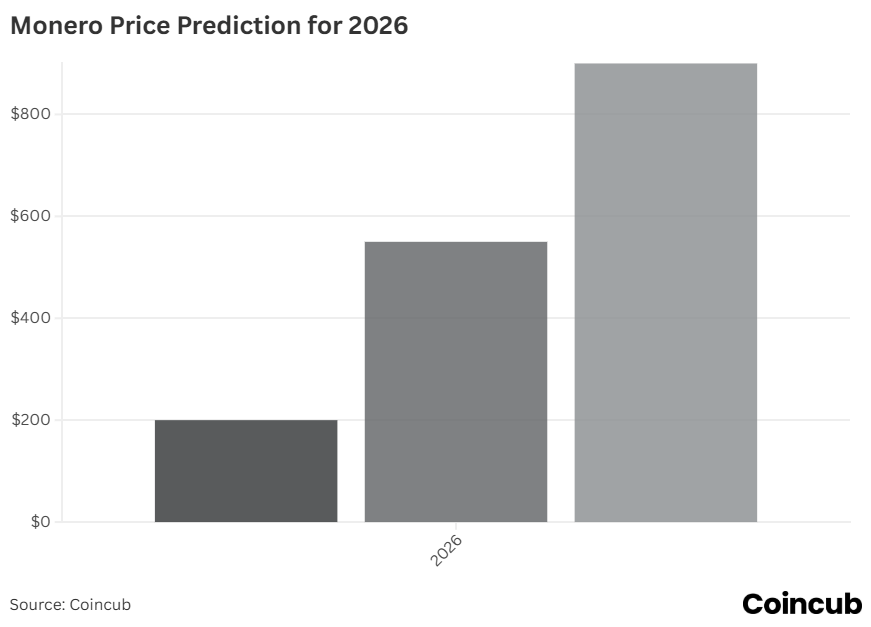
- 2026 scenarios: bear below ~$200, base ~$500-$600, bull toward ~$900, with price stabilizing around $420 in early 2026.
Financial privacy remains a polarizing topic in the digital asset landscape. While most blockchains operate on transparent ledgers, Monero (XMR) offers a different path. It prioritizes the anonymity of its users above all else. This commitment makes Monero the premier “privacy coin,” but it also places the asset in a unique and often precarious market position.
Predicting the price of Monero requires a departure from standard crypto analysis. For most tokens, analysts look at ecosystem growth or decentralized finance metrics. Monero lacks these indicators because its network purposefully hides them. You cannot see transaction sizes or wallet balances on the Monero blockchain. Consequently, valuation models must rely on network security, regulatory shifts, and the fundamental demand for uncensored digital cash.
There are multiple variables that drive Monero’s market value. There’s the technology that shields users, the regulations that threaten liquidity, and the recent security challenges that have shaken investor confidence. Everyone must understand that this analysis provides scenarios and logical conclusions, but no guarantees. The cryptocurrency market is inherently volatile. Privacy coins face specific risks that other assets do not. We aim to provide a simple, technically accurate framework to help you understand where Monero might head in 2026 and beyond.

What Is Monero and Why It Matters
Monero launched in 2014 with a clear goal: to create a digital currency that is secure, private, and untraceable. Unlike Bitcoin, which allows anyone to view the entire transaction history of any wallet, Monero ensures privacy by default. Every user on the network benefits from the same level of anonymity. This “enforced privacy” prevents a system where some coins are “clean” and others are “tainted” by their history.
The project grew as a community-driven effort without a central CEO or formal company. This decentralized nature allows Monero to survive even as regulators increase pressure on privacy-preserving technologies. While other projects like Zcash offer privacy as an optional feature, Monero’s mandatory privacy makes it the gold standard for users who view financial confidentiality as a human right.
Monero continues to exist because it fills a specific niche: functional digital cash. In an era of increasing financial surveillance and the rise of central bank digital currencies (CBDCs), the demand for a medium of exchange that mimics the anonymity of physical paper money remains high. This utility provides a floor for Monero’s value that speculative hype cannot match.
How Monero’s Technology Influences Price
Three core technologies define Monero’s value proposition: Ring Signatures, Stealth Addresses, and Ring Confidential Transactions (RingCT). Ring Signatures mask the sender by grouping their transaction with several others. Stealth Addresses create a one-time destination for every transaction. RingCT hides the amount being sent.
These features grant Monero “fungibility.” In economics, fungibility means every unit of a currency is identical to every other unit. Because no one can trace an XMR token back to a previous “illicit” transaction, every XMR token maintains the same market value. This is a significant advantage over Bitcoin, where “tainted” coins might trade at a discount or face rejection by exchanges.
The project also uses the RandomX mining algorithm. This protocol ensures that consumer-grade CPUs can mine Monero effectively, which prevents specialized ASIC hardware from dominating the network. While this promotes decentralization, it has recently created unexpected vulnerabilities. Technical upgrades like the move to FCMP++ in 2026 aim to expand the anonymity set further. Historically, major upgrades have signaled network health and spurred investor confidence, though they often trigger counter-reactions from regulators.
The 51% Attack and Hashrate Centralization
The most significant threat to Monero’s price in recent years did not come from a government, but from within the mining ecosystem. In late 2025, an entity known as Qubic managed to consolidate a massive portion of the network’s hashrate. By offering miners more profitable rewards in its own native token to mine Monero, Qubic effectively “rented” a majority of the network’s power.
This resulted in a series of chain reorganizations (reorgs). In September 2025, the network suffered an 18-block reorg that invalidated dozens of transactions. This event proved that Monero was vulnerable to a 51% attack. While the attack appeared to be an economic “stress test” rather than a malicious attempt to double-spend funds, it severely damaged the “secure” reputation of the coin.
Confidence in the network’s immutability is a primary driver of price. The Qubic incident forced many exchanges to increase confirmation times to hundreds of blocks, which reduced the speed and utility of XMR. The community has since pushed for the adoption of P2Pool, a decentralized mining pool that prevents any single entity from controlling the hashrate. The success of these decentralization efforts is now a critical factor for Monero’s long-term valuation.
Monero appears to be in the midst of a successful 51% attack.
The privacy-focused blockchain, launched in 2014 and long targeted by governments and 3-letters agencies, is already banned from most major centralized exchanges.
The Qubic mining pool has been amassing hashrate for…
— Charles Guillemet (@P3b7_) August 12, 2025
The Community Response to the Monero 51% Attack
The Monero community responded with a mix of emergency technical measures and social coordination:
| Measure | Description |
| SupportXMR Rally | Thousands of miners moved to the SupportXMR pool to dilute Qubic’s dominance. By early 2026, SupportXMR holds a majority share, though this creates a new (but friendlier) centralization concern. |
| DNS Checkpoints | A controversial proposal to use “checkpoints” via DNS (MoneroPulse) to prevent deep reorgs. While it prevents 51% attacks, critics argue it introduces a layer of centralization. |
| Exchange Policy | Major exchanges like Kraken significantly increased confirmation requirements; at one point requiring 720 confirmations (about 24 hours) to credit a deposit. |
| P2Pool Advocacy | A renewed push for miners to use P2Pool, a decentralized mining pool that prevents any single entity from controlling the hashrate. |
Monero Tokenomics and Supply Dynamics
Monero uses a unique emission model that distinguishes it from the “hard cap” approach of Bitcoin. Once the initial supply reached approximately 18.1 million XMR in 2022, the network shifted to a permanent reward of 0.6 XMR per block. This is known as Tail Emission.
Tail emission serves two vital purposes. First, it ensures that miners always have an incentive to secure the network, regardless of transaction fee volume. Second, it replaces lost coins. This leads to a very low, predictable inflation rate that will eventually trend toward 0% as the total supply grows.
Investors often prefer capped supplies, but Monero’s model offers long-term network stability. Without a permanent block reward, a blockchain risks a “fee-sniping” environment if transaction fees do not stay high enough. Monero’s approach prioritizes the long-term integrity of the ledger over the “scarcity” narrative. Current annual inflation remains lower than that of many major fiat currencies.
Historical Monero Price Performance
Monero has survived multiple market cycles, often showing a low correlation with the broader “altcoin” market. During the 2017-2018 bull run, XMR reached an all-time high of roughly $542. However, it did not experience the same parabolic growth seen in other sectors during 2021, largely due to its lack of DeFi utility.
The most significant impact on Monero’s price history comes from exchange delistings and security scares. Major platforms like Binance and Kraken removed XMR for users in several jurisdictions between 2024 and 2025. These events typically cause short-term price drops as liquidity dries up. The 2025 reorg events also caused a temporary price decoupling from Bitcoin as investors weighed the risks of network centralization.
By mid 2026, the price has stabilized around $350. Its ability to maintain a multi-billion dollar market cap despite being “canceled” by many centralized gatekeepers and surviving a 51% attack attempt proves the existence of a dedicated user base. Past behavior suggests that XMR holds its value better than speculative assets during market corrections.
Market Demand Drivers for Monero
Real-world usage drives Monero more than speculation. Several factors contribute to its steady demand:
- Censorship Resistance: Users in regions with strict capital controls or unstable banking systems use Monero to move value safely.
- The “Anti-CBDC” Hedge: As governments roll out traceable digital currencies, some investors buy XMR to preserve financial autonomy.
- Peer-to-Peer (P2P) Trade: The rise of decentralized marketplaces like Haveno allows users to trade XMR without a middleman.
- Atomic Swaps: The maturation of technology that allows users to swap BTC for XMR without an exchange has increased the coin’s accessibility.
Monero does not compete for “smart contract” dominance. Instead, it competes with Bitcoin for the title of “digital gold” by adding the layer of “digital cash” that Bitcoin currently lacks.
Regulatory Pressure and Its Impact
Regulation is the primary “black swan” risk for Monero. In 2026, the European Union’s MiCA framework has effectively banned custodial services from holding privacy coins. This has forced Monero further into the non-custodial world.
Regulators argue that privacy coins facilitate illicit trade. While studies show that transparent coins are still preferred for crime due to higher liquidity, the “optics” of Monero make it an easy target. Increased pressure could lead to higher barriers to entry for new users and reduced liquidity.
Paradoxically, every time a government tries to ban Monero, it validates the coin’s purpose. This creates a “Streisand Effect” where regulatory crackdowns highlight the need for privacy. This often strengthens the conviction of long-term holders even if it suppresses the price in the short term.
Monero Price Prediction for 2026
| Scenario | 2026 range | What it depends on |
| Bear | Below ~$200 | Coordinated fiat-to-XMR bans + a successful double-spend; hashrate stays centralized |
| Base | ~$500-$600 | Miners migrate to P2Pool, hashrate stabilizes; XMR tracks the broader market cycle |
| Bull | ~$900 | A “privacy awakening” drives demand; network proves resilient to further attacks |
Bear Case Scenario
In a bear case, global regulators successfully coordinate a total ban on fiat-to-XMR gateways. Simultaneously, another 51% attack occurs, leading to a successful double-spend. If the community fails to decentralize the hashrate away from dominant pools, the network loses its “immutable” status. In this scenario, Monero remains a niche tool for technical experts only. The price could drop below $200 as liquidity vanishes and users migrate to newer, more secure privacy protocols.
Base Case Scenario
The base case assumes Monero continues its current trajectory. It remains delisted from most major Western exchanges but thrives on decentralized platforms. The community successfully migrates more miners to P2Pool, stabilizing the hashrate. The price follows the general crypto market cycles, potentially testing the $500 to $600 range during a bull run but failing to achieve “mainstream” adoption due to the high barrier of entry for new users.
Bull Case Scenario
The bull case rests on a “privacy awakening.” If a major geopolitical event or a massive data breach involving financial records occurs, the public may flee toward privacy-preserving tools. As AI-driven surveillance makes transparent blockchains a liability for businesses, Monero becomes the standard for confidential transactions. If the network proves its resilience against further hashrate attacks, XMR could break past its previous all-time highs and target $900 as it absorbs a significant portion of the “store of value” market.
Monero Price Prediction for 2030 and Beyond
Monero’s future depends on its relevance. While other tokens promise gains through complex DeFi schemes, Monero offers a boring but essential service: privacy. As long as people value the ability to spend money without a government or corporation watching, Monero has a use case.
The project faces stiff competition from “privacy layers” on other chains. However, Monero’s advantage is its “privacy-by-default” architecture. It does not rely on complex smart contracts that can be exploited. Its resilience over the last decade proves that its community is committed to the mission regardless of the price. Investors should view Monero as a high-risk, high-conviction play.
Final Thoughts on the Future of Monero
Monero represents the ultimate trade-off in the crypto world. Its technical excellence provides unparalleled privacy, yet that very privacy makes it a target for regulators and a challenge for hashrate stability. Predicting its price is not just about looking at charts. It is about weighing the human desire for privacy against the state’s desire for oversight and the network’s ability to remain decentralized.
As we navigate 2026, Monero remains the leader of the privacy sector. Its supply is predictable and its utility is undeniable. However, the path ahead is fraught with legal challenges and the constant need to defend against hashrate centralization.
FAQ: Monero Price Prediction
Is Monero a good long-term investment?
Monero serves a specific utility that no other major coin provides. If you believe privacy demand will grow, it holds value. However, the risk of delistings and 51% attacks makes it more volatile than Bitcoin.
Can Monero reach a new all-time high?
If demand for privacy outstrips the rate of exchange delistings and the network remains secure, XMR could surpass its $542 peak. This requires continued developer activity and a move toward decentralized mining.
Why did Monero suffer a 51% attack?
The 2025 incident occurred because a single entity incentivized a majority of the hashrate to join their pool. Because Monero is mined on CPUs, it is susceptible to “rented” hashrate if the economic incentives are high enough.
How do regulations affect Monero’s price?
Regulations usually impact liquidity. When an exchange delists XMR, it becomes harder for people to buy and sell, which often leads to a price drop. It does not affect the actual function of the protocol.
Does Monero’s unlimited supply hurt its value?
No. The “tail emission” results in extremely low inflation. This provides long-term security for the network without significantly diluting the value of existing coins.