


 Buy a Licensed Company
 Explore VASP Data
 Talk to an Expert

 Atis Shala
Atis is a senior analyst and community lead with four years of experience in crypto. He has a bachelor from the Rochester Institute of Technology.
Bitcoin Protection ETFs: How Downside and Upside Caps Work

- A bitcoin protection ETF uses options and Treasury bills to limit losses on bitcoin over a fixed outcome period, and it pays for that limit by capping gains.
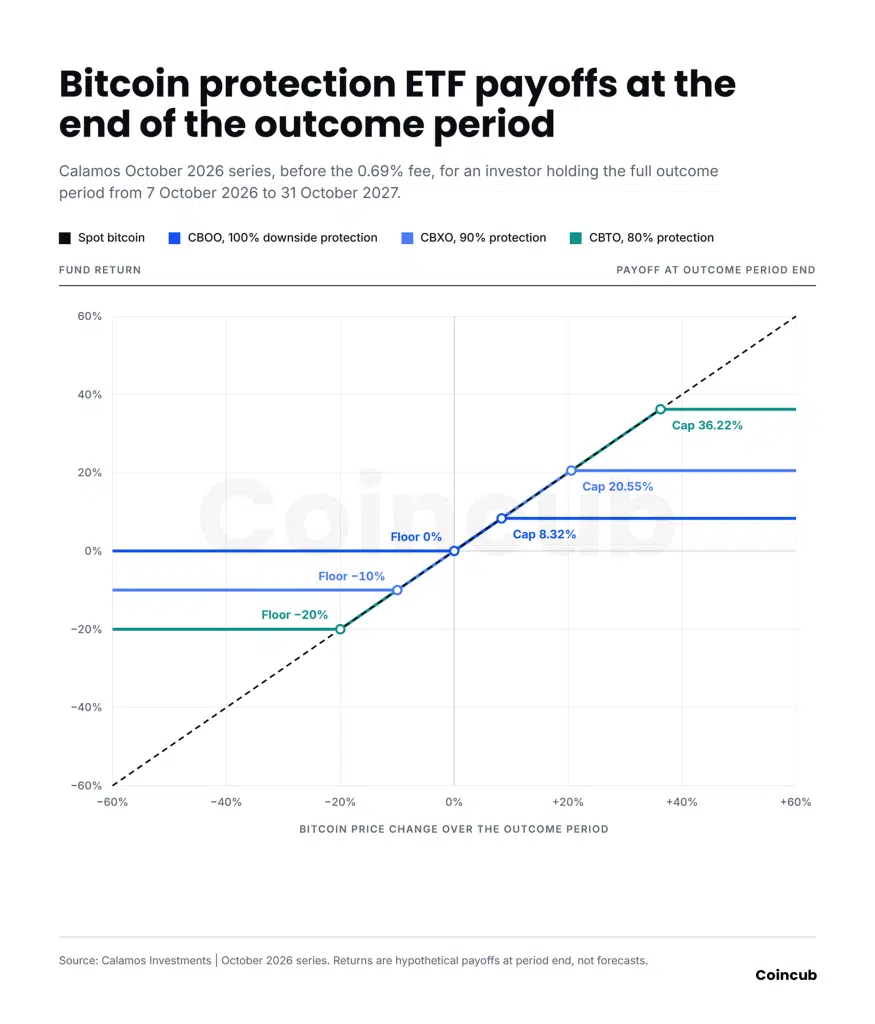
- The October 2026 Calamos series shows the trade-off in numbers: 100% protection comes with an 8.32% cap, a 10% maximum loss with a 20.55% cap, and a 20% maximum loss with a 36.22% cap, all before a 0.69% fee.
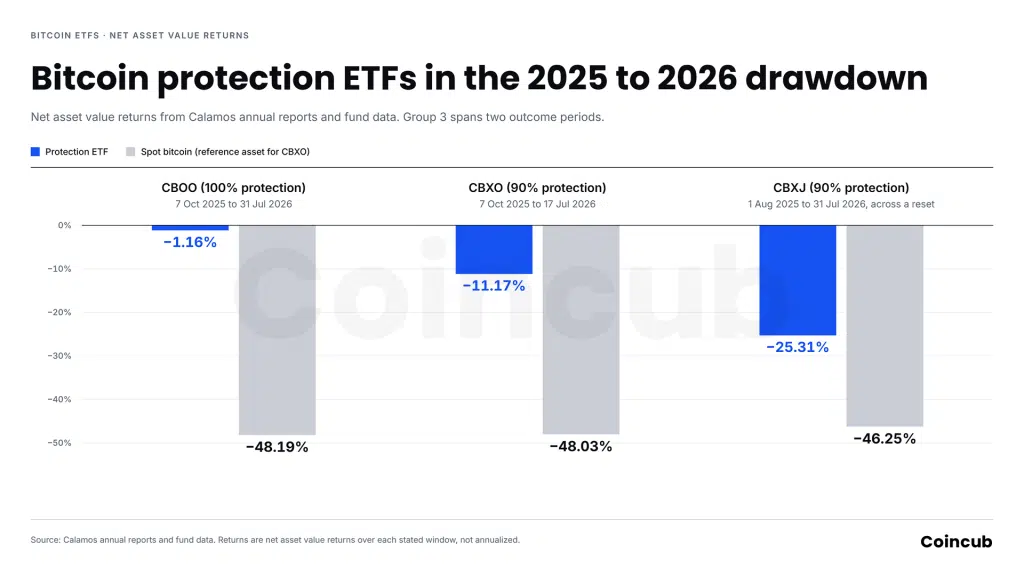
- The structure held up in the 2025 to 2026 bear market. Calamos’s 100% protected October fund lost 1.16% from launch to 31 July 2026 while spot bitcoin fell 48.19%.
- Protection resets every outcome period. A loss taken in one period stays locked in, and an investor who buys mid-period gets a different cap and floor from the ones on the factsheet.
- BlackRock filed for the iShares Bitcoin Managed Protection ETF (PBIT) on 19 October 2026. It would ladder three option tranches with a roughly 10% maximum loss each, and it gives no fixed cap or floor at the fund level.
Bitcoin protection ETFs give investors bitcoin price exposure with a contractual limit on losses over a set period, usually about a year, in exchange for a ceiling on gains. The category is less than two years old. Calamos listed the first one, a fund promising 100% downside protection, on 22 January 2025, and by October 2026 it ran twelve of them alongside products from First Trust and Innovator.
The category drew fresh attention in late 2026. Bitcoin set an intraday record above $126,000 on 6 October 2025, fell to a daily low near $58,600 by the end of June 2026 according to Federal Reserve Bank of St. Louis (FRED) data, and was trading around $77,500 at the end of October 2026. On 19 October 2026, BlackRock filed a prospectus for a buffered bitcoin fund of its own.
That drawdown gave the funds their first real test, and it showed both what the protection covers and where it ends.

What a bitcoin protection ETF is
A bitcoin protection ETF is an exchange-traded fund that tracks bitcoin’s price return up to a predetermined cap while protecting against some or all of bitcoin’s losses over a defined outcome period. The outcome period is the window, often about one year, over which the cap and the protection are measured. At the end of it, the fund resets and sets a new cap for the next period.
These funds belong to a wider family called defined outcome ETFs, also known as buffer ETFs, which started with products on the S&P 500. Buffered and defined outcome products held $81.5 billion in assets at 31 March 2026, according to research firm FUSE, which expected the total to pass $100 billion during the year.
The bitcoin versions hold no bitcoin. Calamos, First Trust, Innovator and the proposed BlackRock fund all build exposure with options that reference spot bitcoin ETFs, such as the iShares Bitcoin Trust (IBIT), or an index of those ETFs. They hold the rest of their assets in short-term Treasuries and cash. Many use FLEX options, which are exchange-listed options with customizable strike prices and expiry dates, and Calamos’s prospectuses also allow over-the-counter options. FLEX options are cleared by the Options Clearing Corporation (OCC), which stands between buyer and seller as central counterparty, the same role crypto derivatives clearing houses play for futures.
That design became possible only recently. Options on IBIT began trading on Nasdaq ISE on 19 November 2024, and exchanges moved during 2025 to allow FLEX trading in them. The first protection ETF arrived about two months after the first listed options, which shows how closely the product follows the plumbing. Both sit one layer above the spot bitcoin ETFs that let Wall Street monetize crypto from January 2024 onward.
The four numbers on every factsheet
Four figures on every issuer factsheet define a bitcoin protection ETF.
| Term | What it means | Example (Calamos CBXO, October 2026 series) |
|---|---|---|
| Cap | The maximum return over the full outcome period, before fees | 20.55% |
| Protection level | The share of bitcoin’s losses the fund absorbs, or the maximum loss it allows | 90% protection, meaning a maximum loss of 10% |
| Outcome period | The window over which the cap and protection apply | 7 October 2026 to 31 October 2027 |
| Expense ratio | The annual fee, which reduces both the cap and the protection | 0.69% |
Two conditions sit behind those figures. Every published cap and protection level assumes the investor buys on the first day of the outcome period and holds to the last. The figures are also quoted before fees, so Calamos states its October 2026 caps after fees as 7.63%, 19.86% and 35.53%, and its 100% protection as 99.31% once the 0.69% fee is taken out.
How options turn bitcoin into a floor and a ceiling
The cap and the floor both come from a small package of option contracts bought and sold on the first day of the outcome period. Option prices on that day decide how high the cap can go for a given level of protection.
The 100% protection build
The 100% protected funds start with Treasuries. If one-year Treasury yields are around 4%, a fund can put roughly $96 of every $100 into Treasuries that grow back to about $100 by the end of the period. That locks in the principal. The remaining few dollars buy a call option on bitcoin, which pays off if bitcoin rises, and the fund sells a second call at a higher strike price to make the first one affordable. The strike of that sold call becomes the cap.
Calamos describes its protection layer as a combination of Treasuries and options, and the exact mix varies, but the logic holds: the interest available on cash sets the budget for upside. Bitcoin options are expensive because bitcoin is volatile, so the budget buys only a short stretch of upside. That is why the 100% protected funds have carried caps between roughly 8% and 12% since launch.
The 90% and 80% builds
The partially protected funds spend more on upside. They accept the first 10% or 20% of losses and use the savings to buy calls that pay off from a lower starting point, which supports a much higher cap.
BlackRock’s PBIT filing spells out the same mechanics. Each tranche buys in-the-money calls on IBIT with a strike set at about 90% of IBIT’s price at the start, and sells out-of-the-money calls above the starting price. If bitcoin falls 50%, the purchased calls expire worthless and the tranche has lost roughly what it paid above intrinsic value, which the prospectus pegs at an initial maximum loss of about 10%, a level it calls the “Floor.” If bitcoin rises past the strike of the sold calls, gains stop there.
Payoff at the end of the outcome period
Applying those rules to the three Calamos October 2026 funds produces the outcomes below for an investor who buys on 7 October 2026 and holds to 31 October 2027. The figures are before the 0.69% fee.
| Bitcoin’s move over the period | Spot bitcoin | CBOO (100% protection, 8.32% cap) | CBXO (10% max loss, 20.55% cap) | CBTO (20% max loss, 36.22% cap) |
|---|---|---|---|---|
| Falls 50% | -50% | 0% | -10% | -20% |
| Falls 20% | -20% | 0% | -10% | -20% |
| Falls 10% | -10% | 0% | -10% | -10% |
| Flat | 0% | 0% | 0% | 0% |
| Rises 10% | +10% | +8.32% | +10% | +10% |
| Rises 25% | +25% | +8.32% | +20.55% | +25% |
| Rises 50% | +50% | +8.32% | +20.55% | +36.22% |
Two patterns run through that table. Below zero, each fund tracks bitcoin until it hits its floor and then stops falling. Above zero, each fund tracks bitcoin until it hits its cap and then stops rising, so the investor in the most protected fund gives up everything above 8.32%.
Buffer, floor and full protection describe three different promises
Issuers use three terms for protection, and mixing them up can make a fund look safer than it is.
A buffer absorbs the first slice of losses. An equity buffer fund that protects against the first 9% of losses, a common design on the S&P 500, leaves the investor exposed to every point of decline beyond 9%. In a 50% crash, a 9% buffer fund loses about 41% before fees.
A floor caps the maximum loss. Calamos’s 90 series has a 10% floor and its 80 series a 20% floor, First Trust’s FT Vest Bitcoin Strategy Floor15 funds use 15%, Innovator’s Uncapped Bitcoin 20 Floor ETF uses 20%, and BlackRock’s proposed PBIT targets about 10% per tranche. In a 50% crash, the investor loses the floor amount plus fees and no more.
Full protection, which only the Calamos 100 series offers among the funds covered here, aims to return the starting value before fees regardless of how far bitcoin falls.
The distinction matters most in a deep drawdown, which is exactly when bitcoin investors want protection. Some early news coverage of PBIT described it as softening the first 10% of losses, which is the language of a buffer. The prospectus describes the opposite structure, a maximum loss of about 10% per tranche. On bitcoin, a floor is the more useful design because bitcoin’s large moves dwarf any small buffer.
Which bitcoin protection ETFs exist in late 2026
Three issuers had live bitcoin protection funds at the end of October 2026, and BlackRock had a fourth on file.
| Fund | Issuer | Protection | Upside | Outcome period | Expense ratio |
|---|---|---|---|---|---|
| CBOO | Calamos | 100% of losses | Capped at 8.32% | 7 Oct 2026 to 31 Oct 2027 | 0.69% |
| CBXO | Calamos | Maximum loss 10% | Capped at 20.55% | 7 Oct 2026 to 31 Oct 2027 | 0.69% |
| CBTO | Calamos | Maximum loss 20% | Capped at 36.22% | 7 Oct 2026 to 31 Oct 2027 | 0.69% |
| BFOC | First Trust and Vest | Maximum loss 15% | Capped at 30.67% | 1 Oct 2026 to 8 Oct 2027 | 0.90% |
| QBF | Innovator | Maximum loss about 20% per quarter | Uncapped, 80% participation | Calendar quarter | 0.79% |
| PBIT (filed, pending launch) | BlackRock (iShares) | About 10% maximum loss per tranche | Capped per tranche, cap not disclosed | Three overlapping tranches, one rolled each month | Not disclosed |
Calamos runs the same three protection levels in January, April, July and October series, so an investor can usually find a fund whose outcome period started recently. First Trust’s floor funds use IBIT as the reference asset for the current period and come in more than one series, including an April version launched in April 2025. Innovator’s QBF takes a different route. It has no cap, participates in 80% of bitcoin’s gains, and resets its 20% floor every calendar quarter, so the protection is shorter and refreshes more often.
All of these funds are products of the United States market, registered under the Investment Company Act of 1940, the framework that governs mutual funds and most ETFs. That puts them inside the rulebook many financial advisers and fiduciaries already use, which can matter where an investment policy restricts direct crypto holdings.
The 2025 to 2026 bear market as a live test
Bitcoin’s slide from its October 2025 record gave the category its first real stress test, and the timing was severe. Calamos launched its October 2025 series on 7 October 2025, one day after bitcoin’s intraday all-time high.
How CBOO held its full protection
The 100% protected fund held its line. Calamos’s annual report shows CBOO returned a loss of 1.16% at net asset value from its 7 October 2025 inception to 31 July 2026, while spot bitcoin, measured by the CME CF Bitcoin Reference Rate, fell 48.19% over the same span. Fees accounted for most of the gap. By 2 October 2026, four days before the period ended, Calamos’s rate sheet showed the fund within 0.01% of its protected starting value.
Why CBXO traded below its floor before expiry
The 90% protected October fund shows a less obvious feature of the structure. On 17 July 2026, with 81 days left in its outcome period, CBXO was down 11.17% from its starting value while its reference asset was down 48.03%. The loss was larger than the 10% maximum because options are marked to market every day and fees accrue along the way. The floor is a promise about the value on the last day of the period, and before then the fund can trade below it.
What CBXJ lost across a reset
The January 90% fund shows the reset problem. CBXJ’s annual report covers 1 August 2025 to 31 July 2026, a span that crosses its February 2026 reset. Over that year it lost 25.31% at net asset value against a 46.25% fall in spot bitcoin. Calamos explains that the fund absorbed its first 10% loss in early 2026, reset on 2 February 2026 with bitcoin near $84,163 and a new cap of 22.24%, and then lost more as bitcoin kept falling into the new period.
That pattern applies to every defined outcome fund. Innovator’s prospectuses state that an investor holding through several outcome periods cannot recover earlier losses, because each new period sets its protection from the price at the reset and any losses below the old floor are locked in. A 10% floor applies to each period separately, and three losing periods in a row at the floor would cost about 27% before fees.
Why caps change from one outcome period to the next
The cap is set on the first day of each outcome period from the option prices available that day, so the same fund can offer very different terms from one year to the next. Calamos’s global head of ETFs, Matt Kaufman, has said interest rates, volatility and options pricing all feed into the cap.
Calamos’s own caps show the drift, mostly downward, across its 100% and 90% funds.
| Fund | First cap | Later cap |
|---|---|---|
| CBOJ (100% protection, January series) | 11.65% (22 January 2025) | 8.36% (February 2026) |
| CBXJ (90% protection, January series) | 29.15% (4 February 2025) | 22.24% (2 February 2026) |
| CBOA (100% protection, April series) | 10.98% (7 April 2025) | 9.72% (8 April 2026) |
| CBOY (100% protection, July series) | 10.00% (8 July 2025) | 10.00% (8 July 2026) |
| CBOO (100% protection, October series) | 8.47% (7 October 2025) | 8.32% (7 October 2026) |
Interest rates do the most work on the fully protected funds, because Treasury yield is the budget for upside. When yields fall, a 100% protected fund has less to spend and its cap shrinks. On the partially protected funds, the price of bitcoin options matters more, and that price rises with implied volatility.
The cap is fixed in price terms for the whole period, which produces a counterintuitive effect after launch. CBTO started its October 2026 period with a 36.22% cap. By 16 October 2026, according to Kaufman, the remaining cap had climbed past 40%, and by 23 October Calamos’s rate sheet showed 40.81%. The fund’s terms were the same. Bitcoin had slipped, so the distance from the current price up to the fixed cap level had grown.
Buying after day one changes the math
An investor who buys a protection ETF partway through its outcome period inherits the remaining cap and the remaining protection, which can look very different from the headline terms.
Calamos publishes these remaining figures every week, and its rate sheet dated 23 October 2026 offers a clear example. The July 2026 series of the 80% fund, CBTY, started with a 20% maximum loss. Bitcoin had risen since July, which lifted the fund’s price, so a new buyer on 23 October faced a possible loss of 30.25% before the protection would start, against a remaining cap of only 20.38%, with 280 days left. A buyer of the January series 100% fund, CBOJ, faced a 1.67% loss before protection, with 6.58% of upside left and 98 days to run.
Both figures follow from the same rule: the floor and the cap are fixed price levels set on the first day. Kaufman has made the same point, saying investors who buy after a period begins need to judge the remaining upside and downside from their own purchase price.
The practical rule is to check the issuer’s daily or weekly figures for remaining cap, downside before protection and days remaining before buying, and to treat a fund near the start of a fresh outcome period as the default choice.
Costs, taxes and access outside the United States
Protection carries three costs on top of the capped upside: the expense ratio, the tax treatment, and the limits on who can buy.
Fees and the cost of the cap
Expense ratios run at roughly three to four times that of a plain spot ETF. Calamos charges 0.69% on all of its protection funds, Innovator 0.79% on QBF and First Trust 0.90% on BFOC. BlackRock’s own spot fund, IBIT, charges 0.25%, and PBIT’s fee was left blank in the filing.
The larger cost is usually the capped upside. Bitcoin gained 119.5% in 2024, according to The Motley Fool, and a fund with a 10% cap would have kept a small fraction of that. The same analysis points out that much of bitcoin’s return arrives in short, strong rallies, which is exactly the part a capped fund gives up.
Tax treatment in the United States
Tax treatment in the United States is more complex than for spot ETFs. BlackRock’s PBIT prospectus says it expects the options on bitcoin reference assets to be treated as Section 1256 contracts, which are marked to market at each year end and generally taxed 60% as long-term and 40% as short-term gains. The same prospectus warns that the tax straddle rules could increase short-term gains, which are taxed as ordinary income when distributed, and that investors could end up with a lower after-tax return than from holding the bitcoin reference asset directly. The prospectus also describes parts of the fund’s tax treatment as unclear, so anyone holding these funds in a taxable account should get advice on the specific fund.
Access outside the United States
Outside the United States, the picture depends on the investor’s home country. Retail investors in the European Union generally cannot buy US-domiciled ETFs through EU brokers because those funds do not publish the key information document that EU rules require. Where access is possible, local rules decide how option-based fund distributions are taxed, and long-term crypto tax rates run from 0% to above 40% across the jurisdictions covered in the Global Crypto Tax Report 2025.
A protection ETF compared with a do-it-yourself barbell
Investors can build their own downside limit by splitting money between a spot bitcoin ETF and Treasury bills, and that comparison shows exactly what a protection ETF charges for.
Take $10,000. A barbell investor puts $1,000 in a spot bitcoin ETF and $9,000 in Treasury bills. The most the barbell can lose is $1,000, or 10%, minus whatever interest the bills earn, which roughly matches CBXO’s 10% maximum loss. The two diverge everywhere else.
| Bitcoin’s move | 10% bitcoin, 90% bills (before interest) | CBXO (before fee) |
|---|---|---|
| Falls 50% | -5% | -10% |
| Falls 5% | -0.5% | -5% |
| Rises 25% | +2.5% | +20.55% |
| Rises 50% | +5% | +20.55% |
| Rises 300% | +30% | +20.55% |
The barbell loses less in every decline, earns interest on top, and keeps unlimited upside. CBXO wins whenever bitcoin rises, up to a rally of about 205%, which is where 10% of the move overtakes the 20.55% cap. A protection ETF is therefore a bet on moderate outcomes. Its advantage is largest when bitcoin rises by roughly the size of the cap, shrinks as the rally grows, and disappears in a crash or a runaway rally.
Building a similar payoff directly with listed options is possible, but short-dated protection on bitcoin is costly. A worked example comparing crypto options vs perpetual futures prices a 30-day at-the-money bitcoin call at about 4.7% of spot at 40% implied volatility, and that cost recurs every month.
What BlackRock’s PBIT filing changes
PBIT would differ from the existing funds in one important respect: it never resets all at once.
iShares Trust filed a post-effective amendment for the iShares Bitcoin Managed Protection ETF on 19 October 2026, under a rule that lets a new series become effective 75 days after filing, which points to early January 2027 at the earliest. The fund would hold three overlapping tranches of IBIT call spreads, with staggered monthly start dates across a calendar quarter, so one tranche expires and a new one starts each month. Each tranche targets an initial maximum loss of about 10%, and the rest of the portfolio sits in cash, money market funds and short-term high-grade debt. The portfolio managers named in the filing are Erin Armstrong, Kyle McClements and Richard Mejzak.
The laddered design solves the day-one problem described above, because a buyer is never far from a fresh tranche. It also gives up the clean promise of the Calamos and First Trust funds. The prospectus states plainly that the fund does not provide a fixed floor or cap, that investors should not expect the outcome of any single tranche, and that BlackRock has broad discretion to change the strikes. It also warns that periods of extreme volatility can significantly reduce both the upside and the protection.
In practice, PBIT would work as a continuously managed bitcoin exposure with a rolling loss limit, closer to a smoothed holding of IBIT than to a one-year contract. Its fee and launch date were still blank in the filing.
How to read a bitcoin protection ETF before buying
Seven checks decide most of whether a protection ETF fits a portfolio.
- Protection type: Confirm whether the fund offers a buffer, a floor or full protection, because a buffer leaves the investor exposed to most of a crash.
- Days remaining: Check how far into the outcome period the fund is, since the published cap and floor apply only to investors who bought on the first day.
- Remaining cap and downside before protection: Read the issuer’s daily or weekly figures and compare them with the headline terms.
- Reset date: Mark the end of the outcome period, because the fund will roll into new terms that may be worse, and losses from the current period will be locked in.
- Fees after protection: Subtract the expense ratio from both the cap and the protection to see the real numbers.
- Tax wrapper: Hold option-based funds in a tax-advantaged account where possible, or take advice on how distributions will be taxed.
- Comparison with a barbell: Run the same scenarios against a small spot position plus Treasury bills before paying for the structure.
Frequently Asked Questions (FAQ)
What is a bitcoin protection ETF? +
A bitcoin protection ETF is a fund that tracks bitcoin's price gains up to a cap while protecting against some or all of bitcoin's losses over a fixed outcome period, usually about a year. It holds options on spot bitcoin ETFs or a bitcoin ETF index plus Treasuries, and it holds no bitcoin directly.
Can you lose money in a 100% protected bitcoin ETF? +
Yes, in small amounts and in specific situations. Fees of 0.69% come off the protection, so Calamos's 100% funds protect 99.31% after fees. An investor who buys after the fund has risen can also lose money down to the starting level, and the issuers state that the protection is not guaranteed.
What is the difference between a buffer and a floor? +
A buffer absorbs the first slice of losses, such as the first 9%, and leaves the investor exposed below that. A floor caps the maximum loss, such as 10%, and absorbs everything beyond it. Most bitcoin protection ETFs use floors.
Why are the upside caps on bitcoin protection ETFs so low? +
The cap is paid for by option premiums and Treasury interest, and bitcoin options are expensive because bitcoin is volatile. A fund with 100% protection can usually afford only an 8% to 12% cap, while a fund that accepts a 20% maximum loss has offered caps between about 36% and 52%.
What happens at the end of the outcome period? +
The fund resets. It sells the expiring options, buys a new set, and announces a new cap based on market prices that day. Protection restarts from the new price, so losses from the previous period stay locked in.
Is BlackRock's PBIT available to buy? +
No, as of 1 November 2026. BlackRock filed a preliminary prospectus on 19 October 2026 without a fee, a listing exchange or a launch date. Under the filing rule used, it could become effective in early January 2027.
Are bitcoin protection ETFs better than holding bitcoin? +
They suit a narrower purpose. They fit investors who would otherwise hold no bitcoin, or who need a hard limit on losses for policy reasons, and who accept giving up large rallies. Long-term holders who can tolerate drawdowns have historically earned more from uncapped exposure.