


 Buy a Licensed Company
 Explore VASP Data
 Talk to an Expert

 Atis Shala
Atis is a senior analyst and community lead with four years of experience in crypto. He has a bachelor from the Rochester Institute of Technology.
Mantle (MNT) Price Prediction 2026-2030

- MNT traded near $0.51-$0.52 on 28 October 2026, roughly 82% below its all-time high, with a market capitalisation of about $1.7 billion.
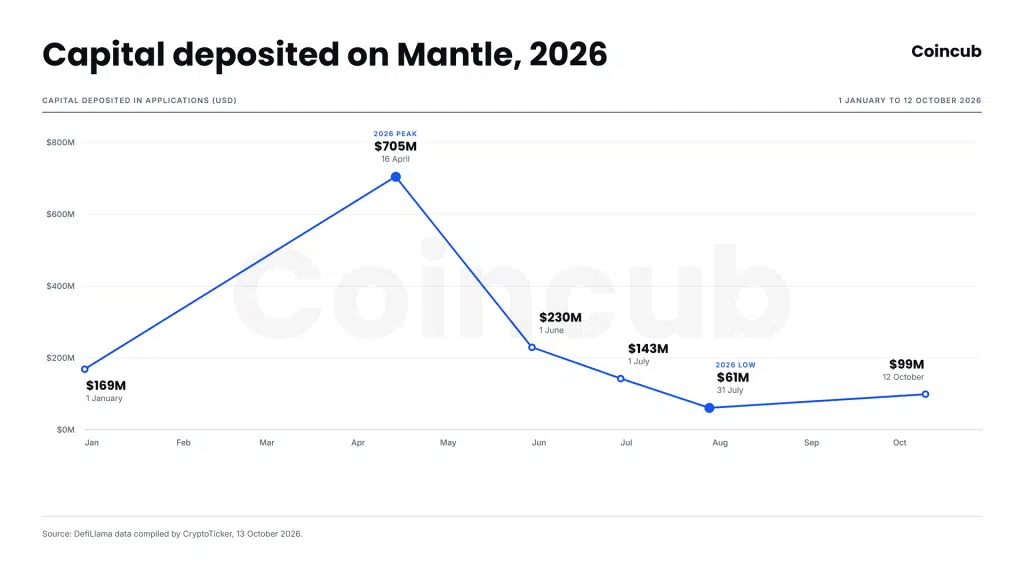
- Mantle’s expanding tokenized asset offering has yet to reverse falling deposits, which dropped about 86% from April’s peak to $99 million in October.
- Mantle’s $2.25 billion treasury holds 71.78% of its value in MNT, meaning a falling token price also reduces the reserves available to fund development.
- The proposed MIP-35 budget would cut the annual MNT spending cap by 25%, potentially slowing supply releases while roughly 2.9 billion tokens remain outside circulation.
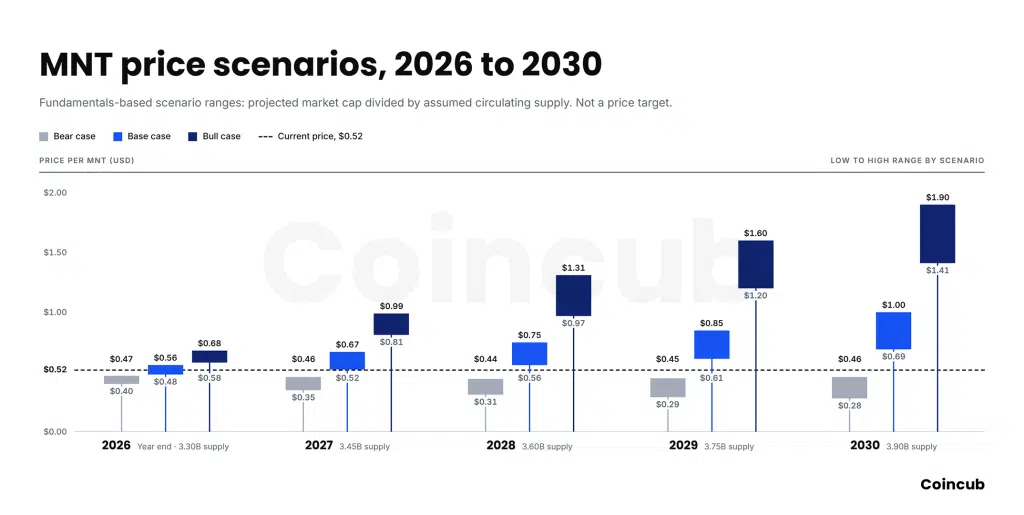
- The base-case forecast puts MNT at $0.48-$0.56 by year-end 2026, $0.52-$0.67 in 2027 and $0.69-$1.00 by 2030, depending on deposited capital, tokenized asset activity and treasury spending.
What Is Mantle (MNT)?
Mantle is an Ethereum layer-2 network that grew out of BitDAO and now positions itself as a venue for tokenized real-world assets. A layer-2 network processes transactions on its own chain and posts the results to Ethereum, which keeps fees low while Ethereum remains the settlement layer. Mantle’s documentation describes the current network as a ZK validity rollup, so each batch of transactions comes with a cryptographic proof that Ethereum verifies.
MNT is the network’s native token. It pays gas fees, gives holders a vote in governance, and makes up most of the Mantle Treasury, which the project valued at $2,252,971,490 on 13 October 2026. Because 71.78% of that treasury is held in MNT, the token’s price and the treasury’s value move together, a link explained further below.
Mantle Price Prediction at a Glance
| Metric | Value (28 October 2026) |
|---|---|
| Price | About $0.51 to $0.52 |
| Circulating market cap | About $1.7 billion |
| Circulating supply | About 3.30 billion MNT |
| Maximum supply | About 6.22 billion MNT |
| All-time high | $2.86 (9 October 2025) |
| Treasury value | $2.25 billion (13 October 2026) |
Mantle Fundamentals in 2026
Nansen’s Q3 2026 report and DefiLlama data show Mantle’s asset base growing while onchain usage stayed small.

| Fundamental | Value | Context |
|---|---|---|
| Tokenized assets on Mantle (25 September) | 1,473 | Up from 71 at the start of 2026 |
| Distributed asset value (25 September) | $476 million | All-time high |
| Mantle Vault assets under management (August) | More than $200 million | Expanded into DeFi on 25 August |
| Stablecoins on Mantle (30 September) | $548.7 million | Up 4.6% in Q3 |
| Capital deposited in applications (12 October) | $99 million | Down from $705 million on 16 April |
| Average daily active addresses (Q3) | About 1,680 | Up about 6% on Q2 |
| Average daily transactions (Q3) | About 67,500 | Concentrated in a July spike |
Two ratios from that table anchor the scenarios below. The $1.7 billion market cap equals about 17 times the capital deposited in Mantle’s applications, and about 2.7 times the roughly $632 million the treasury holds in ETH, BTC and stablecoins. Both show how much of today’s price rests on expected growth rather than current usage, and how closely the token is tied to the treasury behind it.
Mantle (MNT) Price Prediction for 2026
The biggest fundamental change of 2026 was Mantle’s shift toward tokenized assets. OpenStock brought pre-IPO vaults to the network on 2 July, Paxos’s USDG stablecoin went live natively on 3 September, and most of the 1,473 tokenized assets counted in September are equities issued by xStocks and traded on Fluxion. That product type is explained in our guide to what tokenized stocks are and how they work.
The asset growth has yet to show up in onchain capital. Deposits fell about 86% from the April peak to $99 million in October, and Mantle’s own figure of $112 million in DeFi TVL in late October is only slightly higher. Mantle’s $476 million in distributed asset value also remains about 1.2% of the roughly $38.6 billion tokenized asset market, excluding stablecoins, that TokenPost cited in early October.
With two months left, the base case of $0.48 to $0.56 assumes MNT holds the trading range it kept through most of October. The bull case of $0.58 to $0.68 requires a return to early October levels, while the bear case of $0.40 to $0.47 reflects a break below the recent $0.50 floor in a weak altcoin market.
MNT Price Prediction for 2027
The year 2027 is shaped by Mantle’s fourth budget cycle. On 28 October 2026, the core contributor team published MIP-35, which proposes caps of 150 million MNT and 40 million USDx for July 2026 to June 2027, down from 200 million MNT and 52 million USDx in the previous cycle. The proposal remains under discussion, and the budget would renew automatically every 12 months unless governance decides otherwise.
A smaller cap limits how much MNT the team can draw from the treasury, which matters for a token with about 2.9 billion units still outside circulation. If MIP-35 passes and onchain capital recovers toward the $230 million recorded on 1 June 2026, the base case points to $0.52 to $0.67 per token. The bull case of $0.81 to $0.99 requires tokenized equity trading and the Mantle Vault to turn into steady demand for MNT, while the bear case of $0.35 to $0.46 assumes onchain capital stays near $100 million.
Mantle Price Prediction 2030
The 2030 ranges depend on whether Mantle becomes one of the main venues for trading tokenized stocks, funds and stablecoins. Ethereum layer-2 networks compete for that business, including Arbitrum.
Holding today’s ratio of about 17 times onchain capital constant shows what each case requires. The base case of $0.69 to $1.00 on 3.9 billion MNT implies a market capitalisation of roughly $2.7 billion to $3.9 billion, which needs about $160 million to $230 million in deposited capital, close to the June 2026 level. The bull case of $1.41 to $1.90, about $5.5 billion to $7.4 billion, needs roughly $320 million to $435 million. Ratios usually compress as networks mature, so real growth would likely need to exceed those figures. The bear case of $0.28 to $0.46 describes usage staying near current levels while more supply reaches the market.
What Could Drive MNT Higher?
Several fundamentals could lift MNT above the base case.
- Tokenized asset trading: The asset count grew about twentyfold in 2026, and turning those listings into regular trading volume would raise fee demand for MNT.
- Tighter treasury spending: MIP-35 would cut the MNT spending cap by 25%, slowing the flow of new tokens into the market.
- Regulated stablecoins and yield products: USDG and the Mantle Vault give institutions a reason to keep dollar capital on the network.
What Could Push MNT Lower?
The same fundamentals carry clear risks.
- Treasury concentration: With 71.78% of the treasury held in MNT, a falling price shrinks the reserves that fund development.
- Supply release: About 2.9 billion MNT remain outside circulation, and any large release would add selling pressure.
- Weak onchain usage: Deposited capital of about $100 million and around 1,680 daily active addresses are small next to a $1.7 billion market cap.
- Layer-2 competition: Other Ethereum layer-2 networks also court tokenized asset issuers and liquidity.
Mantle Price Prediction Methodology
The ranges come entirely from network fundamentals. Each scenario projects a market capitalisation from assumptions about onchain capital, tokenized asset activity, treasury spending and the outcome of MIP-35, then divides it by an assumed circulating supply. The supply path rises from about 3.30 billion to 3.90 billion MNT by 2030, which assumes treasury releases stay within an annual cap similar to MIP-35’s 150 million MNT, and remains well below the 6.22 billion maximum supply. Supply figures differ slightly between data providers, so the ranges are approximate.
Is MNT a Good Investment?
MNT offers exposure to an Ethereum layer-2 network backed by one of the largest treasuries in the sector, with a clear focus on tokenized assets. Against that, most of the treasury is held in MNT itself, onchain capital fell sharply after April 2026, and roughly half of the maximum supply has yet to reach the market. MNT suits investors comfortable with high volatility and with governance decisions that shape token supply.
Frequently Asked Questions (FAQ)
Can MNT reach $1? +
MNT reaches $1 within the bull case during 2028, which implies a market capitalisation of about $3.6 billion, and only at the top of the base case by 2030. Either path requires onchain capital to grow well beyond its October 2026 level.
What is the Mantle Treasury? +
The Mantle Treasury is the project's reserve, valued at $2.25 billion on 13 October 2026, with 71.78% held in MNT and the rest mainly in ETH, BTC and stablecoins.
What is MIP-35? +
MIP-35 is a governance proposal published on 28 October 2026 that would cap Mantle's July 2026 to June 2027 budget at 150 million MNT and 40 million USDx, below the previous cycle's limits.