


 Buy a Licensed Company
  Explore VASP Data
  Talk to an Expert

 Atis Shala
Atis is a senior analyst and community lead with four years of experience in crypto. He has a bachelor from the Rochester Institute of Technology.
Atis Shala
Atis is a senior analyst and community lead with four years of experience in crypto. He has a bachelor from the Rochester Institute of Technology.
Onchain Credit Scores: Can DeFi Measure Borrower Risk?

- An onchain credit score measures selected wallet behaviours. It is not automatically equivalent to a consumer credit score, and it is not a validated probability of repayment.
- The distinction that matters most is between liquidation risk and default risk. Cred Protocol describes its score as correlating transaction history with an account owner’s ability to repay loans, which is a different question from whether an anonymous borrower will repay an unsecured obligation.
- Blockchain data cannot see income, offchain liabilities, employment, or willingness to repay. Anything a model claims about those is inferred, not observed.
- Overcollateralisation exists because anonymous lending has almost no information. Requiring collateral worth more than the loan substitutes for underwriting, at a heavy cost in capital efficiency.
- Working undercollateralised lending in DeFi is not powered by scores alone. Goldfinch relies on backer assessment, legal recourse and a multi-year underwriting record; Maple uses pool delegates who KYC borrowers and post first-loss capital.
- Wallet fragmentation and Sybil creation are structural problems, not bugs. A borrower with a poor history can open a new address in seconds, which is why a responsible model must treat thin history as unknown rather than as good.
- Model validation is the hard constraint. DeFi has few genuine unsecured defaults to learn from, so out-of-sample performance claims deserve scrutiny before they influence real lending limits.
The Gap Between Measurable and Meaningful
Public blockchains are an unusually rich behavioural dataset. Every borrow, repayment, liquidation, transfer, and protocol interaction is permanently visible, timestamped, and machine-readable, with no need to request it from anyone. Compared to the fragmented and permissioned world of traditional credit data, that is remarkable.
It is also incomplete in ways that matter enormously for credit. The data shows what an address did. It does not show who controls it, what else they own, what they owe elsewhere, what they earn, or whether they intend to repay you. A model built on that data can be genuinely useful for some decisions and actively misleading for others, and the difference depends entirely on which question it was built to answer.
What Is an Onchain Credit Score?
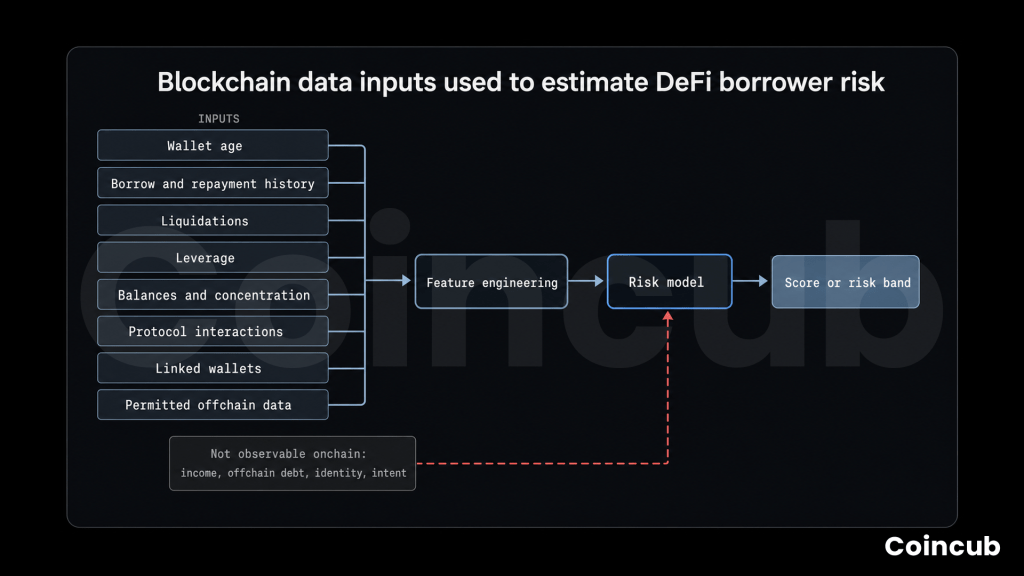
An onchain credit score is a model-generated risk assessment derived partly or wholly from blockchain data. A model ingests an address’s transaction history, computes features from it, and outputs a number, band, or probability intended to summarise risk. Cred Protocol, as one example, produces scores on a 300 to 1000 range using machine learning over time-based account attributes and past transaction behaviour, and can score addresses even where no borrowing activity exists.

Four Different Things Called “Scoring”
These are routinely conflated and should not be.
| Type | Question it answers | Typical user |
| Borrower risk score | Will this address repay or get liquidated? | Lending protocol, underwriter |
| AML / wallet screening | Is this address linked to sanctioned or illicit activity? | Compliance team, exchange |
| Protocol risk rating | How likely is this protocol to fail or be exploited? | Treasury, risk curator |
| Collateral monitoring | Is this position approaching liquidation right now? | Liquidator, risk engine |
A wallet flagged clean by an AML screen may still be a terrible credit. A protocol rated safe may host borrowers who default. Buying an “onchain risk score” without establishing which of these four you purchased is a common and expensive error.
The Predicted Outcome Is the Product
Within borrower scoring itself, the target variable varies, and the variation is not academic. Liquidation risk asks whether a collateralised position will be forcibly closed. Default risk asks whether a borrower will fail to repay an obligation. Wallet quality asks something vaguer about sophistication and behaviour. Fraud probability asks whether the address is adversarial.
These correlate loosely and are not interchangeable. An address that has never been liquidated because it borrows conservatively against volatile collateral tells you something about risk management. It tells you comparatively little about whether that person would repay an unsecured loan with no collateral at stake. Every evaluation of a scoring model should begin by asking which of these it was trained to predict, and against what labels.
Why Does DeFi Need Borrower-Risk Information?
Permissionless lending protocols were built for a world with no identity and no recourse. If a borrower is an address, and the address can be abandoned costlessly, then nothing except collateral makes repayment rational.
The solution the sector converged on was overcollateralisation: lend $70 against $100 of deposited assets, and if the collateral value falls toward the loan, liquidate automatically. This is elegant because it requires no information about the borrower whatsoever. Their identity, income, and intentions are all irrelevant, because the protocol never depends on them.
The Cost of Not Knowing Anything
That elegance has a price, and the price is capital efficiency. A borrower must already hold more value than they wish to borrow, which restricts the use case to leverage, liquidity management, and tax-deferred access to holdings. It excludes essentially every purpose that ordinary credit serves: buying something you cannot yet afford, financing working capital, or smoothing income.
Better borrower information is what would relax that constraint. If a protocol could distinguish a reliable borrower from an unreliable one, it could lend at 90% or 110% of collateral value to the former, unlocking capital currently sitting idle as buffer.
Collateral Does Not Eliminate Risk
It is worth being precise that overcollateralisation manages one risk and creates others. Oracle failure can misprice collateral and trigger wrongful liquidations or permit undercollateralised borrowing. Liquidity crunches can leave liquidators unable to clear positions at the assumed discount. Network congestion can delay liquidation past the point of solvency. Correlated collapses in collateral value can outrun the buffer entirely, leaving the protocol with bad debt.
The Bank for International Settlements has made the underlying point directly, observing that because borrowers are anonymous, overcollateralisation is pervasive in DeFi lending and generates procyclicality, with platform features facilitating speculation in cryptoassets more than real-economy lending. Collateralisation transforms credit risk into market, liquidity, and operational risk rather than removing it. A borrower score, even a good one, addresses only one layer of a stack.
Which Data Can an Onchain Score Analyse?
The feature set available from public chains is broad, and each category carries its own reliability.
| Data category | What it can indicate | Weakness |
| Wallet age and activity consistency | Established behaviour, not a fresh Sybil | Trivially aged in advance |
| Borrow and repayment history | Direct evidence of meeting obligations | Only exists for prior borrowers |
| Liquidation history | Risk tolerance and management quality | Confounded by market conditions |
| Leverage and utilisation | Current strain on the position | Point-in-time, changes fast |
| Balance size and concentration | Capacity and diversification | Ignores offchain wealth entirely |
| Protocol interactions | Sophistication, exposure quality | Reputable-protocol lists are subjective |
| Counterparty exposure | Proximity to risky or illicit flows | Guilt by association risk |
| Governance, LP, staking activity | Longer-term commitment | Cheaply manufactured |
| Linked wallets and attestations | Fuller picture of one entity | Depends on voluntary disclosure |
| Permitted offchain data | Income, identity, credit bureau data | Requires consent and infrastructure |
Cred Protocol states that it can score Ethereum accounts from transaction histories and aggregate multiple addresses supplied to its scoring endpoint, which addresses fragmentation only for the addresses a user chooses to disclose.
What Blockchain Data Structurally Cannot See
This list is short and decisive. It cannot see income or employment; it cannot see offchain debts, so a borrower may be heavily leveraged elsewhere while appearing unencumbered onchain.; it cannot see legal identity without an attestation layer; it cannot see assets held on centralised exchanges or in traditional accounts; and it cannot see intention.
The consequence is that an onchain score describes a slice of a person’s financial life, selected not because it is the most predictive slice but because it is the visible one. That is a reasonable starting point for a risk input. It is a poor foundation for a claim of equivalence with bureau scoring.
The Self-Disclosure Asymmetry
There is a structural bias in aggregated scores worth naming. A borrower who voluntarily links multiple wallets will link the flattering ones. Nothing compels disclosure of the address that was liquidated three times last year. Any scoring system relying on user-supplied address sets inherits an adverse-selection problem, and mitigating it requires either clustering heuristics with their own false-positive costs or an identity layer that most users do not want.
How Can DeFi Use a Credit Score?
Scores are risk-policy inputs. The realistic applications are narrower and more useful than the “credit score for crypto” framing suggests.
The most direct use is adjusting loan parameters. A higher-confidence borrower might receive a lower collateral requirement, a higher borrowing cap, a better rate, or a more forgiving liquidation threshold, and because each of these can be tuned incrementally, the damage is contained when the model turns out to be wrong.
Cruder but more robust is gating access outright, where a protocol excludes addresses below a threshold from a particular pool rather than pricing risk continuously, and this is what most production systems actually do. The strongest case, though, is ongoing exposure monitoring, because a bureau score updates monthly at best while an onchain risk signal updates every block.
For watching a live position deteriorate, that is a genuine advantage with no traditional equivalent. Beyond retail lending, an onchain score can also price institutional and private-credit facilities, sitting alongside financial statements, legal agreements and delegate judgement to inform terms rather than determine them. Increasingly, scoring is applied to protocols, vaults and curators rather than to individual consumers, which sidesteps the identity and privacy problems entirely and is where much of the practical value has landed.
The Framing That Keeps Lenders Out of Trouble
A score is an input to a risk policy, not a guarantee of repayment. The useful posture is to treat it the way an insurer treats a rating factor: it shifts the terms you offer, it does not remove the need for the rest of the structure, and it must be monitored for drift. Protocols that have treated scores as sufficient rather than contributory are the ones that have written off the most bad debt.
Can Onchain Scores Enable Loans Without Collateral?
Potentially, and not on their own. A score can measure a wallet. It cannot compel an anonymous address to repay.
This is the point where the whole subject either becomes clear or stays confused. Credit does not work because lenders can measure borrowers. It works because measurement is combined with consequence. In traditional lending, the consequences are legal enforcement, damage to a persistent reputation the borrower cannot discard, and loss of access to future credit. Remove all three and the best model in the world does not make an unsecured loan rational.
How Undercollateralised DeFi Lending Actually Functions
Look at what production systems do rather than at what scoring vendors describe.
Goldfinch lends without onchain crypto collateral, and its own documentation is clear that this does not mean lending without collateral: loans are collateralised by offchain assets tied to real-world legal structures, with agreements signed by borrowers and backers. Maple runs a curated credit marketplace in which pool delegates KYC individual borrowers, set fixed rates and tenor, and post a first-loss capital tranche so they absorb losses ahead of lenders, with KYC-compliant sub-pools serving institutional participants.
In both cases the enabling ingredients are identity, legal agreements, professional underwriting, aligned skin in the game, and permissioned access. Onchain data may inform those judgements. It does not replace any of them.
| What the loan needs | Can an onchain score supply it? |
| Risk measurement | Partially, for observable behaviours |
| Identity | No, without an attestation or KYC layer |
| Enforceability | No |
| Recourse on default | No |
| Ongoing monitoring | Yes, and better than traditional data |
| Loss absorption | No |
Servicing Is Not Underwriting
A recurring confusion deserves separating out. Blockchain infrastructure is genuinely good at loan servicing: disbursement, interest accrual, repayment tracking, and transparent reporting all work well onchain and are cheaper than their traditional equivalents.
None of that is underwriting. Tokenizing a loan does not reduce the probability that the borrower fails, and it does not create a mechanism for recovering value when they do. Recovery still runs through offchain legal process against an identified counterparty. A protocol that has automated servicing beautifully while leaving underwriting to an unvalidated score has optimised the easy half of the problem.
What Can Go Wrong With Onchain Credit Scoring?
Sybil Creation, Wallet Fragmentation, Manufactured History, and Thin Data
A borrower can generate unlimited addresses. Any scoring system that rewards history must handle the case where a borrower simply presents a different address, and cannot rely on the borrower disclosing the rest. Crosschain fragmentation is another problem. Activity is spread across many networks with inconsistent data availability. Coverage gaps produce systematically wrong scores for users whose activity sits outside the model’s indexed chains.
Every feature that can be measured can be farmed, leading to a manufactured history. Wallet age, transaction count, protocol diversity, small borrow-and-repay loops, governance participation: all are cheap to fabricate relative to the credit they might unlock. Once a score gates real money, the cost-benefit of gaming it flips decisively.
Another issue is thin data for new users. A new address has no history. The correct handling is to classify it as insufficient information, distinct from known-bad. Models that collapse these into one low score punish honest newcomers and are trivially gamed by anyone willing to wait.
Incorrect Identity Linkage, Surveillance, and Biased Features
Start with the question of who a score actually belongs to. The tools that group addresses into a single entity work by inference, and inference produces false positives. Someone wrongly linked to a liquidated or flagged address carries that association without a clear route to contest it, which is a real harm with no established remedy.
That problem compounds because of where the record lives. Attaching a persistent score to a public address creates a permanent, globally visible financial record, and the exposure sharpens once the address is tied to an identity. A traditional credit file is at least held behind access controls, while an onchain reputation is open to anyone who looks. Even when the linkage is correct, the features driving the score deserve scrutiny. Proxy variables can quietly encode geography, wealth, or membership of a particular ecosystem. In regulated consumer lending those patterns raise fair-lending questions, and deploying a model permissionlessly does not make the questions disappear.
Model Training
The deepest problem, though, sits underneath all of this in the training data. Supervised models learn from outcomes, and DeFi has produced relatively few genuine unsecured defaults, concentrated in a handful of credit events and specific market regimes. A model trained largely on liquidations and validated over that same period may be measuring market volatility rather than borrower quality. Whatever the model did learn also has a shelf life, because granting credit changes the borrower. A wallet’s cautious history was produced under conditions where it had no unsecured credit to lose. Extending credit alters the incentives that generated the data in the first place, a version of Goodhart’s law that traditional credit models have wrestled with for decades.
Borrower quality is in any case only one layer of the risk. Oracle manipulation, smart-contract exploits, governance capture, and liquidation failures can each destroy a lender no matter how sound the borrowers were, so a score sitting on top of a fragile stack offers less protection than its precision suggests.
How Should a Lender Evaluate a Scoring Model?
Treat this as model due diligence, not product evaluation. Nine questions, in order.
- What exact outcome does it predict?
- Default, liquidation, delinquency, fraud, or something looser. If the documentation does not state this precisely, that is the finding.
- What is the observation and performance window?
- A model predicting liquidation within 30 days is a different instrument from one predicting default over 12 months, and they cannot be compared on accuracy figures.
- How are the labels defined? Where does delinquency end and default begin? Are liquidations counted as defaults?
- Definitional choices here can move headline accuracy substantially.
- Which chains and protocols are covered?
- Coverage gaps become systematic bias against users active elsewhere.
- How does it handle multiple wallets and new accounts?
- Specifically, does thin history return a distinct “insufficient data” state rather than a low score?
- Is performance measured out of sample?
- In-sample accuracy is not evidence. Ask for out-of-time validation across at least one full market cycle, including a stress period.
- Are error rates, calibration, and version history disclosed?
- Discrimination, meaning the ability to rank risk, and calibration, meaning whether predicted probabilities match observed rates, are separate properties. A model can rank well and be badly calibrated, which produces mispriced loans.
- Can a borrower contest inaccurate data?
- Wrong clustering, misattributed addresses, and stale data need a correction path. Most systems have none.
- What privacy and identity controls apply?
- Who sees the score, what is retained, and whether any of it is published onchain.
Test It Against a Boring Baseline
The most useful discipline is comparison. Before adopting a sophisticated score, measure how it performs against simple alternatives: current collateralisation ratio, prior repayment count, wallet age, and position size. A model that cannot beat those on out-of-sample data is adding complexity, cost, and opacity for nothing.
Then stress it. Simulate wallet splitting, farmed history, a 40% collateral drawdown, an oracle failure, and a congested network. A score that degrades gracefully under those conditions is usable. One that has only been observed during calm markets is untested.
Frequently Asked Questions (FAQ)
Is an onchain credit score the same as a FICO score? +
No. The data sources, predicted outcomes, identity model, regulatory framework, and dispute rights all differ. Onchain scores observe wallet behaviour and cannot see income, offchain debts, or legal identity without additional attestation or consent layers.
Can a wallet receive an unsecured loan? +
In some controlled systems, yes. Production undercollateralised lending typically combines KYC, professional underwriting, legal agreements, and first-loss capital from pool delegates. A score alone cannot compel repayment from an anonymous address.
Can a user erase a poor onchain history? +
A user can create a new wallet and start clean. Clustering heuristics, identity attestations, and transaction-graph analysis may still connect addresses, though these methods produce false positives and are not reliable enough to depend on alone.
Does a new wallet automatically receive a bad score? +
It should not. A responsible model classifies insufficient history as unknown rather than as high risk. Conflating the two penalises legitimate new users and makes the system easy to game by anyone willing to age an address first.
Can scores work across blockchains? +
They can aggregate activity across multiple networks, but coverage varies by chain and linking a user’s addresses across them is unreliable. Gaps in indexed chains produce systematically incomplete scores for users active outside them.
Are onchain credit scores private? +
Generally not fully. Underlying transactions are usually public and permanently visible. Identity attestations and proprietary model features may be held offchain or protected cryptographically, but the behavioural record itself is open to anyone.
Can a high score prevent liquidation? +
No. Liquidation is determined by collateral prices, oracle performance, available liquidity, and protocol rules. A score may influence the threshold a protocol sets in advance, and it has no effect once a position breaches that threshold.