


 Buy a Licensed Company
  Explore VASP Data
  Talk to an Expert

 Dren Hima
 is Head of Research at Coincub, leading research across digital asset regulation, licensing, market structure, tokenization and institutional adoption.
Dren Hima
Dren Hima is Head of Research at Coincub, leading research across digital asset regulation, licensing, market structure, tokenization and institutional adoption.
Crypto Divorce: Irreconcilable Differences, Irreversible Transactions

- No jurisdiction covered here has built a crypto-specific divorce regime, so classification runs on the same acquisition, source-of-funds and commingling rules that govern brokerage accounts and inherited land.
- The valuation date does most of the damage. Florida allows different assets to be valued on different dates, Ontario locks the number at separation regardless of what happens afterwards, and everyone else defaults to trial or hearing date.
- New York’s revised Statement of Net Worth, effective 1 March 2026, and Australia’s new statutory disclosure duty under section 71B have hardened the sanction for concealment without making concealment easier to detect.
- Tracing is expensive enough to be disproportionate in mid-size estates. A Kings County court awarded $125,000 in expert fees on a single interim motion, and Chainalysis Reactor lists at £55,000 per licence per year on UK G-Cloud.
- Section 1041 nonrecognition moves the coins and the embedded tax liability together, so a settlement that transfers appreciated tokens without basis records hands the recipient an unprovable cost base.
A Brooklyn dentist told opposing counsel under oath in May 2025 that he had never owned any cryptocurrency beyond roughly $20,000 of Bitcoin bought two months earlier. Subpoenaed records said otherwise, and by the time Justice Jeffrey Sunshine ruled in A.S. v A.B. in March 2026, the wife’s expert had traced more than $2.6 million in undisclosed holdings across US exchanges, offshore venues that do not verify identity, decentralised exchanges and at least nine self-custody wallets showing relational connections to the husband. What should interest anyone practising in this area is the timing of what happened next, because the hour after opposing counsel gave notice that a motion was coming, the husband converted his entire ETH position into USDC and began moving it out along elaborate routes.
The court awarded the wife a further $300,000 in pendente lite counsel fees on top of a $50,000 interim award, granted $125,000 in expert fees for the tracing work, and shifted 100% of the forensic accountant’s remaining costs onto the husband. “If there were ever a need demonstrated for legal expert fees, this is the case,” the decision reads, before making the point that leveling the playing field means leveling the ability to seek the truth, and not merely the amount each side has paid its lawyers.
None of the doctrine in that decision is new. Domestic Relations Law § 237 is decades old, the fee jurisprudence runs through Prichep, Guzzo and Kaufman, and the court needed no crypto-specific authority to reach the result. Crypto changed the price of finding out what the marital estate contains, and the $475,000 in fees and expert costs awarded in a single interim motion is the number that should be circulating in practitioner circles, because it puts a price on concealment for the party doing the concealing.

Every jurisdiction decided crypto was ordinary property, and moved on
No major common-law system has built a separate divorce regime for digital assets, and the deliberate boringness of that choice is the most useful thing to understand about the field. US federal law treats convertible virtual currency as property under Notice 2014-21, which settles the tax characterisation and leaves classification of the marital or community estate entirely to state law. Canada devolves family property to the provinces while the CRA applies national tax rules on top. Australia runs everything through the just-and-equitable property alteration power in the Family Law Act 1975.
England and Wales took the longest route to the same destination, and finally arrived when the Property (Digital Assets etc) Act 2025 received Royal Assent in September 2025, confirming that a thing in digital form is not prevented from being an object of personal property rights merely because it fits neither of the historic categories of things in possession and things in action. That resolves a proprietary question which was load-bearing for freezing injunctions, constructive trusts and third-party recovery, and it does close to nothing for financial remedy practice under the Matrimonial Causes Act 1973, where the section 25 discretion was always wide enough to capture whatever a spouse controlled regardless of how the common law categorised it.
So the classification questions are the ones lawyers have been asking about closely held companies and inherited farmland for fifty years. When was the asset acquired, with whose money, was it a gift or a legacy to one spouse alone, has it been commingled past the point of tracing, and what did the holder do with it after separation. A token bought in 2019 with salary earned during the marriage is community property in California and Texas and marital property in New York, Florida and Illinois, for exactly the reasons a brokerage account would be.
Texas presumes that property possessed by either spouse on dissolution is community, and Family Code § 3.003 requires clear and convincing evidence to rebut that presumption, a burden the case law satisfies by tracing an existing asset through its mutations back to its separate source, which is the point at which the ordinariness of the doctrine stops being comforting. Crypto generates mutations at a rate no cash account ever managed. A spouse who brought Bitcoin into the marriage, swapped part of it for ETH on a decentralised exchange, bridged that ETH to another chain, wrapped it, deposited it into a liquidity position and later withdrew a different token composition has run six mutations in an afternoon, every one of them a disposal for tax purposes and every one a link that has to be evidenced before a court will accept the end product as the same separate property that walked in the door.
Chain analytics help less here than clients assume, because the data proves that one address sent value to another and says nothing whatsoever about whose separate funds were involved or whether marital income entered the balance at step three. Pro rata apportionment through a commingled wallet is a spreadsheet exercise that turns intractable once staking rewards, airdrops and fee-token dust are in the mix, and no jurisdiction covered here has published guidance on how it should be done. The realistic advice to a client with premarital holdings is to park those coins in a wallet that never receives another deposit, which is advice almost nobody follows.
Four countries, five valuation dates, and an asset that never stops trading
Valuation date rules were written for assets that print a closing price once a day, or, in the case of a private business, once a year at enormous expense. Applied to something that trades continuously across dozens of venues with no consolidated tape, they diverge into results that would strike a client as arbitrary.
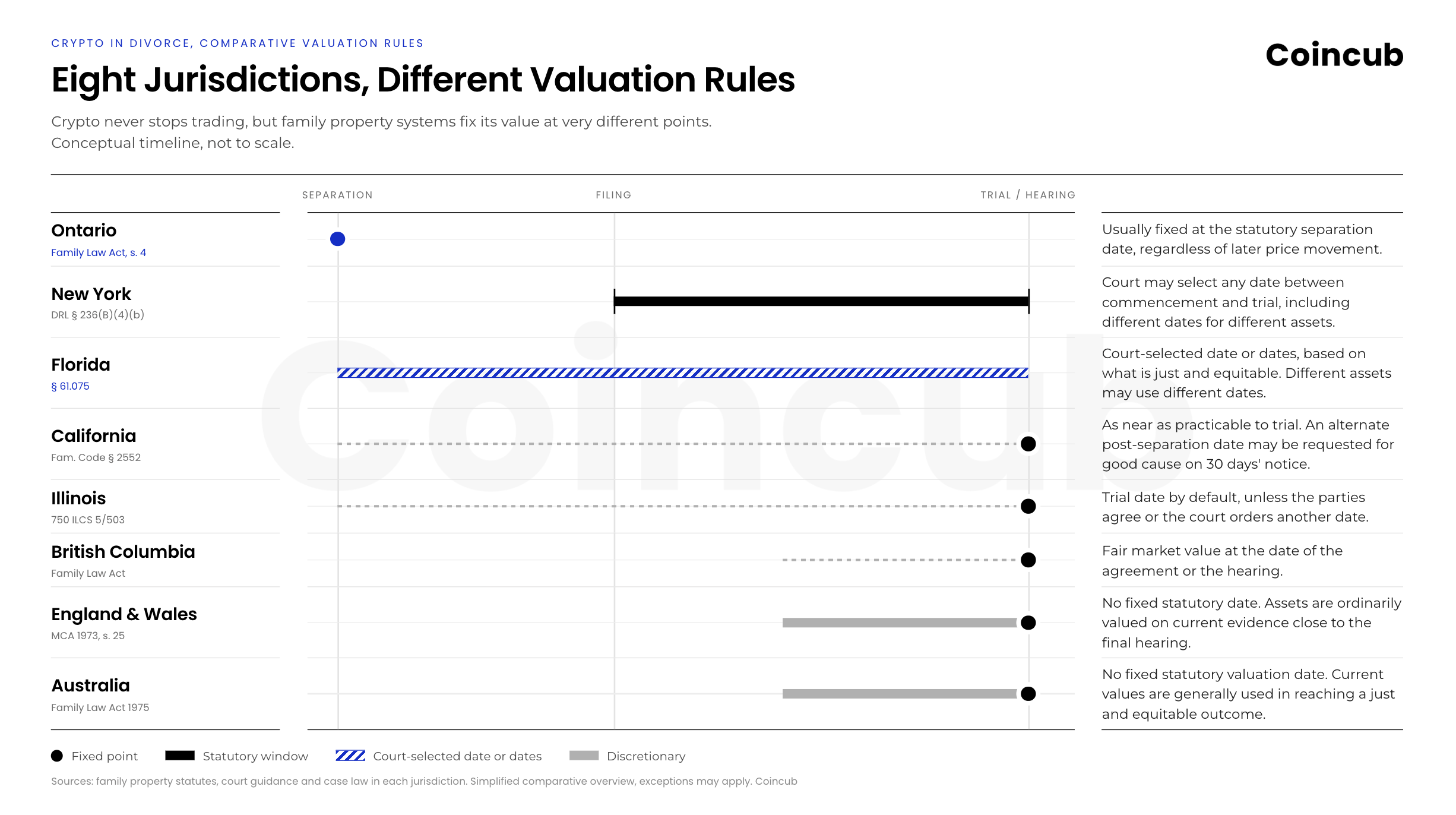
California values the community estate “as near as practicable to the time of trial” under Family Code § 2552, with an alternate date available on thirty days’ notice for good cause where that is needed to accomplish an equal division. Illinois lands in the same place through 750 ILCS 5/503, which sets the date of trial as the default subject to agreement or court order and specifies a fair market value standard. New York permits any date between commencement of the successful action and trial, which gives the court a window rather than a point.
Florida is the outlier in the permissive direction, because § 61.075 lets the judge pick whatever valuation dates are just and equitable and expressly allows different assets to be valued on different dates. For a marital estate holding both a pension and a volatile token position, that flexibility is the single most useful statutory tool in any of the American regimes, and it goes unused in most cases because nobody pleads it.
Ontario runs the opposite experiment. The Family Law Act defines valuation date statutorily as the earliest of separation without reasonable prospect of resumed cohabitation, the grant of divorce, a declaration of nullity, or a successful improvident depletion application, and net family property is measured on that fixed date. Equalisation therefore locks a number in place while the asset keeps trading, sometimes for years of litigation. A spouse who holds through a drawdown owes an equalisation payment calculated on a value that no longer exists anywhere, and a spouse who holds through a run keeps every dollar of the appreciation. British Columbia sits closer to the trial-date camp, with family property valued at fair market value as of the agreement or hearing date, and the Court of Appeal confirmed in 2022 that growth in excluded property is measured to the hearing date rather than separation.
England and Wales, and Australia, both leave it to the court, which in practice means the balance sheet gets built close to the final hearing and the volatility risk sits wherever the parties and the judge decide to put it. The comparative lesson is that only Florida has a statutory answer designed for assets that move at different speeds, and only Ontario has an answer that will reliably produce an outcome one party experiences as a fiction. Everywhere else, discretion is available and has to be argued for, which means crypto cases should be briefed as valuation-date disputes long before they are briefed as technology disputes.
British Columbia adds a second lever worth borrowing conceptually, because unequal division is available where a spouse’s dealings with property after separation cause significant unfairness, and post-separation dealing is exactly what a party moving tokens through decentralised exchanges is doing.
“Fair market value at filing” is not a valuation clause
A settlement term that fixes value at the filing date and stops there has specified maybe a third of what it needed to. Five further things have to be in the drafting, being the exact cut-off time, the time zone, the market being priced, the pricing source that will be archived, and the pricing convention, which is where most of the argument lives.
Spot fair market value at a stated minute is the cleanest to audit and the most exposed to venue selection and short-run volatility. A volume-weighted average over a defined window smooths timestamp disputes and manipulation in thinner books, at the cost of being less connected to anything the holder could have realised at a single moment. Net liquidation value after fees, spread and slippage is the honest number where the settlement contemplates a sale to fund an equalisation payment, and it invites a fight about hypothetical execution costs that neither side can prove.
The accounting profession did this work already, and family lawyers can free-ride on it. FASB ASU 2023-08, effective for fiscal years beginning after 15 December 2024, requires in-scope crypto assets to be measured at fair value each reporting period with changes running through net income, which forced preparers to confront principal-market identification as an operational problem rather than a theoretical one. The AICPA’s updated digital assets practice aid, reissued in June 2024 in a question-and-answer format, goes further into pricing reliability, cut-off, and the specific procedures appropriate when an asset trades in a thin market rather than an active one. Divorce is not a financial reporting exercise, and the questions an auditor asks about a corporate treasury position are line-for-line the questions a court should be asking about a marital one.
An in-kind split of the units sidesteps the entire argument and is underused. Dividing 14 BTC into two lots of 7 requires no agreement on price at all, leaves both parties carrying their own market risk from the transfer date forward, and avoids the spread and tax consequences of a forced liquidation. It only works where both spouses can lawfully and safely custody the asset, which is a real constraint and not a technicality, and it needs express drafting on forks, airdrops, staking rewards and dust that accrue between order and execution.
New York and Australia rewrote the disclosure rules, and the subpoenas still did the work
Procedural reform has moved faster than anyone expected. New York’s revised Statement of Net Worth, in effect from 1 March 2026, carries a dedicated digital assets section requiring the platform or custodian, the wallet or account identifier, the date and party of acquisition, the source of funds, the original purchase price, the value at marriage, the value at commencement, the current number of units and the current value. All of it sworn. A litigant who omits a Coinbase account from that form is no longer able to characterise it as an oversight about an exotic asset class, because the form names Bitcoin, Ethereum, stablecoins, NFTs, DeFi positions and staking accounts by category.
Australia moved the duty of full and frank disclosure out of Rule 6.06 of the court rules and into the statute itself, with the Family Law Amendment Act 2024 commencing on 10 June 2025 and inserting section 71B for married parties and section 90RI for de facto parties. Relocating an obligation from rules to primary legislation looks cosmetic until a party tries to argue that a disclosure failure is a procedural irregularity, at which point the difference becomes substantial. California already imposed continuing fiduciary duties of the highest good faith between spouses alongside its early and ongoing disclosure regime, and England and Wales run the same function through Form E and the pre-application protocol.
But the disclosure rule did not find the $2.6 million in Brooklyn. Subpoenas to exchanges did, followed by thirteen thousand pages from a single bank and an expert willing to read them. Disclosure obligations do their real work at the sanction stage, once an omission has been established by other means, and the practitioners treating the new New York form as a discovery tool rather than a leverage tool will be disappointed, because the form creates the lie and something else still has to catch it.
What a tracing expert can prove, and what it costs to find out
The affirmation filed by the wife’s expert in A.S. v A.B. is a good model precisely because of what it declines to claim. He did not assert that he had identified the husband from the blockchain. He described patterns, being repeated hopping between accounts in a way that breaks the relational connection to prior activity, use of an offshore venue that often fails to collect information about account holders, prolific movement of funds from a known wallet into decentralised exchanges between February 2024 and June 2025, and at least nine further wallets that received funds appearing to hold relational connections to the husband. On the fraud defence, he said the transaction activity showed no indication of being unauthorised or the result of an account takeover, which rebuts a claim of theft without asserting certainty about who signed the transactions.
That is the correct evidentiary posture, because a chain graph on its own is investigative material. It becomes evidence when it is tied to exchange KYC records returned under subpoena, to fiat on-ramp and off-ramp banking data, to device images, to tax return positions, or to admissions. The clustering heuristics underpinning commercial analytics have been well understood since Meiklejohn’s work on Bitcoin transaction graphs, and they remain heuristics, degraded by CoinJoin, cross-chain bridges and any counterparty that never collected an identity document.
Cost is the constraint nobody wants to discuss honestly. Chainalysis Reactor is listed at £55,000 per licence per year on the UK government’s G-Cloud framework, and enterprise pricing for comparable platforms sits in the same band. In Brooklyn the wife sought $150,000 in expert fees and the husband’s own retained expert put the necessary analysis at $80,000, which is itself a concession that the work runs past a hundred hours of blockchain review before anyone reaches a conclusion. The court awarded $125,000.
Those numbers are proportionate against a dental practice grossing seven figures and a husband whose 2023 W-2 income was $1,380,000. They are not proportionate against a $400,000 marital estate holding $60,000 of Bitcoin, and there is no honest way to close that gap at present. A staged approach helps at the margin, running public block explorer work and exchange subpoenas first and escalating to a specialist platform only where the arithmetic justifies it, but the access-to-justice problem in mid-size estates is real and the profession has not solved it.
Section 1041 moves the coins and the tax bill together
Transfers between spouses or incident to divorce fall outside gain recognition under 26 U.S.C. § 1041, with the transferee treated as having acquired the property by gift and taking the transferor’s adjusted basis. Favourable at the transfer, and a trap on the settlement sheet, because a spouse accepting appreciated tokens at a headline valuation is accepting an embedded liability that will crystallise on a later sale. If the wallet arrives without acquisition dates, purchase prices, swap history, fork and airdrop records and prior return positions, the recipient inherits an unprovable basis as well, and the default assumption in a dispute with the IRS about undocumented basis is zero.
The comparative treatment converges on the same principle with different mechanics. HMRC extended no-gain-no-loss treatment for separating spouses and civil partners to three years after the tax year of separation for disposals on or after 6 April 2023, with no time limit at all where the transfer is made under a formal divorce agreement. Canada’s section 73(1) rollover applies automatically to capital property transferred to a spouse or to a former spouse in settlement of rights arising out of the marriage, with the ability to elect out where realising a gain or loss is the better answer.
Australia is the one to watch, because the relationship breakdown rollover only applies where the transfer happens under a court order under the Family Law Act, a binding financial agreement, or an equivalent instrument, and where it applies it is mandatory rather than elective. Separating couples who split a wallet informally and paper it afterwards have made a taxable disposal, and the token holder who sends half his Bitcoin across on a handshake has triggered CGT on the transfer with no relief available.
Orders that nobody can perform
A transfer clause drafted for a brokerage account will fail against self-custody, and the expert affirmation in Brooklyn put the reason plainly, noting that these are self-custody assets held under a private key where, unlike a bank password, there is no help desk and no recovery option. An order cannot compel a keyholder to remember something, and a wrong receiving address is irreversible in a way no wire transfer is.
Workable drafting handles that operationally. One receiving address per asset supplied within a fixed window, a nominal test transfer sent first, written confirmation of receipt, then the balance, with network fees allocated expressly. A non-dissipation covenant that names selling, pledging, swapping, bridging, staking, lending and mixing, because a clause prohibiting “sale” does not stop the conduct that destroyed traceability in the Brooklyn case. A fallback requiring transfer to an agreed qualified custodian or liquidation through an agreed exchange where the receiving spouse cannot safely self-custody, which is a common and unembarrassing situation. And mandatory production of basis and transaction history as a condition of the transfer rather than an afterthought.
Third-party orders need the same discipline. Exchanges respond to process that identifies the account, the assets, the relief sought and the jurisdictional basis, and they decline vague requests, so an order directing a custodian to “freeze the respondent’s cryptocurrency” is a wasted filing.
The workflow that holds up is conventional classification, rigorous tracing, precise valuation, and drafting written by someone who understands how the transfer will physically happen. Courts have had the doctrinal tools for this the entire time. What the Brooklyn decision supplies is a price tag for the party who decides to test whether anyone will bother to look.
Frequently Asked Questions (FAQ)
Is cryptocurrency treated as marital property? +
In every jurisdiction covered here it falls into the ordinary property pool. Tokens acquired during the marriage with marital or community funds are divisible on the same basis as any other asset, and premarital holdings, gifts and inheritances retain their separate or excluded character only where the claimant can trace them.
What date is crypto valued at in a divorce? +
It depends entirely on the jurisdiction. California values as near as practicable to trial, Illinois defaults to the date of trial at fair market value, New York permits any date between commencement and trial, Florida lets the judge set different dates for different assets, British Columbia uses the agreement or hearing date, and Ontario fixes the statutory valuation date at separation.
Why is "fair market value at the filing date" not enough in a settlement? +
Crypto trades continuously across multiple venues with no consolidated price. A workable clause has to specify the cut-off time and time zone, the market being priced, the pricing source that will be archived, and whether the figure is spot value, a volume-weighted average, or net liquidation value after costs.
Can a spouse successfully hide cryptocurrency? +
It is harder than clients assume and more expensive to disprove than most estates can bear. In A.S. v A.B. the husband denied ownership under oath and subpoenaed exchange records produced evidence of more than $2.6 million in holdings, but the wife needed a retained cryptocurrency expert and a court order for $125,000 in expert fees to get there.
Do I pay tax when transferring crypto to a spouse in a divorce? +
Generally no at the point of transfer, though the mechanics differ. US transfers between spouses or incident to divorce are nonrecognition events with carryover basis, the UK allows no-gain-no-loss treatment for three years after the tax year of separation and indefinitely under a formal divorce agreement, Canada applies an automatic section 73(1) rollover, and Australia's relationship breakdown rollover applies only where the transfer is made under a court order or binding financial agreement.
Can a court order someone to transfer crypto held in self-custody? +
It can order it, and it cannot make it physically possible. Self-custody assets sit behind a private key with no recovery mechanism, which is why orders should include a test-transfer procedure, express fee allocation, and a fallback to a qualified custodian or agreed liquidation where the receiving spouse cannot safely hold the asset.