

 Buy a Licensed Company
  Explore VASP Data
  Talk to an Expert

 Dren Hima
 is Head of Research at Coincub, leading research across digital asset regulation, licensing, market structure, tokenization and institutional adoption.
Dren Hima
Dren Hima is Head of Research at Coincub, leading research across digital asset regulation, licensing, market structure, tokenization and institutional adoption.
How Gaming Companies Use NFTs Now That Players Can’t See Them
- Capital repriced the sector from content to infrastructure. Only 53% of Q3 2025 gaming funding went to games at all, and 74.8% of Q2’s went to infrastructure.
- Emission-funded play-to-earn was replaced by sinks. Axie’s extraction dungeon destroys assets, Pixels taxes withdrawals and pays stakers, and both solve the same supply problem from opposite ends.
- Wallet counts are not player counts. Alien Worlds averaged 598.7 transactions per wallet, Kawaii Puzzle 3.4, and MapleStory N minted 1.7 million NFTs into a game averaging above 30,000 daily users.
- On-chain ownership is a claim against a company. F1 Delta Time died with its licence, Ubisoft’s Quartz programme ran about 100 days, and The Sandbox cut over 50% of staff while LAND holders kept their LAND.
- Gambling law binds harder than securities law. Sorare’s UK trial slipped to June 2027, and France’s purpose-built JONUM regime has attracted two declared companies in five and a half months.
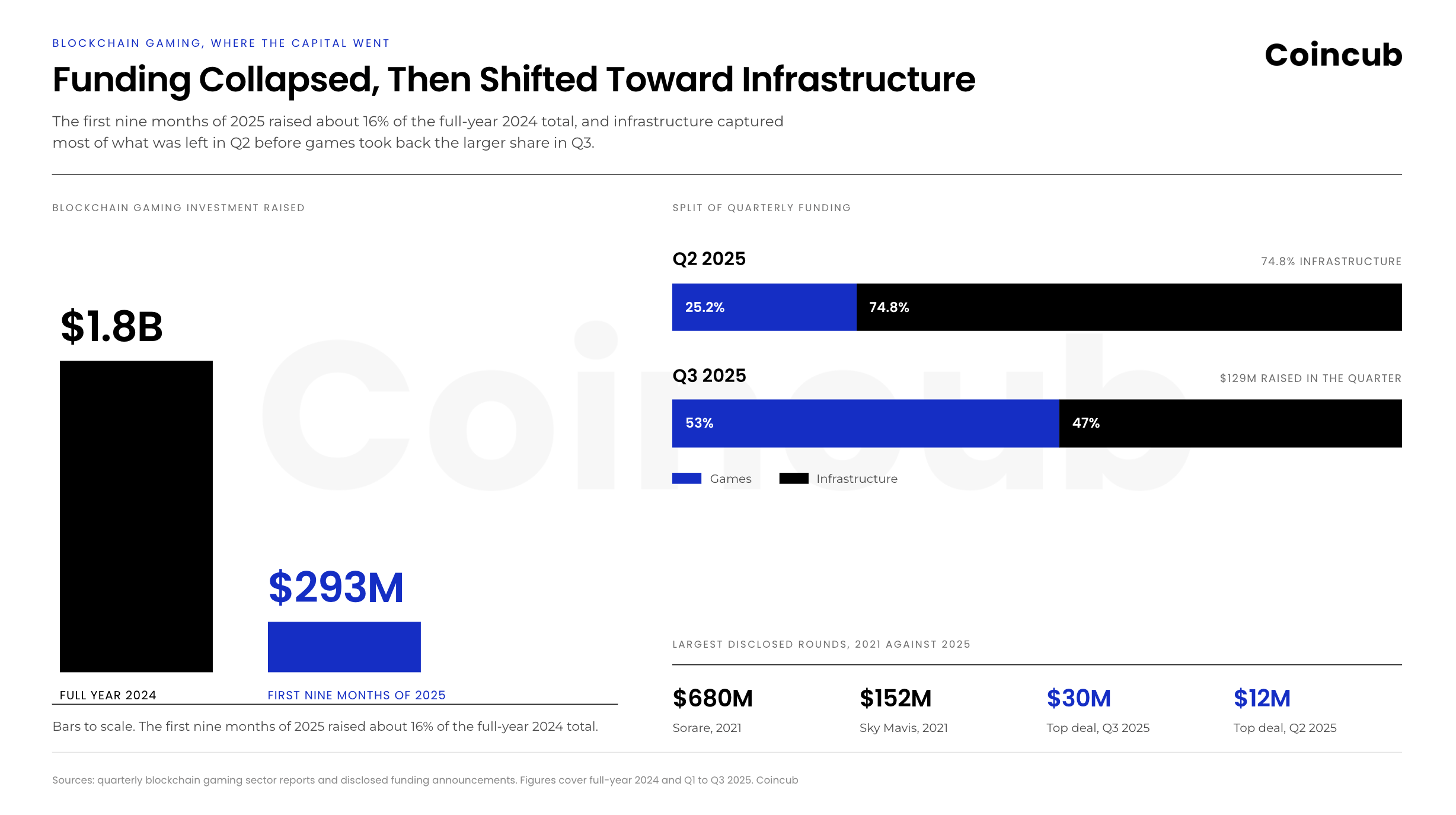
Blockchain gaming pulled in over $1.8 billion of investment across 2024, and then it pulled in $293 million across the first three quarters of 2025. Of the $129 million raised in Q3 2025, only 53% went to games at all, with the rest going to infrastructure. That single split says more about how gaming companies now use NFTs and cryptocurrency than any amount of positioning language about player-owned economies, because capital stopped funding the thing that was supposed to be revolutionary and started funding the plumbing underneath it.
The honest answer to how the industry uses this technology in 2026 is that a shrinking number of companies sell tokenized ownership as a product, a growing number sell the rails other studios rent, and almost everyone left standing has spent the past three years making the crypto part harder for players to see. That is a very different business from the one the sector pitched in 2021, and the people still describing it in 2021 language are usually the ones with a token to move.

The three revenue mechanics that survived, and the one that did not
Primary asset sales, secondary market commissions, and platform infrastructure fees are the mechanics that still generate cash. Studios mint characters, cards, land, or cosmetics and sell them; they take a cut when players trade those items on a first-party marketplace; and a smaller set of companies sells wallets, orderbooks, chains, and bridges to the studios doing the first two. Nothing about any of that requires a novel economic theory, which is precisely why it held up.
What collapsed was the emission-funded loop, where a game printed a reward token, distributed it for play, and depended on new entrants buying that token from earlier entrants. The design has an obvious failure point once inflow slows, and the sector spent 2022 through 2024 discovering exactly where it sits. What replaced it is more interesting than a quiet retreat into conventional free-to-play would have been. Sky Mavis rebuilt Axie’s economics around bonded AXS and an extraction dungeon where players who lose all their HP forfeit their equipped items and risk permanent Axie deletion, which is a sink dressed as a game mode. Pixels went the other direction and made withdrawals expensive, with heavier PIXEL withdrawal fees routed back to stakers so that cashing out subsidises holding.
An economy that only issues has to find someone to absorb the issuance, and once that someone stops arriving, the only remaining options are to destroy supply inside the game or to tax the exit. Play-to-earn drifted toward risk-to-earn because risk consumes supply where earning creates it, and the studios that worked this out while they still had treasury left are broadly the ones still shipping.
Governance tokens deserve less credit than they get. They serve as an alignment story during a raise and as a treasury instrument afterwards, and voting participation in most gaming DAOs is thin enough that calling it governance is generous. The useful function is closer to a loyalty programme with a liquid price attached, and there is nothing wrong with that as long as nobody markets it as ownership of the business.
The activity numbers measure something, and it is not players
Gaming held 25% of all Web3 wallet activity in Q3 2025, up from 20.1% the quarter before, on 4.66 million daily unique active wallets. Read alongside the 4.8 million recorded in Q2 and 5.8 million in Q1, the category was losing users while gaining share, which mostly means the rest of Web3 was falling faster.
But the wallet count is a poor proxy for players, and the transaction data inside the same report makes that clear. Alien Worlds averaged 598.7 transactions per wallet over 30 days. Kawaii Puzzle averaged 3.4. Those two numbers describe entirely different products sitting in the same league table, one where the blockchain carries real game state and one where a wallet touches a contract to claim a daily login and never returns. World of Dypians logged 135 million wallet engagements in a quarter, a figure that should make anyone reading it ask what a “wallet” is being counted for.
The undercount runs the other way too. Hybrid games keep progression, matchmaking, and anti-cheat on centralised servers and only settle mints, trades, and withdrawals on-chain, so a title with a large off-chain population shows up small in wallet terms. Anyone using these dashboards to size the market is measuring a mixture of genuine engagement, airdrop farming, and settlement events, and the industry has been remarkably relaxed about not separating them.
MapleStory N shows how wide the gap gets at launch. Nexon’s NEXPACE ran a week-long free mint that produced 1.7 million Scroll NFTs, the largest mint in Avalanche’s history, with NXPC opening at a $441 million market cap and rising 76% on day one. The game itself has averaged somewhere above 30,000 daily users since. Nothing about that is fraudulent, and the mint was free, so a rational player minted whether or not they intended to log in. The lesson for anyone reading launch metrics is that a free mint measures curiosity, a token price measures liquidity conditions, and neither measures whether the game holds anyone.
Pixels has been more candid than most about this. After claiming a million daily active users in 2024, the team shifted focus toward players with higher lifetime value rather than raw daily counts, which is a polite way of saying a large share of the headline number was never going to spend anything. That is a normal free-to-play realisation arriving late, dressed in Web3 vocabulary.
What the market will pay for, and what it stopped paying for
The 2021 rounds set an anchor the sector has spent five years failing to reach again. Sky Mavis raised $152 million led by a16z at a reported $3 billion valuation in October 2021, a month after Sorare closed $680 million led by SoftBank at $4.3 billion, then Europe’s largest Series B. Against that, the biggest blockchain gaming rounds of Q3 2025 were $30 million, $19.5 million, and $15 million, and the largest of the three went to an AI-and-blockchain gaming platform rather than a game. In Q2, when 74.8% of all sector funding went to infrastructure, the top three deals were $12 million, $7.5 million, and $7 million.
The attrition underneath those figures is easy to miss. DappRadar counted roughly 300 gaming dapps that were active in Q1 2025 and recorded no transactions and no wallets at all in Q2, around 8% of every gaming dapp it lists, and the quarter’s casualty list included Ember Sword after more than $200 million in pledged land sales, Nyan Heroes with its token down over 99%, Gala’s Walking Dead title, and Square Enix winding up Symbiogenesis. Those are not obscure projects run by anonymous teams. Several of them raised at the top of the market from people who are paid to evaluate exactly this.
Trading volumes tell the same story with less noise. The top 15 gaming NFT collections generated $135 million in Q3 2025, under 10% of the $1.6 billion in NFT volume across all of Web3 that quarter, which leaves the entire category of tokenized game items as a minority share of the collectibles market it was supposed to lead. Metaverse NFTs did $17 million, down 55% quarter on quarter, and individual gaming collections now out-trade every metaverse project combined.
Investors concluded that the value accrues to whoever operates the venue and the identity layer rather than to whoever ships the game, which is the same conclusion the app stores reached about mobile fifteen years ago, arrived at from the opposite direction. Tokenized items still sell. The margin on selling them just sits somewhere the game studio does not.
Chain selection is a fee-retention decision
The technical stack converged years ago on Ethereum-compatible asset models, with ERC-721 and the ERC-1155 multi-token standard still underpinning most game inventories even when the gameplay barely touches a chain. What changed is where those assets settle, and the reasoning there is commercial rather than architectural.
Immutable runs roughly two-second blocks and finality with gas sponsorship available for Passport users, which removes both the wait and the fee prompt from a player’s field of view. Ronin rebuilt itself as a permissionless Ethereum L2 with sub-penny fees and grew gaming wallets 55% in Q3 2025 on the back of Lumiterra, Pixels, and Axie. Nexon’s NEXPACE launched MapleStory N on its own Avalanche L1, Henesys, which became one of the network’s most active chains within weeks. Gunzilla runs GUNZ for Off the Grid. The Sandbox announced SANDchain.
Every one of those is a decision about who collects the fee. A studio deploying on a general-purpose chain hands marketplace volume and settlement revenue to whoever owns the venue, while a studio on its own appchain keeps the spread and the data, at the cost of building distribution from scratch and carrying the security burden alone. Sky Mavis learned the second part expensively when the US Treasury tied the North Korean Lazarus Group to the roughly $625 million Ronin bridge exploit and added an associated wallet to the sanctions list, which turned a gaming company into a counterparty in a national security matter.
Sorare moved the other way and in October 2025 migrated its card assets from StarkEx to Solana, covering the migration fees so that no user signed a transaction or paid gas during the transition. The migration itself is unremarkable. The fact that a platform with millions of registered managers considers “the user must not notice this happened” a design requirement is the part worth sitting with, because it is the clearest statement anyone in this sector has made about what tokenization is now for.
Ownership is a claim against a company that may not be there
The strongest argument for tokenized game items was always that a player’s assets survive the publisher’s decisions. In practice the token survives and the utility does not, and the sector has a decade of evidence on this that it prefers to discuss in the abstract.
Animoca announced on 15 March 2022 that F1 Delta Time would cease operations the following day because it could not renew its Formula 1 licence, roughly three years after the game set the price record for a branded game NFT. Holders kept their cars and received replacement assets inside the REVV ecosystem, which is a decent commercial response and also a demonstration that what they owned was a claim on Animoca’s goodwill rather than on Formula 1. Licensed IP does not transfer to the chain, and no amount of on-chain provenance changes what happens when the licensor walks.
Ubisoft’s version was shorter. Quartz launched in beta on 7 December 2021 with Digits for Ghost Recon Breakpoint on Tezos, the last Digit shipped on 17 March 2022, and by 5 April Ubisoft had ended content updates for the game while congratulating owners on having made history. The programme ran about a hundred days. Publishers took the wrong lesson from the backlash, reading it as evidence that players hate NFTs, when the specific complaint was that the cosmetics were bolted onto a game in maintenance mode and solved a problem nobody in the player base had.
The Sandbox case is less dramatic and probably more instructive, because the platform did everything the playbook asked. It built creator tooling, signed brands, ran a marketplace, and sold land. In August 2025 Animoca took control and cut more than 50% of roughly 250 staff, with co-founders Arthur Madrid and Sebastien Borget moved out of executive roles and offices in five countries closing. LAND holders still hold LAND. What they hold it against changed considerably.
Regulation is now the binding constraint, and it bites differently in each market
The SEC issued an interpretive release on 17 March 2026, joined by the CFTC, setting out a five-part taxonomy of crypto assets covering digital commodities, digital collectibles, digital tools, stablecoins, and digital securities. Gaming assets finally have a category name in US federal guidance, which is a genuine improvement on the previous position of inferring everything from enforcement actions. It does not resolve the project-specific question of whether a studio’s token marketing creates an investment contract, and any publisher promising appreciation, fee sharing, or yield around a game asset is still making that argument on its own facts.
The enforcement climate softened first. The SEC issued Immutable a Wells notice in October 2024 over 2021 IMX sales and then closed the investigation in March 2025 with no action, part of a broader retreat that also ended probes into OpenSea, Uniswap Labs, and others. Reading that as permission would be a mistake, because the securities question was never the one most likely to catch a game.
Gambling law was always the likelier trap. The UK Gambling Commission opened its Sorare investigation in October 2021, charged the company in 2024 with three counts of providing unlicensed gambling facilities, and the trial has now been pushed to 7 June 2027 at Birmingham Magistrates’ Court after an earlier June 2026 date slipped. Sorare pleads not guilty and says the regulator has misread its business. Whatever the outcome, a company will have spent close to six years operating under an unresolved criminal charge in a major market, and that timeline is the exposure anyone building a game with prize competitions and a secondary market should be modelling.
France built the alternative and the results are quiet. Decree n° 2026-60 brought the JONUM experimental regime into force on 7 February 2026, creating a lighter category for games where a player makes a financial sacrifice and obtains monetisable digital objects through a mechanism involving chance. The conditions are specific. Winners must receive at least one monetisable object, in-kind rewards are capped at €1,000 per player per game per year, crypto rewards cannot exceed 20% of that game’s annual revenue or €25,000 per player, and no player may ever win in euros. Operators must be headquartered in the EU or EEA, verify player identity under French AML rules, restrict access to adults, and force every player to set weekly spending and playtime limits at account creation. Five and a half months after the regime opened, the ANJ lists exactly two declared companies, Cylimit and Sorare.
That is the take-up for a framework built specifically to accommodate this business model, in the market that produced the sector’s flagship consumer product, and it suggests the compliance burden lands a good deal closer to a licensed gambling operator’s than the “lighter regime” framing implies. Studios read the decree, priced the obligations, and mostly decided France was not worth it.
The practical consequence for a studio is that compliance stops being a legal review at the end and becomes an architecture decision at the start. Age gates, identity verification, per-player spend and time caps, self-exclusion that genuinely blocks account access, transaction data retained in a form a regulator can query on 30 days’ notice, and marketplace surveillance are all things that are cheap to design in and painful to retrofit into a live economy. MiCA has been running in the EU long enough that the disclosure and authorisation questions around any ecosystem token are answerable in advance, and a studio that answers them after launch is choosing to rebuild its own economy under supervision.
Geography compounds the problem. MapleStory N remains unavailable in the United States, the European Union, South Korea, and Japan, which means a Korean publisher’s blockchain title cannot be sold in Korea, and NXPC trades around 93% below its post-launch peak. Tax adds another layer that studios rarely model on their players’ behalf, since the IRS treats digital assets including NFTs as property rather than currency, staking rewards are ordinary income, and Notice 2023-27 opened the door to certain NFTs being treated as collectibles for capital gains purposes. A game that hands a player a tradable item has handed them a reporting obligation.
What the working model looks like
The pattern that survives is a game people would play without the token, wrapped in infrastructure that keeps the token from getting in their way. Sorare and Gods Unchained sit at the top of the gaming NFT tables, with Gods Unchained lifting its Immutable zkEVM volume 507% to $27.2 million after completing its migration and Sorare adding 347% as the European football season restarted. One of those has a clean explanation and one does not, since DappRadar’s own analysts flag that Immutable airdrops periodic rewards to IMX stakers based on trading activity, which could inflate the Gods Unchained and Guild of Guardians figures. Sorare’s number tracks a real-world calendar that would have produced the same behaviour with or without a chain underneath it, and that is the version worth copying.
Friction removal is now table stakes rather than differentiation. Immutable’s own pitch puts the number on it, stating that onboarding drop-off exceeds 70% with traditional wallets because of seed phrases, gas fees, and wallet management, and Passport now claims over 6 million verified users across more than a thousand connected apps. The partner logos on that page include Ubisoft, which is a neat summary of where the industry landed. The publisher that took the worst reputational damage of the 2021 cycle for putting NFTs in front of players came back with Might & Magic: Fates, a free-to-play card battler on Immutable’s zkEVM, built with a partner whose entire product thesis is keeping the blockchain out of sight. Netmarble’s MarbleX committed to seven blockchain titles on the same stack alongside a $20 million ecosystem fund, and Sega, FIFA, and Nexon all shipped or announced Web3 products in the same window. The Web2 publishers did not leave. They stopped letting players see the part that got them shouted at.
Embedded wallets, social login, sponsored gas, fiat on-ramps, and in-client marketplaces are what every serious stack ships, and a studio without them is competing for crypto-native users only, which is a market of a few hundred thousand people who mostly already have somewhere to be. The harder discipline is disclosure, because the same design choices that hide the blockchain also hide what a player is agreeing to. If an item depends on a live service, a third-party licence, or a publisher’s continued willingness to honour it, that belongs in plain language at the point of sale, and F1 Delta Time is the reason.
Interoperability remains the claim to treat with the most suspicion, because the version that works and the version that gets sold are different things. Economic portability is real, in that a card or a skin can be listed on a third-party marketplace, held in a wallet the publisher does not control, and priced by people who never open the game. Gameplay portability is close to nonexistent, since a cosmetic carries no meaning in an engine that was not built to render it and no balance in a ruleset that was not designed around it. Every serious attempt at the second version has ended up as either a licensing negotiation between two studios or a cosmetic reskin, both of which are things publishers could already do without a chain.
Where this goes over the next two years is probably narrower than either the bulls or the obituary writers expect. Large IP holders will keep running tokenized item economies in permissive jurisdictions because the marketplace take rate is real money and the alternative is watching third-party trading happen without them. Infrastructure companies will keep taking the larger share of the funding, because selling wallets and chains to studios is a better business than betting on any individual game. And the phrase “player-owned economy” will keep appearing in decks written by people who have read the JONUM decree and know exactly how much ownership a regulator is prepared to let a player have.
Frequently Asked Questions (FAQ)
Do gaming companies still make money from NFTs in 2026? +
Yes, through three mechanics: primary asset sales, commissions on first-party marketplace trades, and platform fees charged to other studios for wallets, orderbooks, and chains. The third is now taking the larger share of investor capital.
Why did play-to-earn stop working? +
It depended on new entrants buying reward tokens from earlier entrants, which fails once inflow slows. Studios replaced it with mechanics that consume supply, either by destroying assets in-game or by charging heavily on withdrawal.
Are blockchain game user numbers reliable? +
Not as player counts. They mix genuine engagement, airdrop farming, and one-off settlement events, and hybrid games with large off-chain populations are undercounted because only mints and trades touch the chain.
Does owning a game NFT mean the publisher can't take it away? +
The token persists, the utility usually does not. F1 Delta Time shut down in March 2022 when Animoca could not renew its Formula 1 licence, and holders received replacement assets in a different ecosystem rather than continued F1 access.
How does the SEC's 2026 interpretation affect game assets? +
It creates a "digital collectibles" category within a five-part taxonomy issued on 17 March 2026 with the CFTC. It does not settle whether a specific studio's token marketing creates an investment contract, which remains fact-specific.
Why do studios build their own chains? +
Chain choice determines who collects marketplace and settlement fees. An appchain retains the spread and the data, at the cost of building distribution alone and carrying the security burden, as the $625 million Ronin bridge exploit demonstrated.