Buy a Licensed Company
  Explore VASP Data
  Talk to an Expert

 Atis Shala
Atis is a senior analyst and community lead with four years of experience in crypto. He has a bachelor from the Rochester Institute of Technology.
Atis Shala
Atis is a senior analyst and community lead with four years of experience in crypto. He has a bachelor from the Rochester Institute of Technology.
The Rise and Risks of AI-Generated Memecoins

- AI agents can now handle everything from naming and contract deployment to lore creation and social media promotion in minutes, creating an infinite supply of speculative assets.
- According to research, roughly 98.6% of tokens launched on the dominant memecoin platform turn into scams, with the vast majority losing their liquidity within the first hour of life.
- AI personas can automate an endless stream of social media activity, effectively engineering a “lottery mindset” and the illusion of a vibrant community long after human teams would have burned out.
- Automated sniping bots and privileged insiders routinely secure large allocations within the very first block of a contract going live, meaning retail buyers often arrive only to serve as exit liquidity.
- Cautious participants must treat every launch as guilty until proven innocent, using onchain tools to verify locked liquidity, diversified holder distribution, and renounced contract authorities.
- Amid the noise, a minority of projects represent genuine attempts to fund autonomous AI agents performing real economic work, though telling them apart from imitators requires intense scrutiny.
- Survival in this market depends entirely on treating all capital as 100% disposable, respecting the clock, monitoring public unlock schedules, and executing mechanical profit-taking rules without hesitation.
Is Memecoin Season Back?
Memecoins were already the wildest corner of crypto. Then artificial intelligence handed the keys to anyone with a laptop and a prompt. In 2024 a developer needed at least a rough idea, a logo, and a few hours to spin up a token. By 2026 an AI agent can dream up a name, write the lore, generate the art, deploy the contract, seed a liquidity pool, and post the launch thread before a human finishes their coffee. The barrier to creating a speculative asset has effectively dropped to zero, and the market is reacting exactly the way you would expect when supply becomes infinite.
This guide walks through what AI-generated memecoins actually are, why they exploded, where the real money and the real danger sit, and how a cautious participant can engage without becoming exit liquidity. The tone here is honest rather than promotional. Memecoins can produce spectacular returns, and they wipe out far more wallets than they enrich.
The 2024-2025 Memecoin Mania
To understand how we arrived at automated infinity, we have to look at the massive psychological foundation laid during the peak of the 2024-2025 memecoin cycle. That era proved that speculative assets didn’t need utility to achieve institutional-grade valuations, they only needed a hyper-engaged community. Human-led cultural phenomena like dogwifhat (WIF) pioneered the trend, rocketing to a multibillion-dollar market cap on little more than a viral photo of a dog in a beanie and sheer crowd coordination.

As the cycle matured into late 2024 and early 2025, the narrative shifted from pure internet culture to tech-hybrid experiments. Breakthroughs like Fartcoin, initially spawned from terminal-based AI lore and human amplification, similarly crossed the billion-dollar threshold. These assets achieved massive liquidity and mainstream exchange listings, proving that the market was willing to price abstract attention at an astronomical premium. However, that cycle relied on human stamina to build communities, design graphics, and seed early pools. The historic capital flows of 2024 and 2025 essentially taught the market how to trade raw narrative, creating the exact liquidity playground that AI tools have now fully automated.
What Counts as an AI-Generated Memecoin
The phrase covers a spectrum, and the distinctions matter because they carry very different risk profiles.
Tokens Created by AI Tools
At the simplest end are coins where a human still pulls the trigger but leans on AI to do the creative and technical work. Launchpads now bundle prompt-to-token pipelines. You type a theme, the system returns ticker options, a generated mascot, a one-paragraph backstory, and a ready-to-deploy contract. The human picks one and clicks deploy. The token itself is ordinary. What changed is the speed and the volume of creation.
Tokens with an AI Persona
A step further are coins built around an autonomous or semi-autonomous AI character. The agent posts to social media, replies to holders, generates memes, and builds a narrative in real time. Projects experimenting with AI-generated storylines, such as the much-discussed GOAT phenomenon, fall in this bucket. The token becomes a bet on whether the personality keeps people entertained.
Tokens Tied to AI Infrastructure
At the more ambitious end sit tokens that claim to fund or govern actual AI agents, data networks, or compute. Some of these are serious attempts at building agent economies. Many simply borrow the aesthetic of seriousness to attract capital. Telling the two apart is most of the work for any buyer.
The reason these categories blur together in headlines is that the leading AI meme coin by market cap, Fartcoin, sits somewhere between joke and movement, which is precisely the ambiguity that drives attention.
Why AI Supercharged the Memecoin Machine
Three forces collided, and each amplified the others.
Creation Became Free and Instant
When the marginal cost of launching a token approaches zero, the number of launches approaches infinity. Solana-native launchpads built the rails for one-click deployment, and AI removed the last bits of friction around naming, art, and copy. In the first quarter of 2026, decentralized exchange volume on the dominant launchpad exceeded two billion dollars, a signal that the conveyor belt is running at full speed.
Narratives Became Automated
Memecoins live and die on story. An AI persona can generate an endless stream of posts, replies, and images, which keeps a token’s feed alive long after a human team would have burned out. That constant activity creates the illusion of a community even when very few real holders exist.
Attention Became the Only Scarce Resource
With creation free and stories automated, the single thing that cannot be manufactured at zero cost is genuine human attention. This is the core insight of the entire category. Everything else is abundant, so the whole game collapses into a fight for eyeballs. That has uncomfortable implications, which the next section makes concrete.
The Numbers Behind the Hype
It helps to anchor the excitement in data. Independent research paints a sobering picture of what happens to the typical launch.
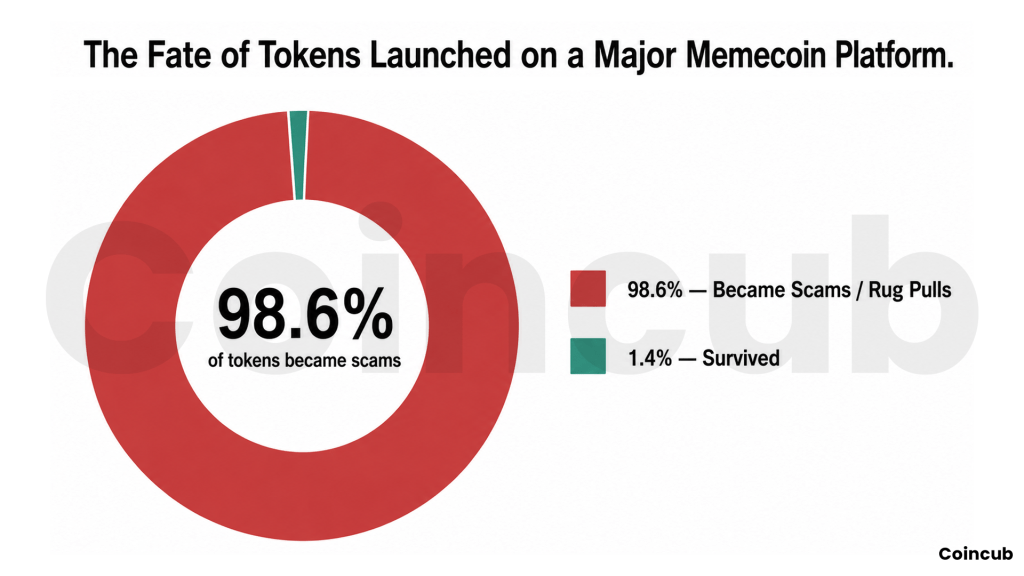
According to research from Solidus Labs, roughly 98.6% of tokens launched on the dominant Solana launchpad eventually turn into scams, either through liquidity drains or rapid creator sell-offs. That figure is not a typo. For every token that survives as something tradable, dozens are designed or doomed to collapse.
The timing of those collapses is just as revealing as the rate. Most AI-generated launches lose the bulk of their liquidity within the first hour of life.
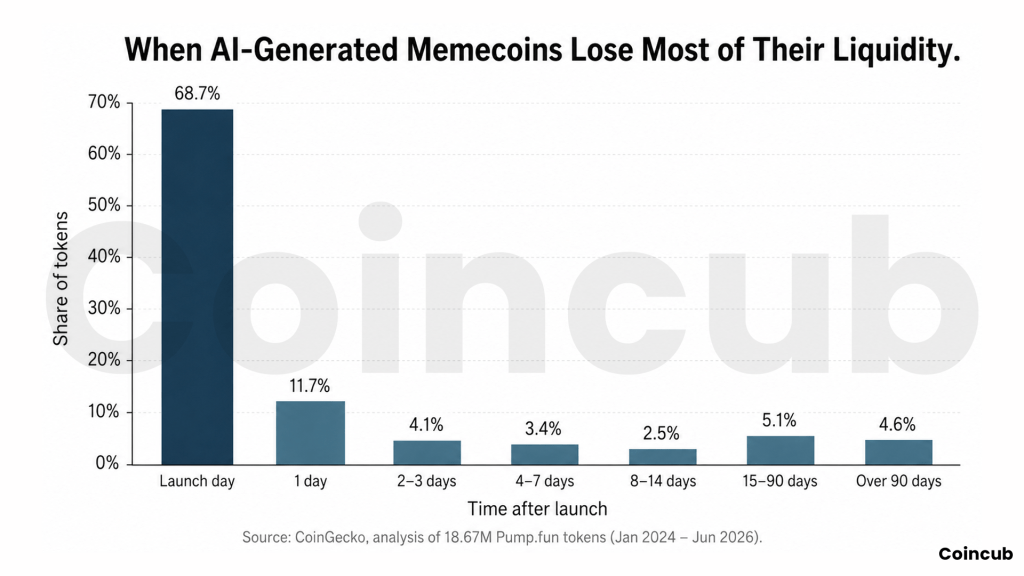
The pattern above is illustrative of a well-documented dynamic. The earliest minutes concentrate both the largest gains and the largest losses. A buyer who arrives ninety seconds late often arrives after the only people who were ever going to profit have already sold.
What These Figures Mean for a Buyer
The honest reading is that buying a random AI-generated memecoin is closer to a lottery ticket than an investment, with worse odds than most lotteries because the house can change the rules mid-draw. That does not make the category worthless. It means the edge, if one exists, comes from filtering, timing, and discipline rather than from the coins themselves.
How the Risks Actually Work
Generic warnings about scams help nobody. The specific mechanics are what let you spot trouble early.
Rug Pulls and Liquidity Drains
The classic rug pull happens when whoever controls the liquidity pool removes it. Buyers are left holding tokens with nothing to sell them against, so the price goes to zero in a single block. AI lowers the effort needed to set up convincing-looking projects, so the volume of rug-ready launches climbs even if the percentage holds steady.
Bonding Curve Games
Many launchpads use bonding curves, where the price rises automatically as more tokens are bought. A live lawsuit seeking around 500 million dollars accuses one major platform’s founders of running an insider-friendly system in which privileged participants gained early access at minimal prices and inflated values through these curves. Whether or not the case succeeds, the structure rewards whoever moves first, and the first mover is rarely a retail buyer.
Insider Access and Sniping
Automated bots, sometimes themselves AI-driven, monitor the chain for new deployments and buy within the same block the contract goes live. By the time a launch appears in your feed, these snipers already hold a large share at the lowest price. The chart of a “fair launch” frequently hides the fact that a handful of wallets owned most of the float from second one.
Supply Unlocks
Even established platform tokens carry timing risk. A major supply event scheduled for mid-July 2026 will unlock 41% of one launchpad token’s total supply, handing founders and early investors the ability to sell into the market. Unlock calendars are public, and ignoring them is a common and avoidable mistake.
No Recourse
In regulated markets there are disclosures, audited filings, and sometimes restitution funds. In this corner of crypto there is none of that. Users who fall victim to a rug pull or manipulation have virtually no path to recover funds. The absence of a safety net should shape position sizing more than any price chart does.
A Side-by-Side Risk View
The table below summarizes how the main risk types differ in how they appear and how a buyer might respond.
| Risk type | How it shows up | Early warning sign | Realistic defense |
|---|---|---|---|
| Liquidity drain | Price collapses to zero in one block | Liquidity not locked or burned | Check lock status before buying |
| Bonding curve insider edge | Chart gaps up before public access | Tiny number of early holders | Inspect holder distribution |
| Sniping bots | “Fair launch” already concentrated | Top wallets hold large float | Avoid chasing the first candle |
| Supply unlock | Steady sell pressure on a date | Public unlock calendar | Trim ahead of known unlocks |
| Fake AI persona | Endless posts, no real holders | Engagement without unique users | Measure real community, not volume |
The point of laying it out this way is that each risk has a tell. None of the defenses are foolproof, and all of them reward patience over fear of missing out.
The Tooling Arms Race
The category is professionalizing on both sides at once. Scammers get better automated tools, and so do the people trying to avoid them.
Tools for the Bad Actors
AI now writes the contract, generates the marketing, runs the persona, and in some cases coordinates the timing of buys and sells across wallets to simulate organic demand. A single operator can run what looks like a dozen independent projects without ever revealing a face or a name.
Tools for the Defenders
On the other side, onchain analytics platforms use AI volume analysis to flag suspicious patterns before a collapse, watching for wash trading, clustered wallets, and liquidity that is present but not locked. Holder-distribution scanners, contract auditors, and launch-quality scorers have all improved. The expectation bar for legitimate teams has risen accordingly, because the tools to vet them are now in everyone’s hands.
What the Arms Race Means
The takeaway is that raw enthusiasm is the worst possible filter. The buyers who survive are the ones who treat every launch as guilty until the data proves otherwise, and who use the same automation the scammers use, only pointed at defense.
The Psychology That Powers the Machine
Technology explains how these tokens get made. Psychology explains why people keep buying them despite the dismal base rates.
Fear of Missing Out
Every viral launch produces a handful of screenshots showing someone who turned a small stake into a life-changing sum. Those screenshots circulate far more widely than the thousands of silent losses around them. The brain weights the vivid story over the boring statistic, and the result is a powerful pull to buy before it is “too late.” AI personas exploit this directly by manufacturing urgency with countdowns, milestones, and hype on a schedule no human team could sustain.
The Lottery Mindset
A small ticket with a tiny chance of an enormous payout is psychologically appealing in a way that a steady, modest return is not. Memecoins package that exact feeling. The trouble is that lottery framing encourages people to buy many tickets, and buying many tickets in a market where the overwhelming majority of issuers turn predatory guarantees losses for almost everyone over time.
Social Proof on Demand
Humans look to crowds for safety signals. When a token’s feed is full of activity, replies, and rising numbers, it feels validated. AI makes that crowd cheap to fake. Recognizing that engagement can be synthetic is the single most protective mental adjustment a participant can make.
Sunk Cost and Bag Holding
Once someone holds a falling token, the urge to wait for a recovery overrides the evidence on screen. Most rugged tokens never recover, because there is nothing underneath them to recover toward. Setting exit rules before buying, and honoring them, is the antidote to a mind that wants to renegotiate after the fact.
A Closer Look at a Typical Launch Lifecycle
Walking through the stages of a representative launch makes the abstract risks concrete.
Stage One: Deployment and Sniping
The contract goes live. Within the same block, automated bots buy large allocations at the floor price. Nothing about this is visible to a casual observer scrolling a feed. By the time a human sees the token trending, the cheapest supply is already spoken for.
Stage Two: The Hype Window
The AI persona and any human promoters flood social channels. Price climbs as fresh buyers arrive, each one paying more than the last along the bonding curve. This is the window where the screenshots of gains are generated, and it is also the window where insiders quietly begin distributing into the new demand.
Stage Three: Distribution
Early holders sell in measured chunks to avoid spooking the chart. Volume stays high, which keeps the token visible and attracts the last wave of buyers who mistake activity for health. Liquidity thins as the people who provided it withdraw their share.
Stage Four: Collapse
The remaining liquidity is removed or simply runs dry. Price falls faster than anyone can react, and the order book offers nothing to sell into. The feed goes silent, the persona moves on to the next launch, and the holders left behind discover there is no recourse.
Understanding this arc does not let you time it reliably. It does explain why getting in early is so often a trap rather than an edge, because the truly early participants are bots and insiders, not the people reading about the token an hour later.
Could Anything Here Be Legitimate
It would be dishonest to write off the entire space. A minority of projects are genuine attempts to build something durable.
Signs of Relative Legitimacy
Locked or burned liquidity, a broad and growing base of real holders rather than a few whales, a team that does not hide behind the AI persona to dodge accountability, transparent token allocation, and a roadmap that survives contact with a skeptical reading. None of these guarantee success, and all of them are necessary before the word investment applies.
The Agent Economy Angle
The more interesting long-term thread is tokens that genuinely tie to autonomous agents performing useful work, paying for compute, or coordinating data. If AI agents become real economic actors, some onchain token may end up being how they transact. That is a credible thesis. The problem is that the thesis attracts a hundred imitators for every real builder, so the burden of proof stays high.
A Practical Framework for Cautious Participation
For readers who still want exposure with their eyes open, a simple discipline reduces the worst outcomes.
Size Positions as Disposable
Treat any single memecoin allocation as money you are fully prepared to lose, because the base rate says you probably will. Never let a position grow to a size that would hurt your finances or your sleep.
Verify Before You Buy
Check liquidity lock status, read the holder distribution, scan the contract for mint and freeze authorities, and look at whether engagement comes from many wallets or a recycled few. If any of these cannot be verified, that absence is the answer.
Respect the Clock
Most value is created and destroyed in the first hour. Chasing a candle that already ran is how late buyers become exit liquidity. Known unlock dates deserve the same respect in the other direction.
Take Profits Mechanically
Decide in advance what return would make you sell a portion, and follow the rule when the moment comes rather than negotiating with yourself in real time. Greed is the mechanism that converts a paper gain into a zero.
| Check | Question to answer | Pass condition |
|---|---|---|
| Liquidity | Is the pool locked or burned? | Yes, verifiably |
| Holders | How concentrated is supply? | No single wallet dominates |
| Contract | Any mint or freeze authority left? | Renounced or clearly justified |
| Community | Is engagement from real, unique wallets? | Broad participation |
| Timing | Has the first hour already passed? | Adjust expectations down |
| Exit plan | Do I know my sell rule? | Written before buying |
A launch that fails any single row is not automatically a scam, yet it deserves a much smaller position or none at all.
Tax and Record-Keeping Realities
The excitement of trading tends to crowd out a dull but important fact. Every trade can be a taxable event.
Each Swap May Be Taxable
In many jurisdictions, swapping one token for another, including swapping a stablecoin for a memecoin and back, can trigger a capital gains calculation. A trader who makes dozens of small memecoin trades can generate a tangled tax position even if the net result is a loss, because gains and losses are assessed per disposal rather than on the final balance.
Worthless Tokens Still Need Records
When a token goes to zero, claiming the loss usually requires documentation of what was paid and when. Wallets full of dead memecoins are common, and reconstructing their cost basis after the fact is painful. Keeping a simple log of entries and exits at the time of trading saves enormous effort later.
Why This Matters for Risk
Taxes turn a break-even year of frantic trading into a net loss once the paperwork and any liabilities are counted. Factoring this in tends to make people trade less and size more carefully, which happens to be the same behavior that improves survival odds in the first place.
How to Research a Token in Ten Minutes
Most of the protective work can be done quickly if you know where to look. A short, repeatable routine beats hours of scattered scrolling.
Start With the Contract
Paste the token address into a block explorer and check whether the smart contract has mint authority and freeze authority. A token whose creator can still mint new supply or freeze your ability to sell is a token that can trap you at will. This single check filters out a large share of obvious traps.
Read the Holder List
The same explorers show how supply is distributed. If a handful of wallets hold the overwhelming majority, those wallets can crash the price the moment they sell. A healthy distribution is broad, with no single non-liquidity wallet dominating the float.
Inspect the Liquidity
Find the liquidity pool and check whether the liquidity is locked or burned, and for how long. Unlocked liquidity is the single clearest precondition for a rug pull, because it can be pulled in one transaction. If you cannot confirm the lock, treat the token as un-investable.
Judge the Community
Look past the follower count and the post frequency. Are real, distinct people replying with specific questions and observations, or is the feed a wall of identical hype from accounts with no history? Synthetic engagement is cheap, and learning to see through it is the most durable skill in this category.
Running these four checks every time, before any emotional decision to buy, is what separates disciplined participants from the crowd that learns the same lessons the expensive way.
Where the Category Goes From Here
The trajectory points toward more launches, faster cycles, and better tools on every side. Regulators are paying closer attention, and the large lawsuits circling major platforms suggest the legal questions around bonding curves, insider access, and disclosure are far from settled. AI personas will grow more convincing, which raises the value of measuring real holders over surface activity. The likeliest future is one where the noise gets louder and the genuine signal gets rarer, which makes filtering skill the durable edge rather than any particular coin.
For most people, the healthiest relationship with AI-generated memecoins is curiosity paired with strict limits. Watch the space to understand where attention and technology are heading, participate only with money you can lose, and let the data rather than the hype decide every entry.
Frequently Asked Questions (FAQ)
What is an AI-generated memecoin? +
It is a meme-style cryptocurrency where artificial intelligence handled some or all of the creation, from the name, art, and lore to the contract deployment and the social-media persona that promotes it. The term covers everything from tokens a human launched using AI tools to coins built around an autonomous AI character that runs its own marketing.
Are AI-generated memecoins a good investment? +
For the vast majority, no. Research suggests that around 98.6% of tokens on the leading launchpad end as scams, and most AI-generated launches lose their liquidity within the first hour. Any participation should be treated as high-risk speculation with money you are fully prepared to lose, rather than as a core part of a portfolio.
How do AI memecoin rug pulls happen? +
The most common version is a liquidity drain, where whoever controls the liquidity pool removes it, leaving buyers with tokens they cannot sell. Others rely on bonding-curve mechanics and sniping bots that let insiders accumulate at the lowest prices and dump on later buyers. AI mainly increases the speed and volume of these schemes rather than inventing new ones.
How can I spot a likely scam before buying? +
Check whether liquidity is locked or burned, review how concentrated the holder base is, scan the contract for leftover mint or freeze authorities, and judge whether social engagement comes from many real wallets or a recycled few. If you cannot verify these basics, treat that uncertainty as a reason to walk away.
Why did AI cause so many more memecoins to launch? +
AI pushed the cost and effort of creating a token close to zero. It writes the name and lore, generates the art, deploys the contract, and runs an endless social feed. When creation becomes that cheap, supply explodes, and the only scarce resource left is genuine human attention.
Is there any legitimate use for AI in crypto tokens? +
Yes, in principle. The most credible thread is tokens tied to autonomous agents that perform real work, pay for compute, or coordinate data, which could matter if AI agents become genuine economic actors. The challenge is that this serious thesis attracts many imitators, so verification standards have to stay high.
What is the safest way to engage with this category? +
Size every position as disposable, verify liquidity, holders, and contract permissions before buying, respect that most value moves in the first hour, watch public unlock dates, and decide your profit-taking rule in advance. Discipline and filtering, rather than enthusiasm, are what separate the survivors from the exit liquidity.