



 Buy a Licensed Company
  Explore VASP Data
  Talk to an Expert

 Atis Shala
Atis is a senior analyst and community lead with four years of experience in crypto. He has a bachelor from the Rochester Institute of Technology.
Atis Shala
Atis is a senior analyst and community lead with four years of experience in crypto. He has a bachelor from the Rochester Institute of Technology.
The Ultimate Guide to Crypto Staking: How to Vet Platforms
- Crypto staking can help long-term holders earn rewards, but the platform you choose can change the level of risk, control, and flexibility.
- The highest advertised APY is not always the best option. Users should compare custody, fees, lockups, liquidity, and withdrawal terms before staking.
- Custodial staking is usually easier for beginners, while non-custodial staking gives users more control over their private keys.
- Staking rewards are paid in crypto, so real returns depend on both the reward rate and the token’s market price.
- A trustworthy staking platform should clearly explain how rewards work, what fees apply, how withdrawals are handled, and what risks users accept.
The Promise and Trap of Crypto Staking
Satoshi had held crypto for more than a year before she noticed the staking offer.
The number caught his attention first: up to 12% annual rewards. It looked simple. She could keep holding the asset she already owned and earn more of it over time. No trading. No charts. No daily market stress.
At first, crypto staking felt like a smarter way to hold. But then she clicked through the details and found words she had only half-understood before: lockup period, validator commission, slashing, unbonding, custodial staking, liquid staking token, variable rewards.

That is where many crypto investors pause. Staking can be useful, but the platform you choose matters. A high reward rate can hide weak security, unclear fees, poor withdrawal terms, or risks linked to the validator behind the scenes.
Quick Answer: How to Vet a Crypto Staking Platform
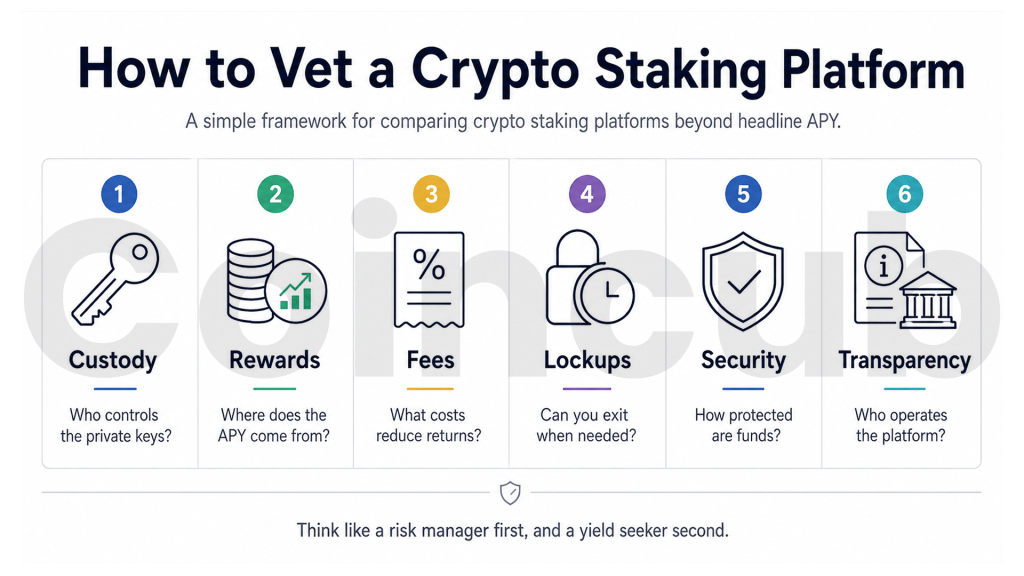
To vet a crypto staking platform, start with the basics: custody, security, rewards, fees, lockups, liquidity, and transparency.
Before staking, ask these questions:
- Who controls the private keys?
- Is the platform custodial or non-custodial?
- Has the platform had past security issues?
- Are staking rewards clearly explained?
- Are fees easy to find and understand?
- Is there a lockup or unbonding period?
- Can you withdraw your assets when you want?
- What happens if a validator goes offline or gets penalized?
- Is the advertised APY realistic?
- Does the company disclose its legal entity and terms?
- Are there clear risk warnings?
- Does customer support respond when problems happen?
A good staking platform should make these answers easy to find. It should explain how rewards are earned, how often they are paid, what fees apply, and what risks users accept.
The highest advertised staking APY is rarely enough to make a smart decision. A platform offering 4% with clear terms, strong security, and reliable withdrawals may be safer than one offering 18% with vague language and little public information.
When you compare staking platforms, think like a risk manager first and a yield seeker second.
What Crypto Staking Actually Means
Crypto staking is a way to take part in certain blockchain networks, especially those that use proof of stake.
In a proof-of-stake system, validators help confirm transactions and secure the network. Instead of using large amounts of computing power, validators commit crypto assets to the network. This commitment gives them a role in keeping the blockchain running.
Regular users can often take part by staking their tokens directly or by delegating them to a validator. In return, they may earn staking rewards.
That sounds simple, but staking is often misunderstood. Staking rewards are paid in crypto, and reward rates can change. The value of the token can also rise or fall while your assets are staked. If a token drops sharply in price, staking rewards may not make up for the loss in portfolio value.
Staking also differs from other crypto earning methods. It is different from lending, where your assets may be loaned to borrowers. It is different from yield farming, which often involves decentralized finance protocols and added smart contract risk. It is also different from trading, where gains depend on buying and selling at the right time.
A simple way to think about staking is this: you are helping support a blockchain network, and the network may reward you for that role. The platform you use decides how easy, safe, flexible, and transparent that process feels.
Why Platform Choice Matters More Than APY
Many beginners compare crypto staking platforms by one number: APY.
That is understandable. A larger reward rate looks better at first glance. If one platform shows 5% and another shows 14%, the second one feels more attractive.
But APY alone does not tell the full story.
A high staking APY may come from token inflation, short-term incentives, higher validator risk, or a promotional rate that can change later. In some cases, the platform may show gross rewards before fees. In others, it may use reward estimates based on past conditions rather than future guarantees.
There is also the issue of access. Some platforms require users to lock assets for a set period. Others have unbonding periods, which means you may need to wait days or weeks before you can move or sell your crypto. During that time, the market can change.
Fees can also reduce your real return. A platform may charge a staking commission, a withdrawal fee, or a spread that is not obvious at first. Even small costs matter when you compare long-term returns.
Then there is custody. If a platform controls your assets, you depend on its security, solvency, policies, and withdrawal process. That can be convenient, but it adds platform risk.
This is why crypto staking should begin with a wider question: What am I risking to earn this reward?
The best staking platform for one user may not be best for another. A beginner may value ease of use and support. A more experienced user may prefer non-custodial staking and direct validator selection. Someone who may need fast access to funds may avoid long lockups.
The APY matters, but it should come after the safety check.
Custodial vs. Non-Custodial Staking Platforms
One of the most important choices in crypto staking is whether to use a custodial or non-custodial platform.
This choice affects control, convenience, and risk.
Custodial Staking
With custodial staking, a platform holds or manages your crypto for you. Many centralized exchanges offer this type of staking. You deposit funds, choose an asset, click a staking option, and the platform handles the technical process.
For beginners, this can feel simple. The dashboard is usually easy to read. Rewards may appear in the account automatically. There may be no need to choose a validator or manage a wallet.
The tradeoff is control. When a platform holds your assets, you rely on that company to protect funds, process withdrawals, follow its stated terms, and manage staking correctly. If the platform pauses withdrawals, changes its policies, suffers a security breach, or faces financial stress, your access may be affected.
Custodial staking can be useful, but users should read the terms carefully. Check whether the platform lends, rehypothecates, pools, or otherwise uses assets. Also review what happens during network upgrades, validator penalties, or market stress.
Non-Custodial Staking
With non-custodial staking, you keep control of your private keys while delegating tokens to a validator. This often happens through a crypto wallet or staking interface.
The main benefit is control. You do not hand over custody of your assets to an exchange or third-party account provider. You may also have more visibility into which validator you use and what commission that validator charges.
The main challenge is responsibility. You need to protect your wallet, understand the staking process, and choose a reliable validator. If you lose access to your wallet, make a transaction mistake, or select a poor validator, the platform may not be able to fix it for you.
For many users, the decision comes down to comfort level. Custodial staking offers convenience. Non-custodial staking offers more control. Both require careful review before you stake.
The 12-Question Framework for Vetting Crypto Staking Platforms
Once you understand the type of staking platform you are using, the next step is to review it with a clear framework. This helps you avoid making a decision based on the reward rate alone.
Think of this process like checking a bridge before you cross it. The view on the other side may look good, but the structure matters first.
1. Who Controls the Private Keys?
Start with custody. If the platform controls the private keys, you are using a custodial staking service. That means you depend on the platform to protect your assets and process withdrawals.
If you control the private keys through your own wallet, the setup is usually non-custodial. You still face staking risk, but you reduce direct platform custody risk.
This question matters because control of private keys affects what happens if the platform has technical, legal, or financial problems.
2. Are Staking Rewards Clearly Explained?
A trustworthy staking platform should explain where rewards come from. In most cases, staking rewards come from the blockchain network itself. They may be affected by validator performance, network inflation, total staked supply, and protocol rules.
Be careful with platforms that promote high rewards but do not explain how those rewards are generated. Clear reward details should include the estimated rate, payout schedule, asset type, and whether rewards are variable.
The platform should also explain whether the displayed APY is net or gross. Net APY includes fees. Gross APY may look higher because it does not subtract platform costs.
3. What Fees Will You Pay?
Fees can change the real return from staking. Some platforms charge a clear staking commission. Others may include costs in the reward rate or charge withdrawal fees later.
Look for:
- Platform fees
- Validator commissions
- Network transaction fees
- Withdrawal fees
- Spread or conversion costs
- Early unstaking fees, if any
A small fee is not always a problem. Hidden or confusing fees are a warning sign. You should know what you will pay before you stake.
4. Are There Lockup or Unbonding Periods?
Many staking networks require assets to stay locked or go through an unbonding period before withdrawal. During this time, you may not be able to sell, transfer, or use your crypto.
This can be a serious issue in a fast-moving market. If the token price drops while your assets are locked, you may have to wait before you can react.
A good crypto staking platform should explain the withdrawal timeline in plain language. It should also state whether rewards continue during the unbonding period.
5. What Happens if a Validator Is Penalized?
Some proof-of-stake networks use penalties to discourage bad validator behavior. These penalties may apply when a validator goes offline, double-signs transactions, or breaks network rules.
This is often called slashing.
Slashing can reduce staked assets or rewards, depending on the network. Not every chain uses the same rules, and not every platform passes the same risks to users.
Before staking, check whether the platform explains validator risk. Ask whether users can lose principal, lose rewards, or face delays if the validator performs poorly.
6. Is the Advertised APY Realistic?
High APY can be tempting, but it deserves extra review. A very high rate may reflect token inflation, promotional rewards, low liquidity, or higher protocol risk.
Compare the rate with other major staking providers for the same asset. If one platform offers much more than the rest, find out why.
A realistic reward rate should make sense in the context of the network. It should also come with clear risk disclosures. Be cautious with any platform that uses guaranteed-return language or pushes urgency.
7. How Reliable Are Withdrawals?
A staking platform can look strong until users try to withdraw. Withdrawal reliability is one of the most important trust signals.
Check whether the platform explains withdrawal steps and timing. Look for public reports of delays, paused withdrawals, account freezes, or unclear support responses.
Also consider testing the process with a small amount before committing more funds. A successful small withdrawal can help confirm that the platform works as expected.
8. How Transparent Is the Company?
Company transparency matters, especially for custodial staking platforms.
Look for a clear legal entity, leadership information, jurisdiction, terms of service, support channels, and risk disclosures. The platform should make it easy to understand who operates the service and which rules apply.
A platform with no clear company information may be harder to trust. If something goes wrong, users need to know who is responsible and how to seek help.
9. What Assets Are Supported?
Different staking assets carry different levels of risk. Some networks are large, liquid, and well established. Others are newer, smaller, or more experimental.
Do not judge a platform only by the number of assets it supports. A long asset list can look impressive, but each asset should be reviewed on its own.
Ask whether you understand the token, the network, the staking rules, the reward source, and the market risk. Staking a weak asset for a high reward can still lead to poor results.
10. Is There Enough Liquidity?
Liquidity affects how easily you can exit a position. Native staking may involve lockups or unbonding periods. Liquid staking may give you a token that represents your staked position, which can sometimes be traded or used elsewhere.
Liquid staking can add flexibility, but it also adds new risks. The liquid staking token may trade below the value of the underlying asset. The protocol may also carry smart contract or governance risk.
Before choosing a liquid staking option, understand how the token works, where it trades, and what could cause it to lose value.
11. What Security Practices Are in Place?
Security should be visible across the platform, not buried in vague marketing language.
Look for signs such as two-factor authentication, withdrawal allowlists, clear custody details, independent audits, bug bounty programs, public incident reports, and secure wallet practices.
No security feature removes all risk. Still, a platform that explains its controls clearly is easier to assess than one that asks users to trust without evidence.
12. What Happens During Market Stress?
Platforms are often tested during extreme market conditions. High traffic, sharp price moves, network congestion, and liquidity pressure can reveal weak systems.
Review how the platform has handled past volatility. Did withdrawals keep working? Did support stay responsive? Did the company communicate clearly?
A staking platform should be judged by how it behaves when conditions are difficult, not just when markets are calm.
Security Signals and Red Flags
Satoshi, the investor from the beginning, almost chose the platform with the highest APY. But after reading the terms, she noticed three problems. The platform did not explain who held the assets. It did not show a clear withdrawal timeline. It also used language that made rewards sound fixed.
That changed his decision.
A strong crypto staking platform usually shows several trust signals. It explains custody, fees, risks, and reward sources in plain language. It may provide independent audit information, public validator details, account security tools, and a clear support process.
Useful security signals include:
- Clear custody disclosures
- Two-factor authentication
- Withdrawal allowlists
- Public terms of service
- Risk disclosures
- Validator performance data
- Security audits, where relevant
- Bug bounty programs
- Status pages
- Clear incident communication
Red flags are just as important.
Be careful with platforms that advertise unusually high APY without explaining why. Watch for vague phrases like “safe passive income” or “guaranteed crypto yield.” Staking involves risk, so any platform that hides risk should raise concern.
Other warning signs include unclear fees, no public company details, poor withdrawal reviews, pressure-based promotions, weak documentation, and limited customer support.
Influencer marketing can also be a problem. A popular person promoting a staking platform does not replace due diligence. Before trusting a recommendation, review the platform yourself.
The safest mindset is simple: if you cannot explain how the platform works, what it costs, and how you can exit, you are not ready to stake there.
Centralized, Wallet-Based, and Liquid Staking Compared
Most crypto staking platforms fall into three broad groups: centralized exchanges, wallet-based staking tools, and liquid staking protocols. Each one gives users a different mix of ease, control, and risk.
Centralized exchange staking is often the simplest option. You log in, choose an asset, review the estimated reward, and click to stake. This can be helpful for beginners who want a clean dashboard and simple reporting. The main drawback is custody. The exchange may control your assets, set the terms, and decide when withdrawals are available.
Wallet-based staking gives users more control. You keep your private keys and delegate tokens through a wallet interface. This can reduce platform custody risk, but it also adds responsibility. You must protect your wallet, choose validators carefully, and understand network rules.
Liquid staking gives users a token that represents their staked position. This can make staking more flexible because the liquid staking token may be traded or used elsewhere. Still, it adds smart contract risk, liquidity risk, and price mismatch risk. The liquid staking token may not always trade at the same value as the original asset.
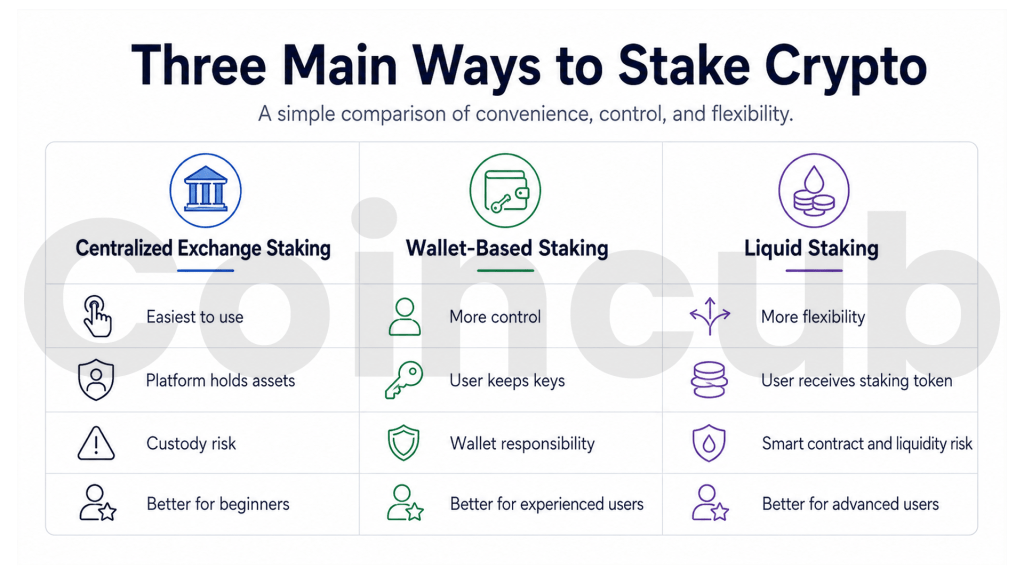
The right choice depends on your goals. If you value convenience, a centralized platform may feel easier. If control matters more, wallet-based staking may be better. If liquidity is the priority, liquid staking may be worth studying further.
A Practical Walkthrough Before You Stake
Before Satoshi staked his crypto, she compared three platforms.
The first platform offered the highest APY, but the terms were vague. It did not explain the fee structure or withdrawal timing clearly. The second platform was a well-known exchange with simple staking tools, but it was custodial. The third option used a wallet-based setup with lower rewards, clear validator data, and a visible unbonding period.
Instead of choosing the highest reward, Satoshi asked better questions. Who controls the keys? What fees apply? How long will withdrawals take? What happens if the validator fails? Are rewards variable? Can she test the platform first?
She decided to stake a small amount first. Then she tested the withdrawal process before adding more.
That approach may feel slow, but it helps reduce avoidable mistakes. In crypto staking, patience can protect you from unclear terms, weak platforms, and reward offers that look better than they really are.
Common Crypto Staking Mistakes
Beginners often make the same staking mistakes.
They choose a platform based only on APY. They ignore lockup periods. They do not check who controls the private keys. They assume staking works like a savings account. They forget that token prices can fall while rewards are being earned.
Some users also stake assets they do not understand. A high reward rate cannot fix weak token fundamentals. Others put too much money into one platform, then discover withdrawal delays or support problems later.
Another mistake is failing to keep records. Staking rewards may have tax implications depending on where you live. Good records make reporting easier.
Final Checklist: Is This Staking Platform Worth Using?
Before using any crypto staking platform, confirm that you understand:
- Who controls the private keys
- Whether the platform is custodial or non-custodial
- How staking rewards are generated
- Whether APY is estimated or fixed
- What fees apply
- How long withdrawals take
- Whether there is a lockup or unbonding period
- What slashing risks exist
- How secure the platform appears
- Whether the company is transparent
- What happens during market stress
- Whether you can test with a small amount first
If you cannot answer these questions, pause before staking.
Conclusion: Stake With Curiosity, Not Blind Trust
Crypto staking can help long-term holders earn rewards, but every platform deserves careful review. The best decision is rarely based on the largest APY alone. It comes from understanding custody, fees, lockups, liquidity, security, and withdrawal risk.
Satoshi started with one question: “Which platform pays the most?”
By the end, she had a better question: “Which platform explains the risks clearly enough for me to make an informed choice?”
That mindset is the real foundation of safer crypto staking. Look for clear terms, realistic rewards, strong security signals, and reliable withdrawals. When a platform makes the risks easy to understand, you can decide with more confidence.
Frequently Asked Questions (FAQs)
What is crypto staking?
Crypto staking is the process of locking or delegating proof-of-stake tokens to help secure a blockchain network and earn potential rewards.
How do I choose a crypto staking platform?
Choose a crypto staking platform by checking custody, fees, APY transparency, lockup periods, withdrawal rules, validator risk, security history, and company transparency.
Is crypto staking safe?
Crypto staking carries risks, including token price drops, lockups, slashing, platform failures, withdrawal delays, and custody risk on centralized platforms.
What is the difference between custodial and non-custodial staking?
Custodial staking means a platform controls your assets. Non-custodial staking lets you keep private keys while delegating tokens to a validator.
Is the highest staking APY always best?
The highest staking APY is not always best. High rewards may reflect inflation, weak liquidity, higher risk, hidden fees, or short-term promotions.









