



 Buy a Licensed Company
  Explore VASP Data
  Talk to an Expert

 Atis Shala
Atis is a senior analyst and community lead with four years of experience in crypto. He has a bachelor from the Rochester Institute of Technology.
Atis Shala
Atis is a senior analyst and community lead with four years of experience in crypto. He has a bachelor from the Rochester Institute of Technology.
Exit Liquidity: How to Avoid Being the Last One In
- Exit liquidity occurs when retail investors buy overpriced tokens to fund the profitable exits of early insiders.
- New buyers often enter the market at the worst possible time during the peak distribution phase of the four-year crypto cycle.
- Investors must separate genuine technological value from manufactured social media hype to avoid losing their capital.
- You should always investigate a project’s token distribution and daily trading volume to spot potential traps before investing.
- Creating a strict exit plan and taking incremental profits will protect your portfolio from sudden market crashes.
The Excitement Has a Dark Side
Crypto has a unique way of pulling people in. The stories are everywhere: early investors who turned a few hundred dollars into a life-changing fortune. Technologies that promise to rebuild the entire global financial system. New tokens launching every week, each one claiming to be the next big thing.
It is easy to get swept up in all of it. The gains are real. The technology is genuinely interesting. The community feels electric. But underneath all that energy sits a mechanic that most new investors never learn about until it is too late.
Crypto operates in large part as a zero-sum game. For someone to sell near the top and pocket a big profit, another person must buy near the top. That buyer absorbs the loss when prices fall. In crypto, that buyer has a name: exit liquidity.

Exit liquidity, in plain terms, means you are buying an overpriced token so that an early investor can cash out. You are not finding a great opportunity. You are funding someone else’s exit.
Understanding Exit Liquidity: The Mechanics of the Trap
Market Liquidity vs. Exit Liquidity
These two terms sound similar, but they describe very different things. Market liquidity is a healthy feature of any financial market. It simply refers to how easily an asset can be bought or sold without causing a large price swing. A liquid market is a functional market.
Being someone’s exit liquidity is something else entirely. It means you are buying an asset at an inflated price, allowing the seller to lock in profits at your expense. Early investors, project insiders, and coordinated groups use retail buyers as the final layer of demand. Once you buy in, they are out. You are left holding a bag that was never meant for them to keep.
The Exit Liquidity Trap
Exit liquidity is not always deliberate fraud. Sometimes it is simply the predictable outcome of how market cycles work. But it often follows a few very recognizable patterns.
Venture capital (VC) unlocks are one of the most common traps. Early backers often buy tokens at a fraction of the public price. Their tokens are locked for a period of time after launch. When that lock-up period ends, they can sell. If retail investors have driven the price up during that period, the VCs sell into that demand. Retail absorbs the sell pressure.
Pump-and-dump schemes are more deliberate. A coordinated group buys a token in bulk, drives the price up through social media hype, and then sells to the wave of retail buyers who came in chasing the green candles.
Memecoin frenzies are perhaps the most transparent version of the trap. These tokens have no underlying technology or utility. Their entire value is manufactured social energy. The moment that energy fades, the floor disappears.
The Psychology of FOMO
None of these traps would work without a reliable psychological trigger. That trigger is FOMO: fear of missing out. When a token’s price is rising fast and every social media post is screaming about life-changing gains, the human brain interprets inaction as a loss. The rational thing is to pause and research. The emotional thing is to buy immediately so you do not miss out.
FOMO is the fuel that keeps exit liquidity traps running. Insiders do not need to force retail investors to buy. They just need to create the conditions for FOMO to take over. The buying happens on its own.
“The most dangerous moment in any bull market is when buying feels like the only sane decision.”
The 4-Year Crypto Cycle: Your Roadmap to Market Timing
The Halving Engine
Bitcoin runs on a built-in supply schedule. Roughly every four years, the reward given to miners for processing transactions is cut in half. This event is called the halving. It reduces the rate at which new Bitcoin enters circulation. When demand stays the same but new supply shrinks, prices tend to rise.
Historically, each halving has been followed by a significant bull market within the next twelve to eighteen months. The entire crypto market tends to follow Bitcoin’s momentum. This pattern has repeated across multiple cycles, making the halving a useful reference point for understanding where the market might be heading.
The Anatomy of a Cycle
Every major crypto cycle tends to move through four distinct phases. Understanding each one can help you figure out where the market currently sits and whether it is a good time to be buying or selling.
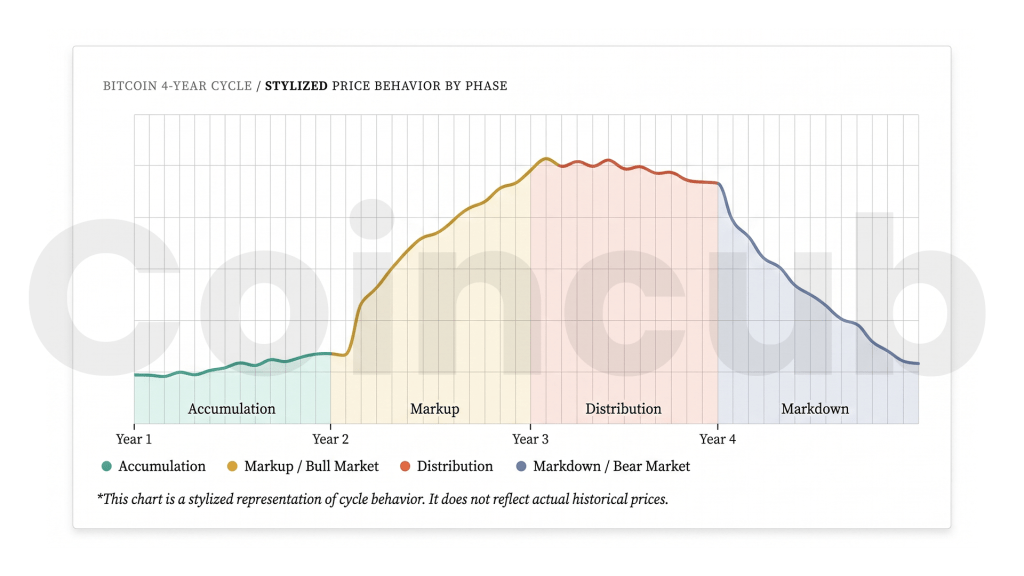
Accumulation is the quiet phase. Prices are flat or slowly recovering from the previous crash. There is very little media coverage. Most retail investors have walked away in frustration. This is when informed buyers are slowly building their positions at low prices.
Markup is when the bull market begins. Prices start rising steadily. Media coverage increases. Early retail adopters start paying attention and entering the market. Momentum builds.
Distribution is the peak phase. Prices are at or near their highest point. Headlines are everywhere. Influencers are posting screenshots of their gains. Friends and family are asking how to get involved. This is when informed, early investors are quietly selling their holdings to the flood of new buyers coming in.
Markdown is the crash. The selling overwhelms the buying. Prices fall sharply. New investors who bought during the distribution phase are now underwater. Many panic-sell at a loss. The cycle resets. For your information, the next Bitcoin halving will happen in 2028.
KEY INSIGHT
The distribution phase is where retail investors most commonly become exit liquidity. The market feels most exciting precisely when the risk is highest.
The Cycle Is Evolving
The four-year pattern is a useful framework, but it is not a reliable clock. The introduction of Bitcoin spot ETFs in 2024 brought large institutional flows into the market. Wall Street timing and macroeconomic forces now influence crypto in ways they did not before. Liquidity cycles from the Federal Reserve, broader risk-on and risk-off sentiment, and large-scale institutional rebalancing all play a role.
Do not rely on the calendar alone. Watch the underlying money flows. Pay attention to on-chain data and exchange volumes. Use the cycle framework as a guide for your thinking, not as a guarantee.
Decoding Crypto Narratives: Hype vs. Value
What Is a Crypto Narrative?
Every bull market has its themes. In one cycle, it might be decentralized finance. In the next, it could be AI-powered tokens, real-world asset tokenization, or blockchain-based gaming. These themes are called narratives, and they drive massive waves of speculation.
A narrative gives investors a story to buy into. The story feels logical. The potential feels enormous. And for a period of time, prices reflect that optimism. But not all narratives have genuine technological or commercial foundations. Many exist primarily to attract fresh capital.
The Lifecycle of a Narrative
Narratives tend to follow a predictable three-stage lifecycle. Recognizing where a narrative sits within that lifecycle can save you from walking into a trap.
In Phase 1, informed investors discover a genuine or plausible trend early. They accumulate quietly before it reaches mainstream attention. Prices are still low because awareness is limited.
In Phase 2, social media takes over. Influencers start promoting the theme. YouTube videos appear. Twitter threads go viral. Trading volume picks up. Prices begin rising fast.
In Phase 3, retail investors pile in at scale. The narrative has reached peak saturation. Everyone knows about it. This is the exit liquidity phase. The early buyers from Phase 1 are now selling to the Phase 3 buyers.
Separating Substance from Noise
The key question to ask about any narrative is: does this represent a real technological advance or a real market need? Or is it a buzzword wrapper around a token with no utility?
Genuine value tends to show up in a few ways: active developer communities, real user adoption, meaningful transaction volumes, and transparent progress toward stated goals. Hype tends to show up as flashy websites, aggressive marketing, vague roadmaps, and celebrity endorsements.
Look at the token’s use case. Ask yourself: what problem does this solve that could not be solved without a blockchain? If the honest answer is nothing, the token likely has no durable value.
The Danger of Echo Chambers
Crypto Twitter, Reddit, and TikTok create powerful echo chambers. Positive sentiment gets amplified. Critical voices get drowned out or mocked. Many influencers who promote tokens are paid to do so, sometimes without any disclosure to their audience.
Treat social media sentiment as a contrarian indicator, not a buying signal. The louder and more universal the enthusiasm, the more cautious you should be. When everyone agrees that something is a guaranteed win, you should be asking who is selling to all these confident buyers.
Red Flags: How to Spot an Exit Liquidity Trap
Certain warning signs appear again and again in projects designed to extract retail capital. Learning to recognize these signals before buying can protect your portfolio from catastrophic losses.
Tokenomics Warnings
Tokenomics refers to how a token’s supply is distributed. This is one of the most important factors to investigate before buying any project. If the founding team, early investors, and insiders collectively control 50 to 80 percent of the total supply, retail buyers are walking into a trap.
When those insiders decide to sell, their selling pressure will overwhelm any buying demand from the public. The price will collapse. Check the token distribution on the project’s official documentation or on tools like CoinGecko and Etherscan before committing any capital.
The “Too Good to Be True” Test
Any project promising guaranteed annual returns of 100 percent, 500 percent, or more should trigger immediate skepticism. Sustainable yield in any financial market is modest and variable. Guaranteed high yields are a sign that the project is either unsustainable or designed as a Ponzi scheme. The same applies to aggressive marketing tactics, celebrity involvement without credible product demonstrations, and urgency-based language like “last chance” or “limited supply.”
Anonymous Teams and Lack of Utility
Anonymity in crypto is not automatically suspicious. Some legitimate developers prefer privacy for reasonable reasons. But an anonymous team combined with a vague or missing use case is a serious warning sign. If the developers cannot be held accountable and the token serves no clear purpose, there is very little stopping the team from abandoning the project and running with investor funds.
Illiquid Markets and Low Trading Volume
Before buying any token, check its daily trading volume. A token with very low volume might look attractive based on its price chart, but low liquidity creates a dangerous trap. When you try to sell a large position in a thin market, your own sell order pushes the price down against you. You can end up receiving far less than the listed price. High volume does not guarantee a good investment, but low volume almost guarantees you will struggle to exit when it matters most.
| Red Flag | What to Look For | Where to Check | Risk Level |
| Concentrated Token Supply | Team and insiders hold more than 40% of total supply | Project whitepaper, Etherscan, CoinGecko tokenomics tab | Very High |
| Short or No Vesting Schedule | Team tokens unlock within weeks of launch | Tokenomics docs, CoinMarketCap vesting data | Very High |
| Guaranteed High APY | Promises of fixed returns above 50% per year | Project website, official documentation | Very High |
| Anonymous Team + No Utility | No verifiable founders and no clear product or use case | LinkedIn, GitHub activity, project roadmap | Very High |
| Low Daily Trading Volume | Under $500K in daily volume for a mid-cap token | CoinGecko, CoinMarketCap volume charts | High |
| Rapid Price Spike Without News | Price doubles in 24 hours with no fundamental announcement | Price charts, on-chain transaction data | High |
| Influencer-Heavy Promotion | Multiple paid promotions with no independent analysis | Twitter, YouTube, Telegram groups | Medium-High |
| No Audit or Failed Audit | Smart contract has never been independently audited | CertiK, Hacken, or PeckShield audit databases | Medium-High |
| Copycat Project | Clearly rebranded or forked from an existing project with no improvements | GitHub commit history, whitepaper comparison | Medium |
Actionable Strategies: How to Protect Your Portfolio
Understanding exit liquidity is only half the battle. The other half is building habits and systems that protect you when market excitement tries to override your judgment.
- Defeat Your Emotions: Write down your investment thesis before you buy anything. Define the price target and the exit plan. Commit to the plan before emotions take over.
- Scale Out of Positions: Do not wait for a single perfect exit price. Sell in fractions as the price rises. Lock in real gains at each level rather than betting on the top.
- Do Your Own Research: Check tokenomics on CoinGecko. Verify vesting schedules in official documentation. Look at 30-day trading volume before committing capital.
- Anchor to Blue Chips: Keep the core of your portfolio in Bitcoin and Ethereum. Limit high-risk altcoins to a small percentage while you are still learning the market.
The Profit-Taking Mindset
One of the most powerful shifts a new investor can make is learning to take profits without guilt. Many retail investors hold through an entire bull run, watch their portfolio reach enormous gains, and then ride it all the way back down during the crash.
A useful rule of thumb: if a gain is large enough that you feel compelled to screenshot your portfolio and share it, it is large enough to sell a portion. Locking in partial gains does not mean you are exiting the market. It means you are converting unrealized paper gains into real money that cannot be taken away by the next crash.
BEGINNER RESEARCH TOOLKIT
CoinGecko for tokenomics, volume, and supply distribution. Vesting schedule pages in official project documentation or Token Unlocks for lock-up details. GitHub to check whether a project has real development activity. These three checks take under ten minutes and can prevent significant losses.
Diversification Is Risk Management
Micro-cap altcoins can generate extraordinary returns. They can also go to zero in a matter of days. New investors who put large portions of their savings into speculative assets often end up becoming exit liquidity for the insiders who positioned ahead of the hype.
Build your understanding of the market before increasing your exposure to high-risk assets. Start with established assets, develop your research skills, and only gradually introduce smaller positions in higher-risk opportunities as your knowledge grows.
Final Thoughts on Exit Liquidity
Crypto markets are full of genuine opportunity. But they are also engineered, in many places, to transfer wealth from late-moving retail investors to early-moving insiders. Exit liquidity is not a rare edge case. It is a structural feature of how speculative markets work at their peak.
The tools to protect yourself are not complicated. Understand the four phases of the market cycle. Learn to read tokenomics before you buy. Treat social media hype as a warning signal rather than a buying guide. Take profits at regular intervals as prices rise. Anchor your portfolio in established assets while you build your knowledge.
Simply knowing what exit liquidity is puts you ahead of the majority of people entering this market. They come in chasing excitement. You now know to look past the excitement and ask who is selling and why. That question alone can protect your capital and, over time, help you become one of the people who exits well rather than one of the people left holding the bag.
Frequently Asked Questions (FAQs)
What is exit liquidity?
Exit liquidity refers to late-arriving buyers who purchase cryptocurrency assets at heavily inflated prices. This influx of fresh retail capital allows early investors and project insiders to sell their holdings and lock in profits before the market crashes.
Who benefits from exit liquidity?
Venture capitalists, project founders, and early investors primarily benefit from exit liquidity. These insiders secure tokens at steep discounts and rely on retail investor FOMO during peak market excitement to offload their massive positions for maximum financial gain.
How can I avoid exit liquidity traps?
You can avoid exit liquidity traps by researching tokenomics, checking team vesting schedules, and monitoring daily trading volume. Smart investors ignore coordinated social media hype, secure consistent profits, and refuse to buy tokens during peak market euphoria.










