


 Buy a Licensed Company
  Explore VASP Data
  Talk to an Expert

 Atis Shala
Atis is a senior analyst and community lead with four years of experience in crypto. He has a bachelor from the Rochester Institute of Technology.
Atis Shala
Atis is a senior analyst and community lead with four years of experience in crypto. He has a bachelor from the Rochester Institute of Technology.
What is an SPI License? A Guide for Crypto Startups

- A Small Payment Institution (SPI) license provides a practical, affordable regulatory entry point for early-stage crypto startups to legally process fiat payments.
- The license permits essential services like fiat deposits and peer-to-peer transfers but caps monthly transaction volumes and generally prohibits the issuance of electronic money.
- Startups frequently use the SPI license as a stepping stone, planning to upgrade to an API or EMI license as their transaction volumes and product offerings expand.
- The UK, the European Union, and Singapore are the most common jurisdictions for acquiring an SPI license, each offering distinct timelines, costs, and passporting rules.
- Successfully securing a license demands serious preparation, requiring founders to submit a comprehensive business plan, tailored AML/KYC policies, and proof of a qualified management team.
If you are building a crypto startup that handles payments, transfers, or fiat on-ramps, you almost certainly need a regulatory license before you can legally serve customers. For many early-stage companies, the Small Payment Institution (SPI) license is the fastest, most affordable, and most practical entry point into the regulated financial system. It allows you to offer real payment services, build credibility with banking partners and investors, and operate within a recognized legal framework, all without the capital requirements and compliance burden of a full payment institution license.
This guide explains what an SPI license is, what it allows you to do, how it compares to other license types, where to obtain one, and what the application process actually involves.
What is an SPI License?
A Small Payment Institution (SPI) license is a regulatory authorization that permits a company to provide payment services to customers under a simplified set of requirements. It is specifically designed for smaller operators and early-stage businesses whose monthly transaction volumes do not exceed a defined threshold, typically 3 million euros per month in the European Union or 3 million pounds per month in the United Kingdom.

The SPI framework exists because regulators recognize that early-stage fintechs and startups cannot always meet the capital and governance requirements demanded of large, fully authorized payment institutions. Rather than forcing small businesses to choose between operating illegally or building the compliance infrastructure of a bank, regulators created a lighter-touch registration pathway that still ensures basic consumer protections, anti-money laundering controls, and operational safeguards are in place.
For crypto startups specifically, an SPI license is relevant in several common scenarios. If your platform processes fiat payments on behalf of users, facilitates crypto-to-fiat conversions, enables peer-to-peer money transfers, or supports merchant payments, you are likely providing payment services in the legal sense. Doing so without the appropriate license exposes your company to serious regulatory risk, including fines, forced shutdown, and personal liability for directors.
What Does an SPI License Allow You to Do?
An SPI license covers a defined range of payment services. These typically include executing payment transactions (including transfers of funds to and from payment accounts), money remittance, and in some jurisdictions, payment initiation services. The specific scope depends on the regulatory framework in your chosen jurisdiction, but the core use cases are consistent across the EU, UK, and Singapore.
In practical terms for a crypto startup, this means you can legally receive fiat deposits from users, send fiat to users upon redemption or withdrawal, process payments between parties on your platform, and operate fiat wallets or account balances as part of your product. These are foundational capabilities for any exchange, neobank, remittance tool, or crypto payment processor.
An SPI license does not permit everything. Holders typically cannot issue electronic money, which requires a separate Electronic Money Institution (EMI) license. They also cannot passport their services across the EU or EEA under most frameworks, meaning authorization is limited to the country of registration. Some jurisdictions also restrict SPI holders from offering payment initiation or account information services, which fall under the broader Authorized Payment Institution (API) license.
SPI vs. API vs. EMI: Understanding the Differences
Three license types come up most often in the payment services world, and understanding how they relate to each other helps crypto founders choose the right starting point.
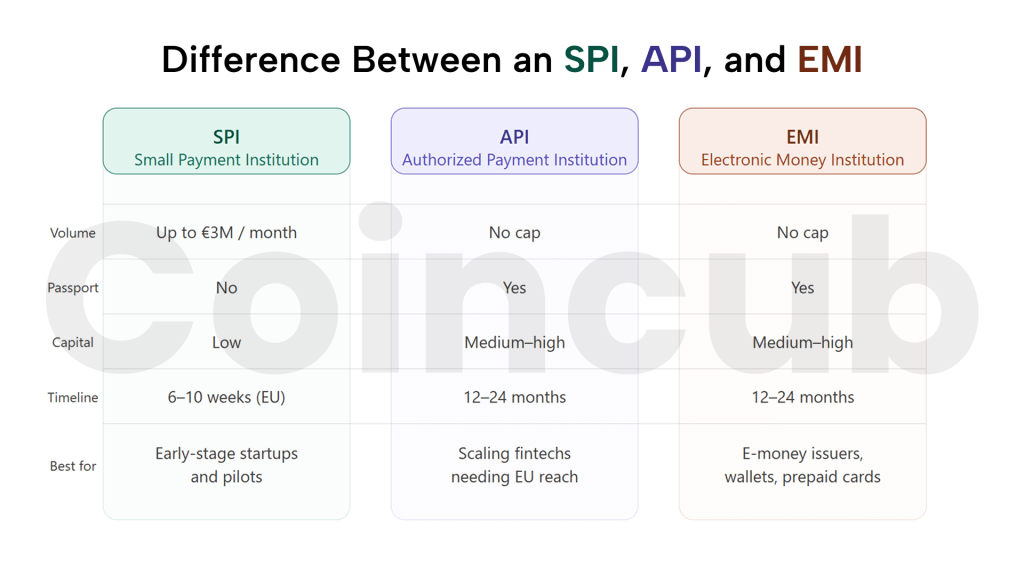
SPI (Small Payment Institution): The most accessible tier. Designed for companies with monthly transaction volumes below 3 million euros or pounds. Lower capital requirements, simplified compliance documentation, and faster approval timelines (typically 6 to 10 weeks in the EU, 6 to 9 months in the UK). No passporting rights. Cannot issue e-money.
API (Authorized Payment Institution): A full payment institution license with no transaction volume cap. Grants EU passporting rights, allowing a company to serve customers across all member states from a single registration. Requires more capital, a more developed compliance framework, and a significantly longer application process, often 12 to 24 months.
EMI (Electronic Money Institution): Required if your business model involves issuing electronic money, which is a digital representation of fiat currency stored on a device or server. E-money licenses are common among companies building prepaid cards, digital wallets, or stored-value products. EMI requirements are similar in rigor to an API but cover a different scope of services.
Most crypto startups begin with an SPI license and upgrade to an API or EMI as their transaction volumes and product scope grow. This phased approach allows companies to enter the market quickly, prove their business model, and generate the revenue needed to support more complex compliance operations later.
Where to Obtain an SPI License?
SPI licenses are available in a number of jurisdictions, each with different timelines, costs, and regulatory environments. The most common choices for crypto startups are the United Kingdom, the European Union, and Singapore.
United Kingdom
In the UK, SPI licenses are issued and supervised by the Financial Conduct Authority (FCA). The application fee is 2,140 pounds, and processing times have stretched to 6 to 9 months as of 2025, up from the previous 4 to 6 month average, largely due to a surge in applications from early-stage fintechs. The FCA has tightened its review process considerably, with particular scrutiny on anti-money laundering procedures, governance frameworks, IT security controls, and the fit and proper status of directors. The FCA approval rate for SPI applications dropped from approximately 85% to 70% between 2023 and 2025. Thorough preparation is now essential.
European Union
Within the EU, SPI licenses are issued by national regulators in each member state. Spain, Poland, Lithuania, and the Czech Republic are among the jurisdictions popular with fintech startups for their relatively accessible processes and reasonable timelines. Approval typically takes 3 to 6 months. A notable exception is Finland, where an SPI license is passportable across the European Economic Area, making it particularly attractive for companies targeting the full EU market. Spain offers an interesting variation in that it does not enforce a hard monthly transaction cap for its small payment institution registration, though cross-border payment restrictions still apply.
Singapore
In Singapore, crypto companies offering Digital Payment Token (DPT) services are regulated under the Payment Services Act (PSA) and supervised by the Monetary Authority of Singapore (MAS). Singapore’s equivalent of the SPI is the Standard Payment Institution license, which imposes caps on monthly transaction volume and maximum account balances, making it suitable for smaller operators. Companies that expect to exceed these thresholds, or that need unrestricted transaction volumes, must apply for a Major Payment Institution (MPI) license instead. The MAS framework is rigorous, requiring at least one executive director who is a Singapore citizen or resident, a locally based compliance officer, and robust AML and cybersecurity controls.
What the Application Process Involves
Regardless of jurisdiction, the SPI application process requires a similar set of core materials and preparations. Understanding what is involved before you begin will significantly improve your chances of a smooth and timely outcome.
Business plan: Regulators want to understand what payment services you intend to offer, who your target customers are, how you will generate revenue, and how your business will remain financially sustainable. A vague or overly optimistic business plan is one of the most common reasons applications are delayed or rejected.
AML and KYC policies: You must demonstrate that your company has documented, practical procedures for verifying customer identity, monitoring transactions for suspicious activity, and reporting to the relevant financial intelligence unit. These policies must be tailored to your specific business model, not copied from a generic template.
IT security framework: Regulators expect evidence that your technical infrastructure is secure, resilient, and appropriate for the payment services you are providing. This typically includes details about data encryption, access controls, incident response procedures, and third-party vendor management.
Governance structure: You need to show that your company is run by qualified, reputable individuals. Regulators conduct background checks on directors and key personnel and assess whether they have relevant financial services or compliance experience. Companies with management teams that lack this background often need to hire a qualified compliance officer before submitting their application.
Financial projections: You must provide realistic financial forecasts demonstrating that your business can meet its obligations and sustain its operations. Some regulators also require evidence of adequate initial capital, even where no formal minimum is specified.
Common Mistakes Crypto Startups Make
Several recurring errors slow down or derail SPI applications from crypto companies in particular.
Treating the process as a tick-box exercise is the most damaging mistake. Regulators, especially the FCA, have stated publicly that they are receiving too many applications from underprepared companies. Surface-level documentation that does not reflect how your business actually operates will result in requests for additional information, significantly extending the timeline.
Underestimating the ongoing compliance burden is another. Obtaining an SPI license is not a one-time event. License holders must continuously monitor and update their AML systems, report to regulators, and stay current with evolving rules. As transaction volumes grow and your product matures, compliance costs grow with them.
Choosing the wrong jurisdiction is a third common error. The cheapest or fastest option is not always the most strategic one. If you plan to serve customers across multiple European countries, for example, starting with a passportable license in Finland may ultimately save more time and money than a faster, non-passportable registration elsewhere.
The Bottom Line for Crypto Founders and Startups
The SPI license is the most practical starting point for crypto startups that need to handle fiat payments legally and build credibility with the broader financial ecosystem. It is not a shortcut, and the application process demands real preparation. But compared to the alternatives, an SPI offers a proportionate, accessible, and upgradeable path into regulated payment services.
Start by defining exactly which payment services your product requires, choose a jurisdiction that fits your target market and growth plans, and build your compliance documentation around how your business actually operates. Done properly, an SPI license is one of the most valuable assets a crypto startup can hold in the current regulatory environment.
Frequently Asked Questions (FAQs)
What is a SPI in banking?
An SPI, or Small Payment Institution, is a regulatory license that allows companies to legally provide payment services under simplified rules. It is designed for smaller businesses with monthly transaction volumes below specific thresholds.
What is a SPI in crypto?
For crypto startups, an SPI license permits legally processing fiat payments, facilitating crypto conversions, enabling money transfers, and operating fiat wallets. It mitigates severe regulatory risks like fines while avoiding full bank compliance burdens.
How to become an SPI?
To become an SPI, you must apply to a national regulator by submitting a detailed business plan, customized compliance policies, a secure IT framework, realistic financial projections, and proof of a qualified governance structure.
Is SPI a payment processor?
An SPI itself is a regulatory license rather than a software tool, but it legally authorizes your company to operate as a payment processor. It allows you to execute transactions, handle remittances, and process payments.