Buy a Licensed Company
  Explore VASP Data
  Talk to an Expert

 Atis Shala
Atis is a senior analyst and community lead with four years of experience in crypto. He has a bachelor from the Rochester Institute of Technology.
Atis Shala
Atis is a senior analyst and community lead with four years of experience in crypto. He has a bachelor from the Rochester Institute of Technology.
Sentiment Analysis 3.0: Using LLMs to Mine Farcaster and Lens Protocol for Alpha

Key Takeaways:
- The sheer volume of retail noise and bot activity on traditional social media destroys early trading signals. By the time a narrative trends on X, the primary opportunity has already vanished.
- Protocol-native networks like Farcaster and Lens host concentrated communities of builders and sophisticated DeFi users. These platforms surface market-moving information hours or days before the mainstream catches on.
- Unlike anonymous accounts on traditional platforms, users on decentralized networks connect their wallets to their profiles. This allows researchers to weigh social sentiment against actual onchain skin in the game.
- Basic keyword sentiment tools fail to grasp crypto nuances. Modern Large Language Models understand context, decode sarcasm, and map narrative clusters across complex social graphs to extract actionable intelligence.
- The API infrastructure to build these contextual sentiment pipelines exists today. Teams are already exploiting this information asymmetry, and the edge will inevitably erode as automated extraction becomes the industry standard.
Nikita Killed X for Crypto Bros
By the time a trade idea trends on X, the alpha is already gone.
That is not a critique of X, nor is it a critique of CT. It is a description of how information propagates through the crypto ecosystem in 2025. Millions of accounts, thousands of bots, and an army of copy-paste analysts compress the half-life of any meaningful signal down to minutes. The crowd moves in, prices adjust, and the window closes. What was alpha becomes noise, and what was noise was someone else’s alpha three hours ago on a platform most traders are not watching.

That platform might be Farcaster. It might be Lens Protocol. And the tool reading it before you do might be an LLM.
This is the thesis behind what is quickly becoming one of the more interesting edges in crypto research: applying large language models to the social graphs of decentralized Web3 networks to surface early-stage sentiment signals, engagement clustering, and emerging narratives before they reach the mainstream crypto feed on X. Call it Sentiment Analysis 3.0- a contextual, graph-aware, protocol-native approach to reading what the most informed and engaged corners of crypto are talking about before the crowd catches up.
Why Is CT No Longer the Primary Signal Layer?
X remains dominant by raw volume. It is still the place where crypto CEOs make announcements, where token prices react within seconds to a single post, and where the loudest retail narratives take shape. None of that is in dispute. The problem is not that X lacks information. The problem is that X has too much of it, most of it low-quality, ai slop and the signal-to-noise ratio has deteriorated significantly as the platform opened up to a broader, more financially motivated user base.
Crypto prices are driven more by investor emotions and herd behavior than traditional metrics, making sentiment indicators like social media trends essential. But when the social media platform you’re monitoring is saturated with retail behavior, what you are measuring is the herd itself, not the signal that precedes it.
The practical consequence is straightforward: by the time a token, protocol, or narrative gains traction on X, it has typically already passed through earlier-stage communities where the most sophisticated participants first engaged with it. Farcaster and Lens Protocol are two of the most significant of those communities. Both are structurally different from X in ways that matter deeply for alpha generation.
The Architecture Advantage: Why Decentralized Social Graphs Are Different
Understanding why Farcaster and Lens produce different kinds of signal requires understanding what makes them structurally distinct from traditional social platforms.
Farcaster has a $1 billion valuation, 40,000-60,000 daily active users, and stores identity data on the OP chain while propagating content through an off-chain peer-to-peer network called Hubs. The user base is small by X standards, but the composition matters far more than the scale. The $5 signup fee and crypto-native onboarding process filter for a specific kind of participant: someone already embedded in the onchain world, familiar with protocols, and likely to encounter new token launches, governance discussions, and ecosystem developments before they surface on mainstream feeds.
Lens Protocol keeps the entire social graph onchain. Profiles, follows, posts, and other interactions are implemented as tokens on Polygon, making all relationships and content directly verifiable and portable. The Lens mainnet launched April 4, 2025, migrating 650,000 user profiles to its own ZK-powered chain. Combined with earlier rounds, Lens has raised over $60 million.
The Social Layer of Crypto
These are not consumer social networks trying to replace Instagram. They are protocol-native communities of builders, developers, DeFi participants, and early adopters. When a new token launches, when a governance vote passes with unexpected results, when a narrative around a specific L2 begins forming, it tends to surface in these communities first.
The onchain structure introduces a second advantage that traditional social platforms cannot offer: every account is linked to a wallet. This means social graph data and onchain behavior data can be merged. A user who casts about a new token on Farcaster and holds that same token in their wallet is not just expressing an opinion. They have skin in the game. LLMs reading that signal can weight it differently than a pseudonymous account on X that may or may not be holding the asset being discussed.
What LLM-Based Sentiment Analysis Actually Does Here
Traditional sentiment analysis applies simple classifiers to text: positive, negative, neutral. It counts keywords, assigns polarity scores, and aggregates results. This approach works reasonably well for understanding broad market mood but struggles with the specific, contextual, and often ironic language of crypto communities.
The integration of LLMs and NLP models for cryptocurrency sentiment analysis represents a powerful toolset that enhances investment decision-making. Spam comments or articles deliberately created to stimulate investment remain a significant risk, requiring models to distinguish genuine signals from manufactured sentiment.
Modern LLMs do something categorically more powerful. Compared to simple lexicon or bag-of-words methods, modern LLMs understand context including sarcasm and nuanced regulatory discussion and can produce multi-dimensional outputs: sentiment polarity, confidence, tone, topic tags, and suggested actions.
Farcaster + Lens + AI = Alpha
Applied to Farcaster and Lens data, this means an LLM can do the following things that no traditional sentiment tool can match:
- Narrative clustering: Identify when multiple distinct conversations, happening across different accounts and channels, are converging on the same underlying theme, even if they use different terminology.
- Graph-weighted scoring: Because both Farcaster and Lens expose their social graphs programmatically, an LLM pipeline can weight signal by the influence topology of the speaker. A cast from a builder who has shipped three protocols carries different weight than a cast from a newly created account with no onchain history.
- Temporal signal detection: Track when a topic first appears in the network, how fast it propagates through social connections, and whether the velocity of spread accelerates. This is the upstream equivalent of watching a token’s volume tick up before the price moves.
- Context-aware classification: Understand that “this protocol is going to zero” from a known contrarian builder who has been right before is different information than the same phrase from a retail account parroting a bearish narrative.
Research has uncovered that sentiment indicators crafted with GPT-4o significantly affect Bitcoin returns, even when accounting for a broad array of control variables and other pre-established sentiment indicators. That finding, based on X data, becomes materially more interesting when the input data source shifts to communities with a higher concentration of sophisticated, wallet-connected participants.
The Information Flow: From Cast to Crypto Twitter to Price
The information cascade in crypto tends to follow a recognizable pattern, and understanding it helps frame where Farcaster and Lens sit in the timeline.
| Stage | Platform | Typical Audience | Time-to-Price |
| 1. Protocol / Discord | Private channels | Core team, early contributors | Hours to days before price |
| 2. Farcaster / Lens | Web3 social graphs | Builders, sophisticated DeFi users | Hours before public narrative |
| 3. X (Crypto Twitter) | Public social media | KOLs, retail, media | Near-price or post-price |
| 4. CoinGecko trending / CoinMarketCap | Aggregators | Mass retail | Lagging indicator |
| 5. News outlets | Crypto media | Passive audience | Significantly lagging |
Farcaster and Lens occupy Stage 2 in this chain. They are not the earliest possible source, private Discord channels and Telegram groups often carry signals earlier, but they are open, programmatically accessible, and structured in ways that make them far more amenable to automated analysis than private groups.
The Farcaster team built their own client to attract users at the product level. High-quality social circles are a new experience, unique alpha information is a new experience, and the combination of crypto and social is a new experience. That observation from within the Farcaster ecosystem itself confirms the community’s self-awareness about being a distinctive information environment.
Building a Sentiment Pipeline: What This Looks Like in Practice
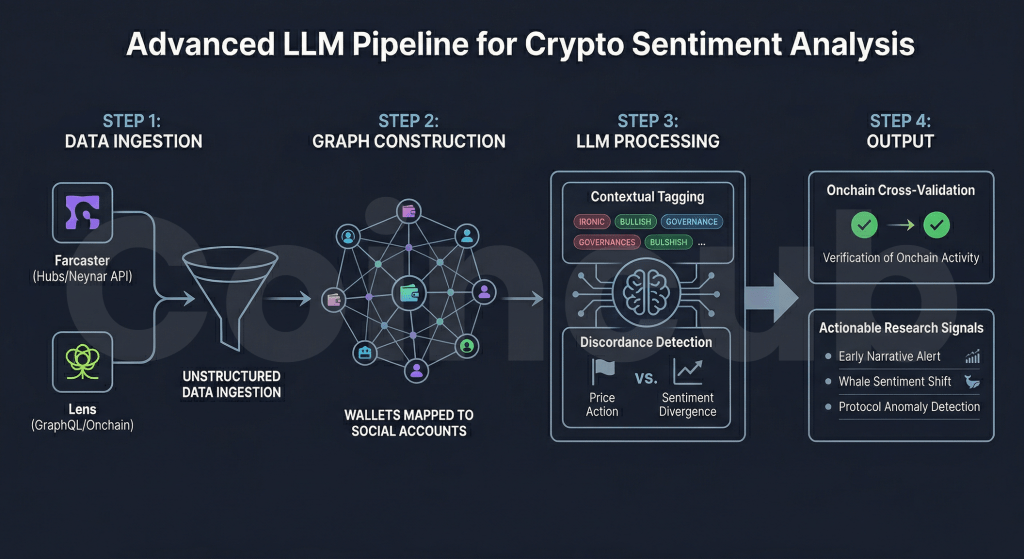
A functional LLM-based sentiment pipeline targeting Farcaster and Lens data is not a theoretical concept. The infrastructure to build one exists today, and several teams are quietly doing it. The architecture involves four components:
1. Data Ingestion
Farcaster exposes data through Hubs, its distributed off-chain network, and through APIs like Neynar, which abstracts Hub access for developers. In January 2026, Neynar acquired the Farcaster protocol and assumed responsibility for maintenance. As the primary infrastructure company now stewarding Farcaster’s API layer, Neynar has become the de facto gateway for programmatic access to Farcaster’s social data at scale.
Lens Protocol exposes its onchain data through GraphQL APIs that allow querying of profiles, follows, posts, and engagement data. Because the social graph lives onchain, the data is canonical and tamper-resistant, you know exactly what was posted, by whom, when, and with what onchain identity attached.
2. Graph Construction
The raw data feeds into a graph representation: nodes are accounts, edges are follows and interaction patterns. This structure allows the pipeline to distinguish between random discussion and coordinated amplification, a signal that often precedes coordinated market activity.
3. LLM Processing
LLMs map unstructured text to structured sentiment and topic signals at scale. The pipeline ingests posts, deduplicates, timestamps, and uses retrieval-augmented generation to produce concise summaries and sentiment scores. Aggregate weights account for source credibility and time decay.
A critical processing layer here is what researchers call discordance detection: situations where the sentiment in the social graph conflicts with price action or onchain data. Monitoring discordance, such as positive social sentiment alongside negative onchain activity, is often a red flag, and vice versa. These discordances are often where the most actionable signals hide.
4. Signal Output and Cross-Validation
Treating social sentiment as a noise-heavy leading indicator is powerful for short-term regime detection but requires cross-validation with onchain or order-book signals before execution. The output of an LLM sentiment pipeline should never be the sole input to a trading decision. Its value is in directing research attention: flagging which tokens, protocols, or narratives deserve a closer look and why.
The Signal Quality Advantage: Who Actually Uses These Platforms
The argument for Farcaster and Lens as higher-quality signal sources rests on a fundamental observation about user composition.
Engagement rate comparison favors Farcaster: 29 engagements per user monthly versus Lens’s 12, indicating higher-quality if smaller community. Farcaster has 546,494 registered users and 40,000-60,000 daily active users, while Lens Protocol has accumulated over 1.5 million users with around 20,000 current daily active users.
Small numbers by traditional social media standards. But consider what those numbers represent in context: a community of DeFi builders, protocol developers, and early-stage crypto investors who have each paid to participate, connected their wallets to their identities, and built reputations within the network over time. The barriers to entry are not just technical, they are motivational. The kind of person who registers on Farcaster in 2025 is, on average, more deeply embedded in the crypto ecosystem than the average account posting about crypto on X.
This selectivity creates a structurally different information environment. When a narrative gains traction on Farcaster, it tends to reflect genuine engagement from participants who have direct economic or technical stakes in the protocols being discussed. When a narrative trends on X, it may equally reflect genuine engagement, bot activity, promotional incentives, or viral entertainment with no connection to underlying fundamentals.
By post-training models on domain-specific datasets, CryptoBERT effectively captures informal expressions and linguistic patterns unique to cryptocurrency communities, significantly improving sentiment classification accuracy compared to general-purpose BERT models. This points to an important refinement: the most effective pipelines targeting Farcaster and Lens data should use models fine-tuned on the specific linguistic register of these communities, not generic sentiment models trained on news headlines or product reviews.
The Limitations: Where This Approach Can Break
Intellectual honesty demands a clear-eyed view of what this approach cannot do and where it can mislead.
Coordinated manipulation is harder to detect at small scale. Because Farcaster’s user base is small and tight-knit, a coordinated group of insiders can amplify a narrative before it reflects genuine consensus. An LLM pipeline that weights social graph influence without modeling the possibility of coordinated behavior can mistake organized promotion for organic signal.
The alpha half-life is shortening. As more sophisticated teams begin mining Farcaster and Lens data with LLMs, the information advantage erodes. The same dynamic that destroyed the edge of X-based sentiment analysis will eventually reach these platforms, particularly as user bases grow and more automated accounts enter the ecosystem.
Lens migration effects are not yet fully understood. Lens Protocol completed one of the largest data migrations in blockchain history, transferring 650,000 user profiles and 125GB of social graph data to its own Layer 2 chain. The behavioral patterns of users on the new Lens Chain are still being established. Historical signal models built on Polygon-era data may not transfer cleanly.
LLM hallucination and context collapse. Real deployments show LLMs can help surface ideas and speed analysis, while still producing poor trading outcomes unless combined with rigorous data, real-time feeds, risk limits, and human review. Models that summarize or classify without grounding in verified onchain data introduce errors that compound badly at scale.
The Broader Shift: Decentralized Social as Financial Infrastructure
The deeper implication of this analysis reaches beyond trading tactics. Farcaster and Lens Protocol are part of a structural shift in how financial information moves through the crypto ecosystem.
Traditional financial markets have always featured information asymmetries between insiders and the public. Crypto markets compressed some of those asymmetries by putting onchain data into the open, but created new ones through the speed and opacity of information flow across fragmented communities. The rise of Web3 social protocols with open, portable, wallet-linked social graphs creates a new layer of financial infrastructure, one where information can be tracked, weighted, and analyzed with a precision that traditional social media cannot offer.
The sentiment around decentralized social platforms could boost related tokens tied to these social graphs, potentially impacting trading pairs such as LENS/ETH. Risk appetite for altcoins tied to social dApps may rise in the short term with possible price surges of 5-10% within 48 hours of major announcements.
LLMs are the natural analytical layer for this infrastructure. Their ability to process unstructured text at scale, understand context, and surface structured signals from noisy environments makes them the right tool for the architecture. The question is not whether this methodology works in principle. The research literature confirms that it does. The question is who builds the most rigorous implementation of it, and how long their edge lasts before the methodology becomes standard.
Conclusion: The Window Is Open, But Not Indefinitely
Farcaster and Lens Protocol represent something rare in financial markets: a genuine information asymmetry that still exists because most market participants have not yet developed the tooling to access it systematically. The communities are crypto-native, wallet-linked, small enough to be coherent, open enough to be accessed programmatically, and early enough in their data history that robust baseline models have not yet been widely deployed against them.
The LLM infrastructure required to exploit this asymmetry, ingestion, graph construction, contextual classification, cross-validation against onchain data, is not simple to build, but it is well within the reach of any serious research team in 2025. The methodology exists. The data is accessible. The signal quality advantage over X is real and measurable.
Every information edge in crypto eventually closes. This one will too. But in the interval between when an edge exists and when it disappears, the traders and researchers who identified it and built around it have already moved on to find the next one. The social graph is the new order book. The question is whether you are reading it.
Frequently Asked Questions (FAQs)
What is Sentiment Analysis 3.0?
It refers to the third generation of crypto sentiment analysis: moving beyond keyword filters (1.0) and basic NLP polarity scoring (2.0) to contextual, graph-aware, LLM-powered analysis that accounts for network topology, wallet identity, and information velocity within specific communities.
Why are Farcaster and Lens better signal sources than X?
Their user bases are smaller but significantly more concentrated among onchain builders and sophisticated DeFi participants. Every account is linked to a wallet identity, enabling social graph data and onchain behavior data to be analyzed together. The signal-to-noise ratio is structurally higher than on X, where bots, promotional accounts, and retail herd behavior dominate.
Can I access Farcaster and Lens data programmatically?
Yes. Farcaster data is accessible through Hubs and via the Neynar API. Lens Protocol exposes social graph and content data through GraphQL APIs. Both are open and permissionless by design.
What models work best for this kind of sentiment analysis?
Domain-specific fine-tuned models like CryptoBERT outperform general-purpose models for crypto community text. For contextual classification and narrative detection at scale, GPT-4 class models offer strong performance with the advantage of zero-shot flexibility. The best deployments combine both.
Is using AI to mine Farcaster legal?
Accessing and analyzing publicly available social graph data for research and investment purposes is generally legal. As with all financial research involving alternative data, consult legal and compliance advisors for your specific jurisdiction and use case. Using signals derived from this analysis does not constitute insider trading, as the data is publicly available.
Does this approach work for long-term investing or only short-term trading?
Both, but with different calibration. Short-term regime detection benefits most from velocity and discordance signals. Long-term investors can use narrative clustering to identify emerging protocol categories or developer attention shifts months before they reach mainstream financial coverage.