


 Buy a Licensed Company
  Explore VASP Data
  Talk to an Expert

 Atis Shala
Atis is a senior analyst and community lead with four years of experience in crypto. He has a bachelor from the Rochester Institute of Technology.
Atis Shala
Atis is a senior analyst and community lead with four years of experience in crypto. He has a bachelor from the Rochester Institute of Technology.
Wyoming DAO LLC: Legal Personhood for Code
A Wyoming DAO LLC is a distinct legal entity that grants decentralized autonomous organizations (DAOs) the same corporate personhood as traditional companies, while explicitly allowing them to be governed by smart contracts on a blockchain. Established under the Wyoming Decentralized Autonomous Organization Supplement (Senate Bill 38), this structure solves the fundamental incompatibility between onchain governance and off-chain compliance.
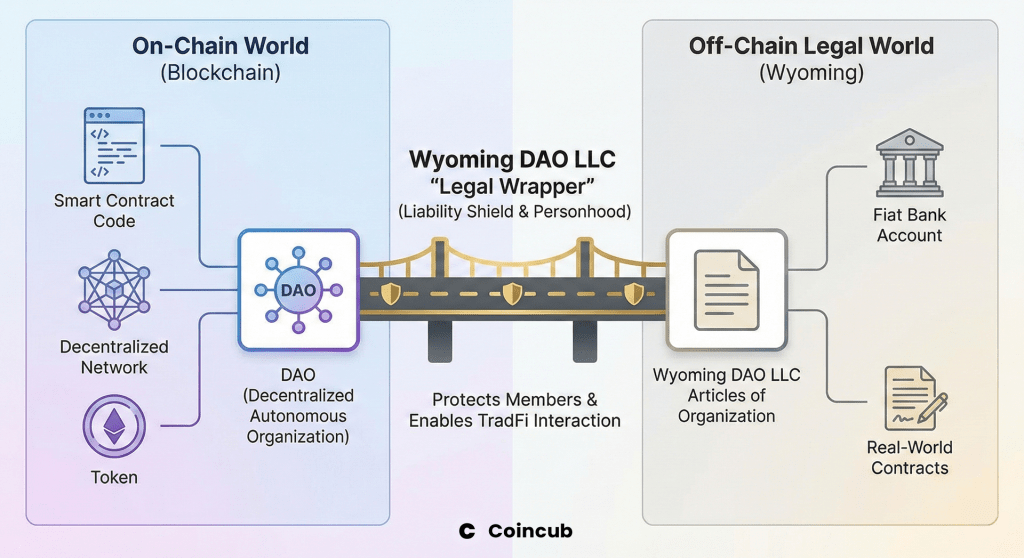
Unlike a standard Limited Liability Company (LLC) which relies on a human-led Board of Managers, a Wyoming DAO LLC recognizes the underlying smart contract protocol as the primary source of truth for governance and operation. It provides the DAO with a legal “wrapper,” enabling the protocol to enter valid contracts, open bank accounts, hold off-chain assets (IP, Real Estate), and pay taxes. Most importantly, it shields individual token holders and developers from personal liability. If the DAO faces litigation or insolvency, the claimants can only pursue the assets held within the LLC, protecting the personal wealth of the participants.
The Compliance Gap: Why DAOs Need Legal Wrappers
Many Web3 founders operate under the dangerous assumption that a DAO is a nebulous internet collective that exists outside the law. This is false. In the absence of a formal legal structure, regulators and courts classify a DAO as a General Partnership. This is the worst possible classification for a business. In a General Partnership, every member faces unlimited joint and several liability for the actions of the entire group. If a DAO gets hacked due to a developer’s error, or if a governance vote results in a lawsuit, every single token holder could be personally sued for the full amount of damages. Your personal savings, home, and assets are exposed. The Wyoming DAO LLC creates a corporate veil, strictly limiting liability to the assets held by the protocol itself.

The “Code is Law” Fallacy
“Code is Law” serves as a powerful philosophy for transaction settlement, but it fails as a defense in a courtroom. Judges do not read Solidity; they read statutes. If a smart contract executes a function that results in a financial loss for a user, the law often views this not as an immutable blockchain event, but as theft, fraud, or breach of contract. Without a legal wrapper to define the terms of service and the limitations of liability, the code is defenseless. A legal entity bridges this gap, translating onchain logic into a format that the traditional legal system respects and enforces.
Beyond liability, a DAO faces paralysis in the real world without a legal face. You cannot open a fiat bank account with an Ethereum wallet address. You cannot pay AWS for hosting, sign an employment contract with a front-end developer, or file a trademark for your logo without a Tax ID (EIN). The Wyoming DAO LLC acts as the API between the blockchain and the legacy financial system. It provides the necessary documentation, like the Certificate of Good Standing, Articles of Organization, and EIN, required to pass KYC (Know Your Customer) checks at exchanges, banks, and enterprise vendors.
The Wyoming DAO Supplement (W.S. 17-31-101)
The Wyoming Decentralized Autonomous Organization Supplement is not a loophole; it is a sophisticated piece of legislation specifically engineered to accommodate blockchain technology. To utilize it effectively, founders must understand the specific statutory mechanisms that differentiate it from a standard LLC.
Member Managed vs. Algorithmically Managed
The statute (W.S. 17-31-104) requires the Articles of Organization to explicitly define how the DAO is governed. This is the first time legislation has recognized software as a manager.
- Member Managed: This mirrors a traditional LLC but replaces the Board of Directors with token holders. Governance decisions, such as treasury diversification or protocol upgrades, occur through onchain voting mechanisms. The humans (members) retain voting power, and the smart contracts execute the will of the majority.
- Algorithmically Managed: This is the radical innovation. The Articles state that the DAO is fully automated. The underlying smart contracts autonomously execute operations based on pre-programmed logic without human intervention. In this structure, the “Manager” is the code itself. This designation is crucial for AI agents or immutable DeFi protocols that function as public utilities rather than active businesses.
The Smart Contract Override
In traditional corporate law, the “Operating Agreement” is the supreme document. If a conflict arises between the company’s practice and the written agreement, the written agreement usually prevails. The Wyoming statute flips this hierarchy for DAOs.
Under W.S. 17-31-115, the statute recognizes the smart contract as the governing authority. If the written Operating Agreement conflicts with the smart contract code, the smart contract prevails (to the extent that the code is immutable and executed onchain). This provides legal certainty to developers: you do not need to worry that a judge will later interpret your “intent” differently than your code. The blockchain execution is the final word. However, the DAO must provide a “Publicly Available Identifier” in its filings. This address becomes the legal anchor for the entity.
The Notice of Algorithm Disclaimer
Wyoming law acknowledges the experimental nature of Web3. The statute requires the Articles of Organization or the Operating Agreement to include a specific warning statement. This disclaimer must inform all members and potential users that the rights of the members may differ materially from those in a traditional LLC and that the software protocols may fail. This statutory disclaimer acts as a robust shield against negligence claims. It effectively codifies the “use at your own risk” ethos of DeFi into the corporate charter, providing a layer of defense against class-action lawsuits stemming from smart contract exploits or bugs.
By leveraging these specific provisions, builders can create a “Dual-Structure” entity: a protocol that lives onchain, protected by a legal entity that lives in Cheyenne.
Strategic Benefits for RegTech & DeFi Projects
For serious projects, a Wyoming DAO LLC is a strategic asset that unlocks the real world.
Asset Protection: Shielding the Treasury
The primary mandate of any DAO is to protect its treasury. Without a legal wrapper, a DAO’s multi-sig wallet is effectively a “pot of money” owned by a general partnership. If a claimant sues the DAO and wins, they can theoretically go after the personal assets of the multi-sig signers. A Wyoming DAO LLC isolates liability. The treasury held by the DAO is legally distinct from the members’ personal wealth. If the protocol becomes insolvent or faces a lawsuit, the liability stops at the LLC’s assets, ensuring that contributors don’t lose their homes because of a governance vote gone wrong.
Tax Clarity: The Pass-Through Advantage
Uncertainty is the enemy of investment. Institutional investors cannot allocate capital to a “maybe.” Wyoming clarifies the tax treatment of DAOs by defaulting to “pass-through” taxation. This means the DAO LLC itself is not taxed at the entity level (avoiding double taxation). Instead, tax liability “passes through” to individual members based on their share of profits or token holdings. This aligns perfectly with the ethos of decentralized protocols, where value accrues to the network participants rather than a centralized corporate hoarder.
TradFi Interoperability: The Power of a Signature
DeFi protocols live onchain, but they need off-chain resources to grow. You cannot sign a lease for a server farm with a private key. You cannot enter a marketing contract with a major agency using a wallet address. A Wyoming DAO LLC gives the protocol a “hand” to sign contracts. It allows the DAO to open an institutional bank account, hold a credit card for operational expenses, and legally own intellectual property (IP). This bridges the gap, allowing a DeFi protocol to interact with the traditional financial (TradFi) world as a peer, not a ghost.
Formation & Operational Requirements
Forming a Wyoming DAO LLC is a precise bureaucratic process. One missed step can render the liability protection void.
Step 1: Name Availability & Reservation
- Your name must explicitly include “DAO,” “LAO,” or “DAO LLC.”
- Example: “Alpha Protocol DAO LLC.”
- Tip: Check the Wyoming Secretary of State database first to ensure uniqueness.
Step 2: The Registered Agent
- You cannot self-represent if you live outside Wyoming.
- You must hire a commercial Registered Agent with a physical address in Wyoming to accept service of process (legal mail) on your behalf.
Step 3: Filing the Articles of Organization
- The Public Identifier: You must provide the specific alphanumeric address of the smart contract that manages the DAO. This publicly links the legal entity to the blockchain.
- The “Notice of Restrictions” (Crucial Step): You must include a “Notice of Restrictions on Duties and Transfers.” This is a mandatory statement declaring that the fiduciary duties of members are restricted or eliminated by the smart contract. SEO Note: Failure to include this specific clause is the #1 reason for rejection.
Step 4: The Operating Agreement
- Unlike the Articles, this document is private.
- It details how members vote, how the treasury is managed, and how disputes are resolved.
- Pro Tip: Embed the hash of this PDF into the blockchain to prove its timestamp and integrity.
Step 5: Maintenance & Annual Reports
- Annual Fee: $60 minimum (based on assets located in Wyoming).
- Deadline: Due annually on the first day of your anniversary month.
Challenges and Regulatory Friction Points
While Wyoming offers a pioneering framework, it is not a magic shield against federal oversight. We value transparency, so here are the risks you must mitigate.
The SEC Preemption Reality
State law does not override federal law. Registering as a Wyoming DAO LLC does not exempt your token from securities laws. If your token passes the Howey Test (investment of money, expectation of profit, efforts of others), the SEC will view it as an unregistered security, regardless of your LLC status. The American CryptoFed DAO learned this the hard way when the SEC halted their registration. The LLC wrapper protects against civil liability (lawsuits), not regulatory enforcement.
The “Dissolution Trigger” (The 1-Year Rule)
W.S. 17-31-114 contains a “dead man’s switch” that catches many inactive projects off guard. If a DAO fails to approve any proposals or take any actions for a period of one year, it is legally dissolved. This is designed to prevent “zombie DAOs” from cluttering the registry.
Mitigation: Ensure your DAO passes at least one minor governance proposal (even a procedural one) every 11 months to keep the entity active.
Member Anonymity Limits
While Wyoming allows for significant privacy, your Registered Agent must know the identity of the contact person. If a court issues a subpoena, that anonymity can be pierced. Absolute anonymity is incompatible with legal personhood.
Final Thoughts on Wyoming DAO LLC
The Wyoming DAO LLC is the bridge between the rigidity of the law and the fluidity of code. For Web3 founders, it offers the only viable path to protect personal assets while maintaining decentralized governance. Whether you are launching a DeFi protocol, a social club, or an autonomous AI agent, giving your code a legal body is the first step toward legitimate scale.
Frequently Asked Question (FAQs)
Can a DAO LLC buy real estate?
Yes. As a legal person, a Wyoming DAO LLC can hold title to physical property, real estate, and other off-chain assets in its own name.
Do I have to live in Wyoming to start a DAO LLC?
No. You can be a resident of any country. You only need a Wyoming Registered Agent to represent you locally.
How much does a Wyoming DAO LLC cost?
The state filing fee is $100. Annual reports are $60. Registered Agent fees typically range from $150 to $300 per year.
Is my DAO token a security if I form an LLC?
The LLC structure does not change the nature of your token. If your token is a security under federal law, the LLC wrapper does not protect you from SEC registration requirements.
Can an AI Agent be the manager?
Yes. Wyoming law explicitly allows for “Algorithmically Managed” DAOs, where the smart contract code itself acts as the manager.