Buy a Licensed Company
  Explore VASP Data
  Talk to an Expert

 Dren Hima
Rochester Institute of Technology (RIT) graduate.
Crypto Analyst, Market Researcher and Editor.
Dren Hima
Rochester Institute of Technology (RIT) graduate.
Crypto Analyst, Market Researcher and Editor.
DePIN for AI in 2026: Real Costs & Enterprise Barriers
- DePIN solves inference scarcity. Decentralized networks excel at distributed inference and burst workloads, but synchronous frontier model training still belongs in centralized hyperscale data centers.
- Cost savings are real until reliability comes into play. Raw GPU pricing on DePIN can be 45-60% cheaper, but reliability variance often forces overprovisioning, which eats into those gains fast.
- Enterprise adoption stalls on operations. The biggest blockers are orchestration complexity, debugging distributed failures, lack of enforceable SLAs, and crypto-native procurement workflows.
- The DePIN stack is fragmented. Compute, storage, verification, and data live on separate protocols. Developers must stitch together multiple systems, increasing engineering overhead and slowing production adoption.
- DePIN becomes infrastructure once crypto disappears from the UX. Real scale arrives when developers pay with credit cards, SLAs look familiar, and blockchain mechanics stay invisible in the background.
Artificial intelligence requires raw physical resources to function. Machine learning models run on silicon processors, and those processors consume massive amounts of electricity. The centralized cloud computing model places tens of thousands of processors inside massive, contiguous facilities. Demand for artificial intelligence applications has outpaced the ability of legacy providers to build these facilities. Decentralized Physical Infrastructure Networks organize independent hardware operators globally to supply compute, data, and storage to AI developers.
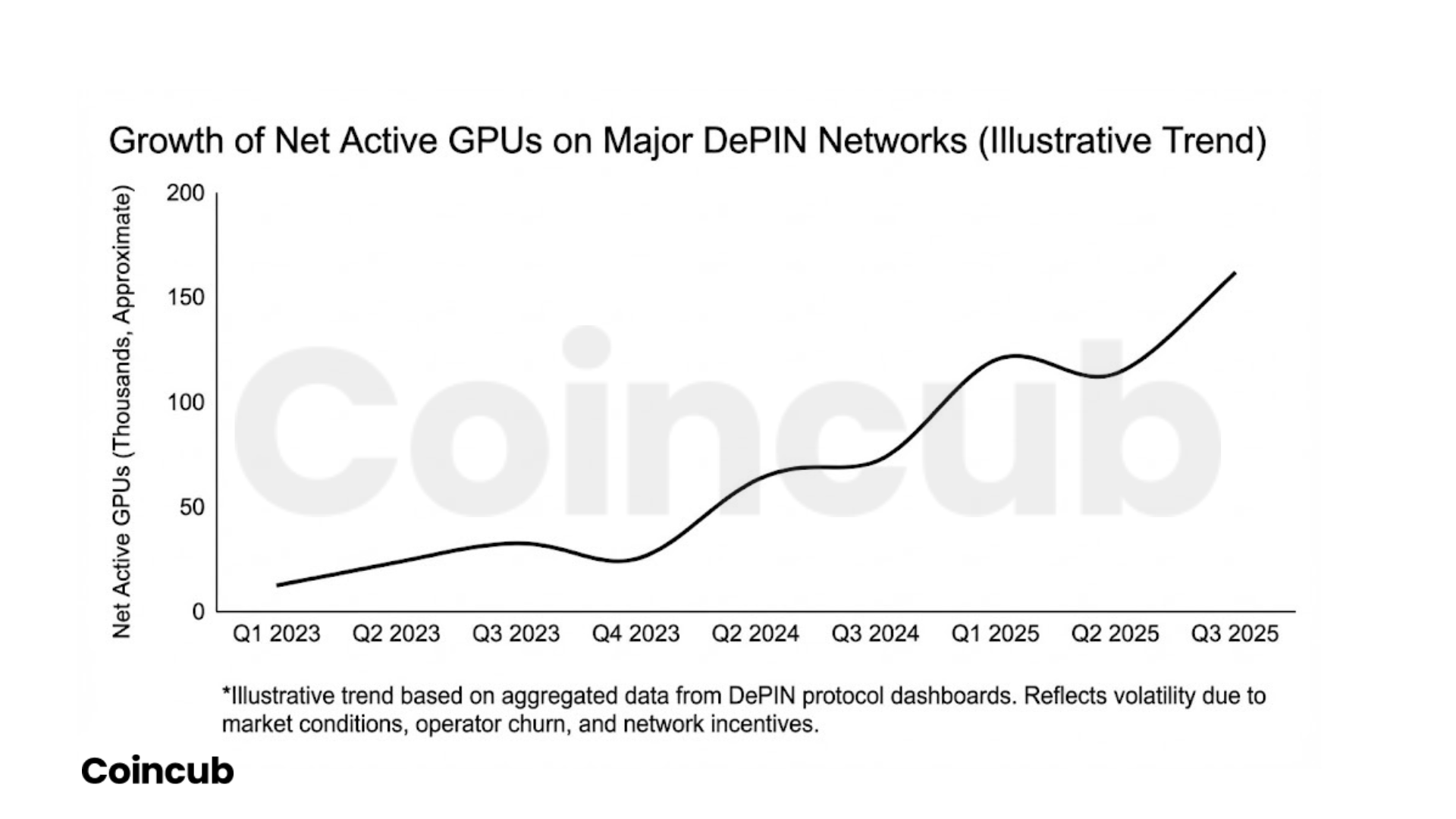
The market has begun to transition from experimental infrastructure to revenue-generating utilities. The “State of DePIN 2025” report published by Messari notes that the sector has stabilized into a $10 billion market. These networks generated $72 million in verifiable on-chain revenue over the past year. DePIN aggregates latent resources and routes them to developers who need immediate capacity. By crowdsourcing hardware, the network completely bypasses the capital expenditures required to construct new data centers.
Physical Limits and the Compute Bottleneck
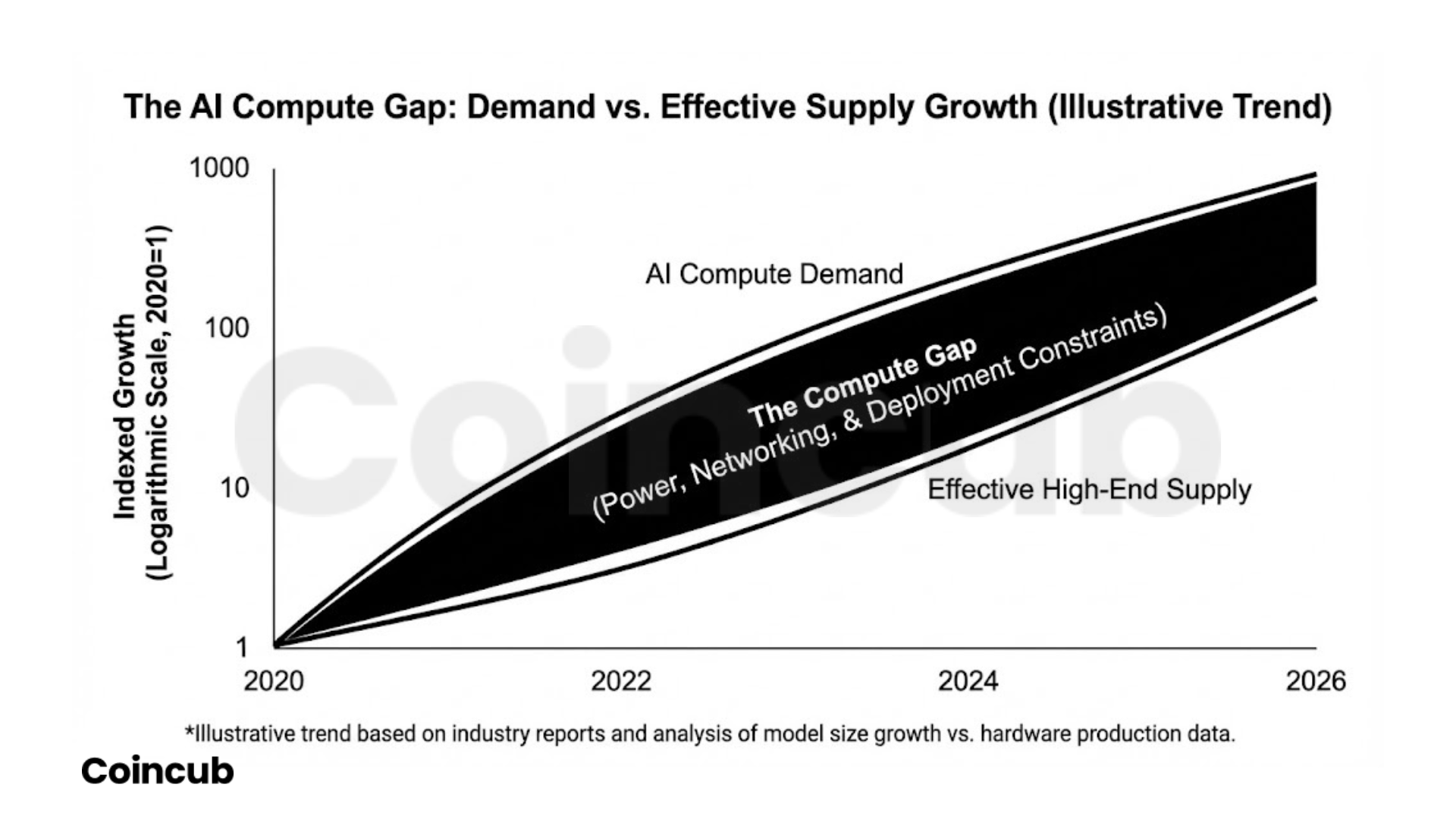
The artificial intelligence industry faces hard physical constraints. Silicon performance improvements have slowed to an annual growth rate of roughly 20%. Simultaneously, the computational power required to train frontier models doubles every 3.4 months. Optimizing a robust language model requires testing hundreds of thousands of distinct parameter configurations. This exponential demand curve forces centralized providers to construct increasingly massive infrastructure.

Power availability dictates the ceiling for centralized AI expansion. A single hyperscale data center, such as the xAI Colossus facility in Memphis, draws 350 megawatts of power. Ownership plans to expand that facility to 1.5 gigawatts. OpenAI intends to scale its Abilene Stargate facility to 1.2 gigawatts. Industry projections indicate that individual training clusters will require up to ten gigawatts of power by the end of the decade. Ten gigawatts rivals the output of the Grand Coulee Dam, the largest power plant in the United States.
Regional power grids lack the capacity to support these contiguous loads. Major utility executives warn that supplying even five gigawatts to a single facility creates severe infrastructural stress. Centralized cloud providers dictate pricing because they control the limited supply of active hardware. Amazon Web Services, Google Cloud, and Microsoft Azure apply steep markups to high-end accelerators. Furthermore, egress fees punish developers financially when they attempt to move data out of a specific cloud ecosystem.
Network Economics and Market Realities
The economic model underpinning decentralized infrastructure is messy and currently undergoing a necessary transition. Early DePIN projects survived almost entirely on inflationary token emissions. Networks subsidized hardware providers with highly inflationary tokens to bootstrap supply. That model collapsed for many networks when token prices inevitably fell, leaving providers unprofitable.
The surviving protocols now enforce utility-driven tokenomics. Projects link token emissions directly to verifiable compute sales and stablecoin revenue. Messari characterizes the current market leaders as undervalued, noting they trade at ten to twenty-five times their revenue. The reality of the market is mixed. Some networks still subsidize supply to maintain liquidity, and some transparency claims remain aspirational rather than fully realized.
Decentralized networks offer steep discounts on raw compute. An Nvidia H100 GPU costs upwards of $7.90 per hour on a legacy cloud provider. The same hardware frequently lists between $2.56 and $5.95 on decentralized networks. Thunder Compute and Verda report similar spreads for older A100 models, showing 45% to 60% compared to AWS. Startups migrate specific workloads to survive. Leonardo.Ai scaled to 19 million users and cut their inference costs by 50% using decentralized nodes. Wondera utilized a decentralized cluster of 96 high-end GPUs to train audio models, saving over $2 million against projected AWS costs.
Hardware Reality: Training vs. Inference
Decentralized networks supplement centralized hyperscalers; they do not replace them. The distinction between training an AI model and running inference dictates where DePIN functions effectively.
Training frontier foundation models requires thousands of GPUs operating in perfect synchronization. The processors must share memory states constantly. Centralized data centers bind these chips together using ultra-high-bandwidth, low-latency technologies like NVLink. Decentralized networks rely on the public internet to connect geographically isolated nodes. Internet bandwidth fluctuates drastically, ranging from 200 megabits to 100 gigabits per second. Mailing data packets across the open internet introduces latency that completely disrupts synchronous training loops. Frontier model training will remain inside centralized data centers due to these unyielding physical laws.
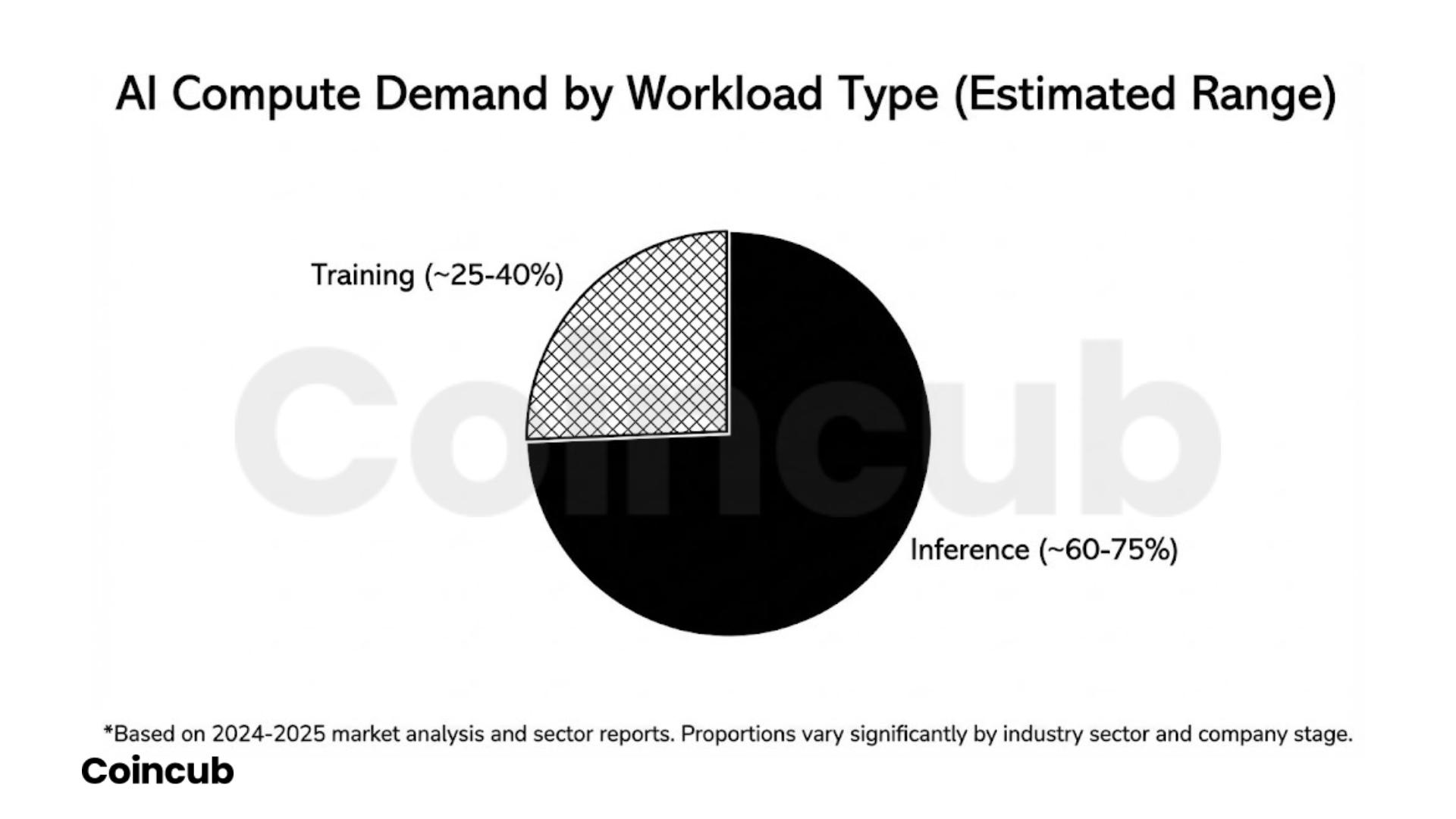
Inference represents a fundamentally different workload. Inference occurs when a trained model processes new data to generate a response. These tasks are atomizable. An application can split thousands of inference requests and route them to completely independent, isolated nodes without requiring the nodes to synchronize. Industry analysts estimate that inference, agentic workflows, and prediction loops drive up to 70% of global GPU demand. Decentralized architecture excels here. Networks place compute geographically closer to the end-user, reducing latency for specific requests and respecting regional data sovereignty laws.
Protocol Synthesis and Value Capture
The decentralized AI stack operates across multiple layers. The ecosystem relies on hardware aggregators, verification protocols, and data pipelines working in tandem.
- Hardware Aggregation: Protocols like io.net, Akash Network, and Aethir gather the physical supply. io.net integrates deeply with Ray.io to cluster GPUs specifically for machine learning. Akash Network operates a reverse-auction marketplace for containerized applications, recently expanding support to top-tier Nvidia GPUs. Aethir targets enterprise gaming and AI deployments by aggregating Tier-4 data center resources. These networks act as the physical backbone, routing workloads to available machines.
- Verification and Intelligence: Decentralized networks must prove that untrusted hardware executed tasks correctly. Gensyn developed the Verde Verification Protocol to solve this trust gap. Generating cryptographic zero-knowledge proofs for deep learning costs more than the computation itself. Verde uses refereed delegation. A task goes to multiple providers. If their outputs disagree, a bisection game pinpoints the exact mathematical operation where the divergence occurred. A neutral referee re-executes only that single operation to identify the malicious node. Bittensor approaches intelligence differently. It operates subnets where AI models compete to produce the best outputs. Subnet 64, known as Chutes, provides serverless compute for massive models and routes rewards based on performance.
- Data Pipelines: Models require immense volumes of clean data. Grass operates a decentralized web-scraping network that utilizes millions of residential bandwidth connections. The network cleans public web data and uses zero-knowledge proofs to guarantee data provenance. Filecoin provides the permanent storage layer for raw datasets and model checkpoints.
Value capture across this stack remains highly fragmented. No single protocol dominates every layer. Hardware providers capture the actual fiat value of the compute they supply. Token holders capture value when networks implement buy-and-burn mechanics tied to network revenue. The fragmentation creates friction. Developers must piece together storage from Filecoin, compute from Akash, and verification from Gensyn to build a fully decentralized application.
The Hardest Question: The Enterprise Adoption Wall
Decentralized computing costs a fraction of AWS and offers global distribution. Despite these advantages, the vast majority of startups and enterprises remain locked into centralized providers. Corporate adoption stalls against severe operational realities, orchestration complexity, and procurement friction.
Reliability Variance and Overprovisioning
A decentralized network inherently possesses higher reliability variance than a dedicated data center. Nodes consist of residential setups, independent mining farms, and data centers at varying tiers. Individual machines go offline due to local power outages, hardware failures, or operators simply turning them off.
To maintain uptime on a decentralized network, engineering teams must overprovision resources. Overprovisioning involves allocating more compute power than the workload realistically requires to create a safety buffer. A HashiCorp-Forrester report indicates that 94% of organizations already overspend on cloud infrastructure, with 59% citing overprovisioning as the primary cause. If a startup saves 60% on the hourly rate of a GPU but has to rent twice as many GPUs to guarantee the job finishes without interruption, the economic advantage evaporates. Managing this volatility requires engineering effort that many lean startups cannot spare.
Orchestration and Debugging Failures
Managing distributed AI workloads introduces severe orchestration overhead. Debugging a failed training run or a stalled inference loop across fifty anonymous, geographically dispersed nodes presents a massive technical challenge.
Errors stem from noisy data, floating-point hardware discrepancies, network timeouts, or incorrect learning rates. In a centralized environment, an engineer investigates a unified system log. In a decentralized environment, the orchestrator must determine if the model failed due to an algorithmic flaw or because a specific node in Eastern Europe lost connectivity mid-calculation. An industry analysis indicates that poor orchestration accounts for 42% of AI project failures, driven by unchecked agent behavior and system drift. The technical debt required to build fault-tolerant routing logic deters risk-averse IT departments.
SLA Enforcement and Cryptographic Slashing
Enterprises operate on Service Level Agreements. When AWS promises 99.99% uptime and fails, the enterprise receives a defined billing credit or legal recourse. Decentralized networks replace corporate contracts with cryptographic mechanisms that penalize misbehavior.
Protocols punish bad actors by slashing the tokens they have staked. If a node fails to attest or returns malicious data, the network algorithmically destroys a portion of its collateral. However, translating a cryptographic slashing event into a corporate SLA guarantee remains a massive hurdle. A corporate client does not care if an anonymous node lost $50 in staked tokens; the client cares that their customer-facing chatbot went offline for four minutes. Decentralized networks currently lack the legal and technical frameworks to enforce binding, enterprise-grade SLAs. Until decentralized networks can guarantee performance rather than simply punishing failure, traditional hyperscalers will maintain their enterprise monopoly.
Procurement Friction and Crypto Accounting
Corporate finance departments process fiat invoices through established vendor management systems. Adopting decentralized infrastructure introduces severe procurement friction. Purchasing compute often requires interacting with utility tokens, managing Web3 wallets, and interacting with smart contracts.
Treating tokens as operational expenses creates an accounting nightmare. Companies must track the cost basis of tokens purchased at varying prices, calculate realized gains or losses upon spending them, and ensure compliance across multiple tax jurisdictions. Every token transfer to a compute node constitutes a taxable event in many regions. Integrating these micro-transactions into legacy enterprise resource planning software requires specialized blockchain analytics platforms. Most corporate procurement officers will reject a cheaper compute solution if it requires fundamentally altering their accounting and compliance infrastructure.
Strategic Outlook
The DePIN sector forces a necessary re-evaluation of how physical infrastructure scales. As the industry matures, the networks that succeed will obscure the underlying blockchain mechanics entirely. Developers will pay with credit cards, and the protocol will handle the token conversion and node routing in the background.
Enterprises will increasingly adopt Hybrid AI architectures. They will run sensitive, low-latency models locally on edge devices. They will utilize centralized hyperscalers for massive proprietary data storage and frontier model training. And they will route flexible, burst-capacity inference workloads to decentralized networks to arbitrage costs. The decentralized AI ecosystem provides a critical release valve for the global compute shortage. It forces market efficiency, drives down the cost of foundational intelligence, and ensures that the physical layer of the internet remains open to competition.
Frequently Asked Questions (FAQ)
What is DePIN in the context of AI?
DePIN stands for Decentralized Physical Infrastructure Networks. The model uses blockchain technology and token incentives to coordinate real-world hardware deployments. For AI, DePIN crowdsources GPUs, storage, and bandwidth from independent operators worldwide. This creates a distributed marketplace where developers rent compute power without relying exclusively on centralized hyperscalers.
How do decentralized GPU costs compare to AWS or Google Cloud?
Decentralized networks offer significant discounts by eliminating corporate overhead, real estate costs, and executive margins. Platforms frequently list high-end hardware like the Nvidia H100 or A100 for 45% to 60% less than the hourly rates charged by AWS or Azure. Additionally, decentralized networks rarely charge the exorbitant data egress fees common in centralized ecosystems.
Why do frontier AI models still train on centralized clouds?
Training massive frontier models requires thousands of GPUs working in perfect synchronization. Centralized data centers connect these processors via ultra-fast interconnects such as NVLink to minimize latency. Decentralized nodes connect via the public internet, where bandwidth limits and latency spikes disrupt the highly synchronized training loops required for models with billions of parameters.
What is the difference between AI training and AI inference?
Training is the process of teaching a model to recognize patterns using massive datasets, requiring sustained, synchronous computing. Inference occurs when a trained model processes new data to answer a question or make a prediction. Inference tasks are highly atomizable and can be executed independently across isolated nodes, making them ideal for decentralized networks.
Why are enterprises hesitant to adopt decentralized compute?
Enterprise adoption faces several severe blockers. Decentralized networks suffer from reliability variance, requiring engineers to overprovision resources to guarantee uptime. Managing distributed workloads introduces complex orchestration and debugging challenges. Furthermore, corporate finance departments struggle with the procurement friction and complex tax accounting required when purchasing compute with utility tokens.
How do networks enforce Service Level Agreements (SLAs)?
Traditional cloud providers offer legal contracts that guarantee uptime. Decentralized networks rely on cryptographic slashing. If a node fails to perform its required computation or drops offline, the network algorithmically seizes or burns a portion of the node operator’s staked tokens. Translating these cryptographic penalties into reliable corporate SLA guarantees remains a major challenge for the sector.
How does Gensyn verify machine learning work?
Gensyn uses the Verde Verification Protocol to ensure anonymous nodes perform calculations correctly. It utilizes refereed delegation rather than expensive zero-knowledge proofs. A task is sent to multiple nodes. If the outputs diverge, a bisection game pinpoints the exact mathematical operation where the error occurred. A referee re-runs only that single operation to identify the malicious node.
What role does data scraping play in DePIN?
AI models require continuous, high-quality data feeds. DePIN projects like Grass crowdsource millions of residential internet connections to scrape, clean, and structure public web data. This decentralized approach bypasses the data monopolies held by major tech companies and provides verified training datasets directly to AI laboratories.