Buy a Licensed Company
  Explore VASP Data
  Talk to an Expert

 Atis Shala
Atis is a senior analyst and community lead with four years of experience in crypto. He has a bachelor from the Rochester Institute of Technology.
Atis Shala
Atis is a senior analyst and community lead with four years of experience in crypto. He has a bachelor from the Rochester Institute of Technology.
Near Protocol Price Prediction 2026-2030
- Near Protocol has successfully pivoted from being a Solana alternative to the universal orchestration layer for the Agentic Web. Its core value in 2026 is its ability to handle cross-chain identities and payments, making the underlying blockchain effectively invisible to the end-user.
- A landmark governance shift in late 2025, the Halving Upgrade, slashed maximum annual inflation from 5% to 2.5%. This move, combined with a verifiable 1 million TPS benchmark achieved through 70 shards, has transformed NEAR’s tokenomics from a high-emissions model to one aimed at sustainable, demand-driven scarcity.
- Chain Abstraction is no longer a concept but a production-ready reality. Through Multi-Party Computation (MPC) and Chain Signatures, a single Near account can now sign transactions on over 25 blockchains, including Bitcoin and Ethereum. This allows Near to capture value (via gas and storage fees) from activity happening outside its own ecosystem.
- The protocol has become the primary settlement layer for User-Owned AI. Using IronClaw technology and Trusted Execution Environments (TEEs), Near enables AI agents to perform private financial tasks without exposing sensitive data. This makes it a preferred infrastructure for the autonomous economy where agents, not just humans, are the primary transaction drivers.
- Institutional interest has hit a fever pitch with Bitwise filing for a spot NEAR ETF in late 2025. This, alongside the launch of regulated ETPs by firms like Grayscale, signals a shift from retail speculation to NEAR being viewed as essential Web3 infrastructure on par with ETH.
- Looking toward 2030, Near’s trajectory is a binary bet on the Invisible Web. If the Near.com Super-App succeeds in onboarding the next 100 million users via gasless, human-readable accounts, the Infrastructure Premium could drive the token into the $130–$180 range. However, its success remains tied to winning the high-stakes battle for developer mindshare against parallelized EVM competitors.
The Era of L1s: Near Protocol
In 2026, the cryptocurrency industry operates on a frequency distinct from the speculative craziness of previous cycles. We have moved past the era where whitepapers alone commanded billion-dollar valuations. Today, the market demands execution, tangible network activity, and a clear path to sustainable revenue. In this matured landscape, Near Protocol stands at a critical juncture. It is no longer just fighting for market share among Layer-1 blockchains; it is attempting to redefine how users interact with the entire Web3 ecosystem through Chain Abstraction and User-Owned AI.
Our outlook examines Near Protocol not merely as a token but as a technology stack. We will assess its transition from a standard smart contract platform to a universal interface for the decentralized web. We will analyze the impact of the 2025 tokenomics shift, the reality of its AI integration, and the institutional currents shaping its future. This is a scenario-based forecast designed to educate rather than hype.
This article is for educational purposes only and is not financial advice. Cryptocurrencies carry risk as they are volatile. Do your own research and only invest what you can afford to lose!

Near Protocol in 2026
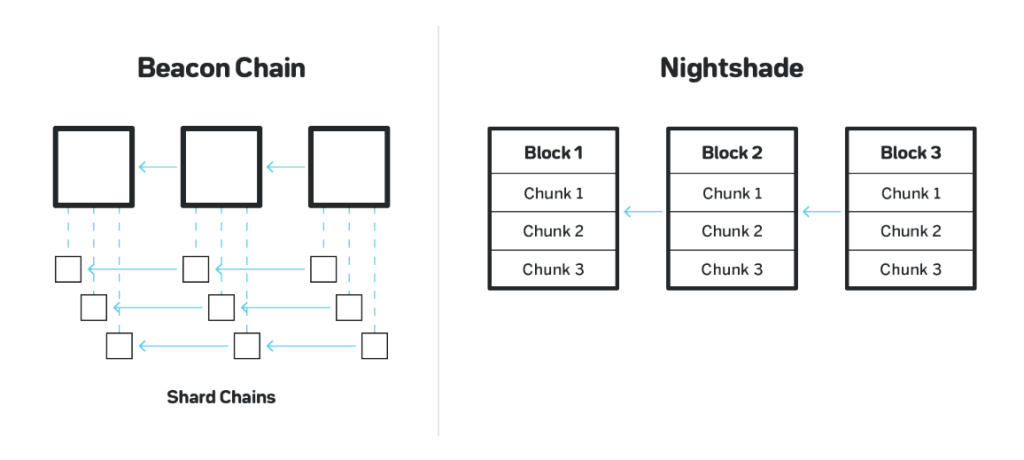
By today, Near Protocol has evolved significantly from its initial positioning as a simple competitor to Ethereum. It now functions as a high-throughput Layer-1 and a cross-chain orchestration layer. The network operates on the Nightshade sharding architecture, which allows it to process transactions in parallel, aiming for infinite scalability.
The project currently focuses on two primary narratives. First, chain abstraction allows users to transact on any blockchain without leaving their Near account. Second, the AI-Native thesis positions the network as the settlement layer for autonomous AI agents.
From a financial perspective, the protocol recently underwent a major shift. The governance vote in late 2025 to reduce inflation from roughly 5% to approximately 2.5% altered the supply dynamics, aiming to make the asset deflationary under high network usage. The core investment question for the next four years is simple. Can Near Protocol successfully capture the value of transactions happening on other chains via its abstraction layer, or will it remain an isolated island in a sea of liquidity?
What Is Near Protocol?
To understand where the price might go, we must first understand the fundamental problem Near solves. Historically, blockchains have been hostile environments. Users navigated a fragmented maze of technical hurdles. They had to manage complex remote procedure calls (RPCs), manually bridge assets between networks, and hoard specific gas tokens for every chain they touched. This friction killed mass adoption before it could even begin.
Near Protocol emerged with a mission to act as the Blockchain Operating System. It prioritizes usability above all else. Unlike Ethereum or Solana, where an account is a string of hexadecimal characters, Near uses human-readable account names, such as user.near. These accounts function like smart containers. They can hold sub-accounts, manage complex permissions, and even recover access via email or phone, removing the terrifying finality of losing a private key.
This focus on the frontend of crypto is not just a cosmetic feature. It represents a philosophical divergence from other Layer-1s. While others chased pure speed or total decentralization at the cost of usability, Near built a foundation designed to onboard the next billion users seamlessly. The network achieves high speed and low cost through Proof-of-Stake consensus, but its true value proposition in 2026 lies in its ability to hide the blockchain entirely. A user playing a game or using a social app on Near often does not realize they are interacting with a distributed ledger. This invisibility is the holy grail of Web3 adoption.
The Tech Stack of NEAR Protocol
The price of the NEAR token serves as a reflection of the demand for block space and the utility of the network. Several technical pillars directly influence this value.
Most blockchains struggle with a trilemma where security, decentralization, and scalability conflict. Near utilizes a sharding design called Nightshade to bypass this bottleneck. Instead of requiring every validator to process every transaction, Nightshade splits the network into parallel shards or lanes. As more nodes join the network, the capacity increases linearly.
By 2026, the implementation of stateless validation further refined this process. Validators no longer need to download the entire state of the blockchain to verify a block. This lowers hardware requirements and improves decentralization. For the investor, this technology ensures that the network can handle massive spikes in traffic without gas fees skyrocketing. While low fees might seem counterintuitive for token value appreciation, Near relies on a volume-based model. It aims to process billions of micro-transactions rather than a few high-value ones.
NEAR Protocol Chain Abstraction and Intents
The most potent driver for Near in the current cycle is chain abstraction. This technology fundamentally changes the role of the NEAR token. Through a cryptographic method called Multi-Party Computation (MPC), a Near account can sign transactions on foreign chains. A user can hold assets on Near and execute a trade on an Ethereum decentralized exchange or sign a Bitcoin transaction without ever leaving the Near interface.
This transforms Near into a universal dashboard for the crypto economy. If this narrative holds, users will hold NEAR not just to pay for transactions on the Near network, but to subsidize gas fees across the entire ecosystem. It effectively turns NEAR into a universal gas token, aggregating demand from Ethereum, Solana, and Bitcoin users who prefer the Near user experience.
The Convergence of AI and Web3 The third pillar of the 2026 thesis is the User-Owned AI narrative. Centralized AI models dominate the technology sector, but they lack transparency and user control. Near positions itself as the infrastructure for decentralized AI. The low-cost, high-speed environment is ideal for AI agents, autonomous software programs that perform tasks on behalf of users.
An AI agent might book travel, manage a portfolio, or purchase data services. These agents require a payment rail that is fast, programmatic, and permissionless. Near provides this rail. The introduction of Near Tasks creates a marketplace for data labeling and AI training, settled onchain. If AI agents become the primary users of the internet, the blockchain that hosts them will see exponential growth in transaction volume. Near is betting its future on being that home.
NEAR Protocol Ecosystem Growth
Technology without adoption is merely an academic exercise. For Near Protocol to justify a multi-billion dollar valuation in 2026, it must demonstrate that its chain abstraction thesis is actually attracting users. The ecosystem landscape has shifted drastically over the last two years, moving away from the total value locked (TVL) metrics that dominated the DeFi summer of 2020 and toward a metric that Near prioritizes: Daily Active Accounts (DAA).
The Consumer App Engine Near has carved a distinct niche by becoming the backend for consumer-facing applications. While Ethereum dominates high-value finance and Solana captures the memecoin casino, Near has quietly onboarded millions of users who barely realize they are using blockchain.
Applications like Sweat Economy and Kai-Ching (by Cosmose AI) served as the initial proof of concept, but the 2026 landscape is defined by Super Apps. These platforms aggregate messaging, payments, and gaming into single interfaces. The growth here is sticky. Unlike DeFi yield farmers who migrate to the highest APR, users of a fitness app or a shopping loyalty program tend to stay. This creates a baseline of consistent network activity that is less correlated with the volatility of the broader crypto market.
However, consumer apps alone cannot sustain a Layer-1 economy. A robust financial layer is required to service the liquidity needs of these users. The Near DeFi ecosystem has matured into a functional, if not dominant, sector. Liquid Staking has become the standard, with protocols unlocking the liquidity of staked NEAR to be used across lending markets.
Bitcoin Integration Within NEAR Protocol
The critical evolution here is the integration of Bitcoin. Through the Bitcoin non-custodial bridging initiatives, Near has positioned itself as a secondary execution layer for Bitcoin liquidity. This allows Bitcoin holders to use their assets in Near’s DeFi ecosystem without trusting a centralized bridge, a significant unlock for the network’s total value locked.
Perhaps the most significant shift in 2026 is the changing perception of Near among institutional allocators. Following the filing for a potential conversion of the Grayscale Near Trust into a spot ETF in January 2026, the narrative has moved from experimental tech to investable infrastructure.
Enterprises are less interested in decentralization and more interested in reliability and predictability. Near’s stable fee structure and partnership-heavy approach with major Web2 conglomerates have made it a preferred sandbox for corporate blockchain pilots. The success of these pilots is a leading indicator for the protocol’s long-term retention.
Tokenomics: The Economic Machine
Understanding the price potential of NEAR requires a deep look at the engine under the hood. The tokenomics of 2026 are fundamentally different from the high-inflation model of 2022. The governance decision in late 2025 to reduce annual inflation from roughly 5% to approximately 2.5% marked a turning point in the asset’s supply dynamics.
The NEAR token serves three primary functions:
- Security: It is staked by validators to secure the network.
- Gas: It is used to pay for transaction fees and data storage.
- Governance: It is used to vote on protocol upgrades and resource allocation.
The interplay between these functions creates a specific economic pressure. As network usage rises, more NEAR is burned for gas. Simultaneously, the demand for state staking increases. On Near, developers and users must lock a small amount of NEAR to pay for the storage space their account data occupies. This is state rent.
Consider the implications of the AI narrative here. If millions of AI agents are launched onchain, each requiring its own account and data storage, the amount of NEAR locked for storage grows exponentially. This effectively removes tokens from the circulating supply, creating a supply shock that complements the fee-burning mechanism.
With inflation cut to ~2.5% and transaction volume stabilizing at high levels, the real yield for stakers has become attractive. We are no longer looking at nominal yields eroded by massive dilution. Instead, stakers are earning rewards in an environment where the supply expansion is modest. This shift entices long-term holding, further reducing the sell pressure on the open market.
Key Price Drivers for NEAR
Forecasting price action for the latter half of the decade involves weighing bullish catalysts against bearish headwinds. The market will likely price NEAR based on its ability to execute on its chain abstraction promise.
The Bullish Drivers for NEAR
- The Aggregation Monopoly: If Near succeeds in becoming the Universal Account for Web3, it captures value from every other chain. Users paying gas in NEAR to execute trades on Ethereum or Solana is the ultimate value capture scenario.
- AI Agent Explosion: We are witnessing the infancy of onchain autonomous agents. If Near becomes the standard rail for agent-to-agent commerce, the transaction volume could dwarf current human-generated traffic.
- The Usability Premium: As crypto attempts to onboard the late majority, the premium on User Experience (UX) skyrockets. Near’s human-readable accounts and seed-phrase-free onboarding make it the most logical entry point for non-technical users.
The Bearish Risks for NEAR
- The Liquidity Moat: Ethereum and Solana possess massive liquidity moats. If Near cannot attract sufficient stablecoin liquidity, it risks becoming a zombie chain, technically superior but financially barren.
- Regulatory Fragmentation: Chain abstraction relies on complex cryptography (MPC). Regulatory crackdowns on privacy tools or non-custodial bridging could severely hamper Near’s core value proposition in the United States and Europe.
- Competition: The high throughput lane is crowded. Newer parallelized EVM chains (like Monad or Sei) offer similar performance guarantees with better compatibility for existing Ethereum developers.
NEAR Adoption Metrics
Investors should filter out the noise and focus on four key metrics that signal genuine health:
- Monthly Active Accounts (MAA) with >$1 balance: This filters out bot spam and empty wallets.
- External Chain Transactions: The number of transactions Near accounts sign on other chains. This measures the success of chain abstraction.
- Storage Staking Volume: The amount of NEAR locked for data storage. This is a proxy for the growth of complex apps and AI agents.
- Developer Retention: The number of active repositories and contributors. If developers leave, the ecosystem dies.
NEAR Protocol Adoption Metrics to Watch
Investors must look past the price ticker to understand the health of the network. A practical checklist of metrics provides the necessary clarity:
- Monthly Active Accounts (MAA) with Balance: This tracks real users rather than empty bot wallets.
- MPC Signature Volume: This measures how many users utilize Near to interact with other chains.
- Shard Expansion: The recent move to 9 shards in late 2025 indicates growing demand for blockspace.
- Staked Percentage: A stable staking ratio near 50% ensures security and reduces liquid supply.
- Developer Activity: Continuous commits to the Nearcore and Near Intents repositories signal long-term protocol viability.
We base our models on three distinct trajectories:
- The Bear Case: Assumes slow adoption of chain abstraction and continued dominance by Solana and Ethereum.
- The Base Case: Forecasts steady growth in consumer applications and moderate success in the AI agent economy.
- The Bull Case: Envisions Near becoming the primary Operating System for Web3, coupled with an approved spot ETF and a global crypto bull market.
Near Protocol (NEAR) Price Prediction 2026-2030
Before reviewing the scenarios, here is the starting point: as of mid-2026, NEAR traded near 1.90 to 2.20 dollars with a market cap around 2.4 billion dollars. That matters because roughly half of 2026 has already passed without NEAR approaching the 4.50 to 8.00 dollar base case below, so treat these ranges as full-cycle targets that depend on a spot ETF approval and a broad market upturn rather than near-term price levels.
| Year | Bear Case (Low-High) | Base Case (Low-High) | Bull Case (Low-High) | Key Narrative |
| 2026 | $1.20 – $3.50 | $4.50 – $8.00 | $12.00 – $18.00 | Ecosystem Rebuilding & ETF Filing |
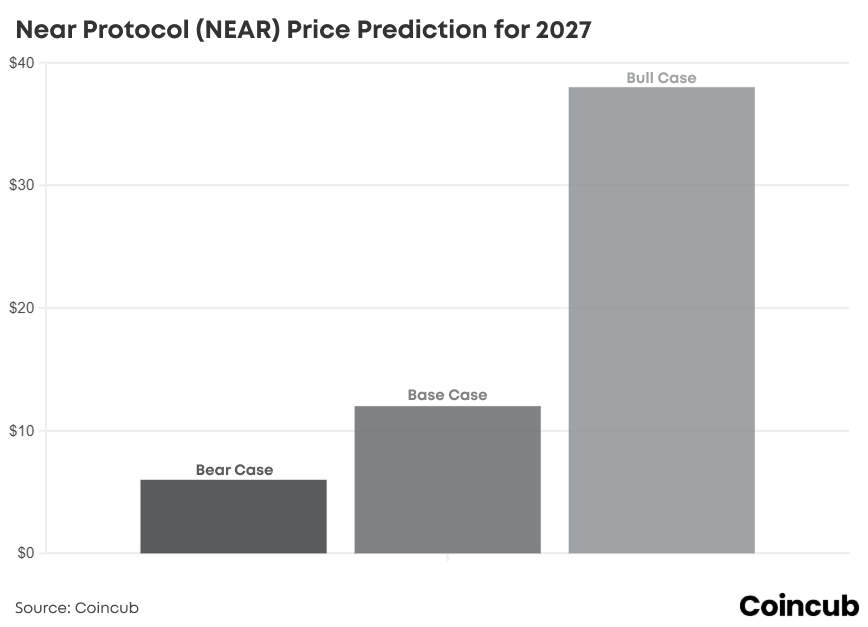
| 2027 | $2.50 – $6.00 | $10.00 – $15.00 | $35.00 – $50.00 | Chain Abstraction Breakout |
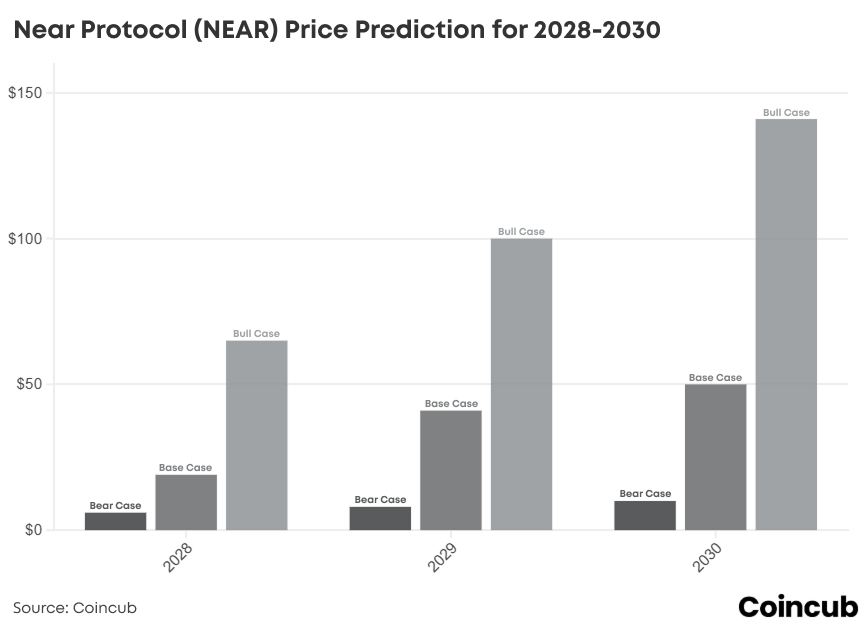
| 2028 | $4.00 – $9.00 | $18.00 – $28.00 | $60.00 – $85.00 | AI Agent Economy Maturation |
| 2029 | $6.00 – $12.00 | $30.00 – $45.00 | $90.00 – $115.00 | Infrastructure Premium Phase |
| 2030 | $10.00 – $15.00 | $50.00 – $75.00 | $130.00 – $180.00 | Mass-Market Consumer L1 |
Near Protocol (NEAR) Price Prediction 2026
The current year focuses on accumulation and infrastructure refinement. The halving of inflation to 2.5% in late 2025 has started to tighten the supply. The primary catalyst for 2026 is the institutional narrative. If the SEC approves the spot ETF applications, we expect a significant re-rating. However, a weak macro environment remains the primary risk to this recovery.
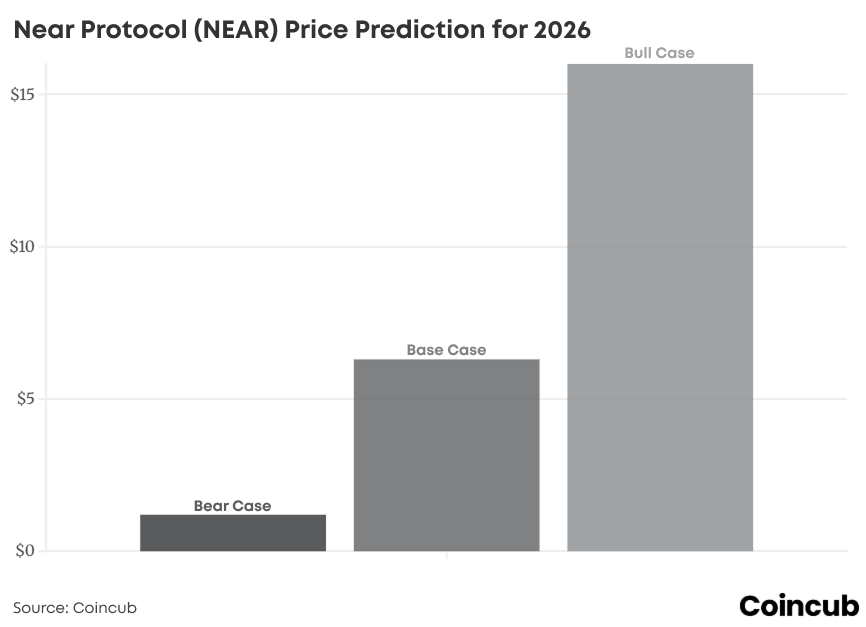
Reflecting this Ecosystem Rebuilding phase, the divergence in price outcomes is heavily dependent on institutional flows. In our bull case, where the ETF filing narrative takes hold and liquidity returns, NEAR targets a price between $12.00 and $18.00, effectively reclaiming cycle highs. Conversely, a failure to capture this momentum could see the token struggle in a bear case of $1.20-$3.50, barely holding above accumulation zones. The most probable base case settles between $4.50-$8.00, assuming steady developer retention and a wait-and-see approach from Wall Street.
Near Protocol (NEAR) Price Prediction 2027
By 2027, the success of Near Intents will determine the price. If users find value in controlling their Ethereum and Bitcoin assets through a single Near account, the protocol creates a sticky user base. This year could see the first major breakout toward previous all-time highs as the network effects of chain abstraction compound.
The market anticipates a definitive chain abstraction Breakout in 2027. If NEAR successfully abstracts away the complexities of bridging and gas fees, the bull case projects a violent repricing to $35.00-$50.00, driven by a premium on user experience dominance. However, if Near Intents fails to gain traction against competing interoperability solutions, the protocol risks stagnation; the bear case envisions a cap at $2.50-$6.00. A realistic base case of $10.00-$15.00 suggests moderate adoption where NEAR functions as a successful, though not monopolistic, orchestration layer for Web3.
Near Protocol (NEAR) Price Prediction 2028-2030
In the final years of the decade, the focus shifts to the AI economy. If autonomous agents become the primary drivers of transaction volume, Near’s sharded architecture will likely be one of the few platforms capable of handling the load at a low cost. In the bull case, NEAR achieves a valuation comparable to top-tier Layer-1s, reflecting its role as a global coordination layer.
As we approach 2030, the valuation gap widens into a binary outcome based on the AI Agent Economy. By 2028, a functional AI ecosystem could drive the bull case to $60.00-$85.00, eventually peaking in 2030 between $130.00-$180.00 as NEAR cements itself as a Mass-Market Consumer L1. This scenario assumes it becomes the standard infrastructure for autonomous agents. In stark contrast, if the network fails to capture this AI volume, the bear case sees prices languishing between $10.00-$15.00 by 2030, a minimal return over five years. The base case tracks the Infrastructure Premium narrative, steadily climbing from $18.00 in 2028 to prices around $50.00 by the decade’s end.
What Could Move NEAR to New Highs?
Several black swan events could accelerate this timeline:
- The Killer Consumer App: A social media or gaming platform that onboards 100 million users via Near’s seamless UX.
- Layer-1 Consolidation: If fragmented liquidity begins to flow toward a few dominant hubs, Near’s abstraction tech positions it as a natural winner.
- Regulatory Clarity: Definitive favorable laws for Proof-of-Stake networks would remove the uncertainty discount currently applied to NEAR.
No investment is without danger. When conducting your own research, watch for these red flags:
- Governance Centralization: Monitor the House of Stake to ensure power remains distributed among validators.
- Developer Migration: If builders leave Near for parallelized EVM chains, the ecosystem will hollow out.
- Inflation vs. Burn Ratio: If transaction volume fails to rise, the 2.5% inflation will continue to dilute holders without an offset.
- Security Breaches: Any vulnerability in the MPC network used for chain abstraction would be catastrophic for trust.
Final Thoughts on Near Protocol’s Future
Near Protocol presents one of the most compelling infrastructure bets for the late 2020s. Its shift away from pure speed toward usability and AI integration sets it apart from a crowded field of Layer-1 competitors. The price of NEAR will likely mirror the network’s ability to simplify the decentralized web. While our scenarios provide a range of targets, the ultimate outcome depends on whether the world is ready for User-Owned AI and a blockchain that is finally invisible to the end-user.
Frequently Asked Questions (FAQ)
What is NEAR's price in 2026? +
As of mid-2026, NEAR Protocol traded in roughly the 1.90 to 2.20 dollar range, with a market cap near 2.4 billion dollars. The price sat well below prior highs, so the higher forecasts in this guide depend on future catalysts rather than current conditions.
Is NEAR a good investment in 2026? +
NEAR may suit investors who believe in chain abstraction and User-Owned AI, but it carries real risk from strong Layer-1 competition and uncertain AI-agent adoption. Its low price offers upside if the thesis plays out, though none of the higher targets are guaranteed.
What is NEAR Protocol used for? +
NEAR Protocol is a high-performance Layer-1 blockchain used for building decentralized applications (dApps). Its sharding technology, Nightshade, enables massive scalability with sub-cent fees. Currently, it is a leader in chain abstraction, allowing users to manage assets across different blockchains, like Ethereum and Bitcoin, through a single, human-readable account, significantly simplifying the overall Web3 user experience.
Does near coin have a future? +
NEAR has a robust future as it evolves into a universal Blockchain Operating System. Its 2026 roadmap focuses on scaling to one million transactions per second and integrating AI-native workloads. With a maturing ecosystem, a shift toward deflationary tokenomics, and increasing institutional interest from spot ETF filings, NEAR is positioned as a primary infrastructure provider for the decentralized web.
Can near coin reach $100? +
While reaching $100 is an optimistic long-term goal, it would require NEAR to become a top-tier cryptocurrency by market capitalization. Most credible 2026-2030 forecasts suggest a more realistic climb toward $25 to $50. Achieving $100 depends on the global adoption of its AI agent infrastructure and the successful execution of its multi-chain abstraction thesis.
How high can near go in 2026? +
For 2026, price projections for NEAR range from a conservative $9.50 to a bullish $18.75. Factors influencing this height include the potential approval of a spot NEAR ETF and the success of its recent sharding upgrades. While market volatility remains a factor, the protocol's fundamental growth suggests significant upside potential as it captures more institutional and developer mindshare.
Is near an AI crypto? +
Yes, NEAR is widely recognized as a premier AI crypto. It specializes in User-Owned AI, offering a secure environment for autonomous agents to transact and manage data. With its founder being a pioneer in modern AI research, the protocol has integrated AI Cloud tools and encrypted inference, making it a preferred settlement layer for decentralized artificial intelligence applications.