


 Buy a Licensed Company
  Explore VASP Data
  Talk to an Expert

 Atis Shala
Atis is a senior analyst and community lead with four years of experience in crypto. He has a bachelor from the Rochester Institute of Technology.
Atis Shala
Atis is a senior analyst and community lead with four years of experience in crypto. He has a bachelor from the Rochester Institute of Technology.
Prediction Markets vs. Media: The Live Reporting Battle
People love guessing what comes next. We predict the weather, elections, stock prices, and even who wins reality shows. But something changed in the 2020s. Markets started predicting faster than journalists could report. Platforms like Polymarket, Manifold, and Kalshi began showing probabilities for real-world events before the first headline appeared. The crowd didn’t just consume the news; it started moving ahead of it.
That shift created a clash between two kinds of truth. The media tells stories built on narrative, shaped by perspective, bias, and timing. Prediction markets run on numbers, prices that move with every new piece of information. Journalists ask, “What’s happening?” Markets ask, “How likely is it to happen?” The difference is subtle but powerful. One describes reality, the other measures it.
What Are Prediction Markets?
Prediction markets now act like live news feeds. Every bet on a political outcome, policy decision, or sports event turns into a data point. The more people trade, the sharper the odds become. In a way, these markets crowdsource truth. They reward those who are right and penalize those who are wrong. No opinions, no clickbait. Just people putting money where their mouth is.

The real question is not whether prediction markets will replace journalism, but whether they will change how people trust information. Would you rather read an article that says “analysts think” or look at a market showing a 72 percent chance that something happens determined by real people putting real money behind outcomes of certain events?
Prediction markets do not destroy journalism. They push it to improve and demand faster reporting, clearer facts, and accountability to data. And in that transformation, we get closer to what news was always meant to be: a real-time reflection of reality, powered by everyone, not just a few voices in a newsroom.
How Headlines Are Being Challenged by Odds
For centuries, news shaped how people understood the world. Newspapers once held the monopoly on truth, deciding what was worth knowing. Television brought that authority to living rooms, turning anchors into national voices of trust. Then came social media, where anyone could publish and everyone could react. What began as democratization slowly turned into noise. In the race to go viral, speed began to outweigh accuracy.
Today, credibility is the media’s biggest problem. Audiences scroll past headlines designed to provoke emotion rather than inform. Stories are framed for engagement, not understanding. Political leanings, algorithmic incentives, and financial pressures all shape what gets published and how it’s told. As trust erodes, people turn to data, betting odds, and open models that promise transparency, something traditional media lost.
The rise of data-driven storytelling marked the first step in that shift. Outlets such as FiveThirtyEight, Bloomberg, and The Economist began to blend journalism with statistics, using models to explain rather than predict. Betting markets and poll aggregators joined the conversation, offering probabilities instead of opinions. The appeal is simple: numbers feel honest. They may not always be right, but they show their reasoning in public.
Prediction Markets on the Blockchain
Then blockchain prediction markets pushed this evolution further. Platforms like Polymarket let anyone trade on future outcomes without asking for permission or relying on central gatekeepers. Users can deposit different stablecoins and cryptocurrencies like Solana and Ethereum and use them to predict immediately. Every trade leaves a record onchain, visible to anyone. That makes truth not only measurable but also verifiable. A market cannot hide its bias; the odds reveal collective belief in real time.
The contrast is striking. Journalists interpret data to tell a story. Prediction markets price data to reveal probability. One depends on trust in the author; the other depends on trust in the crowd. Both aim to explain reality, but their incentives differ. The journalist seeks attention, while the trader seeks accuracy.
In that tension lies the future of information. The public no longer waits for headlines to confirm what the odds already suggest. Truth, once filtered through editors and producers, now moves freely through markets that reward precision over narrative. The story is still being written, but this time, it is priced instead of printed.
How Do Prediction Markets Work?
Prediction markets turn opinions into tradable assets. Each market represents a future event, such as “Will Candidate X win the election?” or “Will inflation fall below 3 percent by December?” Instead of posting opinions, participants buy and sell shares that represent outcomes. The price of each share reflects the crowd’s collective belief in how likely something is to happen. If a share trades at 0.72, it suggests a 72 percent chance that the event will occur.
At their core, prediction markets act as information aggregators. Every trader contributes a mix of data, instinct, and bias. When money is at stake, people reveal what they truly believe, not what they want others to hear. Prices shift instantly when new information appears, creating a live and constantly updated consensus built on incentives rather than commentary.
2024 Elections as a Stress Test for Prediction Markets
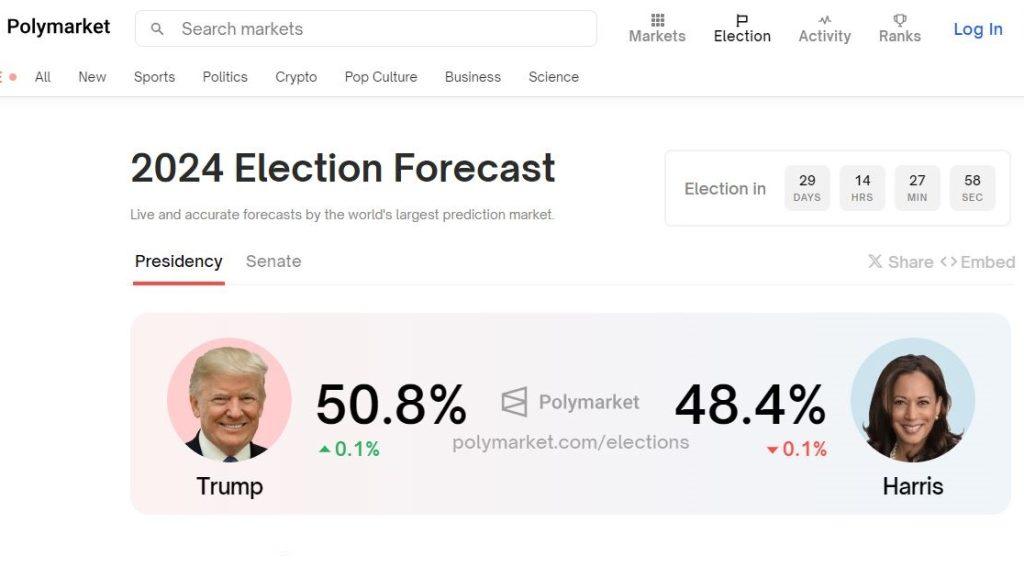
Polymarket illustrates this well. During the 2024 U.S. election, its trading odds often outperformed major polls in predicting outcomes. While mainstream outlets debated narratives about campaign momentum or candidate strategy, Polymarket’s prices reacted in real time to news, debates, and shifts in sentiment. Polls capture what people say. Markets capture what people are willing to bet on.
Three forces drive this accuracy: liquidity, incentives, and belief contracts. Liquidity allows enough traders to move in and out of positions without distorting the price. Incentives align truth with profit since being wrong costs money. Belief contracts, the yes-or-no outcome shares, let traders express conviction directly through price. Together, these elements create what economists call the “wisdom of the market,” where collective judgment becomes sharper than expert analysis.
For credibility, blockchain prediction markets rely on oracles like UMA that verify real-world results. When an event settles, oracles confirm the outcome and trigger automatic payouts. This process happens transparently onchain, making manipulation extremely difficult. The entire system operates without intermediaries, giving users confidence that every result is fair and verifiable.
The real difference between journalism and prediction markets is accountability. Newsrooms often operate under a “publish first, correct later” rhythm, driven by speed and engagement. Prediction markets follow a tougher rule: “bet first, lose if wrong.” One risks reputation; the other risks capital. That financial pressure creates discipline. In the economy of foresight, truth rewards those with the courage to back their beliefs with real stakes.
How Are Prediction Market Outcomes Verified?
Prediction markets must end with a clear result. Each event, whether an election, sports match, or economic indicator, requires a trusted process to confirm what actually happened. In decentralized systems like Polymarket, this task is handled by oracles, automated data feeds that connect real-world outcomes to smart contracts.
When an event concludes, the oracle checks a publicly verifiable source such as an official election result, a government report, or a recognized news agency. Once confirmed, it records the outcome on the blockchain. This automatically triggers payouts to traders who made correct predictions. Because every step occurs onchain, anyone can verify how the result was determined. No private committees or editors make the call, the process is transparent, auditable, and immediate. The oracle’s role ensures that prediction markets rely on verified truth, not opinion or rumor.
How Are Prediction Market Disputes Resolved?
Even with automated verification, disagreements sometimes arise. Events can be ambiguous, sources may conflict, or unforeseen circumstances can change what a question means. Decentralized markets solve this through dispute resolution mechanisms that balance openness with accountability.
If a user believes an oracle’s decision is wrong, they can challenge it by staking tokens to support their claim. This challenge triggers a community review process or an additional verification step, often using multiple data sources or onchain voting. If the dispute is upheld, the outcome is corrected and the challenger earns a reward. If it fails, the challenger loses their stake. This system discourages false claims while rewarding legitimate corrections.
Platforms like UMA and Chainlink strengthen this process by using layered validation across multiple oracles and voters. Every step is transparent and recorded onchain, ensuring that truth in prediction markets is both economically incentivized and publicly verifiable.
The Real-Time Newsroom: Polymarket as a Case Study
Polymarket has evolved into something more than a prediction platform. It has become a real-time newsroom where the story of the world unfolds through prices rather than paragraphs. Every market created on the platform acts like a headline written in numbers, updating second by second as global events shift.
During the 2024 U.S. election, Polymarket turned into a hub for live political analysis. Millions of dollars flowed into markets predicting the outcome of each swing state. While television networks debated polling margins and turnout models, traders reacted to breaking news in real time. When early voting data came in from Georgia and Nevada, the odds moved within minutes, often hours before journalists updated their forecasts. By the time major outlets adjusted their coverage, the crowd had already priced in the shift.
The same pattern appeared across other global events. When tensions rose in the Middle East, markets tracking ceasefire probabilities and oil prices moved before official statements hit the press. Nobel Prize predictions gathered scientific chatter long before announcements were made. Even markets on tech layoffs and sports championships reflected insider signals faster than traditional media could confirm them. Each price chart became a living record of collective intelligence at work.
Polymarket’s Edge: Transparency
What makes Polymarket powerful is transparency. Every trade, wallet address, and outcome resolution is stored on the blockchain. There are no anonymous sources or hidden edits, only a public record of belief and correction. The accuracy of information is determined by money, not by authority. This open ledger creates a form of accountability that traditional journalism struggles to match. When a bet goes wrong, the loss is visible. When a forecast proves right, the reward is instant.
The viral phrase “markets moved before headlines” became common during 2024. Screenshots of Polymarket charts spread across social media, showing shifts in probabilities hours before reporters published updates. The effect changed how audiences viewed credibility. News outlets began referencing Polymarket data to complement polling or to sense where public expectations were heading.
One striking example came on election night. Major polls predicted a tight race in Wisconsin, but Polymarket odds leaned strongly toward one candidate days before official results. When the outcome matched the market’s prediction, commentators began to treat the platform not as speculation but as signal.
Polymarket did not replace journalism. It forced it to evolve. By turning foresight into data and data into public record, it blurred the line between reporting and reacting. In the process, it created a new kind of newsroom, one powered by markets, verified by code, and trusted by those willing to stake their belief on truth.
The Media Response
Traditional media outlets have had mixed feelings about prediction markets. Some see them as valuable new tools for gauging public sentiment, while others treat them with deep skepticism. Editors and journalists are used to relying on experts, polls, and official statements. The idea that truth can be measured through prices on a crypto platform challenges decades of newsroom hierarchy.
At first, most outlets dismissed prediction markets as a niche experiment or a form of online betting. The thought of journalists citing numbers from traders instead of analysts felt risky. But as markets like Polymarket and Kalshi began accurately forecasting elections, policy outcomes, and corporate events, that attitude started to shift. Reporters noticed that market odds often moved hours or even days before traditional indicators. Slowly, prediction markets began showing up in headlines.
Bloomberg, The Economist, and Reuters have started using “market-informed reporting,” weaving real-time probabilities from platforms like Kalshi and CME into their coverage. Instead of saying “analysts expect the Fed to hold rates,” they now include live odds showing the likelihood of a rate cut. These numbers offer context that traditional sources cannot match, providing a snapshot of collective belief in motion.
Still, there is unease about what this means for journalism. Some reporters worry that turning truth into a tradable asset undermines the ethics of reporting. They see it as financializing knowledge, reducing facts to bets. Critics argue that such markets encourage speculation rather than understanding. Supporters counter that this is not gambling but a public test of reasoning. They call it “epistemic accountability,” where ideas compete under real-world consequences.
Using Real-time Data as Facts
This tension is reshaping how journalism operates. Data journalism, once a niche specialty, has become a core skill. Newsrooms now build forecasting dashboards, visualize probabilities, and track live models alongside market movements. The boundary between reporting and real-time analysis is disappearing.
Culturally, the change runs deeper. Reporters are no longer just competing with other reporters; they are competing with traders who can publish truth in price form before a single word is written. The speed of markets exposes how slowly traditional verification can move. Some journalists adapt by integrating these signals into their coverage. Others resist, fearing the loss of authority.
Biggest Prediction Market Platforms
As we enter the last quarter of 2025, prediction markets are growing faster than ever. People are putting money on their beliefs on all kinds of markets, from predicting what Trump will say during a specific meeting, to forecasting the weather. At the moment, two of the biggest prediction markets are Polymarket and Kalshi. The main difference between the two? One operates fully onchain, the other doesn’t. Apart from that, these two platforms are on par.
Polymarket vs. Kalshi
| Category | Polymarket | Kalshi |
|---|---|---|
| Founded / Launched | Founded 2017, launched 2020 | Founded 2018, launched 2021 |
| Headquarters | New York (operating globally, U.S. users to join soon) | New York, United States |
| Onchain | Yes (Polygon blockchain, USDC-based contracts) | No (traditional fiat-based) |
| Regulatory Status | Operates offshore; fined by CFTC in 2022; coming to the U.S. soon | CFTC-regulated Designated Contract Market (DCM); fully legal for U.S. trading |
| Users (2025) | ~450,000 monthly active traders | ~2,000,000 users (claimed) |
| Trading Volume | $21 billion total volume in 2024-2025 | $1.3 billion monthly (Sept 2025); projected $50 billion annualized volume |
| Market Share (2025) | ~35-38% global share | ~59% of global prediction-market volume |
| Primary Markets | Politics, global events, crypto, entertainment | U.S. macro, politics, weather, inflation, sports |
| Funding & Valuation | Estimated valuation ~$9 billion (private, 2025) | Valuation ~$5 billion (June 2025); raised ~$185 million |
| Revenue Growth (YoY) | +700% (2024-2025, driven by retail traders) | +1,200% (2024-2025, sports contracts and U.S. macro events) |
| Top Feature | Onchain resolution, transparent outcomes, decentralized UI | Regulated real-money event contracts (CFTC-approved) |
| Community / Social Presence (Oct 2025) | ~696,800 X followers | ~194,800 X followers |
| Geographic Reach | Global except U.S.; most traffic from Asia, EU, LatAm | Global (140 countries); dominant in the U.S. |
| Currency / Settlement | USDC, USDT, SOL, ETH, BTC, POL, +10 cryptocurrencies on over 6 networks; supports fiat deposits | U.S. dollar (regulated banking rails) |
| Notable Events | Surge during 2024 U.S. election cycle; Solana expansion 2025 | Record volume after sports event integration 2025 |
| Weaknesses | Regulatory gray zone; limited fiat access | Centralized custody; slower international payout rails |
| Tech / Infrastructure | Smart-contract based; fully transparent markets | Centralized engine; futures-style contract settlement |
Prediction Markets and Regulatory Challenges
Prediction markets sit at the crossroads of gambling law and free expression. U.S. regulators frame many event contracts as swaps, which pulls them under the Commodity Futures Trading Commission. That is why Kalshi’s efforts to list political contracts triggered years of wrangling, including federal litigation and state pushback, even as some courts have granted Kalshi relief against state enforcement. The result is a patchwork where federal derivatives rules, state gambling laws, and speech rights collide.
Enforcement has shaped crypto markets too. Polymarket paid a civil penalty in 2022 and geofenced U.S. users. In 2025, reporting indicated the CFTC cleared a path for Polymarket to reenter the United States, signaling a softer stance toward regulated event markets. The shift came as Intercontinental Exchange, the owner of the New York Stock Exchange, announced it would invest up to 2 billion dollars in Polymarket, with plans to distribute market data broadly across finance. That single deal moved prediction markets from an experiment to mainstream market infrastructure.
What Does MiCA Mean for Prediction Markets?
Europe took a different route. MiCA created a single rulebook for cryptocurrencies and service providers across the EU in late 2024, while gambling oversight remains national. In practice, a crypto prediction venue that touches EU users must meet MiCA obligations on licensing, capital, disclosures, and travel rule compliance, and still navigate member-state gambling restrictions. That dual layer pushes serious operators toward higher compliance standards and clearer product design.
The ethics debate is not going away. Critics argue that trading on war, disasters, or geopolitical shocks turns human suffering into profit. Supporters counter that markets price risk honestly, surface dispersed information, and improve public decision making. The PredictIt litigation and the Kalshi cases have amplified a broader question: are these venues casinos in disguise, or instruments of public epistemology where claims face monetary accountability. Courts and agencies are still drawing lines.
For newsrooms, the dilemma is practical. Quoting market odds can inform coverage, but probabilities are not truth. Editors must show sources, explain settlement criteria, and note model risk. Markets punish wrong views with losses; journalism punishes them with corrections. That difference in accountability is why regulators are likely to separate “forecasting” from “wagering,” allowing data products and hedging tools under derivatives law while cordoning off retail gambling. The ICE-Polymarket deal, the CFTC’s evolving posture, and MiCA’s harmonization all point in the same direction: more transparency, tighter guardrails, and a clearer line between information markets and pure betting.
Final Thoughts: Prediction Markets vs. Media
Prediction markets are not the death of journalism. Instead, they expose where narratives align with reality and where they drift apart. Newsrooms once dictated the rhythm of public understanding, but now that rhythm is being set by live markets reacting to information in real time. The story no longer ends with publication, it begins the moment the market responds. Every update, correction, and headline feeds into an ongoing feedback loop between reporters, readers, and traders.
This shift challenges how credibility is built. For decades, authority came from reputation, not verification speed. Prediction markets flip that model. They measure truth continuously and reward accuracy with profit instead of praise. When odds shift before headlines, they remind journalists that the public no longer waits passively for explanations. It reads markets, cross-checks data, and tests claims in real time.
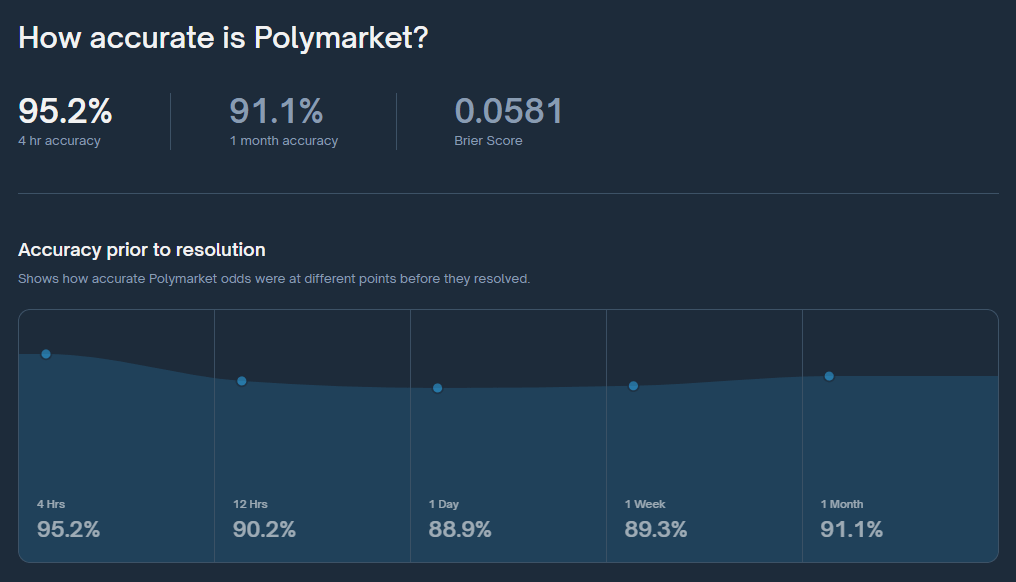
Surveys from Pew Research Center and Reuters Institute show that top international news outlets consistently rank within the 80-90% confidence range in terms of how accurate they are. On the other hand, Polymarket’s confidence range is higher on average. Onchain data shows that the 4 hour accuracy on Polymarket is currently 95.2%, while the 1 month accuracy stands at 91.1%.
The deeper lesson is about accountability. In the information age, credibility has a price, and it is denominated in probabilities. Truth now trades in open view, and those who misjudge it pay a cost, whether in capital or in trust. Journalism and markets are learning to coexist within the same ecosystem of verification. One interprets, the other quantifies. Together they reveal a world where belief, data, and consequence meet in real time, turning the pursuit of truth into a collective act, one priced by conviction and settled by evidence.
Frequently Asked Questions (FAQs)
Are prediction markets more accurate than polls?
Prediction markets are often more accurate than polls because they aggregate real-time data and financial incentives. While polls capture what people say, prediction markets capture what people are willing to bet on. Traders adjust prices as new information appears, creating a continuously updated probability that often outperforms traditional polling models in forecasting outcomes.
Are prediction markets regulated?
Prediction markets are regulated differently depending on where they operate. In the United States, platforms like Kalshi are overseen by the Commodity Futures Trading Commission (CFTC) as Designated Contract Markets. Others, such as Polymarket, operate offshore under crypto frameworks. Regulation generally depends on whether the market is treated as a financial derivative, a data product, or gambling.
Are prediction markets legal?
Prediction markets are legal where they meet regulatory standards. In the U.S., only CFTC-approved platforms like Kalshi can operate. Polymarket runs offshore for now. Other countries classify them as gambling or financial products, depending on local law.
What are some famous prediction markets?
Some of the most famous prediction markets include Polymarket, Kalshi, and Manifold Markets. Polymarket runs fully onchain using crypto, Kalshi operates under U.S. regulation, and Manifold focuses on play-money forecasting. These platforms attract millions of users who trade on politics, economics, sports, and global events.
How does Polymarket make predictions?
Polymarket makes predictions through trading activity on its blockchain-based markets. Each event has outcome shares priced between 0 and 1 dollar, reflecting the crowd’s belief in its likelihood. As traders buy and sell shares, market prices update in real time, turning collective opinion into measurable probabilities.
How does Polymarket determine prices?
Polymarket determines prices through supply and demand. Each market uses an automated market maker where the price of a “Yes” or “No” share changes as traders buy or sell. If more users buy “Yes,” the price rises, signaling higher probability. These real-time shifts reflect the crowd’s collective belief about an outcome.
Does Kalshi pay real money?
Yes, Kalshi pays real money when your prediction is correct. Contracts settle at $1 if you pick the winning outcome, and you receive your original stake plus profit.
Is Kalshi a trusted app?
Kalshi is considered a trusted prediction market platform. It is regulated by the U.S. Commodity Futures Trading Commission (CFTC) as a Designated Contract Market, making it legal and compliant for real-money trading. Users receive verified payouts in U.S. dollars, and the platform operates under strict financial and security standards.