Buy a Licensed Company
  Explore VASP Data
  Talk to an Expert

 Dren Hima
 is Head of Research at Coincub, leading research across digital asset regulation, licensing, market structure, tokenization and institutional adoption.
Dren Hima
Dren Hima is Head of Research at Coincub, leading research across digital asset regulation, licensing, market structure, tokenization and institutional adoption.
How to Get an MSB License in Canada: Fast & Compliant Registration

- Canada offers a structured path into the MSB market, but entry is not one-size-fits-all. Businesses can either register a new Canadian MSB or acquire an existing B.C.-incorporated MSB, depending on their timeline, operating model, and compliance needs.
- FINTRAC registration is the core federal requirement, but it is not a licence or endorsement. It confirms that the business is registered under Canada’s anti-money laundering framework, and material changes must be reported to FINTRAC within 30 days.
- If you acquire an existing B.C. MSB, the legal work goes beyond the share transfer. A change in directors must be filed in B.C., ownership records must be updated internally, and the post-closing structure must be reflected in the company’s corporate records and FINTRAC update.
- Corporate records matter as much as the regulator filing. In practice, the Notice of Articles does not prove who owns the company, and B.C.’s transparency register is still maintained internally rather than being publicly accessible today.
- Getting registered is only the start. Whether you build a new MSB or acquire one, the business still needs an active AML/ATF compliance program with clear policies, risk controls, training, and ongoing oversight.
Why Canada? – Canada in Numbers
| Category | Score | Description |
| Regulatory Environment | 4/5 | Canada provides a structured and transparent regulatory framework for MSBs, supporting compliance and stability in the crypto sector. |
| Market Accessibility | 4/5 | Access to North American markets with high crypto adoption rates and favorable business conditions for international companies. |
| Crypto Infrastructure | 4/5 | Canada has an extensive network of crypto ATMs, Bitcoin nodes, and blockchain infrastructure, though the Spring Economic Update 2026 proposed banning crypto ATMs and making it a criminal offense to operate one. |
| Talent Pool | 4.5/5 | Home to leading universities and research institutions, Canada offers a deep talent pool with strong blockchain and crypto expertise. |
| Cost-Effectiveness | 3/5 | While costs are moderate, Canada’s operational expenses are balanced by the benefits of a stable and developed economy. |
| Consumer Adoption | 4/5 | One in four Canadians owned crypto when the Ontario Securities Commission surveyed them over the 2025 holiday period, creating strong demand for compliant VASP and MSB services. |
What You Get
We handle the setup, the filing, and the compliance work needed to launch or transition an MSB in Canada. That can include a new registration path or the acquisition of an existing B.C.-incorporated entity, depending on the structure you want.
Company setup and structuring
We help you set up a new Canadian company or work with an existing corporate structure, prepare the core company documents, and organize the records needed for registration or transfer.
FINTRAC registration support
We prepare and coordinate the FINTRAC registration process, including submission support, follow-up, and responses to routine regulator requests. Money services businesses operating in Canada must register with FINTRAC before they begin to operate.

Since 1 October 2025 the entry point is a short pre-registration request. FINTRAC assigns a compliance officer who then sends you the actual registration form, and the completed form and supporting documents go back over secure Canada Post Connect. Registration itself carries no FINTRAC fee.
Compliance framework preparation
We build the core AML/ATF documentation around your business model, including policies and procedures, risk assessment, training support, and review planning. FINTRAC’s compliance program framework is built around five required elements: a compliance officer, policies and procedures, risk assessment, training, and an effectiveness review.
Corporate records and ownership updates
For acquisitions, we help coordinate director changes, internal corporate records, ownership documentation, and post-closing updates so the legal structure and the regulatory record stay aligned.
Banking and operational support
We help prepare the supporting material financial institutions usually ask for, including business summaries, forecasts, and compliance-facing documentation.
Ongoing compliance support
We help keep your registration and compliance program current as the business evolves, including change notifications, clarification responses, and routine compliance upkeep. Registered MSBs must keep their registration information up to date, and FINTRAC gives 30 days to respond to clarification requests.

Acquiring a B.C.-Incorporated MSB
The acquisition of a Canadian Money Services Business (MSB) incorporated in British Columbia involves a dual-track process. Purchasers must navigate provincial corporate governance updates governed by the Business Corporations Act (B.C.) (BCBCA) alongside federal regulatory reporting obligations enforced by the Financial Transactions and Reports Analysis Centre of Canada (FINTRAC) under the Proceeds of Crime (Money Laundering) and Terrorist Financing Act (PCMLTFA).
This process note details the legal requirements, typical transaction mechanics, corporate registry procedures, and compliance framework updates necessary to effect a change of ownership and leadership for a B.C.-incorporated MSB.
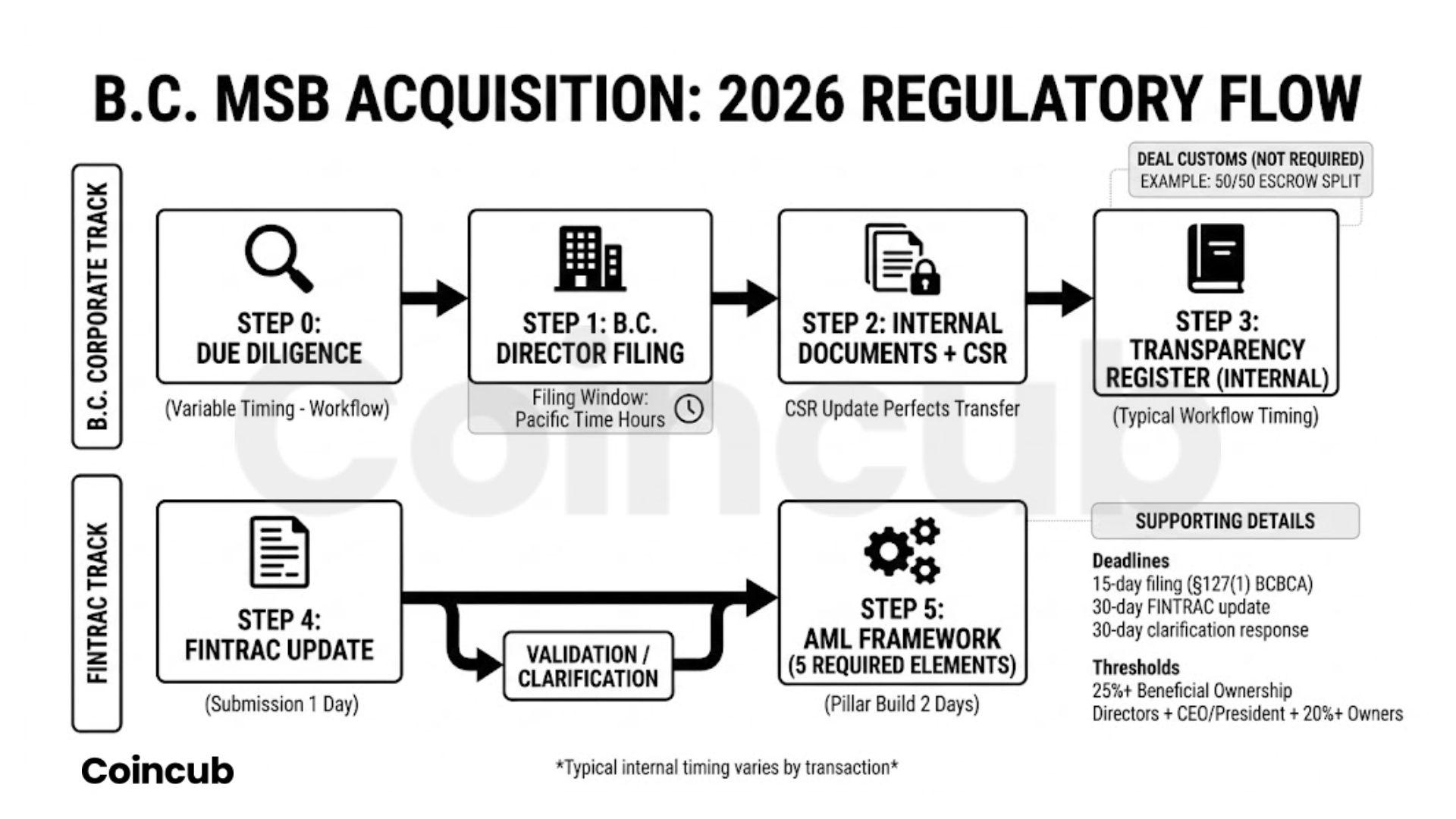
| Phases | What happens | Key output | Timing / legal trigger |
| Due diligence | Review the Certificate of Incorporation, Notice of Articles, Central Securities Register, and the public FINTRAC MSB registry. | Ownership and compliance risk check | Complete before signing. FINTRAC registration status can be checked publicly, and registration is not an endorsement or licence. |
| Sign SPA and set escrow | Execute the Share Purchase Agreement and any escrow or milestone-payment structure. | Signed SPA, escrow terms | Contract-driven, not a statutory filing deadline. |
| Update directors in B.C. | File the Notice of Change of Directors after the seller’s directors resign, and the buyer’s directors are appointed. | Updated public director record | Must be filed within 15 days of the change. Corporate Online accepts filings 6:00 a.m.–10:00 p.m. Monday–Saturday and 1:00 p.m.–10:00 p.m. Sunday. |
| Complete internal share transfer | Execute the instrument of transfer, resolutions, share certificate changes, and update the securities register. | Internal ownership transfer completed | The transfer is perfected in practice when it is registered in the company’s securities register. |
| Update the B.C. transparency register | Record the new significant individuals in the company’s internal transparency register. | Updated transparency register | B.C. guidance says companies must keep the register current and update it within 30 days of receiving new or different information. |
| Submit FINTRAC change update | File the MSB registration update for changes to directors, ownership/control information, and compliance officer details. | FINTRAC update submission | Material changes must be reported within 30 days. If FINTRAC sends a clarification request, the MSB has 30 days to respond. |
| Refresh AML/ATF framework | Align the compliance program with the new ownership and operating model. | Updated compliance framework | FINTRAC requires a compliance program with five core elements. |
Here is a simplified chart to help you understand the process:
Phase 1: Due Diligence on the B.C. MSB
Before entering into a definitive agreement, an acquiring party typically conducts legal and regulatory due diligence to verify the target company’s corporate standing, ownership structure, and regulatory compliance.
Corporate Records and Share Ownership
For a B.C. company, verifying the public corporate record is a standard first step. The buyer will review the Certificate of Incorporation, which confirms the entity’s legal formation, and the Notice of Articles. The Notice of Articles outlines the authorized share structure and lists the company’s current directors.
However, the Notice of Articles does not disclose share ownership. In British Columbia, the definitive record of a company’s share ownership is maintained internally. To verify who actually owns the MSB, the buyer must inspect the target company’s Central Securities Register. Under the BCBCA, every company must maintain this register, which acts as a combined register of allotments, transfers, and shareholders. The Central Securities Register must record the name and last known address of each shareholder, the number and class of shares held, and the date of each share issuance or transfer. Reviewing this document is critical, as it confirms the seller has a clear title to the shares being purchased.
FINTRAC Registry Verification
Simultaneously, the acquiring party should verify the target’s federal regulatory status by searching the public FINTRAC Money Services Business Registry. This database lists the MSB’s name, registration number, and current status. The registry will indicate whether the business is “Registered,” “Expired,” “Revoked,” or “Ceased”.
It is important to note that registration with FINTRAC indicates that the business is registered with FINTRAC under the PCMLTFA, not that FINTRAC endorses or licenses it.
Check the expiry date as well as the status. A FINTRAC registration runs for two years and lapses unless the business renews it before that date, and FINTRAC has been revoking registrations on eligibility grounds well ahead of their expiry dates, so a target with a renewal falling due shortly after closing hands the buyer a deadline it has not priced.
Phase 2: Transaction Mechanics and the Purchase Agreement
While the statutory requirements govern the transfer of shares and regulatory notifications, the financial execution of an MSB acquisition is driven by a private contract, most notably the Share Purchase Agreement (SPA).
The Share Purchase Agreement and Annexes
The SPA outlines the terms of the sale, the purchase price, representations and warranties regarding the company’s compliance history, and post-closing covenants. The agreement is frequently accompanied by annexes or schedules that specify the transfer of proprietary software, banking relationships, and the transition of the compliance framework.
Customary Milestone Payments and Escrow
Because FINTRAC requires post-closing notifications for changes in ownership and leadership, and the agency’s processing times can span several months, the parties often use an escrow agreement. A common transaction design choice (though not a legal requirement) is a milestone-based payment structure, such as a 50/50 split.
In this structure, the buyer typically releases 50% of the purchase price upon signing the SPA. The remaining 50% is placed in escrow. The release of the escrowed funds is contractually tied to specific post-closing deliverables. Usually, the seller receives the final tranche only after the buyer has received the filed Notice of Change of Directors, the updated internal corporate records (such as the executed Instrument of Transfer of Shares and updated Central Securities Register), and proof that the mandatory MSB registration update has been submitted to FINTRAC through its online change form. This structural choice protects the buyer from having to release the full purchase price until operational control and regulatory notifications are complete.
Phase 3: Public Governance and B.C. Registry Updates
In British Columbia, altering the board of directors is a public governance update that must be reported to the provincial government. A change of ownership typically coincides with the resignation of the seller’s directors and the appointment of the buyer’s representatives.
Under section 127(1) of the BCBCA, a company is statutorily required to file a Notice of Change of Directors with the Registrar within 15 days of a change occurring. This filing publicly records the removal of the legacy directors and the appointment of the incoming directors, along with their respective delivery and mailing addresses. The BCBCA no longer imposes residency requirements; a B.C. company doesn’t need to have a resident Canadian director.
This filing is submitted electronically via the B.C. Corporate Online system (or the modernized BC Business Registry). Practitioners managing the transaction must account for the system’s specific hours of operation. Corporate Online accepts filings from 6:00 a.m. to 10:00 p.m. Pacific Time, Monday through Saturday. On Sundays, the system is available from 1:00 p.m. to 10:00 p.m., as the morning hours are reserved for scheduled maintenance. Once filed, the system processes the notice, and the updated corporate documents are typically available within a few business days.
Phase 4: Internal Corporate Reorganization (Minute Book Updates)
While the director change is a public filing, the transfer of the company’s shares is a private, internal corporate procedure. Perfecting the change of ownership requires the preparation and execution of several documents to be retained in the company’s records office.
The standard documentation bundle for a B.C. share transfer includes:
- Resignation Letters: The outgoing directors must formally resign from their board and officer positions.
- Consent to Act as Director: As a standard closing practice, an individual typically provides written consent to act as a director, acknowledging they meet the statutory qualifications (e.g., they are not an undischarged bankrupt), though the BCBCA also recognizes consent by conduct or after appointment.
- Instrument of Transfer of Shares: The BCBCA stipulates that a share transfer must not be registered unless the company has received a written instrument of transfer executed by the transferor (seller) and the transferee (buyer).
- Director Resolutions: The newly appointed board of directors must pass resolutions (often by written consent) approving the share transfer, authorizing the cancellation of the old share certificates, and directing the issuance of new certificates.
- Share Certificates: The seller’s original share certificates are marked as cancelled, and a new certificate representing the acquired shares is issued to the buyer.
- Central Securities Register Update: The company’s Central Securities Register must be updated to record the transfer date, the cancellation of the seller’s shares, and the entry of the buyer as the new shareholder of record.
In practice, the transfer is perfected when the company registers it in its securities register, typically the Central Securities Register for a private company.
Phase 5: The B.C. Transparency Register
An essential compliance step during the internal reorganization is updating the company’s Transparency Register. Introduced to combat hidden corporate ownership, the BCBCA requires private companies to create and maintain a register listing all “significant individuals”.
Defining a Significant Individual
An individual is classified as significant if they meet specific thresholds for control. This includes individuals who hold, directly or indirectly, 25% or more of the company’s issued shares, or shares carrying 25% or more of the voting rights. It also includes individuals who possess the right to elect, appoint, or remove a majority of the company’s directors. When the MSB is acquired, the new ultimate beneficial owners must be recorded in this register.
The register must contain the individual’s full legal name, date of birth, last known address, citizenship status, and tax residency.
Internal Maintenance vs. The Transition to Public Filing
Currently, a B.C. private company must maintain and update its transparency register internally at its records office. The register is not publicly accessible, though directors and specified inspecting officials may inspect it in accordance with the Act. B.C. has announced a future public Transparency Register. Still, practitioners should confirm on the transaction date whether any new filing obligations have come into force before treating public filing as mandatory.
Phase 6: FINTRAC Registration Updates
With the corporate governance and share transfers completed, the acquiring entity must address the MSB’s federal regulatory obligations. Under the PCMLTFA, an MSB must keep its registration information with FINTRAC current.
The 30-Day Update Obligation
An MSB is legally required to inform FINTRAC of any material changes to its registration information within 30 days of the change occurring. Failure to update this information on time can result in administrative monetary penalties (AMPs), compliance issues with the registration update, or the revocation of the MSB registration.
The cost of missing that window rose sharply in 2026. The Strengthening Canada’s Immigration System and Borders Act received Royal Assent on 26 March 2026 and rebuilt FINTRAC’s penalty framework, raising the maximum penalties for prescribed violations, adding ability to pay to the criteria FINTRAC weighs, attaching a compliance agreement to every penalty it imposes, creating compliance orders as a new enforcement tool, and elevating certain compliance program violations from serious to very serious.
Changes go through FINTRAC’s Change form for updating money services business registration information, which now sits as an online Government of Canada form outside the old registration portal. The update must include:
- Ownership and Directors: The names and addresses of the new directors and any shareholders owning or controlling 25% or more of the entity (classified as beneficial owners).
- Compliance Officer: The contact details of the newly appointed compliance officer (often referred to as the CAMLO).
- Criminal Record Checks: DMSBs and foreign MSBs alike must submit criminal record checks for the chief executive officer, the president, the directors, and every person who owns or controls, directly or indirectly, 20% or more of the entity or its shares. It should be noted that the 20% ownership threshold for criminal record checks does not align with the 25% threshold for beneficial ownership disclosure; these thresholds are distinct under the current FINTRAC registration framework, so practitioners must evaluate both independently when compiling the update. These checks must be current (issued within the last six months).
Clarification Requests and Processing
After the web form is submitted, FINTRAC will process the request. It is critical to understand that FINTRAC registration is not an approval or an endorsement of the new shareholders; it is a mechanism for maintaining accurate intelligence data.
If the submitted information is incomplete or requires further context, FINTRAC will issue a clarification request via email. The MSB has exactly 30 days to respond to this request and provide the required information. Because of the high volume of applications and updates, processing times for these changes can span several months. During this period, the business generally remains registered as long as the initial submission was made within the statutory 30-day window.
Phase 7: AML Policy and Risk Management Obligations
Finally, the new ownership must ensure that the MSB operates under an Anti-Money Laundering (AML) and Anti-Terrorist Financing (ATF) compliance framework. The entity must maintain and document its compliance regime.
Under FINTRAC guidance, a comprehensive compliance program must include five specific elements:
- Appointment of a Compliance Officer: The business must designate an individual to implement the program. This officer must have the necessary authority, access to resources, and knowledge of the MSB sector’s vulnerabilities.
- Compliance Policies and Procedures: The MSB must develop detailed, written methodologies outlining how it will meet its obligations, including Know Your Client (KYC) identity verification and transaction reporting (such as Large Cash Transaction Reports and Suspicious Transaction Reports).
- Risk Assessment: The MSB must conduct and document a risk assessment of its business activities using a risk-based approach (RBA). This involves analyzing risks associated with specific clients, delivery channels, and geographic locations.
- Training Program: A written, ongoing compliance training program must be maintained for employees and agents.
- Effectiveness Review: The MSB must institute a plan to independently review and test the effectiveness of its compliance program at least every two years.
Since 26 March 2026 the Act has required a compliance program to be reasonably designed, risk-based and effective, so a template program sitting in a drawer no longer clears the bar. The new leadership must tailor these policies immediately to the MSB’s current operations, new product offerings, and evolving FINTRAC guidelines.
Frequently Asked Questions (FAQ)
What is an MSB registration in Canada? +
It is the federal FINTRAC registration required for a business that offers covered money services in Canada. Even if a business is licensed or registered provincially, it must still register with FINTRAC before it starts operating.
Can non-residents enter the Canadian MSB market? +
Yes. The route depends on the structure. Some businesses register a Canadian MSB, while others may fall under the foreign MSB framework if they direct services at clients in Canada. FINTRAC maintains separate registration tracks for MSBs and foreign MSBs.
Do I need to visit Canada to complete the process? +
Not always. A lot of the process can be handled remotely if the document flow, signatures, and filing support are set up properly. The exact steps depend on the structure, the service provider, and the banking side.
What documents are usually required for registration? +
The main package usually includes incorporation or governance documents, ownership and management information, compliance officer details, criminal record checks, and documents that show the ownership and control structure of the business.
Is buying a B.C. MSB just a private share purchase? +
No. It usually involves the share transfer, B.C. corporate record updates, and a FINTRAC registration update after closing. A B.C. company must file a notice of change of directors within 15 days of a director change, and registered MSBs must update FINTRAC within 30 days if their registration information changes.
How long do I have to file a B.C. director change? +
Within 15 days after the change in directors.
How long do I have to update FINTRAC after a material change? +
Within 30 days of the change to the registration information.
What happens if FINTRAC asks for more information? +
FINTRAC sends a clarification request when information is missing, incomplete, or needs confirmation. You have 30 days to respond.
Is the B.C. transparency register public? +
No. For B.C. private companies, the transparency register is kept in the company’s records office. The public does not have access to it.
What criminal record checks are required for registration? +
For registration, FINTRAC requires criminal record checks for the chief executive officer, the president, the directors, and each person who owns or controls, directly or indirectly, 20% or more of the entity or its shares. The checks must be issued no more than six months before submission.