


 Buy a Licensed Company
 Explore VASP Data
 Talk to an Expert

 News Room
Admin Coincub
US Judge Acquits Brothers in $25 Million Ethereum Exploit Case
A US judge acquitted Anton and James Peraire-Bueno in a $25 million Ethereum MEV exploit case. Tokenized stock venues operating under SEC relief disclose MEV risks but offer little compensation.
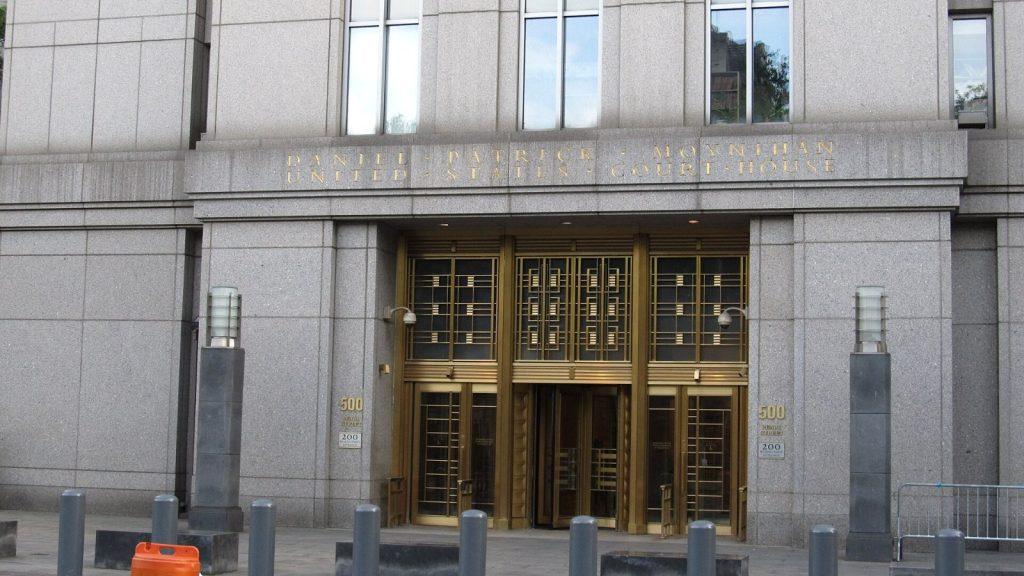
A federal judge in the United States acquitted Anton and James Peraire-Bueno on November 16 in a $25 million Ethereum exploit case, finding prosecutors failed to prove a material misrepresentation. The ruling comes a year after their first trial ended in a mistrial when the jury could not agree on a verdict.
- US District Judge Jessica Clarke granted acquittals on wire fraud, wire fraud conspiracy and money laundering conspiracy charges in a 46-page opinion.
- Prosecutors said the brothers used bait transactions in April 2023 to take about $25 million from trading bots in 12 seconds.
- Their first trial ended in a mistrial in November 2025 after the jury deadlocked.
Judge Clarke finds no material misrepresentation
Prosecutors charged the brothers over a 2023 operation, called Omakase, that targeted sandwich-trading bots on Ethereum. According to the opinion, the operation used lure transactions to attract the bots and exploited a vulnerability in relay code, producing about $25 million in 12 seconds.
The case involved maximum extractable value (MEV), the profit that can be captured by controlling the order in which transactions are processed. Sandwich bots place trades just before and after another user’s trade, which can leave that user with a worse price.
Clarke wrote that “the government failed to prove that the Peraire-Buenos made any material misrepresentations in the execution of their scheme.” She rejected the argument that submitting an invalid block header with a digital signature counted as one. She also said that sending a transaction on Ethereum carries no promise about the order in which it will be processed.
The judge also set the case apart from spoofing cases in traditional markets, where traders place and then cancel orders to mislead others. Here, the bait trades were not placed on a regulated market with rules banning the conduct.
How the case reached an acquittal
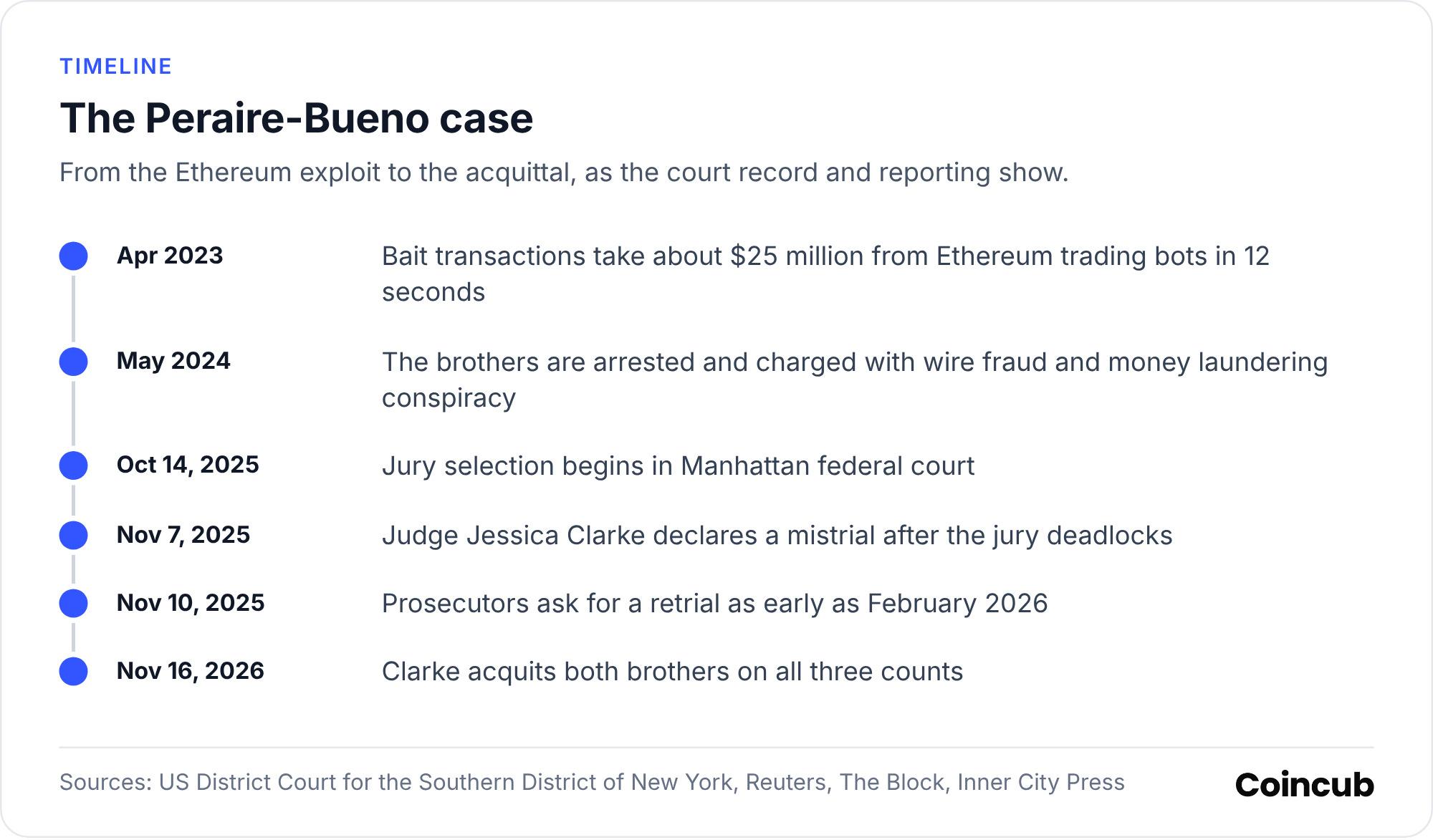
The brothers were arrested in May 2024 and charged with wire fraud, wire fraud conspiracy and money laundering conspiracy. Prosecutors said they used a flaw in MEV-Boost, software many Ethereum validators use to receive blocks from builders, to see bundled trades before they settled and then reorder them.
Their trial in Manhattan federal court began with jury selection on October 14, 2025. On November 7, 2025, Clarke declared a mistrial after the jurors said they could not agree. Prosecutors asked for a retrial as early as February 2026. Clarke instead granted the brothers’ motion for a judgment of acquittal, closing a case that had run for more than two years.
Peter Van Valkenburgh of Coin Center, a crypto policy group, had called the prosecution a “massive overstep” after the mistrial.