

 Buy a Licensed Company
  Explore VASP Data
  Talk to an Expert

 Dren Hima
 is Head of Research at Coincub, leading research across digital asset regulation, licensing, market structure, tokenization and institutional adoption.
Dren Hima
Dren Hima is Head of Research at Coincub, leading research across digital asset regulation, licensing, market structure, tokenization and institutional adoption.
Dark Pools and Algorithmic Execution: How Institutions Hide Large Orders
- Dark pools are private ATS venues that allow institutions to trade large blocks without orders being visible before execution.
- Off-exchange trading is broader than dark pools and also includes wholesalers, internalizers, and block desks.
- Institutions use algorithms like TWAP, VWAP, and Implementation Shortfall to split large orders into smaller pieces.
- Dark pools reduce market impact, but they also create risks around stale pricing, pinging, and fragmented price discovery.
- Regulators focus on best execution, routing transparency, and the use of AI and automated tools in execution workflows.
The structure of global equity markets relies on a combination of public and private negotiation to process varying types of order flow. While retail trades are frequently executed through transparent public order books (or routed to off-exchange wholesalers), large institutional investors managing pension, mutual, and endowment funds utilize a different set of mechanisms to facilitate block trades. Chief among these are Alternative Trading Systems (ATS), commonly referred to as dark pools.
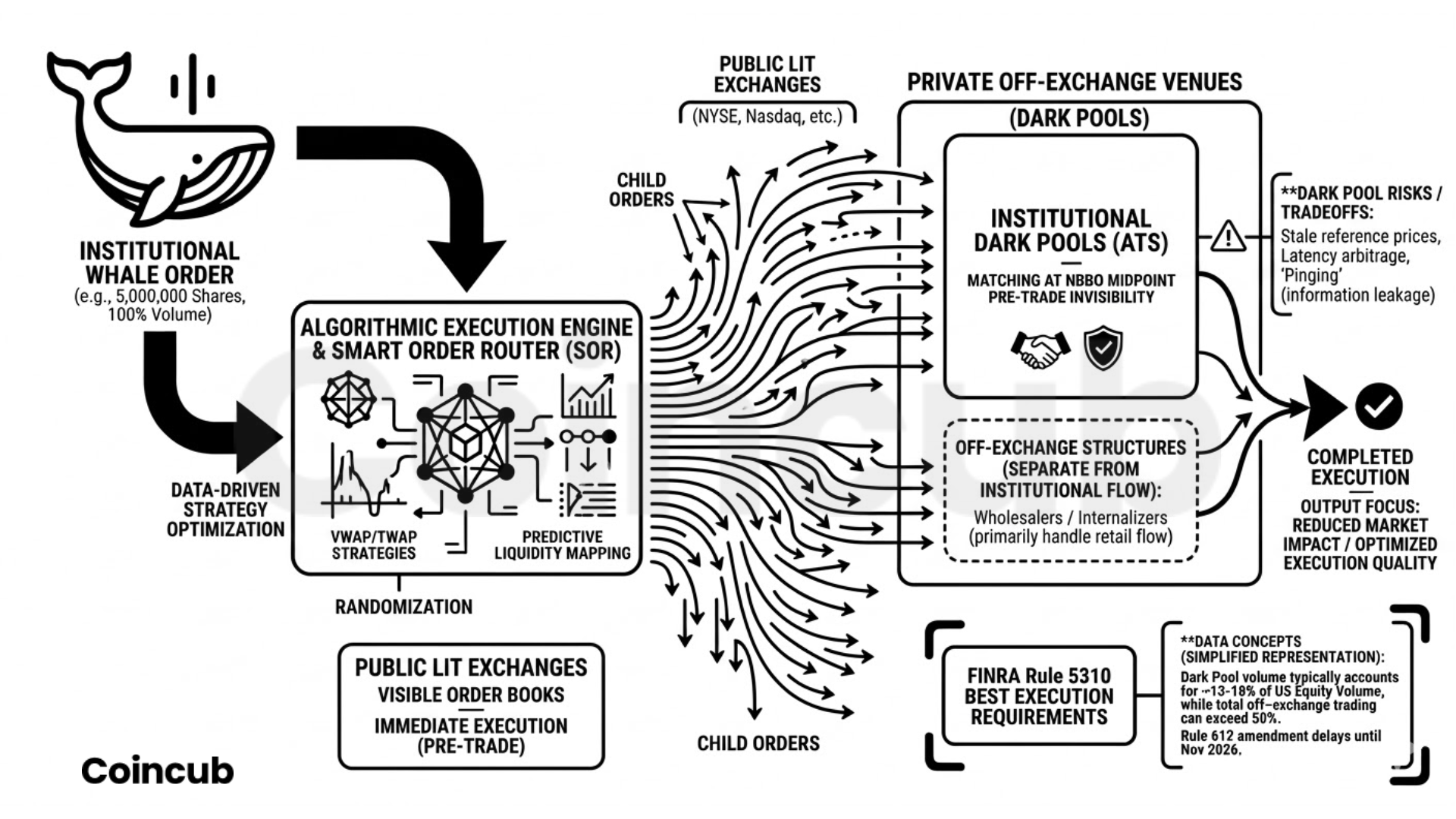
Dark pools are private trading venues that match buy and sell orders without displaying pre-trade pricing or volume information to the public. They exist primarily to address market impact: when an institution needs to trade hundreds of thousands of shares, displaying that order on a public exchange immediately alerts the market to a supply or demand imbalance, causing prices to move unfavorably before execution is complete.
It is a common misconception that all off-exchange trading occurs within dark pools. In the current U.S. equity market structure, off-exchange trading routinely accounts for approximately 50% of total consolidated volume. However, this broad category includes bilateral wholesaler internalization, retail broker routing, and high-touch block trading desks. Dark pools, specifically, represent a smaller, specialized subset of this off-exchange ecosystem. Recent industry data from trackers like Rosenblatt Securities indicates that ATS dark pools generally execute a volume share fluctuating from the mid-teens to roughly 18% of total U.S. equity volume.

U.S. Equity Venue Types
| Venue type | Pre-trade transparency | Main users | How pricing works | Main purpose |
| Public lit exchanges | Full visible order book | Retail traders, institutions, market makers, HFT firms | Prices are formed directly on the exchange through displayed bids and offers | Price discovery and immediate execution |
| ATS dark pools | No public display of orders before execution | Primarily institutional investors and block traders | Often execute at or near the NBBO midpoint, depending on venue rules | Reduce market impact and information leakage on large trades |
| Wholesalers/internalizers | No public displayed book in the same way as lit exchanges | Primarily, retail broker flow is routed off the exchange | Execute against or around public reference prices under off-exchange routing arrangements | Internalize retail flow and provide fast execution, sometimes with price improvement |
Within this segment, the integration of algorithmic trading and advanced routing technology has altered how liquidity is sourced and executed. Execution algorithms have evolved to slice large “whale” orders, manage resting liquidity, and navigate fragmented markets. This report examines the documented mechanics of dark pool execution, the regulatory parameters governing off-exchange trading, the ongoing latency competition between market participants, and the academic research proposing future frameworks for order routing.
The Microstructure of Opaque Liquidity
To understand the utility of dark pools, it is necessary to contrast them with traditional, “lit” exchanges such as the New York Stock Exchange (NYSE) or NASDAQ. On a lit exchange, bids and offers are displayed publicly in a central limit order book. This pre-trade transparency is highly efficient for price discovery but inherently costly for large institutional trades due to the signaling risk it carries.
Dark pools operate with zero pre-trade transparency. Order sizes and limit prices are kept hidden within the ATS matching engine. Participants only learn of a trade after it has been executed, at which point the transaction is reported to a Financial Industry Regulatory Authority (FINRA) Trade Reporting Facility (TRF) and published to the consolidated tape.
Because dark pools do not display public quotes, they derive their execution prices from the public market, often matching buyers and sellers at or near the midpoint of the National Best Bid and Offer (NBBO), depending on venue rules. This derivative pricing model improves prices for both parties by allowing them to bypass the public bid-ask spread entirely. However, unlike lit exchanges where designated market makers are obligated to provide liquidity, dark pools offer no guarantee of execution; an order will only fill if a natural counterparty is resting in the pool at the same time.
SEC Tick Size Reforms and Midpoint Pricing
The pricing dynamics within dark pools are directly tied to regulatory parameters set on the public exchanges. In September 2024, the Securities and Exchange Commission (SEC) adopted amendments to Rule 612 of Regulation NMS, establishing a new minimum pricing increment (or “tick size”) of $0.005 for quotations in NMS stocks priced at or above $1.00 per share that demonstrate a specific time-weighted average quoted spread.
The SEC implemented this reduction because many stocks were constrained by the previous $0.01 tick size, which prevented market participants from posting more competitive prices. The initial compliance date for these new tick sizes, as well as associated reductions in access fee caps under Rule 610, was scheduled for November 2025. However, following judicial review and a lapse in appropriations, SEC exemptive orders recently delayed the compliance deadline for the tick-size and access-fee rules until November 2026.
For dark pools, halving the minimum tick size on lit exchanges naturally compresses the NBBO spread. Because dark pool execution algorithms calculate their savings based on midpoint matches, a narrower public spread reduces the nominal fractional dollar amount saved per share. Consequently, routing algorithms must adjust their logic to assess whether the diminished spread savings in a dark venue justify the opportunity cost of resting an order without an execution guarantee.
Algorithmic Execution: Slicing and Order Management
Executing a large block order requires balancing the need to fill the required volume against the risk of moving the market price. Institutional trading desks utilize algorithms to “slice” large parent orders into smaller child fragments, executing them over a specified duration to minimize their data footprint.
Documented Industry Practices
In current industry practice, standard execution algorithms are highly deterministic, relying on historical volume profiles and time parameters to distribute orders.
- Time-Weighted Average Price (TWAP): This algorithm distributes an order evenly over a set time horizon. For instance, a 500,000-share order scheduled for execution over a full trading day is broken into mathematically uniform slices executed at regular intervals.
- Volume-Weighted Average Price (VWAP): VWAP algorithms dynamically align trade execution with the historical intraday volume curve of a stock. The algorithm typically executes more aggressively during the high-volume market open and close. It scales back during the lower-volume midday period, allowing the order to blend naturally into overall market activity.
- Implementation Shortfall (IS): IS algorithms are designed to minimize the difference between the decision price (the stock price at the time the portfolio manager decided to trade) and the final execution price. These algorithms balance the immediate cost of executing aggressively against the opportunity cost of waiting for passive fills.
To prevent opposing algorithms from detecting predictable patterns in TWAP or VWAP execution, modern trading platforms introduce basic micro-randomization, altering the precise timing and share count of each child order.
Academic and Experimental Frontiers
While deterministic algorithms form the backbone of current execution, financial researchers are actively testing more sophisticated machine learning models to handle order execution. These concepts currently exist primarily in academic literature and experimental environments rather than as ubiquitous industry standards.
- Reinforcement Learning (RL): Researchers are utilizing RL frameworks, such as Proximal Policy Optimization (PPO), to train trading agents in simulated market environments. In classical models, market impact is often hard-coded as an assumption. In experimental RL models, agents operate within simulated Hawkes Limit Order Books that account for endogenous price impact, enabling the agent to mathematically deduce how its own executions alter the future state of the order book.
- Limit Order Book Transformers (LiT): Drawing from natural language processing, academic researchers are applying transformer architectures to high-frequency LOB data. Experimental LiT models replace standard convolutional layers with structured patches and self-attention mechanisms to model spatial and temporal features in market microstructure, attempting to forecast short-term price movements more accurately under distributional shifts.
Smart Order Routing (SOR)
Because U.S. equity liquidity is fragmented across more than a dozen lit exchanges and over 30 active dark pools, institutions rely on Smart Order Routing (SOR) technology to navigate the landscape.
Standard Implementation
A traditional SOR system acts as an automated director, scanning connected trading venues to find the optimal execution price and available liquidity. Rather than relying on a single exchange, the SOR algorithm continuously compares quotes and routes child orders to the venues with the highest probability of a fill. Many modern SORs utilize “probe” or “sweep” strategies, deploying small, immediate-or-cancel orders to test for hidden liquidity across various dark pools before committing larger volumes.
The CMAB Theoretical Framework
In academic literature, the challenge of navigating dark pool opacity is frequently framed as a Combinatorial Multi-Armed Bandit (CMAB) problem. Researchers have proposed frameworks, such as the DP-CMAB algorithm, to theoretically optimize the total dollar volume gained from slicing an order across multiple venues.
The mathematical challenge in this research centers on a “censored observation” problem. Because dark pools lack pre-trade transparency, an algorithm only receives incomplete feedback. If an algorithm routes 5,000 shares to a dark pool and all 5,000 execute, the true depth of the pool remains unknown. It may have held exactly 5,000 shares, or 50,000. Conversely, if only 2,000 shares execute, the algorithm receives a direct observation of the exact liquidity ceiling. While current commercial SORs use historical fill rates to approximate this, CMAB research aims to develop formal learning algorithms that dynamically balance exploration of unknown pools with exploitation of known liquidity sources.
Latency Arbitrage and Defensive Microstructure
The intersection of high-frequency trading (HFT) and dark pool mechanics has generated significant debate regarding execution quality. While dark pools shield participants from the pre-trade signaling risk of public exchanges, their reliance on derivative pricing exposes them to specific latency-based risks.
Stale Reference Pricing
Because dark pools calculate their execution prices (such as the midpoint) using the NBBO from public exchanges, they are vulnerable to latency arbitrage. HFT firms that invest heavily in ultra-low-latency infrastructure (such as microwave networks) can often receive public-market data updates microseconds faster than the dark pool’s internal pricing engine.
During this microscopic window, the dark pool maintains a “stale” reference price. A working paper by the Bank for International Settlements (BIS) analyzing participant-level regulatory data found that a substantial amount of trading occurs at these stale prices, imposing costs on passive liquidity providers. The study indicated that HFT firms frequently consume dark liquidity to exploit stale reference prices during market transitions.
Furthermore, some market participants utilize “pinging” strategies, deploying small 100-share orders across ATS venues to map hidden liquidity. By analyzing execution responses, these algorithms attempt to deduce the presence of large institutional orders and trade ahead of them on lit exchanges.
Defensive Countermeasures
To protect institutional order flow and maintain the integrity of their venues, ATS operators deploy several structural countermeasures.
A straightforward defense often employed is to implement minimum order size thresholds, which are designed to neutralize pinging strategies by rejecting inexpensive probe orders. More advanced ATS operators utilize execution randomization. Rather than executing a trade the millisecond a match is found, some ATS designs use a matching engine that delays the execution by a randomized, discrete duration (e.g., on the scale of milliseconds). This unpredictable delay disrupts the deterministic timing required for latency arbitrage.
This concept of intentional latency was popularized in the public markets by the Investors Exchange (IEX). While IEX operates as a fully regulated public exchange rather than a dark pool, its architecture features a 350-microsecond physical “speed bump” via a coiled fiber-optic cable. This delay was explicitly designed to neutralize the advantage of co-located HFT servers, ensuring that reference price updates arrive at the exchange’s matching engine before an HFT firm can execute against a stale quote. The SEC’s approval of IEX’s speed bump validated the use of de minimis intentional delays to protect passive liquidity providers, influencing the structural design of both lit and dark venues.
Institutional Execution Infrastructure
The sheer scale of institutional trading requires robust technological ecosystems to manage order generation, risk assessment, and execution routing. These platforms are engineered specifically to process fragmented market data and execute algorithms with minimal latency.
BlackRock’s Aladdin (Asset, Liability, Debt, and Derivative Investment Network) is a prime example of this infrastructure. Functioning as a central portfolio and execution management platform, Aladdin unifies risk analytics and trading operations for institutional clients. The platform integrates natively with asset servicers, broker-dealers, and external trading venues, allowing trading desks to assess liquidity and route orders systemically across both lit exchanges and dark pools without manually fragmenting their workflow.
Major broker-dealers also continuously upgrade their execution platforms to compete for institutional order flow. For example, Goldman Sachs has deployed its Atlas trading platform, introducing algorithms such as AXIS that predict short-term price movements and optimize the routing of passive and aggressive child orders over short trading intervals. Similarly, JPMorgan operates the JPM-X dark pool alongside algorithmic execution suites that allow clients to customize their routing logic and explicitly opt out of specific dark venues to manage information leakage. These proprietary platforms form the underlying plumbing that physically executes the deterministic slicing algorithms utilized by the buy-side.
Regulatory Oversight and FINRA Compliance
Alternative Trading Systems operate under the regulatory framework of the SEC’s Regulation ATS and are heavily scrutinized by FINRA. The opacity of dark pools has historically led to conflicts of interest, as broker-dealers operating the pools must balance their proprietary trading desks against their obligation to provide best execution for their clients.
In the mid-2010s, these conflicts resulted in significant enforcement actions. The SEC and the New York Attorney General levied substantial fines against major ATS operators for misleading subscribers. For instance, Barclays was cited for misrepresenting the efficacy of its “Liquidity Profiling” tool, assuring clients that it continuously policed the dark pool for predatory trading, while manually overriding the system to favor aggressive HFT subscribers. Credit Suisse faced similar penalties for misrepresenting a feature called “Alpha Scoring” within its Crossfinder dark pool, and for operating a routing technology that systematically alerted external HFT firms to the existence of hidden institutional orders.
Current FINRA Focus and Rule 5310
Today, FINRA maintains strict oversight of broker-dealer routing practices. In its 2026 Annual Regulatory Oversight Report, FINRA highlighted several critical compliance areas, including Best Execution and the governance of Generative AI.
Under FINRA Rule 5310 (Best Execution and Interpositioning), firms must exercise reasonable diligence to ascertain the best market for a security to ensure the customer receives the most favorable price under prevailing conditions. FINRA expects firms to conduct “regular and rigorous” reviews of their execution quality, which include comparing venues, analyzing the impact of payment for order flow, and documenting the justification for routing orders to specific ATS venues rather than lit exchanges.
Furthermore, the 2026 Report addresses the integration of AI within member firms. While FINRA observes that the top GenAI use case is currently “Summarization and Information Extraction,” the regulator explicitly notes that existing rules regarding supervision, communications, and recordkeeping apply neutrally to AI. Firms are expected to implement comprehensive testing protocols (evaluating AI models for privacy, integrity, and accuracy) to ensure that the deployment of algorithmic tools does not compromise regulatory compliance or investor protection.
Market Microstructure
The routing of significant institutional volume away from lit exchanges fundamentally alters the mechanics of public price discovery. Financial economists continually debate whether this fragmentation impairs or improves the accuracy of the NBBO.
Academic models, notably those developed by Haoxiang Zhu, analyze this dynamic by segmenting traders into two categories: informed traders (with directional alpha or proprietary information) and uninformed liquidity traders (who trade to rebalance portfolios). Because dark pools do not guarantee execution, informed traders (who typically possess correlated information and trade on the same side of the market simultaneously) face a lower probability of execution in dark venues. Consequently, informed traders self-select to route their aggressive orders to lit exchanges, where execution is guaranteed. In contrast, uninformed liquidity traders route their orders to dark pools to capture midpoint price improvements.
Zhu’s research concludes that under natural conditions, this self-selection process concentrates price-relevant, informed order flow on the lit exchange, effectively improving the accuracy of public price discovery. However, subsequent research notes that this dynamic is dependent on signal precision; if information risk is high and informed traders cluster in the dark pool, price discovery on the public exchange can be impaired.
This concentration of informed trading on lit exchanges carries consequences for retail investors. As public exchanges experience a higher density of informed trading, market makers face increased adverse selection risk, prompting them to widen bid-ask spreads. Nevertheless, retail traders are not entirely disadvantaged; academic studies from SMU Cox indicate that retail investors who use patient “limit order” strategies act as liquidity providers themselves, benefiting from wider spreads and lowering their overall trading costs.
Retail Data Aggregation and Analysis
While retail investors cannot view resting limit orders in a dark pool, post-trade reporting mandates ensure that all ATS transactions are published to the consolidated tape via the FINRA Trade Reporting Facility.
Because analyzing millions of daily TRF prints is impossible to do manually, a cottage industry of retail software platforms has emerged to aggregate and filter this data. Platforms such as Unusual Whales, Bookmap, and BlackBoxStocks provide retail traders with scanners that track off-exchange volume and large block trades in real time. These tools attempt to separate routine market-maker noise, such as delta-hedging or ETF creation/redemption, from directional institutional activity. By identifying trades that print at the midpoint or form clusters of similar-sized blocks, retail analysts utilize these scanners to infer institutional support and resistance levels, applying “tape reading” techniques to modern electronic markets.
Decentralized Dark Pools: DeFi Extensions
The core concepts of dark pool opacity are also being explored within the cryptocurrency and Decentralized Finance (DeFi) sectors. Traditional public blockchains operate with complete transparency, allowing all participants to view pending transactions in the public mempool. This transparency exposes traders to Maximal Extractable Value (MEV) predation, in which automated bots observe a pending large trade, buy the asset first to drive up the price, and then immediately sell it to the original trader (a “sandwich attack”).
To mitigate this, developers are building decentralized dark pools. These experimental platforms utilize cryptographic protocols such as Zero-Knowledge Proofs (ZKPs) and Fully Homomorphic Encryption (FHE). FHE, for instance, allows participants to submit encrypted orders to a smart contract. The contract matches the orders using homomorphic computations without ever decrypting the underlying data. This enables block trading on a blockchain while keeping the order size and limit price completely confidential, attempting to merge traditional financial privacy with decentralized settlement.
Frequently Asked Questions (FAQ)
What is the difference between Off-Exchange Trading and a Dark Pool?
Off-exchange trading is a broad category encompassing any trade that does not occur on a public lit exchange (like the NYSE). This includes retail orders routed to wholesalers, internalizers, and bilateral block trades. Dark pools are a specific subset of off-exchange trading; they are regulated Alternative Trading Systems (ATS) that match orders confidentially without displaying a public order book. Off-exchange trading accounts for roughly 50% of U.S. equity volume, while ATS dark pools account for a smaller share, typically ranging from the mid-teens to roughly 18%.
Why do institutional investors use dark pools?
Institutional investors use dark pools to minimize market impact. When an institution attempts to buy or sell millions of shares, displaying the order on a public exchange signals their intent to the market, often causing prices to move unfavorably before the trade executes. Dark pools allow these entities to match orders confidentially, often achieving price improvement by executing at or near the midpoint of the public bid-ask spread, depending on venue rules.
How do algorithms execute large block orders?
Institutional trading desks use algorithms such as Time-Weighted Average Price (TWAP) and Volume-Weighted Average Price (VWAP) to slice large parent orders into smaller child orders. These algorithms execute the smaller pieces over a set time horizon or align them with historical volume profiles to blend the trades into standard market activity. To prevent pattern detection, these systems often randomize the static share count and execution timing.
How do dark pools protect against High-Frequency Trading (HFT)?
Predatory HFT algorithms often attempt to “ping” dark pools with small orders to detect hidden liquidity and to utilize ultra-low-latency networks to execute against stale reference prices. To counter this, ATS operators implement minimum order size thresholds to reject small probe orders. Some pools also utilize randomized execution delays, breaking the deterministic timing required for latency arbitrage and protecting passive liquidity providers.
Are dark pool trades hidden forever?
No. While dark pools lack pre-trade transparency (order sizes and prices are hidden before execution), they are subject to strict post-trade transparency rules. In the U.S., all dark pool executions must be reported to a FINRA Trade Reporting Facility (TRF) and published on the consolidated tape shortly after the trade occurs, ensuring the volume contributes to historical price data.
What is the focus of FINRA’s 2026 Regulatory Oversight Report regarding AI and execution?
The FINRA 2026 Report emphasizes the governance of Generative AI, noting that existing rules and supervision and recordkeeping apply to AI tools as well and require firms to implement robust testing protocols. Regarding execution, the report focuses heavily on FINRA Rule 5310 (Best Execution). It mandates that firms conduct “regular and rigorous” reviews of their execution quality, carefully analyzing where they route orders and documenting the rationale for utilizing specific ATS venues over lit exchanges.