


 Buy a Licensed Company
 Explore VASP Data
 Talk to an Expert

 News Room
Admin Coincub
CFTC Staff Let Exchanges Count Bitcoin, Ether Toward Reserves
CFTC staff said US futures exchanges and clearinghouses may count Bitcoin, Ethereum and qualifying stablecoins toward annual operating resources, with a 20% discount on Bitcoin and Ethereum.

Staff at the Commodity Futures Trading Commission (CFTC), the US derivatives regulator, issued guidance on Nov. 23 on crypto in exchange reserves. Futures exchanges, swap execution facilities, and clearinghouses may count bitcoin, ether, and qualifying payment stablecoins toward a year of operating costs. The crypto counts only after valuation discounts, and it still cannot fill the cash buffer the rules require.
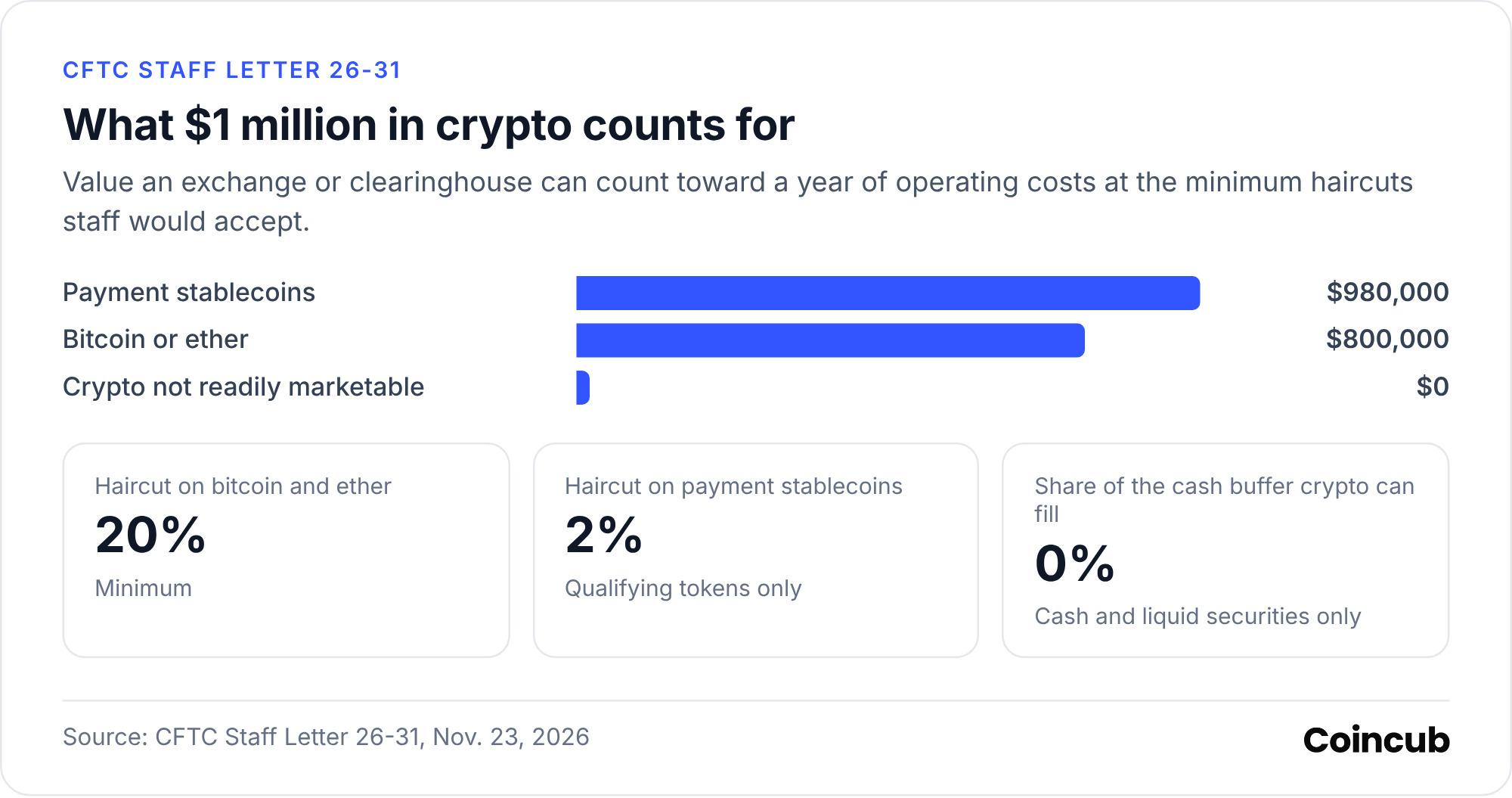
- Staff would not object to a minimum 20% discount for bitcoin and ether and a 2% discount for qualifying payment stablecoins.
- Crypto does not count toward the separate liquidity requirement, which calls for cash or highly liquid securities.
- The guidance is Staff Letter 26-31, an advisory from two CFTC divisions, and it creates no new rules.
What CFTC staff said about crypto reserves
CFTC rules require US designated contract markets, swap execution facilities, and derivatives clearing organizations to hold resources covering at least one year of projected operating costs. The Division of Market Oversight and the Division of Clearing and Risk said bitcoin, ether, and payment stablecoins can count toward that figure.
A discount, often called a haircut, cuts the value a firm can count below the asset’s market price. Staff said they would not object to the same haircuts they already accept for futures commission merchants’ capital. At those rates, $1 million of bitcoin or ether counts as $800,000, and $1 million of qualifying payment stablecoins counts as $980,000. Other crypto that is not readily marketable takes a 100% haircut and cannot count at all.
What crypto cannot cover
Part of the one-year pool must sit in cash or highly liquid securities. That portion covers six months of costs for exchanges and clearinghouses and three months for swap execution facilities. Staff said crypto assets, including payment stablecoins, do not count as cash under US accounting rules and are not highly liquid securities.
The advisory covers only operating costs. It does not touch the separate resources a clearinghouse holds to cover a member’s default.
Staff also told firms to weigh wrong-way risk. That is the chance that operating losses and falling crypto prices hit at the same time, shrinking the buffer when it is needed most.
Which stablecoins qualify
Until the GENIUS Act takes effect, a qualifying stablecoin must be a US dollar token issued by a state-regulated money transmitter. Its reserves must be limited to cash and Treasury-type holdings, and the issuer must publish monthly reserve attestations.
Once the law takes effect, the stablecoin must meet the law’s definition. It must also come from a permitted payment stablecoin issuer or a foreign issuer that meets the law’s requirements.
Status of the guidance
The advisory reflects only the two divisions’ views and does not necessarily reflect the Commission’s. It gives no no-action position on enforcement and creates no new rules or enforceable rights.