Buy a Licensed Company
 Explore VASP Data
 Talk to an Expert

 Dren Hima
 is Head of Research at Coincub, leading research across digital asset regulation, licensing, market structure, tokenization and institutional adoption.
April Crypto Licensing Recap: A Quiet Month with Regional Signals
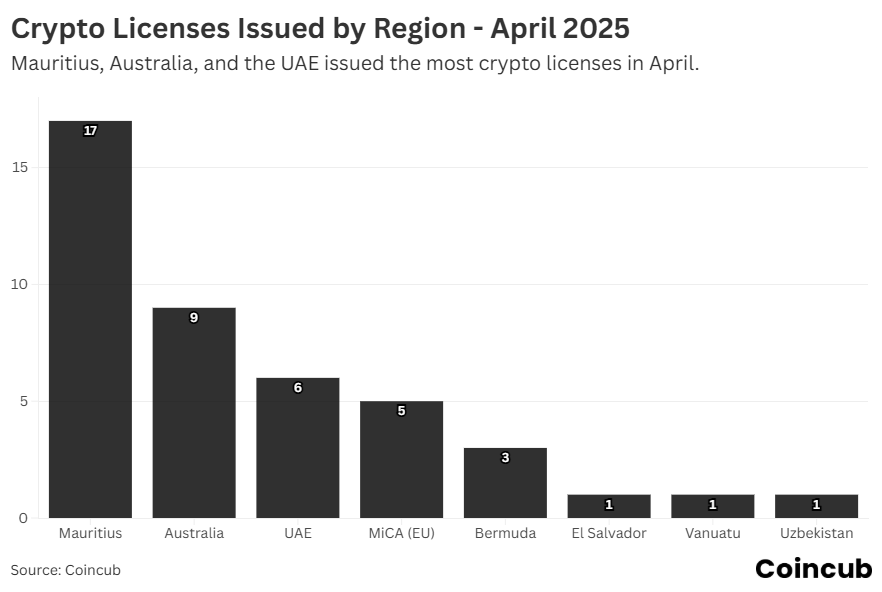
This article tracks crypto company registrations in April 2025 using Coincub’s VASP Database, which compiles licensed entities from over 50 jurisdictions. The data tracks only regulator-published directories, not self-reported activity or other 3rd parties.
We highlight jurisdictions where licensing is more deliberate and regulator activity can be meaningfully interpreted.
April didn’t bring a surge in registrations but showed concentrated movement in a few key regions. The UAE continued its steady onboarding of custody-focused entities under VARA. Mauritius maintained a high approval rate through its Financial Services Commission, particularly for investment dealers and fund managers offering virtual asset services. Bermuda added several digital asset businesses to its books, including firms licensed for derivatives and custodial wallets. Canada, while they had 50 registrations in 2025 so far, recorded none in April. Similarly, the United States, as one of the leaders in crypto regulation, has seen 21 licenses for crypto companies so far in 2025, but none were recorded in April.

Not every entry reflects an operational launch. Still, the data shows where companies are positioning themselves, and how regional licensing trends are shifting under the surface.
MiCA Registrations in April
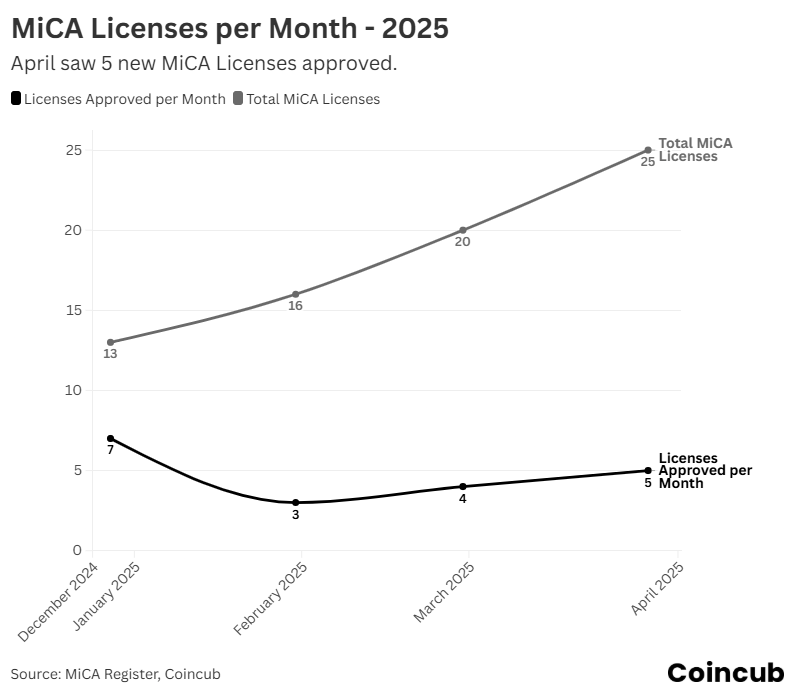
April saw a handful of MiCA-related authorizations and passporting notifications, including new approvals under Article 60 of the MiCA regulation. While most filings are still concentrated in Germany and Austria, the early adopters offer a preview of how the licensing landscape might evolve.
Bitpanda GmbH was formally listed by Austria’s Financial Market Authority (FMA) on April 9, securing approval to offer a full suite of crypto-asset services across the EEA. These include custody, trading, execution, placing, and transfer of crypto-assets. The firm has already notified over 30 countries of its intent to provide services under MiCA passporting, highlighting its role as one of the most institutionally aligned retail platforms in the region.
From Germany, BitGo Europe GmbH received BaFin authorization on May 9, but it had already submitted its intent to operate under MiCA by April. This included core custody and transfer functions, reinforcing BitGo’s longstanding focus on regulated infrastructure across Europe. Though based in Germany, the notification spans the full EEA region, underscoring the scope of MiCA’s cross-border access.
Trade Republic Bank GmbH was another notable name. Approved by BaFin on April 28, it was authorized for custody, order execution, and transmission services. This positions the neobroker to extend its digital asset offering across the EU, complementing its MiFID-compliant stock and ETF platform.
Finally, 360 Treasury Systems AG, also BaFin-regulated, was authorized on April 2 to operate a trading platform for crypto-assets. While its presence in crypto markets is less visible to retail, the company plays a role in backend trading infrastructure and OTC desk connectivity.
Most approvals focused on foundational services (custody, trading, and execution) by already regulated financial actors.
Notable Registrations – UAE
Dubai’s Virtual Assets Regulatory Authority (VARA) continues to be a licensing destination for global firms positioning themselves in the Gulf. Five entities were registered under VARA in April, including several well-known platforms with custody or infrastructure offerings.
Gate Technology FZE: Operating under the Gate.io ecosystem, Gate Technology FZE obtained a complete Virtual Asset Service Provider (VASP) license from VARA, authorizing the company to offer exchange services, including spot trading, fiat on-ramps/off-ramps, and custody solutions to institutional, professional, and retail clients in Dubai. This move aligns with Gate.io’s global compliance strategy, having previously secured licenses in jurisdictions such as Hong Kong and Lithuania. This adds to Gate’s existing approvals in Japan, Türkiye, Lithuania, and Argentina, reinforcing its multinational compliance posture. These prior registrations span exchange and VASP permissions under regulators like the JFSA, CNV, and SPK.
BitGo Custody MENA FZE: BitGo also expanded its global footprint by securing a VASP license from VARA for its MENA subsidiary. The license permits BitGo Custody MENA FZE to offer secure custody and staking services to institutional and qualified investors across the UAE. This recent VARA registration adds to BitGo’s growing regulatory footprint, which already includes licenses in the United States under FinCEN and the New York DFS, authorization in Singapore as a Major Payment Institution, and an ABN-registered entity status in Australia.
Bitpanda Custody MENA DMCC: European fintech firm Bitpanda received a full broker-dealer license from VARA, marking its first fully licensed expansion beyond Europe. The license enables Bitpanda to offer its virtual assets platform to investors in the UAE, including access to over 500 digital assets. Bitpanda’s recent license in the UAE builds on its existing authorizations across the European Union and the United Kingdom since Bitpanda also holds UK FCA registration for both broker and custody operations through its local entities.
HashKey MENA FZE: HashKey Group, a digital asset financial services firm, launched HashKey Global MENA after obtaining a VASP license from VARA. The license authorizes HashKey MENA FZE to provide both virtual asset exchange and broker-dealer services within and originating from Dubai. The company plans to offer a suite of products, including fiat on/off-ramp services through partnerships with established financial institutions, catering to the growing institutional demand in the region. In Singapore, HashKey Group operates under a Major Payment Institution license issued by the MAS, focused on digital payment token services. In Bermuda, HashKey Bermuda Limited holds a Class F Digital Asset Business license, permitting a wide range of activities including custodial services and digital asset derivatives.
Atremo Digital FZE: Atremo Digital, focusing on institutional trading solutions for virtual assets, secured a broker-dealer license from VARA. The company aims to deliver institutional-grade infrastructure for virtual asset trading, designed for sophisticated institutions and qualified investors. Atremo’s offerings include secure global asset transfers between traditional and digital markets, comprehensive trading solutions with deep liquidity, and strategic positioning for market opportunities.
Mauritius Licensing Momentum
Mauritius saw a dense wave of virtual asset registrations in April, with over a dozen entities listed under the Financial Services Commission (FSC). Most approvals fell under the VA-1.3 Virtual Asset Custodian (Class R) license, a designation tied to safekeeping services for digital assets.
The companies span a mix of financial functions, such as CIS managers, investment dealers, family offices, fund vehicles, and qualified trustees. While the entities vary in structure and scope, they all share a common regulatory pathway. The clustering suggests either a backlog of approvals or coordinated filings by financial groups aiming to serve institutional clients or launch tokenized products in a controlled environment.
In contrast to retail-facing exchanges, many of these firms appear to be infrastructure or asset management focused. Licenses tied to closed-end funds, full-service dealers (excluding underwriting), and fund managers dominated the list. Some entries also include management firms or advisers serving high-net-worth clientele through trust and private fund structures.
Because most of these entities do not maintain a public-facing crypto product or website, we aren’t breaking them down individually. What stands out instead is the consistency in their licensing activity and the regulatory configuration. Class R custody, when paired with fund or dealer permissions, points to a deliberate framework aimed at bringing tokenized assets into existing financial channels.
Mauritius is making itself a regional bridge between African, Middle Eastern, and South Asian markets. The FSC’s licensing categories allow for digital asset service layering inside traditional fund structures, making it appealing for cross-border wealth managers and multi-jurisdictional investment groups.
The pattern indicates continued alignment between financial service providers and virtual asset regulation, especially in markets that favor structured fund vehicles over consumer exchanges.
New Names in El Salvador, Bermuda, Uzbekistan, and Australia
Several smaller but notable licensing developments took place across El Salvador, Bermuda, Uzbekistan, and Australia in April. While activity levels varied by jurisdiction, a few of the names stand out based on their profiles or the nature of their registrations.
Bitget, a cryptocurrency exchange, secured a Digital Asset Service Provider (DASP) license from El Salvador’s National Commission of Digital Assets (CNAD) on April 9, 2025. This license complements its earlier Bitcoin Services Provider (BSP) license obtained in 2024, allowing Bitget to offer a comprehensive suite of services, including spot and derivatives trading, staking, and custody solutions within El Salvador.
Bermuda added three digital asset businesses in April, all approved by the Bermuda Monetary Authority (BMA). Capital Com Investments (Bermuda) Ltd. received a Class F license to operate a digital asset derivatives platform. Stillman Digital Bermuda Ltd. and Triangle Digital Ltd. were both approved under Class M licenses for custodial services and virtual asset issuance, respectively.
In Uzbekistan, Asterium LLC was granted a license by the National Agency for Perspective Projects (NAPP) to operate as a crypto custodian. This license, issued in accordance with the country’s regulations on crypto asset circulation, allows Asterium to offer custodial services, marking a significant step in Uzbekistan’s efforts to regulate and integrate digital assets into its financial system.
Australia saw a handful of new ABN-registered crypto companies in April, but most were early-stage or had no visible product. One exception was Zodia Custody Australia Pty Ltd, registered in April under ASIC. Zodia operates globally with a focus on institutional custody and is backed by established financial firms. The Australian arm has a dedicated site and reflects ongoing regional expansion.
Key Takeaways
- April saw at least five new MiCA registrations, with Bitpanda, Trade Republic, flatexDEGIRO, EUWAX AG, and 360 Treasury Systems receiving approvals.
- UAE: Five new VARA registrations signal continued traction for Dubai as a regulated custody and infrastructure hub. Notable entries include Gate.io, BitGo, Bitpanda, HashKey, and Atremo.
- Mauritius: A concentrated wave of approvals under FSC for investment dealers, CIS managers, and fund vehicles, all tied to the Class R virtual asset custodian license.
- Bermuda: Three entities received digital asset licenses, covering derivatives platforms and custodial services, reaffirming Bermuda’s institutional positioning.
- El Salvador: Bitget expanded its footprint with a DASP license, reinforcing the country’s evolving regulated framework for crypto operators.
- Uzbekistan: Asterium received a custodial license under NAPP, part of the country’s phased digital asset rollout.
- Australia: Most new ABN-registered firms were early-stage, though Zodia Custody’s registration reflects credible institutional entry.
- No registrations in Canada or US in April, though the countries have seen new entrants throughout the year.