


 Buy a Licensed Company
  Explore VASP Data
  Talk to an Expert

 Dren Hima
 is Head of Research at Coincub, leading research across digital asset regulation, licensing, market structure, tokenization and institutional adoption.
Dren Hima
Dren Hima is Head of Research at Coincub, leading research across digital asset regulation, licensing, market structure, tokenization and institutional adoption.
Inside the Crypto Tax Report: The Reporting Shift

- Crypto taxes in 2025 are driven by reporting.
- Exchanges are becoming mandatory data providers to tax authorities.
- Low or zero tax no longer equals low visibility.
- Long-term holding can reduce tax, but it does not remove reporting.
- The grey zone in crypto taxation is closing fast.
For most of crypto’s history, taxes were theoretical.
Rules still existed on paper, but enforcement lagged, and the whole reporting aspect was patchy. If activity stayed fragmented across exchanges and wallets, many users assumed nobody was really watching. Well, that assumption is now breaking.
The Global Crypto Tax Report 2025, produced by Coincub in collaboration with Blockpit, shows that the real major change in crypto taxation is all about visibility.

Across jurisdictions, governments are building something more durable than new tax laws. They are building reporting infrastructure.
Reporting is the New Enforcement Layer
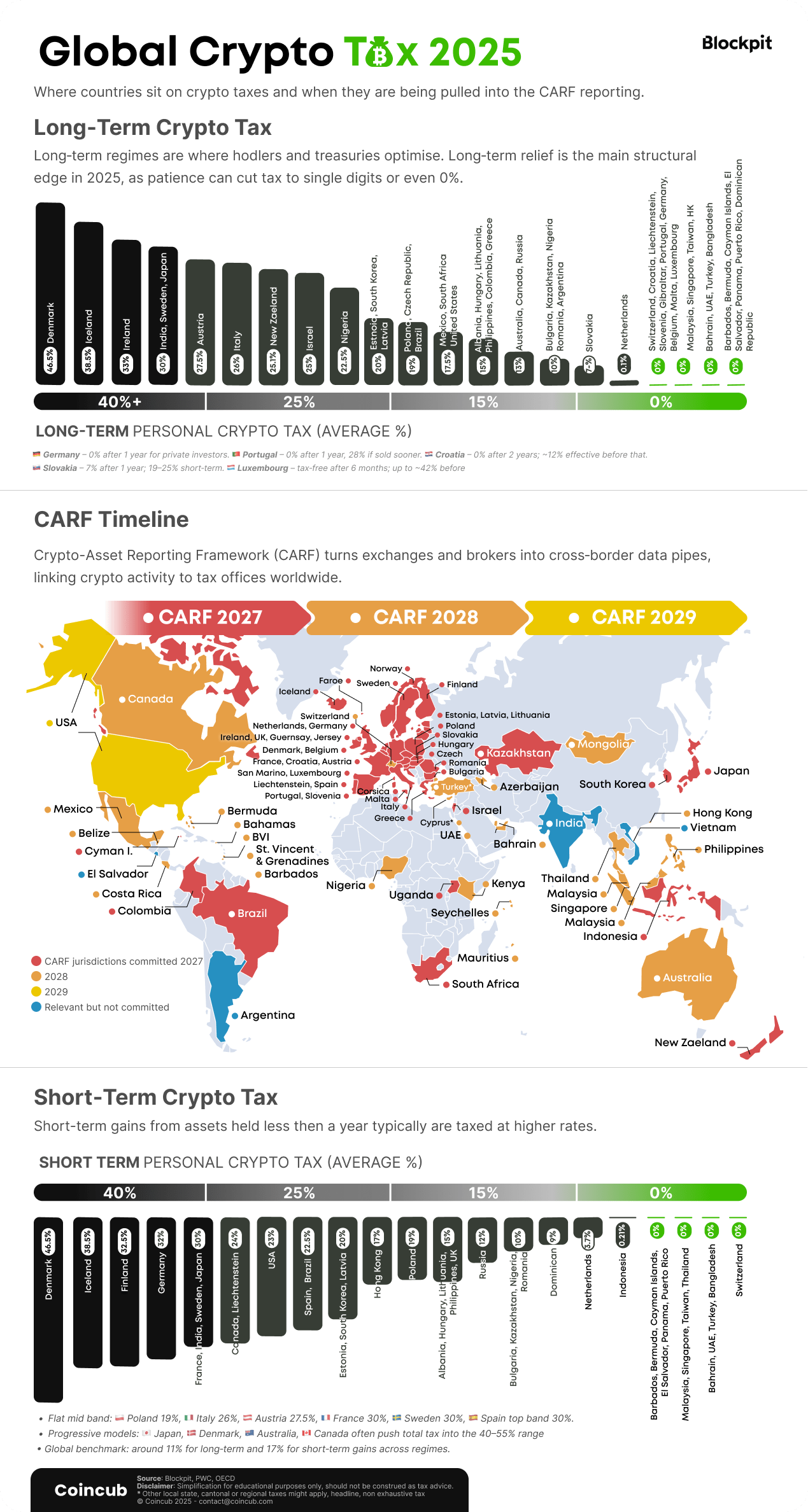
At the center of it all, we have the OECD’s Crypto-Asset Reporting Framework (CARF). 75 jurisdictions have now committed to CARF-style reporting, with the first large-scale data exchanges expected from 2027. In the EU, DAC8 mandates crypto reporting across all 27 member states starting in 2026. The United States follows its own path through 1099-DA, feeding domestic data first and international exchange later.
Individually, none of these frameworks reinvent crypto taxation. Capital gains rules remain familiar, though long-term versus short-term distinctions still matter. Zero-tax regimes still exist.
However, exchanges, brokers, custodians, and other intermediaries are being turned into reporting nodes. Once reporting becomes systematic, enforcement stops depending on audits, whistleblowers, or voluntary disclosure. It essentially becomes a mere matching exercise.
So, when reporting goes live, tax authorities no longer need to guess who did what. They only need to connect the dots.
Rates Still Vary
Despite the reporting shift, crypto tax rates have not converged globally. The report shows three dominant long-term outcomes.
One cluster sits at or near 0%. This includes jurisdictions such as the UAE, Singapore, Switzerland, parts of the Caribbean, and some European and Latin American countries. Most now sit inside CRS or CARF-style information exchange networks.
A larger group taxes crypto like other financial assets. Flat rates between 19 and 30% dominate much of Europe. The likes of Italy sit at 26%, France and Spain push toward 30%, Sweden remains high and unapologetic.
A third group applies progressive income models. Japan, Denmark, Australia, Canada, and others push effective crypto taxation into the 40-55% range, especially for active traders, which is not ideal.
Countries with clear rules and consistent treatment tend to generate higher compliance, even when rates are not low. Ambiguity now carries more risk than a headline percentage.
Long-Term Relief Still Shapes Behavior
Holding periods remain one of the few areas where tax policy actively influences behaviour.
Germany, Portugal, Croatia, Slovakia, and Luxembourg all reward long-term holding, with exemptions or sharply reduced rates after six months to two years. These regimes continue to attract long-term capital, family offices, and passive investors.
But while long-term relief reduces tax, it does not reduce reporting. Once CARF and DAC8 data flows begin, authorities will still see transactions, even if the resulting tax bill is zero.
Simply put, visibility and liability are no longer the same thing.
Zero Tax ≠ No Reporting
One of the more uncomfortable conclusions of the report is that zero-tax regimes have changed in character.
In 2025, a 0% rate inside a dense reporting network looks very different from a 0% rate in a jurisdiction that exchanges no data. The former offers legal certainty but little anonymity. The latter is becoming rare.
So the findings of the report matter if you’re in residency planning, choosing what exchange to use, or exploring compliance strategies. Some countries with low or zero rates still face pressure on banking access and correspondent relationships because reporting standards tend to increasingly travel alongside capital.
Country details, methodology, and sources are in the report.
Explore the full report here: https://t.co/JzGG82xF1B
— Coincub (@Coincub_) December 17, 2025
On the Path to Normalization
The report avoids the familiar narrative that governments are “coming after crypto.” The evidence suggests something less dramatic and more structural.
For users, the old strategy of staying small, fragmented, or quiet is becoming unreliable. The new strategy is to simply be coherent. So, you need one tax story, one set of records, and an activity that matches the classification.
For platforms, tax reporting is no longer a compliance edge case. Instead, think of it as a core infrastructure. Building for the strictest regime encountered is increasingly the only defensible option.
No More Grey Zone
The Global Crypto Tax Report 2025 does not try to predict every national change. Laws will keep moving, rates will shift, thresholds will be tweaked, and so on and so forth.
Crypto taxes are no longer defined by what governments say. They are defined by what systems can see.
That reality arrives quietly. Then it becomes permanent.
Frequently Asked Questions (FAQ)
What is the Global Crypto Tax Report 2025 about?
It analyzes how crypto is taxed and reported worldwide in 2025, with a focus on CARF, DAC8, and exchange-level reporting.
What is CARF in crypto taxation?
CARF is the OECD’s Crypto-Asset Reporting Framework that requires exchanges and intermediaries to report user transactions to tax authorities for cross-border data exchange.
When does crypto exchange reporting start?
EU-wide reporting under DAC8 starts in 2026. Global CARF exchanges begin from 2027, with some countries starting later.
Does CARF increase crypto tax rates?
No. CARF changes reporting and enforcement. Countries still apply their own capital gains or income tax rules.
Are zero-tax crypto countries still relevant?
Yes, but most now participate in reporting networks. A 0% tax rate no longer means no visibility.
Do DeFi users fall under CARF?
Pure non-custodial DeFi remains harder to report, but activity routed through exchanges, bridges, or fiat onramps is increasingly visible.