Buy a Licensed Company
  Explore VASP Data
  Talk to an Expert

 Dren Hima
 is Head of Research at Coincub, leading research across digital asset regulation, licensing, market structure, tokenization and institutional adoption.
Dren Hima
Dren Hima is Head of Research at Coincub, leading research across digital asset regulation, licensing, market structure, tokenization and institutional adoption.
Decentraland Price Prediction 2026-2030: Is the Metaverse Comeback Real?
Decentraland was one of the main characters of the 2021 metaverse mania. Land auctions, branded districts, tokens flying. Then the hype died, the charts fell apart, and most people left the conversation.
The project did not disappear. It moved into a long, boring phase of shipping upgrades, cleaning up the tech, and trying to build a real creator economy instead of a pure land casino.
MANA trades around $0.15, with a market cap in the $293-$296M range. That is roughly 97% below the all-time high near $5.90. It is also roughly 80% up over the last year and around 30% up over the last month, which tells you there is still some life left in the market.

So do you treat MANA as a dead metaverse bag, or as cheap optionality on a creator-driven virtual world that survived the winter?
Disclaimer: This article is for informational purposes only and does not constitute financial advice. Cryptocurrency markets, especially metaverse tokens like MANA, are highly volatile. Never invest more than you can afford to lose.
Quick Decentraland Price Prediction Overview
Decentraland sits in that awkward middle zone. Too big and established to ignore, too damaged to pitch as a “safe” bet.
Price sits near $0.15. Market cap hovers just under $300M. Fully diluted value is around $330M. Supply is roughly 1.9-2.0 billion MANA in circulation out of a total 2.193 billion.
The token is still crushed versus the 2021 highs, but it has put in a slow recovery from the absolute bottom. The recent push came alongside broader altcoin strength and more awareness of the new Decentraland 2.0 desktop client and 2026 roadmap.
- 2026 has room for a mild recovery if the 2.0 client, events, and creator rewards keep pulling people back in.
- 2030 depends on whether VR/AR and 3D web browsing become normal, and whether Decentraland still feels relevant in that world.
- 2040-2050 sit in pure scenario territory. Survival depends on Decentraland behaving like a protocol and a creator platform, not just a one-off game from a past cycle.
You are looking at high risk, high variance. Any upside is tied to a very specific corner of the crypto market, which is user-owned virtual worlds.
What is Decentraland – More Than Just a Game
Decentraland is a decentralized virtual world on Ethereum. Users control parcels of land as LAND NFTs, build experiences on them, and interact through avatars. The in-world currency is MANA, an ERC-20 token.
There are 90,654 LAND parcels, each mapped to a fixed coordinate on the world map. Parcels can be combined into Estates. Ownership lives on-chain as ERC-721 tokens. Wearables and emotes mostly use ERC-1155. MANA itself is used for land, wearables, emotes, Names, services, and governance.
Since 2020, Decentraland has been run by a DAO, not a central company. Voting Power (VP) comes from holding or locking MANA, owning LAND, Names, and some classes of wearables. The DAO treasury funds grants, events, tools, and maintenance.
The roadmap in 2024-2025 shifted away from pure “buy land and wait” thinking. The new focus is on the desktop client 2.0 (better performance, improved visuals, more stable experience), worlds for personal and themed instances beyond the main map, communities, referral programs, Marketplace Credits, and eventually AI-driven NPCs hinted in White Paper 2.0 and the 2025 Manifesto.
Decentraland is trying to become a creator-driven social and cultural space that happens to live on-chain.
Decentraland Price History and Current Performance
Historical Price Milestones
Decentraland has been around longer than many remember. The project started as a rough pixel experiment in 2015, raised around $26M in a 2017 ICO at roughly two cents per token, and opened the public world in early 2020.
The big moment came in late 2021. Facebook rebranded to Meta, metaverse headlines filled every feed, and tokens like MANA became proxies for the entire narrative. MANA spiked to roughly $5.85-$5.90 in November 2021, with market cap over $10B. Land floors were reported near double-digit ETH at the peak.
Then the cycle turned. The 2022-2023 crypto winter took down everything. Metaverse tokens suffered even more, because they were priced for explosive user growth that never arrived. MANA dropped more than 90%, land prices cratered, and the “daily active users” drama on Twitter painted Decentraland as nearly empty.
The team and DAO used 2024 and 2025 to push a different story. They shipped Decentraland 2.0 for desktop, published White Paper 2.0, and laid out a self-sustainability Manifesto that puts creators, events, and economic activity at the center of the flywheel instead of only land speculation.
At the time of writing, these are the metrics:
- Price around $0.15
- Market cap around $293-$296M
- Fully diluted value $330-$335M
- Circulating supply roughly 1.92-1.96B MANA, total supply 2.193B
Short-term performance has been mildly positive. Roughly +32% over the last 30 days, around +80% over the last year, while still sitting more than 97% below the all-time high. The backdrop is a slow altcoin recovery and a niche group of metaverse believers cycling back in.
Ecosystem metrics tell a mixed story. Desktop client downloads sit above 426,000. Reported monthly active users for 2025 reach into the hundreds of thousands according to some industry reports. Historical DAU numbers from 2022 were in the low thousands, depending on how you count. Third-party dashboards still show modest on-chain activity, with spikes around events like Art Week and the Music Festival.
So this is not exactly a ghost chain, but it is not Roblox scale either.
Factors That Could Move Decentraland Price
The “Apple” Effect and VR Hardware
MANA is a meta-bet on whether people actually use immersive interfaces.
Apple shipped Vision Pro in 2024 and followed up with a refreshed model in 2025. Meta keeps pushing Quest hardware. Valve and others still support VR ecosystems. Headsets are not mainstream yet, but the tech is moving fast.
Decentraland’s 2.0 client tries to position the world as future-ready for this cycle. If mixed-reality headsets become normal for gaming and social hangouts, worlds with established identity, creator economies, and land systems can benefit. If VR/AR adoption stalls, Decentraland remains mostly a desktop virtual world, and the upside ceiling stays lower.
For price, each hardware milestone, OS integration, or native client improvement becomes a potential catalyst. Lack of progress on this front is a drag.
Ecosystem Health and the Creator economy
Decentraland is leaning hard into the idea that creators make or break the platform.
The key focus areas in 2024-2025:
- Big seasonal events like Decentraland Music Festival, Art Week, and holiday trails.
- Better tools and docs for building interactive experiences.
- Worlds, which allow creators to deploy personal or themed spaces without fighting for expensive or crowded coordinates on the main map.
- Referral programs and Marketplace Credits to reward engagement and transactions.
If creators see real revenue from wearables, services, events, and sponsorships, they stay. If they stay, there are more things to do and more reasons for users to come back. And if that happens, MANA gains real utility as a spending and coordination token, not only a speculative chip.
If creator economics stay weak, the world risks turning into a set of abandoned parcels with a few flagship events keeping the lights on.
Tokenomics, Burns, and Demand
MANA has a long, documented deflationary component.
Initial supply was about 2.8B MANA. Primary land auctions required burning MANA to mint LAND parcels, which cut supply over time. Current total supply is around 2.193B, which means more than 600M MANA has been burned historically. There is no ongoing protocol inflation on top of that.
Circulating supply sits near 1.92B, with the rest held in vesting contracts and the DAO. MANA is used for in-world purchases, Names, some services, and is locked for Voting Power in the DAO. Marketplace fees historically supported burns or treasury accumulation, depending on the period and parameters the DAO set.
The chain reaction is straightforward. More activity means more fees and more pressure on circulating MANA, either through burns or through treasury accumulation and grant spending that pushes development. Less activity means those mechanics idle.
Supply is no longer the main problem. Demand is.
Competition in the Metaverse Space
Decentraland does not operate in a vacuum.
On the crypto side, The Sandbox is the direct rival, with a more voxel-style look and strong IP partnerships. Off-chain, giants like Roblox, Fortnite Creative, VRChat, Rec Room, and Horizon Worlds dominate user time and attention.
Decentraland differentiates through fully DAO-run governance, fixed land map, strong bias toward open, community-run events, and art scenes.
The trade-off is obvious. The project gains censorship resistance and long-term credibility, but loses the kind of centralized polish, budgets, and growth tactics that Web2 giants can deploy. MANA’s valuation reacts to how well Decentraland navigates that trade-off.
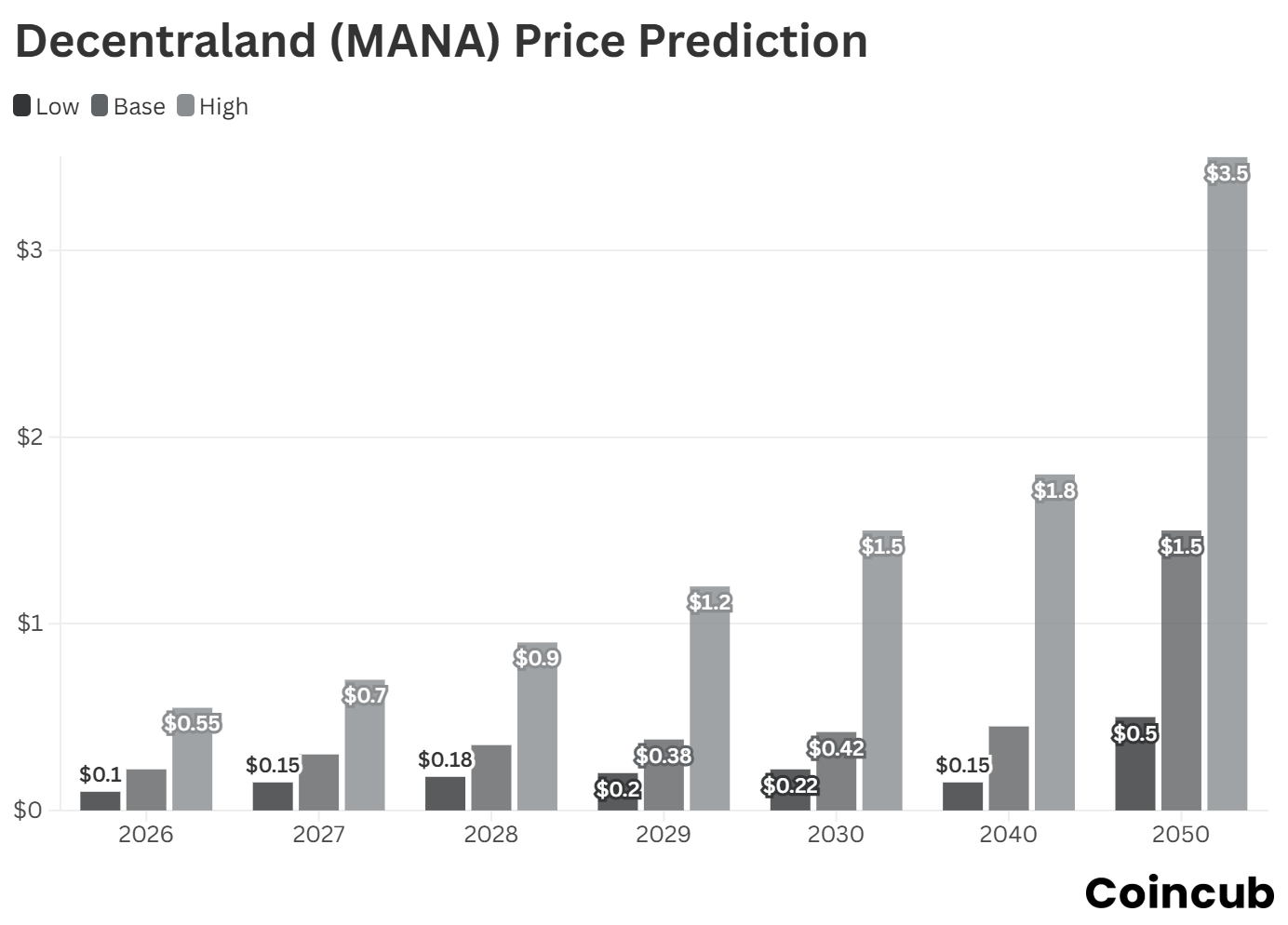
Decentraland price prediction 2026-2027
2026-2027 are the proving years.
The next two years will be about hard numbers. Daily active users, repeat visitors, marketplace volumes, and grants that actually result in sticky content will matter more than PR.
Reasonable ranges:
- 2026 (low / base / high):
- Low around $0.15
- Base around $0.30
- High around $0.70
- 2027 (low / base / high):
- Low around $0.18
- Base around $0.35
- High around $0.90
These bands assume Decentraland keeps a clear spot in the metaverse token basket. Strong VR/AR adoption, a breakout game or social experience inside Decentraland, or major partnerships can push the upper side. On the flip side, brutal competition or execution mistakes can trap MANA near the low end.
Decentraland price prediction 2028-2030
By 2028-2030 the market will answer a bigger question. Is Decentraland an active part of the 3D internet, or just a legacy world that a small group still loves?
The 2030 ranges we work with:
- Bear case: $0.15
- The project survives but stagnates. New virtual worlds dominate, VR/AR adoption is slower than expected, and MANA trades mostly on inertia.
- Base case: $0.45
- Decentraland grows slowly, keeps a steady creator base, and benefits from moderate VR/AR adoption. MANA becomes a niche but respectable metaverse asset.
- Bull case: $1.80
- Decentraland manages to position itself as a standard venue for events, social spaces, and creator hubs, integrated with headsets and browsers. The world remains relevant, and MANA captures enough of that value to rerate significantly from current levels.
At $1.80, MANA still sits below its 2021 high, but the move from $0.15 to that level would be strong for anyone who entered in the current range.
Long-Term Outlook (2040-2050)
Anything beyond 2030 is extremely speculative. The only honest way to talk about 2040 and 2050 is with very wide bands.
For 2040, a broad range that fits the current information is $0.50-$3.50
The lower end assumes Decentraland becomes a cult classic, with a small but loyal user base and limited market attention. The upper end assumes it remains one of a small group of canonical virtual worlds and benefits from a much larger immersive internet.
For 2050, the only fair description is scenario planning:
- Low: around $0.30 if Decentraland shrinks and loses liquidity but lingers as a niche.
- Base: around $1.00 if it sustains itself as an old but still-used hub.
- High: around $5.00 if it evolves into protocol-level infrastructure that supports multiple front-ends and integrations beyond the original client.
Nobody can model that cleanly. These numbers are there to show direction and scale.
How Does Decentraland Compare to Other Cryptos?
Decentraland vs. Bitcoin
Bitcoin is macro infrastructure. It tracks global liquidity, interest rates, and broader risk sentiment. It plays the “digital monetary asset” role.
MANA plays a very different role. It is tied to:
- A single virtual world
- User-owned land and assets
- The health of a specific creator ecosystem
MANA can outperform Bitcoin in short bursts during altcoin seasons, but the long-term risk profile is far more aggressive. Bitcoin sits in the core allocation bucket for many portfolios. MANA sits in the speculative satellite bucket.
Decentraland vs. The Sandbox (SAND)
The main crypto comparison is The Sandbox.
Decentraland leans into art, events, and social presence with a fully DAO-run structure and a fixed map. The Sandbox leans into gaming, IP partnerships, and more curated experiences with a different visual style.
From an investor angle:
- MANA gives cleaner exposure to a DAO-governed world where the community has strong control.
- SAND gives exposure to a more top-down, brand-heavy approach.
Both tokens live in the same risk band. Decentraland’s upside comes from executing the creator-economy pivot and staying relevant as hardware and user habits evolve.
Is Decentraland a Good Investment?
You can think of MANA as a small, high-beta bet on the idea that metaverse and virtual worlds still have another cycle in them.
The bull case rests on a few pillars. The project survived the worst of the bear. It shipped a significantly better desktop client. It updated its white paper, manifesto, and roadmap to focus on sustainable creator economics. The token supply went through meaningful historical burns, and there is no ongoing inflation schedule. If VR/AR adoption picks up and Decentraland holds its spot as one of the recognizable worlds, MANA has room to rerate from current levels.
The bear case is just as clear. User numbers stay modest, competing worlds on newer engines and chains feel better for most people, and metaverse narratives fail to recover. In that path, MANA either bleeds slowly or stays range-bound for years, while other sectors in crypto outperform.
On balance, MANA works best as a 1-5% slice of the high-risk part of a crypto portfolio, after Bitcoin, Ethereum, and your other core positions are already in place. It does not make sense as a “safe haven” or a capital-preservation tool.
How to Buy and Store Decentraland (MANA)
MANA is listed on most large centralized exchanges. You can usually find pairs against USD, USDT, BTC, and sometimes EUR. Liquidity is decent for the size of the project.
Storage is simple, because MANA is an ERC-20 token:
- For small, short-term positions, an exchange wallet is the easiest path, while understanding that you trust the exchange with custody.
- For longer holds and larger size, you move to self-custody. You hold MANA in a browser wallet such as MetaMask, or pair that with a hardware wallet like Ledger or Trezor for extra safety.
- If you plan to take part in the DAO, you keep your MANA in a wallet that can connect to the governance interface and sign votes.
Self-custody carries more responsibility but gives you control over your asset. That matters if you plan to treat MANA as a multi-year metaverse bet instead of a short-term trade.
Frequently Asked Questions (FAQ)
Will MANA Reach $10?
A $10 MANA would require a market cap far beyond the 2021 peak unless supply dropped further. That level would imply massive VR/AR adoption, strong user growth, and Decentraland staying at the center of the virtual world conversation for years.
Under the current data, $10 sits in the extreme tail of the distribution. It is not a realistic short- or medium-term target. You treat it as a theoretical upside, not something to base a serious plan on.
Is Decentraland dead?
The token chart looks brutal if you anchored at the top, but the project itself is not dead.
Development continues. The Decentraland 2.0 desktop client is live and iterating. White Paper 2.0 and the 2025 Manifesto outline a long-term plan. Events such as Music Festival, Art Week, and seasonal trails still draw crowds. The DAO treasury still funds grants and tools.
The honest answer is that Decentraland is alive, but in a survival and rebuild phase, not in a blow-off top phase.
Can I play Decentraland for free?
Yes. You can enter Decentraland as a guest without a wallet and walk around, explore scenes, and attend many events for free.
You only need MANA or an Ethereum wallet when you want to buy land, wearables, Names, services, or when you want to take part in governance. That split lowers the friction for new users, because they can test the world before they commit.
What is MANA used for?
MANA is the token that glues the economy together.
It is used for buying LAND on secondary markets, picking up wearables and emotes on the marketplace, registering Names, purchasing services and tickets for events, and locking for Voting Power in the DAO. It also appears in some DeFi integrations as a way to get structured metaverse exposure.
The more active the in-world economy is, the more relevant this utility becomes. If economic activity stays low, MANA mostly acts like a governance and speculation token.