


 Buy a Licensed Company
  Explore VASP Data
  Talk to an Expert

 Dren Hima
 is Head of Research at Coincub, leading research across digital asset regulation, licensing, market structure, tokenization and institutional adoption.
Dren Hima
Dren Hima is Head of Research at Coincub, leading research across digital asset regulation, licensing, market structure, tokenization and institutional adoption.
France Threatens to Block EU Crypto Passporting Under MiCA
Summary
- France has warned it could block passporting, raising the prospect of national barriers inside the EU’s new crypto regime.
- MiCA’s harmonization goals are under strain, as firms exploit lighter licensing regimes in certain member states.
- Italy and Austria back France’s push for ESMA oversight, while smaller hubs like Malta resist ceding authority.
- Major exchanges such as Gemini, Bitvavo, Kraken, and Coinbase could be directly affected, facing higher compliance costs or restricted access.
- The EU must decide between national flexibility and central supervision, a choice that will shape Europe’s competitiveness in digital assets.
France has warned it could block cryptocurrency firms licensed in other European Union countries from operating in its market. The threat targets the “passporting” system under the bloc’s new Markets in Crypto-Assets (MiCA) regulation, which was designed to let companies operate across all 27 member states with a single license.
The warning matters because it strikes at the core of MiCA’s promise to create a unified European crypto market. If France follows through, it could fracture the single market framework and trigger new disputes over how crypto rules should be enforced across the EU.
Background on MiCA and Passporting
The Markets in Crypto-Assets regulation, or MiCA, came into effect across the European Union in 2024. It created a single framework for crypto-asset service providers, covering licensing, investor protection, and operational standards.

A central feature of the regime is “passporting.” Once a company is licensed in one EU member state, it can use that authorization to operate across the bloc without applying again in each country. The idea was to give firms access to a larger market while ensuring consistent safeguards for users.
In practice, the system has encouraged what regulators call “forum shopping.” Companies are applying in countries with lighter licensing requirements to gain entry into stricter markets such as France or Germany. That uneven approach is at the heart of the current dispute.
France’s Position
France’s financial regulator, the Autorité des Marchés Financiers (AMF), has raised the prospect of blocking crypto companies licensed in other EU countries from operating domestically. Its chair, Marie-Anne Barbat-Layani, described the option as an “atomic weapon” that France keeps in reserve. She acknowledged it would be legally complex and send a poor signal for the single market, but said it remains a possibility if regulatory gaps persist.
France didn’t stop at the warning. The AMF also pushed for the European Securities and Markets Authority (ESMA) to take charge of supervising the biggest crypto firms. The idea is that putting oversight in one place would close the loopholes firms look for in softer jurisdictions and finally set the same standard across the EU.
Italy and Austria have joined France in backing ESMA’s involvement, setting up a divide between countries that favor stronger centralization and those that want to retain national control.
The crypto regulators of France, Italy and Austria are in panic-mode, because no one likes them.
MiCA allows passporting your crypto license across all EU countries. This is in the spirit of the European Union: capital and labour can go where it is the most competitive.
This… pic.twitter.com/Nwvvojgpu2
— Mikko Ohtamaa (@moo9000) September 16, 2025
Regulatory Tensions
The uneven way MiCA has been applied across Europe is at the core of the dispute. Earlier this year, Malta’s licensing process came under scrutiny after a peer review by the European Securities and Markets Authority found its regulator had not fully assessed risks before approving a crypto firm. Malta defended its record as an early adopter of digital asset rules, but the review reinforced concerns that some countries are moving faster and with looser standards than others.
France’s move has kicked off a legal fight. Some lawyers say there’s no way to block passporting because MiCA is an EU regulation that applies everywhere and was built to guarantee equal access. Others think the AMF could pull it off in practice, even if it’s politically messy, and see the threat more as a signal to firms looking for shortcuts through weaker regulators.
MiCA was meant to harmonize crypto rules, yet France’s stance signals that national regulators may still take unilateral steps when they feel investor protection is at stake.
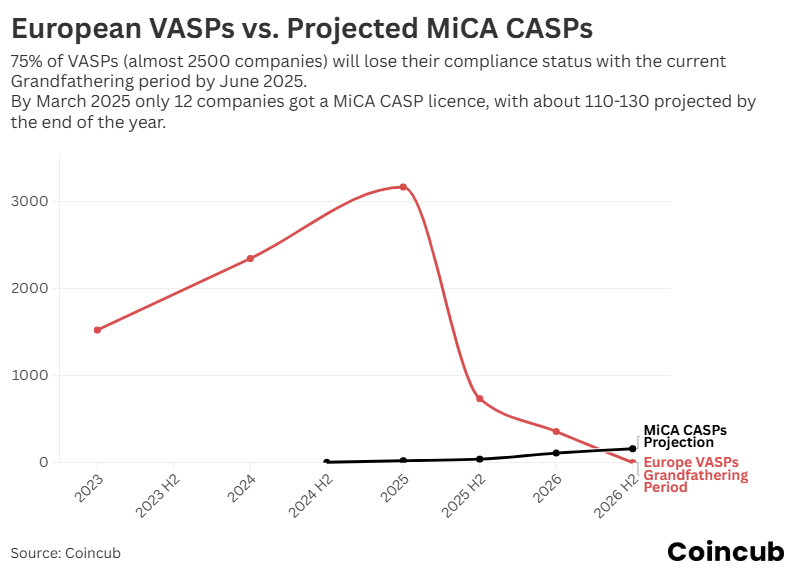
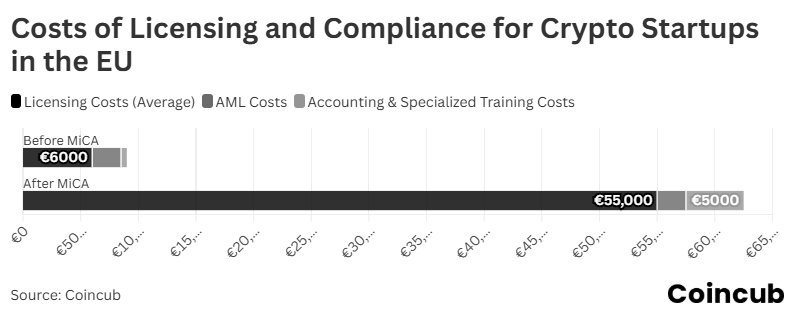
Europe’s own data shows how fragile the single-market promise looks in practice. Coincub’s Europe Crypto Report 2025 finds only a few CASPs and e-money token issuers licensed so far under MiCA, while compliance costs jumped from roughly €10,000 to about €60,000 for many firms preparing applications. The report also highlights a banking bottleneck, where only 14% of crypto startups managed to open accounts without later closures, and projects that roughly three quarters of the region’s 3,167 VASPs could lose their legacy registrations as the grandfathering window closes. Hiring has thinned as well, with crypto-related job postings down sharply since 2022. Together, those pressures help explain why larger markets push for tougher oversight and why smaller hubs resist a shift to ESMA.
Industry Impact
Several large platforms could be caught in the middle if France moves ahead. Gemini received its license in Malta, Bitvavo operates under Dutch supervision, and Kraken is authorized in Ireland. All of them rely on MiCA’s passporting rights to serve customers across Europe, including in France. A challenge to that model would force these firms to either meet French licensing standards separately or risk losing access to one of the EU’s biggest markets.
The uncertainty also raises compliance costs. Companies may need to duplicate applications, increase legal spending, or restructure operations to satisfy both national and EU-level demands. Smaller firms could struggle with the added burden, while larger exchanges might reconsider where they base their European operations.
For investors, the short-term effect could be stronger protections in France if regulators take a tougher line. But a fractured market risks pushing users toward less regulated platforms or creating uneven access across the bloc. That tension between national safeguards and EU-wide openness will determine how much MiCA can deliver on its original promise.
Looking Ahead
The big question now is whether ESMA gets the power to oversee major crypto firms directly. France, Italy, and Austria want that shift, but it would take political agreement and possibly fresh legislation. Other countries are pushing back, arguing that supervision should stay with national regulators.
There’s also talk of tightening MiCA itself. The three regulators have floated tougher rules for activity outside the EU, stronger checks on cybersecurity, and clearer rules for new token launches. Any of those changes would reopen negotiations in Brussels and keep firms guessing on what their final obligations will look like.
How this plays out will shape Europe’s position in the global crypto market. Giving ESMA more control could boost trust and close gaps, but it could just as easily slow down innovation if the rules become too heavy-handed. Europe has to find the middle ground between one clear framework and the flexibility firms need to build.
Conclusion
France has positioned itself as the leading voice for stronger central control of crypto oversight in Europe. Its threat to block passporting underscores the depth of frustration with uneven national enforcement and the risks of regulatory arbitrage.
That stance also puts MiCA’s harmonization goals at risk. The regulation was built to create a single framework for the bloc, but France’s warning shows how quickly national concerns can challenge the idea of a unified market.
Frequently Asked Questions (FAQ)
What is passporting under MiCA?
Passporting allows a crypto company licensed in one EU member state to operate across the entire bloc without seeking approval in each country. It was meant to reduce barriers and create a single European market.
Why is France threatening to block it?
France’s regulator, the AMF, argues that some firms are seeking licenses in jurisdictions with weaker enforcement, then using passporting to enter stricter markets. The AMF sees this as undermining investor protection and MiCA’s integrity.
Can France legally block passporting?
Opinions differ. Some legal experts say MiCA, as an EU regulation, applies directly across all member states and cannot be overridden. Others believe France could challenge a license on grounds of investor risk, even if the process is legally complex.
Which countries support France’s position?
Italy and Austria have joined France in calling for the European Securities and Markets Authority to oversee major crypto firms. Smaller states such as Malta have resisted, seeing centralization as an erosion of national authority.
What does this mean for crypto companies?
Firms like Gemini, Bitvavo, Kraken, and Coinbase could face higher compliance costs, duplicated licensing, or even barriers to certain markets. The outcome of the debate will determine whether the EU delivers one unified regime or fragments into competing approaches.