


 Buy a Licensed Company
 Explore VASP Data
 Talk to an Expert

 News Room
Admin Coincub
US Senators Ask Treasury to Protect State Stablecoin Issuers
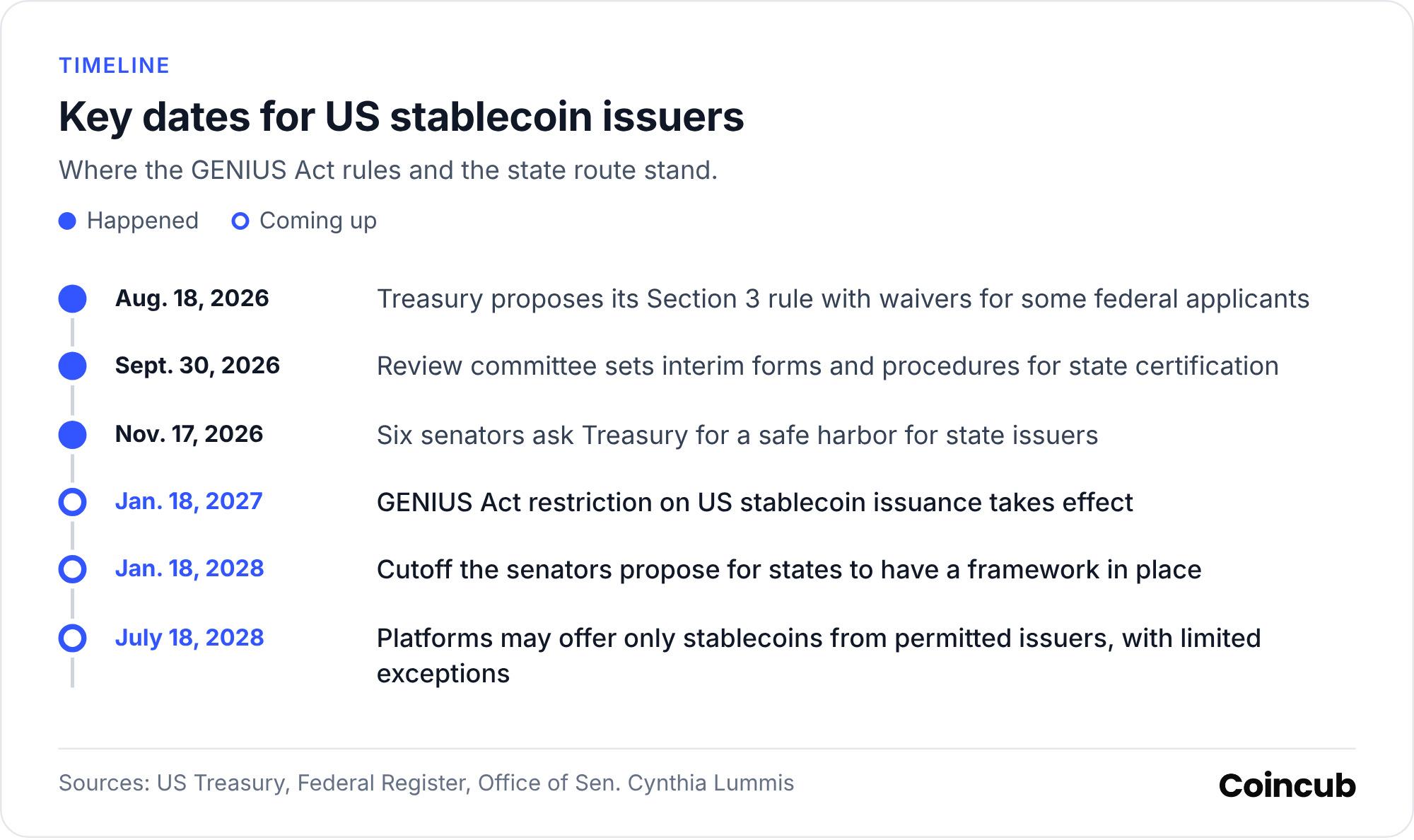
Six US senators asked Treasury to protect state-regulated stablecoin issuers from an issuance pause when the GENIUS Act takes effect on January 18, 2027. Treasury’s draft rule offers waivers only to certain federal applicants.
Six US senators have asked the Treasury Department to let state-regulated stablecoin issuers keep issuing while federal officials review their states’ rules. From Jan. 18, 2027, the GENIUS Act generally allows only permitted issuers to issue payment stablecoins in the US. A stablecoin is a crypto token designed to hold a steady value, usually one US dollar.
- Senators Cynthia Lummis and Kirsten Gillibrand led the bipartisan letter, dated Nov. 17, which Lummis’s office released on Nov. 18.
- Treasury’s draft rule offers up to 12 months of relief only to some federal applicants, and only with a waiver from their regulator.
- New York’s financial regulator has told Treasury that the law already lets state issuers keep operating.
What the senators asked Treasury to do
The letter went to Treasury Secretary Scott Bessent. Senators Angela Alsobrooks, Kevin Cramer, Pete Ricketts and Mark Warner also signed it. It asks Treasury to protect issuers in states that have certified their rules as “substantially similar” to federal law. This safe harbor from Section 3 would last while a federal committee reviews those rules.
“Treasury should establish a safe harbor for state issuers operating in states that will have a framework in place before January 18, 2028,” the senators wrote. They argued that without one, issuers could be pushed toward a federal charter over a state license.
How Treasury’s proposed waiver would work
Treasury proposed its Section 3 rule on Aug. 18. It offers relief to two groups with applications pending when the law takes effect. One is a subsidiary of an insured bank whose parent applied on its behalf. The other is a company applying for a federal stablecoin license.
The applicant’s primary federal regulator must grant a waiver that covers the Section 3 restriction. Relief can last up to 12 months from the law’s effective date. State issuers are not on that list. Treasury asked in its proposal whether they should get relief before a state files for certification or while a review is pending.
How state certification works
Issuers with $10 billion or less in outstanding stablecoins can choose state supervision if their state’s rules are substantially similar to the federal ones. A state certifies its own rules, and the Stablecoin Certification Review Committee, chaired by the Treasury secretary, reviews them.
The committee set its forms and procedures in an interim rule on Sept. 30. It must approve or deny a complete initial certification within 30 days. It will start accepting certifications once its forms clear federal paperwork review.
State groups disagree on what issuers need. The Conference of State Bank Supervisors and three other state organizations asked Treasury for safe harbors in October. New York’s Department of Financial Services (NYDFS) said none is needed because the statute already permits continued operations, Ledger Insights reported.
Which issuers are affected
NYDFS has long supervised the largest US stablecoin issuers. Ripple USD (RLUSD), worth about $2.5 billion, is issued by Standard Custody & Trust Company, a Ripple subsidiary regulated by NYDFS. Ripple National Trust Bank won final approval from the Office of the Comptroller of the Currency (OCC) on Oct. 26 and will manage RLUSD’s reserves. Issuance stays with the New York company.
What comes next for exchanges
From July 18, 2028, exchanges and other crypto platforms may sell payment stablecoins to people in the US only from permitted issuers, with limited exceptions. Foreign issuers face separate conditions, including the ability to comply with lawful orders to freeze or block tokens. More on the federal and state routes is in our guide to stablecoin licenses and bank charters.