


 Buy a Licensed Company
 Explore VASP Data
 Talk to an Expert

 Atis Shala
Atis is a senior analyst and community lead with four years of experience in crypto. He has a bachelor from the Rochester Institute of Technology.
Crypto White Paper Requirements in 2026: MiCA, UK, US, UAE

- Under MiCA, a crypto-asset white paper is a mandatory legal disclosure for offers to the public and for admissions to trading of tokens other than stablecoins regulated as asset-referenced or e-money tokens.
- The document must be notified to the home regulator at least 20 working days before publication. Regulators do not approve it in advance, and the first page has to say so.
- Since 23 December 2025, every MiCA white paper must be filed as XHTML with Inline XBRL tags under Implementing Regulation (EU) 2024/2984. A PDF on its own no longer complies.
- Small offers are exempt: fewer than 150 persons per Member State, a total consideration of no more than €1 million over 12 months, or offers made only to qualified investors.
- Tokens that were already trading in the EU before 30 December 2024 need a compliant white paper by 31 December 2027, and the trading platform is responsible for making sure one exists.
- The person drawing up the white paper, and its management body, are liable to holders for incomplete, unclear or misleading information, and contract terms that try to exclude that liability have no legal effect.
- The UK regime starts on 25 October 2027 and uses a “qualifying cryptoasset disclosure document” reviewed by the trading platform. The US remains at proposal stage, with the SEC’s Regulation Crypto Assets published in August 2026.
Crypto white paper requirements
Crypto white paper requirements have moved from marketing convention to statute. In the European Union, anyone who offers a token to the public or asks for it to trade on an EU platform must now produce a standardised disclosure document, notify it to a regulator, tag it in a machine-readable format and accept legal liability for every line. The UK, the United States, Dubai, Japan and El Salvador are building or running their own versions, and each one sets different rules on who writes the document, who checks it and who gets sued when it is wrong.
The EU’s Markets in Crypto-Assets Regulation (MiCA) gets the most space here, because it is the most detailed regime in force and the one most token teams meet first. Everything below reflects the rules as of November 2026.
What counts as a crypto white paper today
A crypto white paper began as a technical essay and is now, in most regulated markets, a prescribed disclosure document. The original model was Satoshi Nakamoto’s nine-page Bitcoin paper of October 2008, which described a peer-to-peer payment system and said nothing about the identity of the author, the rights of holders or the risks of buying in. The initial coin offering boom of 2017 kept the name and turned it into a sales document, usually a long PDF with a roadmap, a token allocation chart and very little that a buyer could enforce.
MiCA keeps the term “crypto-asset white paper” but gives it a legal definition through its content rules. The document has to describe the offeror, the issuer, the project, the offer, the token, the rights attached to it, the underlying technology, the risks and the climate impact of the consensus mechanism, in a fixed order and using fixed data fields. In practice it now reads much closer to a short prospectus than to the Bitcoin paper, and the gap between the two is where many first-time teams underestimate the work.
Who must publish a white paper under MiCA
The obligation falls on whoever brings a token to the EU public, and MiCA identifies three routes. Title II covers crypto-assets other than asset-referenced tokens (ARTs) and e-money tokens (EMTs), which includes most utility and governance tokens. Title III covers ARTs, which reference a basket of assets or a non-euro value, and Title IV covers EMTs, which reference a single official currency. Each title has its own white paper rules, and the Title II rules apply to the widest set of projects.
Offers to the public
Article 4 allows only a legal person to make an offer to the public of a Title II token, and that person must draw up, notify and publish a white paper first. The offeror also takes on conduct duties under Article 14, which include acting honestly and fairly, managing conflicts of interest and keeping adequate security systems. Where a token gives access to a good or service that does not yet exist, the offer period is capped at 12 months from the date the white paper is published.
Funds raised in an offer must be safeguarded with a credit institution or a custodial crypto-asset service provider (CASP) while the offer runs. If the offer is cancelled, the offeror has 25 calendar days to return the money.
Admission to trading
Article 5 applies the same core requirements to anyone seeking admission of a token to an EU trading platform. The person seeking admission and the platform operator can agree in writing that the operator will take on the white paper duties. When a platform lists a token on its own initiative and no white paper has been published, the operator has to produce one itself, which shifts white paper liability onto the trading venue along with the drafting work.
Tokens with no identifiable issuer, the category usually associated with Bitcoin, sit outside Title II under recital 22 of MiCA. ESMA’s Q&A 2552, answered by the European Commission in May 2025, confirms that Article 5(2) does not reach those assets, although the platform must still be authorised and must still assess what it is admitting.
Exemptions from the white paper requirement
MiCA removes the duty to notify and publish a white paper for three kinds of small or professional offers. The first is an offer to fewer than 150 natural or legal persons per Member State acting on their own account. The second is an offer whose total consideration does not exceed €1,000,000 over 12 months. The third is an offer addressed only to qualified investors, where only those investors can hold the token.
A further set of offers falls outside the requirement altogether. These include tokens offered for free, tokens created automatically as a reward for maintaining the ledger or validating transactions, utility tokens that give access to a good or service that already exists, and tokens usable only within a limited network of merchants. The exemption covers the offer and stops at the point of listing: if the token later seeks admission to a trading platform, the Article 5 white paper requirement applies.
Stablecoins follow a stricter track
ARTs and EMTs carry heavier white paper rules because they are tied to authorisation. An ART issuer submits its white paper as part of its authorisation application, and under Article 21 the white paper is deemed approved when the issuer is authorised. The regulator has 25 working days to check the file is complete and 60 working days to assess a complete application.
An EMT may only be issued by a credit institution or an electronic money institution, which must notify its regulator at least 40 working days before the offer and notify the white paper at least 20 working days before publication. The economics of euro stablecoins under MiCA are shaped by these issuer rules as much as by the disclosure itself, and the rest of this guide concentrates on the Title II white paper that most token projects need.
What a MiCA white paper must contain
The content rules for a Title II white paper sit in Article 6 and Annex I, which is divided into nine parts.
| Annex I part | What it covers
|
|---|---|
| Part A | The offeror or person seeking admission to trading |
| Part B | The issuer, where different from the offeror |
| Part C | The trading platform operator, where it draws up the white paper |
| Part D | The crypto-asset project |
| Part E | The offer to the public or the admission to trading |
| Part F | The crypto-assets |
| Part G | Rights and obligations attached to the crypto-assets |
| Part H | The underlying technology |
| Part I | Risks |
Part C exists because MiCA expects some white papers to be written by exchanges that never had a relationship with the token’s developers, and Part I makes risk disclosure a standalone section instead of a paragraph at the back.
Several statements are mandatory on top of the Annex I data. The first page must carry a clear and prominent statement that “this crypto-asset white paper has not been approved by any competent authority in any Member State of the European Union,” together with a statement that the offeror is solely responsible for its content. The document must warn that the token may lose all or part of its value, may not always be transferable or liquid, and is not covered by investor compensation or deposit guarantee schemes.
Is English required in a white paper?
The management body also has to sign off in a statement confirming that the white paper complies with MiCA and that its information is fair, clear and not misleading. A summary follows that statement, written in brief and non-technical language, and it carries its own warning that it should be read as an introduction to the full document. The white paper may not make assertions about the future value of the token.
The white paper must be written in an official language of the home Member State or in a language customary in international finance, which in practice means English for most projects.
Sustainability disclosures
The climate section draws on a separate technical standard. Article 6(1)(j) requires information on the principal adverse environmental and climate impacts of the consensus mechanism used to issue the token, and Delegated Regulation (EU) 2025/422 sets the indicators and the presentation template. Energy consumption is the starting indicator, and Paul Hastings notes that further indicators become mandatory once annual consumption exceeds 500,000 kWh. The same regulation allows a white paper to reuse consensus mechanism data already published for another token on the same network, which spares smaller projects on large chains from commissioning their own energy study.
The format rules: iXBRL since 23 December 2025
The content rules tell a team what to write, and since late 2025 a separate set of rules has governed how the document is built. Commission Implementing Regulation (EU) 2024/2984 sets the forms, formats and templates for white papers and has applied since 23 December 2025. Article 2 of that regulation requires the document to be prepared in XHTML, with the fields listed in its Annex tagged using Inline XBRL 1.1.
Inline XBRL, or iXBRL, is a way of embedding machine-readable data tags inside a document a person can still read in a browser. Each required field, such as the issuer’s name or the token’s supply, is tagged against a taxonomy so that a regulator’s system can extract it automatically. ESMA chose the format after an independent study found that it combined machine readability with the flexibility to handle long narrative text.
ESMA published the MiCA XBRL taxonomy in 2025, and on 8 October 2025 it released an optional Excel-based tool for generating an iXBRL white paper. Its statement of 28 November 2025 makes clear that ESMA accepts no liability for that tool and that issuers and CASPs remain responsible for validating whatever it produces.
What does the format rule imply?
The format rule raised an immediate question for teams that had filed before December 2025. ESMA’s Q&A 2845, published on 12 May 2026, answered it in two parts. A white paper notified before 23 December 2025 does not have to be refiled just because the new format applies, and the start of the implementing regulation is not itself a “significant new factor.” Once a modification is triggered for any other reason, though, the modified version must be prepared in iXBRL.
Exchanges add identifiers on top of the format. Kraken’s listing guidance, updated on 1 October 2026, asks for a valid Legal Entity Identifier (LEI) for the issuer and for the ISO 24165 Digital Token Identifier (DTI), as well as the Functionally Fungible Group DTI, inside the white paper. A DTI is a short code that links a token to reference data about its ledger and technical attributes, and ESMA expects CASPs and white paper preparers to use one where no other EU identifier exists.
Notification, publication and the life of a white paper
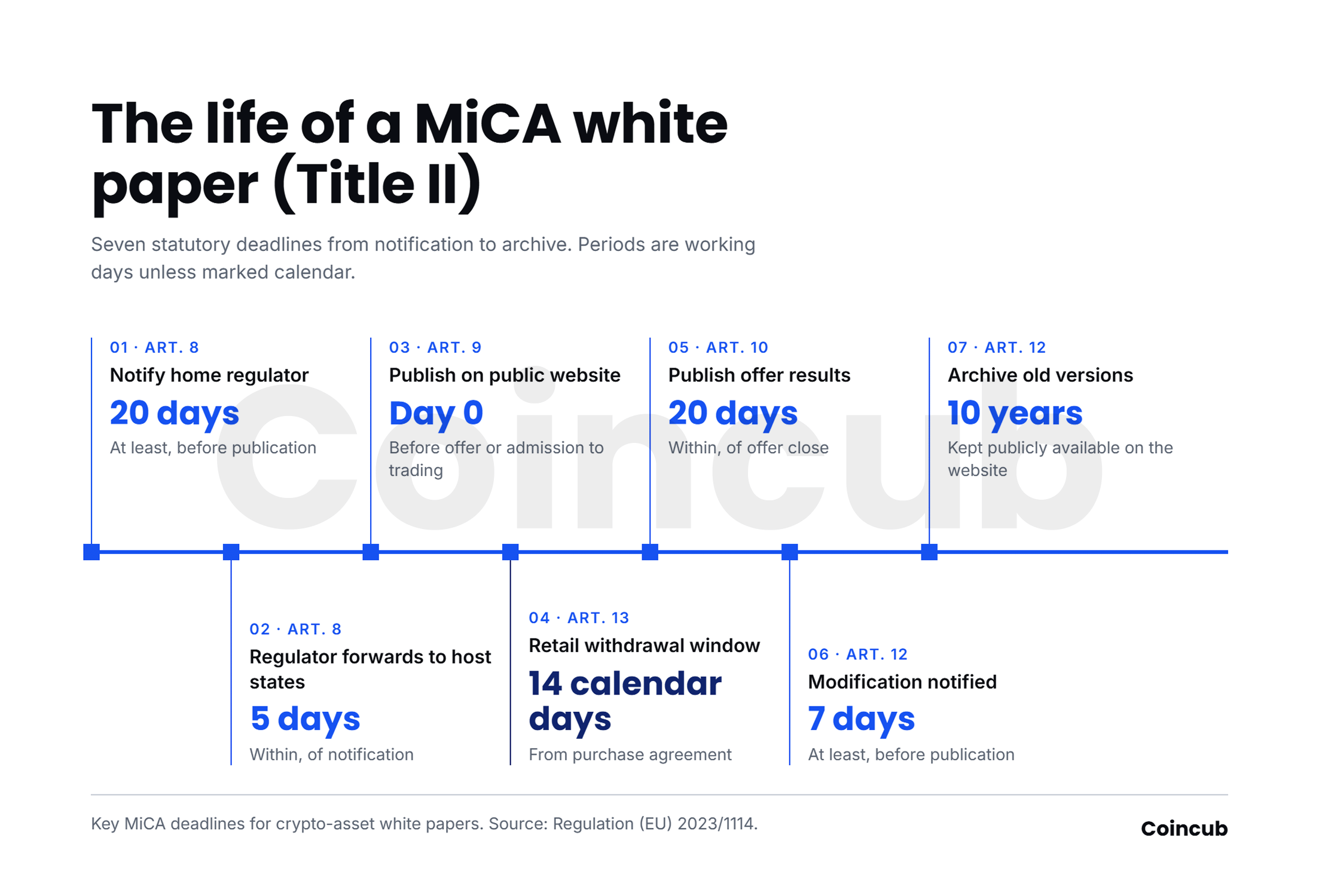
Once the document is drafted and tagged, MiCA sets a fixed sequence of deadlines that runs from notification to long after the offer closes.
Are tokens excluded from MiCA?
The notification under Article 8 must include an explanation of why the token is not excluded from MiCA under Article 2(4), which covers financial instruments among other products, and why it is neither an EMT nor an ART. The European Supervisory Authorities have published joint guidelines with templates for that explanation, so the classification analysis has to be finished before the 20 working day clock starts. The published white paper must match the notified version exactly and stay available for as long as the token is held by the public. The withdrawal right does not apply once a token is already admitted to trading, which is why it matters most for presales and token generation events sold directly to retail buyers.
Modifications are triggered by a significant new factor, a material mistake or a material inaccuracy that could affect how the token is assessed. A change to tokenomics, a new governance structure or a revised use of funds will usually meet that test, and each one restarts the shorter seven working day notification clock.
Liability and penalties
The deadlines above carry weight because MiCA attaches civil liability and administrative fines to the document. Under Article 15, an offeror or person seeking admission, together with the members of its management body, is liable to token holders for losses caused by information in the white paper that is incomplete, unfair, unclear or misleading. A holder has to show the infringement and show reliance on it, and any contractual clause that tries to exclude or limit that liability is deprived of legal effect.
The summary has narrower protection. Liability arising from the summary alone applies only where it is misleading, inaccurate or inconsistent with the rest of the white paper, or where it leaves out key information that investors need.
Administrative penalties are set by Member States within floors fixed in Article 111. For a legal person, the maximum fine for breaching Articles 4 to 14 must be at least €5,000,000 or 3% of total annual turnover. For a natural person, the maximum must be at least €700,000, and regulators can also impose fines of at least twice the profit gained or loss avoided where it can be calculated.
Legacy tokens and the 31 December 2027 deadline
Liability also explains why exchanges have been pressing older projects for paperwork. MiCA’s Title II has applied since 30 December 2024, and Article 143 sets out how it treats tokens that existed before then. Offers to the public that ended before 30 December 2024 are outside Articles 4 to 15 altogether. Tokens that were already admitted to trading before that date follow a lighter regime, and the trading platform operator must make sure a compliant white paper has been drawn up, notified and published by 31 December 2027.
The platforms have not waited for the deadline. In an October 2025 alert, Paul Hastings reported that EU exchanges were requiring the new format well ahead of December 2025 and warned that tokens without a compliant white paper risked delisting. The ESMA register reflects that pressure. A February 2026 study of the register by LegalBison counted 484 white papers for Title II tokens, of which 251 had been filed by exchanges or third-party compliance providers on behalf of established token networks.
That register is the main public record of MiCA compliance. ESMA has run it as an interim set of five CSV files since December 2024, covering Title II white papers, ART issuers, EMT issuers, authorised CASPs and non-compliant entities, and it was last updated on 5 November 2026. ESMA states that the white papers it lists have not been reviewed or approved by any regulator. Because entries arrive weekly, counts drawn from regulator register data move quickly, and the wider effect of MiCA on European firms, from compliance costs to bank access, is measured in the Europe Crypto Report 2026.
How white paper rules compare outside the EU
MiCA set the most detailed template, and other jurisdictions have built disclosure rules that differ on three points: who prepares the document, who reviews it and how long it has to be. A project launching in several markets has to satisfy each regime separately, much as firms face different capital floors and timelines from each licensing regulator.
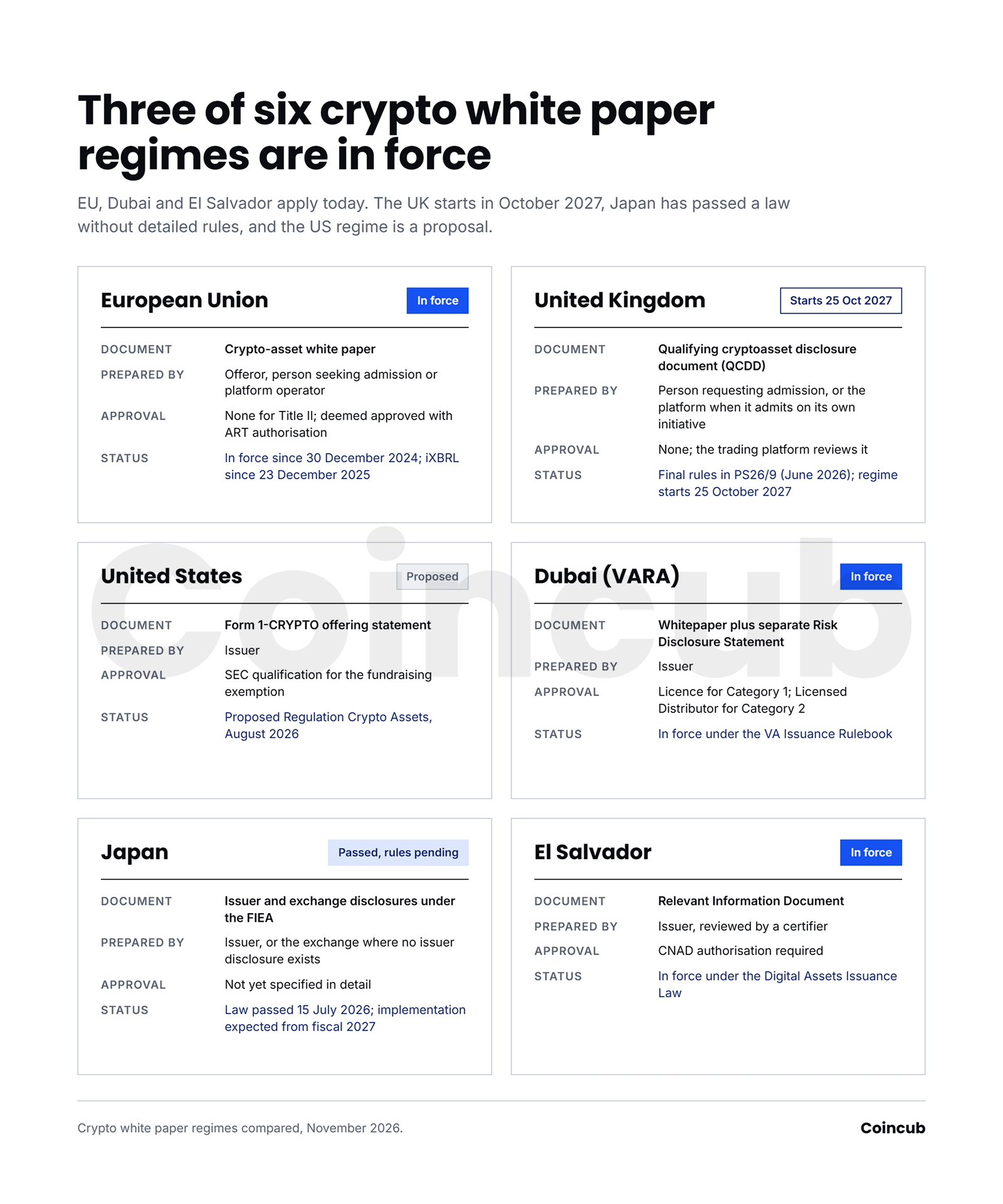
Most regimes now give the trading venue a formal role in checking or producing disclosure, and only the United States and El Salvador put a government review step in front of the offer.
United Kingdom
The UK has written the closest equivalent to MiCA, with a different allocation of responsibility. The FCA’s Policy Statement PS26/9, published on 30 June 2026, sets the rules for the Admissions and Disclosures regime that applies from 25 October 2027. A retail-facing UK trading platform must carry out due diligence and publish a QCDD before admitting a qualifying cryptoasset, and the FCA does not approve the document, which must say so.
Responsibility for the QCDD sits with the person requesting admission, or with the platform where it admits a token on its own initiative, and it applies even where there is no identifiable issuer. The summary is limited to two pages of A4 in plain English and must include the token’s DTI. QCDDs are filed with an FCA-owned central repository before trading starts.
The UK liability model is more forgiving of forecasts than MiCA’s. Ordinary statements carry a negligence standard, with the burden on the defendant, while “protected forward-looking statements” are actionable only for recklessness or dishonesty, and the claimant has to prove it. The FCA dropped a proposed exception that would have let fungible versions of already-admitted tokens list without a QCDD, and its September 2026 quarterly consultation proposed deferral arrangements for tokens already in circulation when the regime starts.
United States
The United States still has no statutory white paper regime, and its most concrete step is a rule proposal. The Digital Asset Market Clarity Act failed a Senate cloture vote by 49 votes to 50 on 15 September 2026. The SEC moved separately on 18 August 2026 with proposed Regulation Crypto Assets, which would create a startup exemption of up to $5 million over four years and a fundraising exemption of up to $20 million (Tier 1) or $75 million (Tier 2) over 12 months.
The fundraising route requires an offering statement on a new Form 1-CRYPTO, qualified by SEC staff, with disclosure across ten topics that include the network and development plan, security and source code, tokenomics and allocations, governance and risk factors. Whitepapers appear as exhibits to that filing. Comments closed on 20 October 2026, and the rule remains a proposal.
Dubai
Dubai’s Virtual Assets Regulatory Authority (VARA) requires every entity in the emirate that issues a virtual asset to publish both a Whitepaper and a separate Risk Disclosure Statement, apart from issuers of exempt assets. The UAE rulebook splits issuances into categories: Category 1, covering fiat-referenced and asset-referenced tokens, requires a VARA licence, while Category 2 tokens need no licence but must be placed through a Licensed Distributor that checks compliance.
The Dubai documents must be machine-readable, kept accurate at all times and published before the token is offered or marketed. Issuers cannot exclude civil liability for what they contain, and records of previous versions must be kept for at least eight years after the token stops circulating.
Japan and El Salvador
Japan passed an amendment to the Financial Instruments and Exchange Act on 15 July 2026 that moves crypto-assets out of the Payment Services Act. The reform, covered in more depth in how Japan regulates crypto, introduces annual disclosure duties for issuers of covered tokens and requires exchanges to publish information on the tokens they handle, with implementation expected from fiscal 2027 and the detailed rules still to come.
El Salvador puts a review step in front of every public offer. Its Digital Assets Issuance Law requires a Relevant Information Document for public offerings, reviewed by an accredited certifier and then authorised by the National Commission of Digital Assets (CNAD) before the offer opens. Issuing without authorisation can draw a fine of up to 1% of the offering’s value.
A practical checklist for a MiCA white paper
The differences between regimes matter for planning, but for most teams the EU file is the first one due, and it follows a predictable order.
- Classify the token: Confirm the token falls outside the Article 2(4) exclusions and is neither an EMT nor an ART, then write the explanation that Article 8 requires, using the ESAs’ template.
- Check the exemptions: Test the offer against the 150 person, €1 million and qualified investor thresholds, and remember that a later listing brings the white paper requirement back.
- Pick the home Member State: Non-EU offerors notify the regulator of the Member State where they intend to offer the token, so the choice fixes the language and the supervisor.
- Gather identifiers: Obtain an LEI for the offeror and a DTI for the token before tagging starts.
- Draft against Annex I: Fill Parts A to I, the mandatory statements, the management body statement, the summary and the sustainability indicators.
- Build the iXBRL file: Tag the document with the ESMA taxonomy and validate it before submission.
- Notify and wait: File with the regulator at least 20 working days before publication, and agree the listing date with the platform accordingly.
- Publish and maintain: Post the identical version on a public website, update it when a significant new factor arises, and archive superseded versions for ten years.
The checklist covers the minimum, and platforms often add their own requirements on templates, permissions and timing, so the listing venue’s guidance is worth reading before drafting begins.
Frequently Asked Questions (FAQ)
Does every crypto project need a white paper under MiCA? +
No. Offers to fewer than 150 persons per Member State, offers of up to €1 million over 12 months, offers only to qualified investors, free tokens, mining rewards and some utility tokens are exempt from the offer requirement. Tokens with no identifiable issuer, such as Bitcoin, fall outside Title II entirely. A listing on an EU trading platform can still trigger the requirement.
Does a regulator approve a MiCA white paper? +
No, for tokens under Title II. The white paper is notified to the home regulator at least 20 working days before publication, and regulators cannot require prior approval, although they can request changes. An ART white paper is different, because it is deemed approved when the issuer is authorised.
What format does a MiCA white paper have to use? +
Since 23 December 2025, a MiCA white paper must be prepared in XHTML with fields tagged in Inline XBRL 1.1, using the ESMA MiCA taxonomy, under Implementing Regulation (EU) 2024/2984.
Do white papers filed before December 2025 need to be redone in iXBRL? +
Not automatically. ESMA's Q&A 2845 of 12 May 2026 says the new format does not by itself require a refiling, but any modified white paper notified after 23 December 2025 must use iXBRL.
Who is liable if a white paper is misleading? +
Under Article 15 of MiCA, the offeror or person seeking admission, and the members of its management body, are liable to holders for losses caused by incomplete, unfair, unclear or misleading information. Contract terms that exclude that liability have no legal effect.
What happens to tokens that were listed before MiCA applied? +
Tokens admitted to trading before 30 December 2024 must have a compliant white paper drawn up, notified and published by 31 December 2027, and the trading platform operator is responsible for making sure that happens.
Is the UK QCDD the same as a MiCA white paper? +
They cover similar ground but differ in structure. The UK document is reviewed by the trading platform, limits the summary to two pages, applies from 25 October 2027 and uses a lighter liability test for protected forward-looking statements.