


 Buy a Licensed Company
 Explore VASP Data
 Talk to an Expert

 News Room
Admin Coincub
US Senators Urge CFTC to Drop Order on State Prediction Market Blocks
Nine Democratic senators urged the CFTC to withdraw or freeze its November 5 order against state geoblocks on prediction markets, as Politico reported probes into Kalshi and Polymarket.
Nine Democratic US senators asked the Commodity Futures Trading Commission (CFTC) to withdraw its order against state geoblocks on prediction markets. They said the order conflicts with court rulings, while Politico reported the agency is investigating Kalshi and Polymarket.
- The senators asked the CFTC to withdraw or freeze its November 5 interpretation on state-by-state geographic restrictions.
- They asked Chairman Michael Selig to respond and confirm record preservation by November 23.
- Politico reported the CFTC is running separate investigations into Kalshi and Polymarket.
Senators challenge the CFTC geoblock interpretation
The letter went to Selig on November 16. It targets an interpretation the CFTC, the United States derivatives regulator, issued on November 5. That guidance gave exchanges 30 days to drop state-level geographic limits or explain why they cannot. The CFTC argued such limits break its rule requiring “impartial access” to its markets.
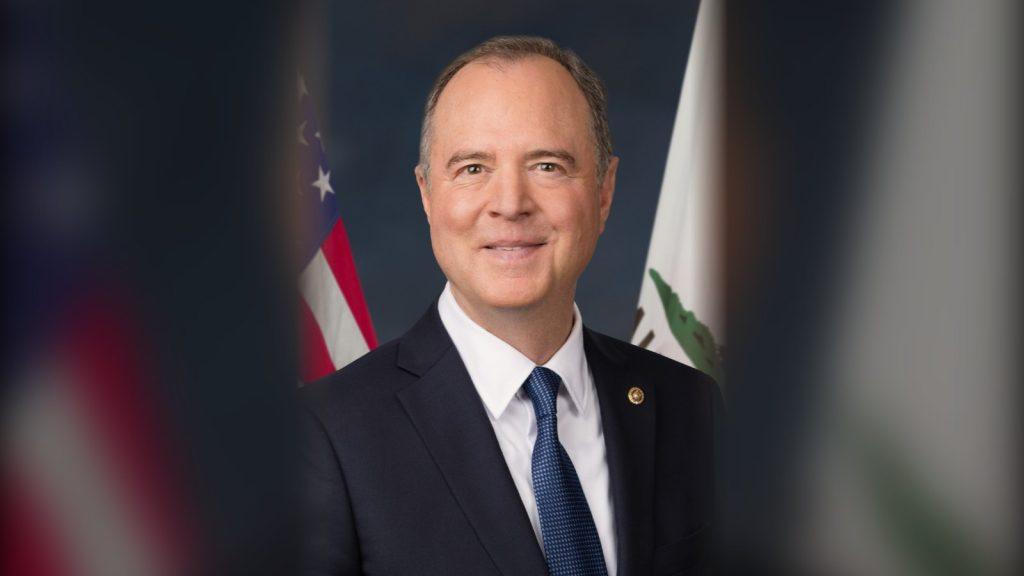
A geoblock, or geofence, stops users in a set location from reaching a service. Sen. Adam Schiff of California led the letter. Every senator from California, Michigan, Nevada and Washington signed it, along with Sen. Amy Klobuchar of Minnesota, ranking member of the Senate Agriculture Committee, which oversees the CFTC.
The senators said courts in California, Michigan, Nevada and Washington have ordered platforms to geofence those states or tribal lands. They wrote that the CFTC is encouraging prediction markets to offer prohibited contracts “in contempt of these court orders during active litigation.”
They also noted the guidance came hours after a federal court in California ordered Kalshi to geofence land of tribes that sued it. The senators said this raised concerns of possible coordination with platforms in litigation.
What the senators want from the regulator
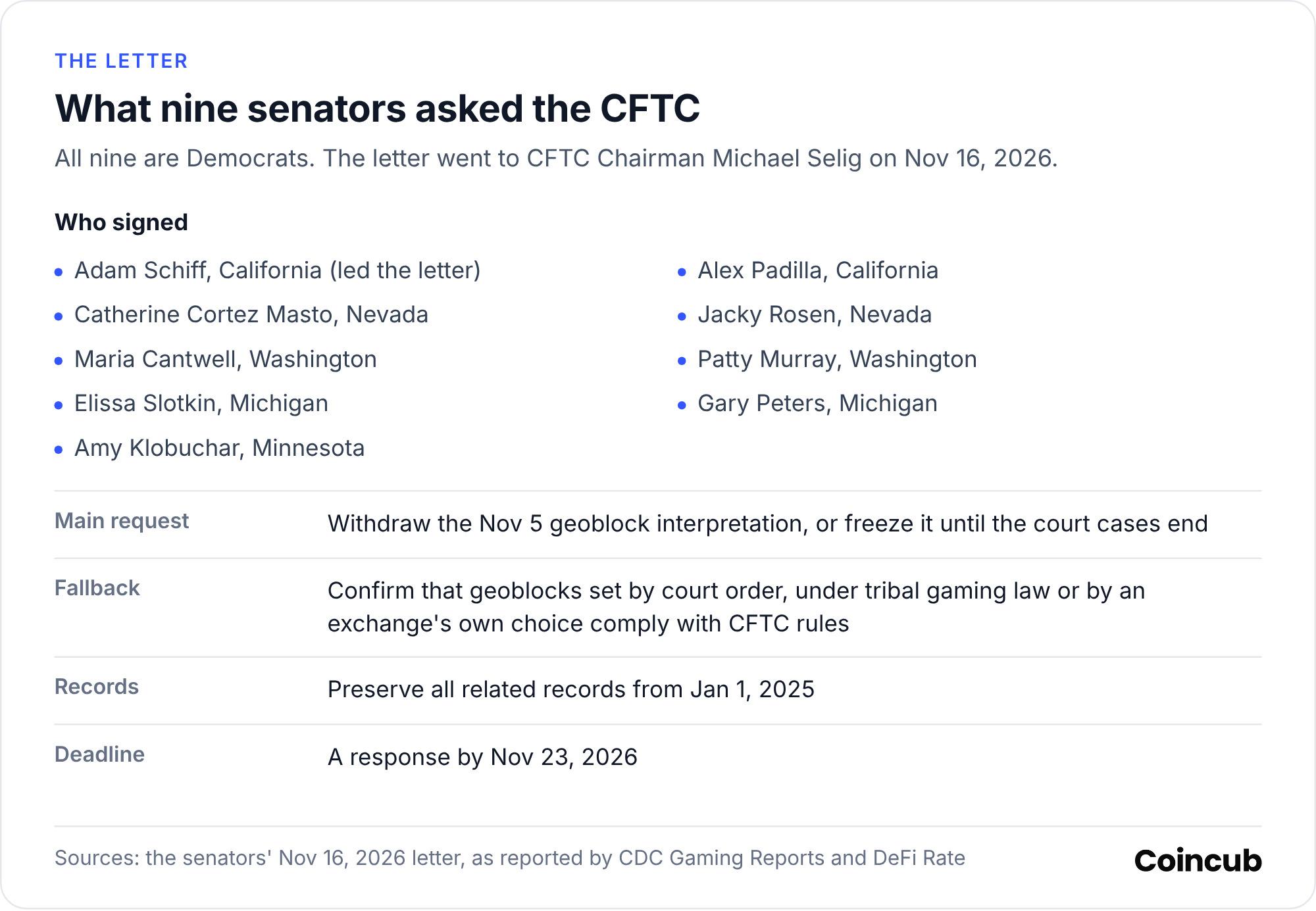
The letter asks the CFTC to withdraw the interpretation or pause it until the litigation ends. At a minimum, the senators want the agency to confirm that geoblocks do not violate its rule when imposed by court order, adopted to comply with federal Indian gaming law or tribal-state compacts, or added voluntarily by an exchange. They also asked the CFTC to preserve all related records dating back to January 1, 2025.
Politico reports probes into Kalshi and Polymarket
Politico reported that the CFTC is running separate probes into Kalshi, a US prediction market, and Polymarket, a rival platform. The Kalshi probe examines whether the company properly notified the agency about dozens of new products, and Politico reported on November 10 that the CFTC had warned Kalshi of possible charges. Kalshi spokesperson Elisabeth Diana described the matter as a procedural error involving submissions for a handful of contracts, many of which never went live.
The Polymarket inquiry looks at whether the company complied with a 2022 CFTC settlement that required its offshore platform to exclude US users, according to Politico. No charges have been filed against either company.
Congress and CFTC nominees
Selig, the agency’s only commissioner, has backed prediction markets in court fights with states. In Congress, Schiff and Sen. John Curtis of Utah have introduced the Prediction Markets Are Gambling Act, which would ban sports and casino-style event contracts on CFTC-registered platforms. Sen. Richard Blumenthal of Connecticut has called on Congress to act over the agency’s alleged ties to Kalshi.
Senators pressed both of President Donald Trump’s CFTC nominees on prediction markets at the Senate Agriculture Committee’s November 17 hearing. Democrat Matthew Rowland said he sympathized with states and tribes challenging sports contracts. Republican Nathan Anonick declined to call an NFL-linked contract sports betting and said he would follow any future Supreme Court ruling. If confirmed, they would join Selig on a commission designed to have five members.