


 Buy a Licensed Company
 Explore VASP Data
 Talk to an Expert

 Dren Hima
 is Head of Research at Coincub, leading research across digital asset regulation, licensing, market structure, tokenization and institutional adoption.
Crypto License vs EMI License: When USDC Withdrawals Became Payments
- Since 2 March 2026, EU CASPs that hold or move e-money tokens for clients need payment authorization or an agent arrangement.
- The EBA says a customer’s EMT withdrawal to their own wallet can be a payment transaction under PSD2.
- Without full CASP authorization, an EMI may custody and transfer only the e-money tokens it issues.
- UK e-money and payment firms offering crypto services need separate MLR registration, and neither status converts into the FSMA permissions due on 25 October 2027.
- PSD3 would end the standalone EMI license, pending Parliament’s second reading.
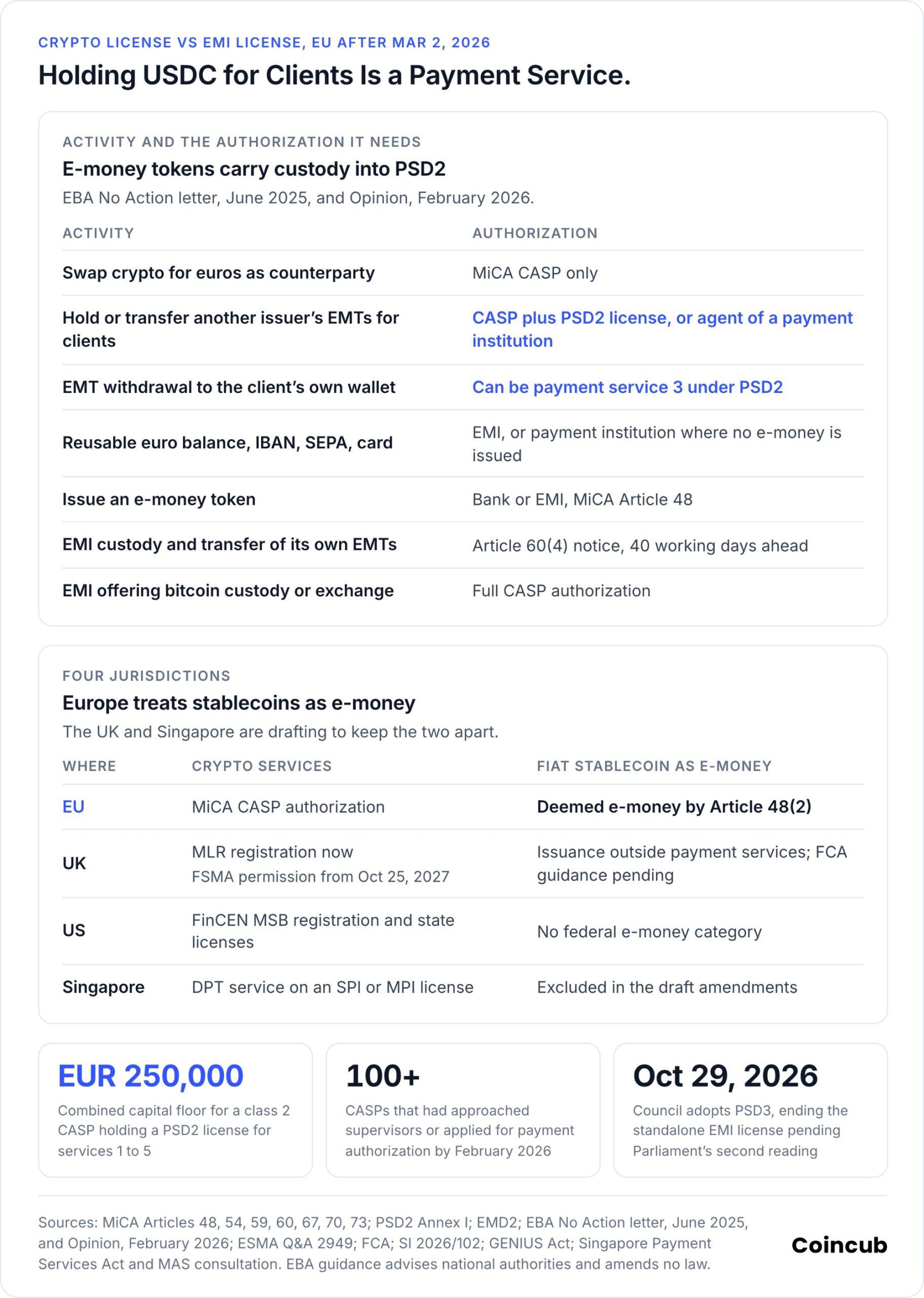
Since 2 March 2026, an EU exchange that lets a customer withdraw USDC to an outside wallet has been executing a payment transaction in the European Banking Authority’s reading. A withdrawal to a hardware wallet the customer owns counts as well. The EBA’s February 2026 Opinion advised national supervisors to make CASPs without a payment license or an agency arrangement stop those services and offboard the clients using them. More than 100 CASPs had approached supervisors or applied for payment authorization by the time it was published.
For most exchanges, the crypto license versus EMI license question used to come down to whether the product needed a euro balance. MiCA changed the inputs when it deemed e-money tokens to be electronic money, and the EBA spent 2025 and early 2026 working out what follows. A business needs both authorizations when it performs services from both perimeters. The e-money token is the asset that carries an ordinary custody business into the second perimeter with no fiat feature added.
Britain and Singapore are writing their stablecoin rules to keep stablecoins and e-money apart, and the United States regulates stablecoin issuance and money transmission as separate stacks.
What a MiCA CASP authorization covers
MiCA licenses by service. Article 59 bars anyone from providing crypto-asset services in the Union without CASP authorization or one of the Article 60 routes for banks, investment firms, EMIs and other entities already licensed under another EU act. The list runs from custody and administration and operating a trading platform to exchange for funds or for other crypto-assets, execution, placing, reception and transmission of orders, advice, portfolio management and transfer services.
Fiat on the platform does not add a payments license by itself. The EBA’s June 2025 No Action letter told supervisors not to treat MiCA’s exchange of crypto-assets for funds, or for other crypto-assets, as a payment service. A CASP buying a customer’s euros for bitcoin as counterparty stays inside MiCA for that trade. The letter gave the same treatment to CASPs intermediating purchases paid for with EMTs.
Article 70 requires a CASP to place client funds other than EMTs with a credit institution or a central bank by the end of the next business day, in an account separate from its own. The same article lets the CASP provide payment services connected to its crypto services directly or through a third party, provided whoever provides them holds PSD2 authorization. The CASP has to tell clients which arrangement applies. Paragraph 5 lifts the placement rule for CASPs that are themselves EMIs, payment institutions or banks.
ESMA closed one shortcut in Q&A 2949, answered in October 2026. A CASP may hold incoming client funds in a payment account at an EMI or payment institution for a short period. The money has to reach a credit institution or central bank account by the end of the following business day. An account opened in the EMI’s name fails Article 70(3) even when it is segregated for the CASP. The CASP would then hold a claim against the EMI and would not be the bank’s account holder.
E-money token issuers need an EMI or bank license
Article 48 settles the issuer side, and CASP authorization plays no part in it. Only the issuer may offer an EMT to the public or seek its admission to trading in the Union, and the issuer has to be a credit institution or an EMI with a notified white paper. Article 48(2) then deems e-money tokens to be electronic money, and EMD2 applies to every euro or dollar token issued in Europe from that line forward.
MiCA layers its own rules over EMD2. Holders have a claim on the issuer, tokens are issued at par on receipt of funds, and redemption runs at any time, at par and free of charge. Article 54 requires at least 30% of the funds received to sit in separate accounts at credit institutions, with the rest in secure, low-risk assets in the referenced currency.
Circle’s French entity won its EMI authorization from the ACPR in July 2024 and has issued USDC and EURC as EMTs in the EU since then. The EBA classified USDC as a significant EMT on 14 October 2026, the first of the 45 EMTs notified under MiCA. Since 12 November 2026 the EBA has supervised Circle Europe’s own funds, reserve of assets, liquidity, and recovery and redemption plans. Governance, qualifying holdings, fit-and-proper assessments, outsourcing and conflicts of interest stay with the supervisor in France.
Under Article 60(4), an EMI may provide custody and administration and transfer services for the e-money tokens it issues, after notifying its home supervisor at least 40 working days before it starts. The permission covers the issuer’s own tokens and nothing else. Bitcoin custody, an exchange desk for another issuer’s stablecoin and a trading venue each need full authorization under Article 59.
EMT custody and transfers after 2 March 2026
A CASP that holds another issuer’s EMT for customers sits in both perimeters. The No Action letter told supervisors to treat transfers of EMTs carried out on behalf of clients as a payment service, and to treat custody and administration of EMTs the same way. A custodial wallet counts as a payment account where it lets the client send EMTs to third parties and receive them. The letter set a transition to 2 March 2026 and advised supervisors to run the PSD2 applications through a streamlined procedure that reuses the CASP file.
The February 2026 Opinion set out what happens after the deadline. It names two routes. A CASP can hold its own PSD2 authorization or act as an agent of a payment service provider authorized for the relevant services. In the agent case, supervisors should check whether the partner itself needs authorization under Article 59. A CASP with a pending application could keep serving existing clients if it stopped marketing the EMT payment services and took no new clients for them.
Paragraph 15 of the Opinion reaches the first-party transfer. It reminds supervisors that executing EMT transfers can be payment service 3 under PSD2 Annex I whether or not the custodial wallet qualifies as a payment account. PSD2 makes no exception for transactions between accounts of the same user, and the 2025 letter had already rejected the industry argument that first-party transfers fall outside payment law. CASPs still running under a national grandfathering regime sat outside the post-March restrictions until 1 July 2026 or their MiCA decision, whichever came first.
All of it is guidance. The No Action letter and the Opinion advise national authorities and amend nothing in PSD2 or MiCA, and the national authorities remain the licensing bodies. The EBA asked the co-legislators to remove the overlap through PSD3, and its 2025 letter states that dual authorization creates a significant administrative burden for CASPs and supervisors alike.
Holding CASP and payment institution licenses in one entity
Latvijas Banka’s Supervision Committee granted SIA Paybis Europe a crypto-asset services license and a payment institution license on 12 May 2026. The CASP license covers custody and administration, exchange for funds and for other crypto-assets, order execution, advice and transfer services. The payment license lets the entity execute payments, including transfers to payment accounts. Paybis was the third company in Latvia to receive a MiCA license. Its counsel at Sorainen linked the payment authorization to the firm’s transactions in e-money tokens.
Paybis added a payment institution license. For the EMT leg that is enough. Holding and transferring another issuer’s tokens is a payment service, while issuing e-money is a separate activity reserved to EMIs and banks. A CASP that never issues stored value of its own needs PSD2 authorization for the EMT business. The EMI license only becomes necessary once the platform issues euro balances itself.
The No Action letter advised supervisors to stack the capital, applying PSD2 and MiCA initial capital and own funds requirements cumulatively. Its worked example pairs a class 2 CASP, whose permanent minimum under MiCA Annex IV is EUR 125,000, with a payment institution authorized for PSD2 payment services 1 to 5. That institution needs EUR 125,000 of initial capital, and the combined floor is EUR 250,000. Article 67 then sets the CASP requirement at the higher of the Annex IV figure and one quarter of the previous year’s fixed overheads. For a CASP with a large cost base, the overheads figure is the one that binds. The letter also told supervisors to stop the same own funds from being counted twice across the two regimes.
Fiat wallets, IBANs and licensed partners
PSD2 Annex I lists operating payment accounts, executing credit transfers, direct debits and card payments, issuing payment instruments, acquiring and money remittance among the regulated services. EMD2 defines e-money as electronically stored monetary value representing a claim on the issuer, issued on receipt of funds for making payment transactions and accepted by someone other than the issuer. An app that adds a reusable euro balance, a dedicated IBAN, SEPA transfers and a card to its MiCA services is running an EMI business whatever its CASP license says. Where it issues no e-money, a payment institution license covers the same features. The IBAN is only the identifier on an account that someone has to be licensed to operate.
Article 70(4) lets the CASP keep the front end and hand the payment leg to a licensed partner. The partner has to contract for the payment service, operate the account and execute the transfers, and the CASP has to tell clients that a third party provides those services. Article 73 keeps the CASP fully responsible for its own obligations when it outsources, and it bars outsourcing from altering the conditions of the CASP’s authorization. A CASP that rents a partner’s rails while still performing the payment service itself keeps the licensing problem. For EMT services the EBA’s agent route gives the arrangement a defined legal form, with the CASP acting as the payment institution’s agent and the partner answering for the payment service.
Licenses attach to legal entities. An EMI in the same group does not authorize an unlicensed CASP sister to issue e-money, and a CASP license held by one subsidiary covers no other. Groups that split the functions need the customer contracts, key control, account operation and disclosures to follow the same split.
UK crypto registration and e-money authorization until October 2027
Britain already requires both. The FCA says businesses already registered with or authorized by it for other services, e-money and payment institutions included, must also register under the Money Laundering Regulations before providing in-scope cryptoasset services. Coinbase’s UK business runs on that model. CB Payments Ltd has held e-money authorization since 2018 and joined the FCA’s cryptoasset register in early 2025, after which the same entity offers fiat and crypto services.
The FSMA regime replaces the registration model on a fixed date. The Cryptoassets Regulations 2026, SI 2026/102, were made on 4 February 2026 and bring most of their provisions into force on 25 October 2027. The new regulated activities include issuing qualifying stablecoin, safeguarding qualifying cryptoassets, operating a trading platform, dealing as principal or agent, arranging deals and arranging staking. An MLR registration does not convert into FSMA authorization, and a payment or e-money authorization supplies none of the cryptoasset permissions, as BCLP’s guide to the gatewaysets out. Firms that apply between 30 September 2026 and 28 February 2027 can rely on savings provisions to keep operating while the FCA decides.
The 2026 Regulations also amend the Payment Services Regulations so that issuing a qualifying stablecoin does not amount to a payment service. A second instrument, the Miscellaneous Amendments Regulations, changes the treatment of UK qualifying stablecoins across the safeguarding, dealing and arranging activities. It was laid in draft on 14 September 2026 and debated in committee in both Houses on 10 and 11 November, with no record yet of it being made. The FCA has also said it will consult on guidance separating e-money from qualifying stablecoins, with final guidance expected in early 2027.
The e-money side tightened while the crypto regime was being built. The FCA’s CASS 15 rules took effect on 7 May 2026 for authorized payment institutions and EMIs. They add reconciliation and audit requirements to the statutory safeguarding duties in the Electronic Money Regulations 2011 and the Payment Services Regulations 2017. A UK firm running an e-money wallet with crypto custody today works under the MLRs, the EMRs and CASS 15 at once, and from October 2027 under Part 4A permissions as well.
Crypto and payments licensing in the US and Singapore
The United States has no EMI equivalent to map the question onto. The OCC’s final GENIUS Act rule of 21 October 2026 takes effect with the Act on 18 January 2027. From that date the Act generally bars anyone other than a permitted payment stablecoin issuer from issuing a payment stablecoin in the US. A permitted payment stablecoin issuer can be a subsidiary of an insured depository institution, a federal qualified issuer or a state qualified issuer.
Custody, exchange and transfer for customers stay in the money transmission layer. FinCEN’s 2019 guidance treats money transmitter status as a question of the facts and circumstances of the business model. Registering with FinCEN as an MSB leaves every state license requirement in place. State money transmitter licenses still run state by state. The Conference of State Bank Supervisors counts 31 states that have enacted its Money Transmission Modernization Act in full or in part, and it acknowledges that uneven adoption has produced different readings by examiners.
Singapore never split the two. The Payment Services Act licenses providers as standard or major payment institutions, and one license can carry digital payment token service, account issuance, domestic and cross-border transfers, merchant acquisition and e-money issuance together. A firm needs a major payment institution license above S3millioninmonthlytransactionsforanyonepaymentserviceorS6 million across two or more. Daily outstanding e-money above S$5 million triggers the same move (account issuance and money-changing sit outside the transaction counts).
MAS’s consultation, open from 1 September to 16 October 2026, proposes a standalone stablecoin issuance license and an amended e-money definition under which fiat-pegged stablecoins do not constitute e-money. Issuers could provide digital payment token services in their own MAS-regulated stablecoins without a second license where those services are incidental to issuing, a permission close to MiCA’s Article 60(4).
| Jurisdiction | Crypto services | Fiat payments and e-money | Fiat stablecoin issuance | Fiat stablecoin as e-money |
| EU | MiCA CASP authorization | EMI or payment institution under EMD2 and PSD2 | Bank or EMI under MiCA Article 48 | Deemed e-money by Article 48(2) |
| UK | MLR registration now, FSMA permission from 25 October 2027 | EMRs 2011 and PSRs 2017 | FSMA permission for issuing qualifying stablecoin from 25 October 2027 | Issuance sits outside payment services, FCA e-money guidance pending |
| US | FinCEN MSB registration and state licenses | State money transmission licenses | GENIUS Act permitted issuer from 18 January 2027 | No federal e-money category |
| Singapore | DPT service on an SPI or MPI license | Further services on the same license | Proposed stablecoin issuance license | Excluded in the draft amendments |
What PSD3 changes for EMIs and CASPs
The Council adopted its first-reading positions on PSD3 and the Payment Services Regulation on 29 October 2026, and Parliament still has to approve them at second reading. The directive amends MiCA and repeals EMD2 and PSD2. Under the agreed text, e-money issuance becomes payment service 8 in Annex I and the standalone EMI authorization ends. Existing EMIs would keep operating on their current authorization for 21 months from entry into force, followed by six months in which supervisors verify compliance with the new rules, according to A&L Goodbody’s analysis. A supervisor already holding evidence of compliance may authorize an EMI automatically.
E-money token issuers that are EMIs today would hold payment institution licenses after that transition. For CASPs, the agreed text brings EMTs that meet the e-money definition inside the new framework and keeps transfers used to pay for goods or services in scope. EMT transactions used for investment or trading fall outside, including exchanges by a CASP acting in its own name as buyer or seller. An authorized payment institution also gets a notification route to offer EMT-linked crypto services, and CASPs that transfer EMTs still need payment services authorization, as MT Mamo TCV’s review of the drafting reads the text.
Until Parliament votes and the new texts apply, PSD2, EMD2 and the EBA’s Opinion set the terms. A CASP holding USDC for EU customers in November 2026 needs its own payment authorization or an agency arrangement with an authorized payment institution, or it has to stop offering the EMT payment services.
Frequently Asked Questions (FAQ)
Does a crypto exchange need an EMI license in the EU? +
An exchange that only swaps crypto for euros or for other crypto-assets needs no payment license for that activity. A payment license becomes necessary when the exchange holds or transfers e-money tokens for clients, operates fiat payment accounts, executes transfers to third parties or issues cards. A payment institution license covers most of that unless the exchange issues e-money itself.
Can an EMI offer crypto services under MiCA? +
An EMI can offer custody, administration and transfer services for the e-money tokens it issues, after notifying its home supervisor at least 40 working days in advance under Article 60(4). Bitcoin custody, exchange services, a trading platform or services in another issuer's stablecoin all need full CASP authorization.
Is withdrawing a stablecoin to my own wallet a payment under PSD2? +
For e-money tokens, the EBA says it can be. Its February 2026 Opinion reminds supervisors that EMT transfers can be payment service 3 under PSD2 even where the custodial wallet is not a payment account. PSD2 also has no exception for transfers between accounts of the same user.
Is a payment institution license enough for a CASP, or does it need an EMI license? +
A payment institution license covers custody and transfers of another issuer's EMTs. Issuing e-money of its own, such as a reusable euro balance, takes the platform into EMI territory, and MiCA Article 48 reserves EMT issuance to EMIs and banks.
Can a CASP use a licensed partner in place of its own payment license? +
MiCA Article 70(4) allows a third party authorized under PSD2 to provide the payment services. For EMT services, the EBA also accepts a CASP acting as an authorized payment institution's agent. The partner has to perform the regulated service in law and in substance, and the CASP must tell clients that a third party provides it.
Does a UK EMI need separate crypto registration? +
A UK EMI has to register separately. The FCA requires e-money and payment institutions to register under the Money Laundering Regulations before providing in-scope cryptoasset services. From 25 October 2027 they also need FSMA permissions for regulated cryptoasset activities, and neither the EMI authorization nor the MLR registration converts into them.
Will PSD3 end the need for two licenses? +
PSD3 folds e-money issuance into the payment institution license and gives payment institutions a notification route for EMT-linked crypto services. Practitioner readings of the agreed text still expect CASPs that transfer EMTs to hold payment services authorization. The Council adopted its position on 29 October 2026. Parliament has yet to vote.
How much capital does a CASP with a payment license need? +
The EBA advises supervisors to add the two regimes together. Its example pairs a class 2 CASP at EUR 125,000 with a payment institution at EUR 125,000 for a EUR 250,000 floor. MiCA Article 67 raises the CASP figure to a quarter of the previous year's fixed overheads where that is higher.