


 Buy a Licensed Company
 Explore VASP Data
 Talk to an Expert

 Atis Shala
Atis is a senior analyst and community lead with four years of experience in crypto. He has a bachelor from the Rochester Institute of Technology.
The 61,800 Bitcoin Dispute: Who Has a Claim to Seized Crypto?

- British authorities hold more than 61,000 bitcoin seized from convicted launderer Zhimin Qian, and Chinese prosecutors put the figure at 61,896.41552945 BTC in a confiscation application accepted by a Tianjin court on 28 September 2026.
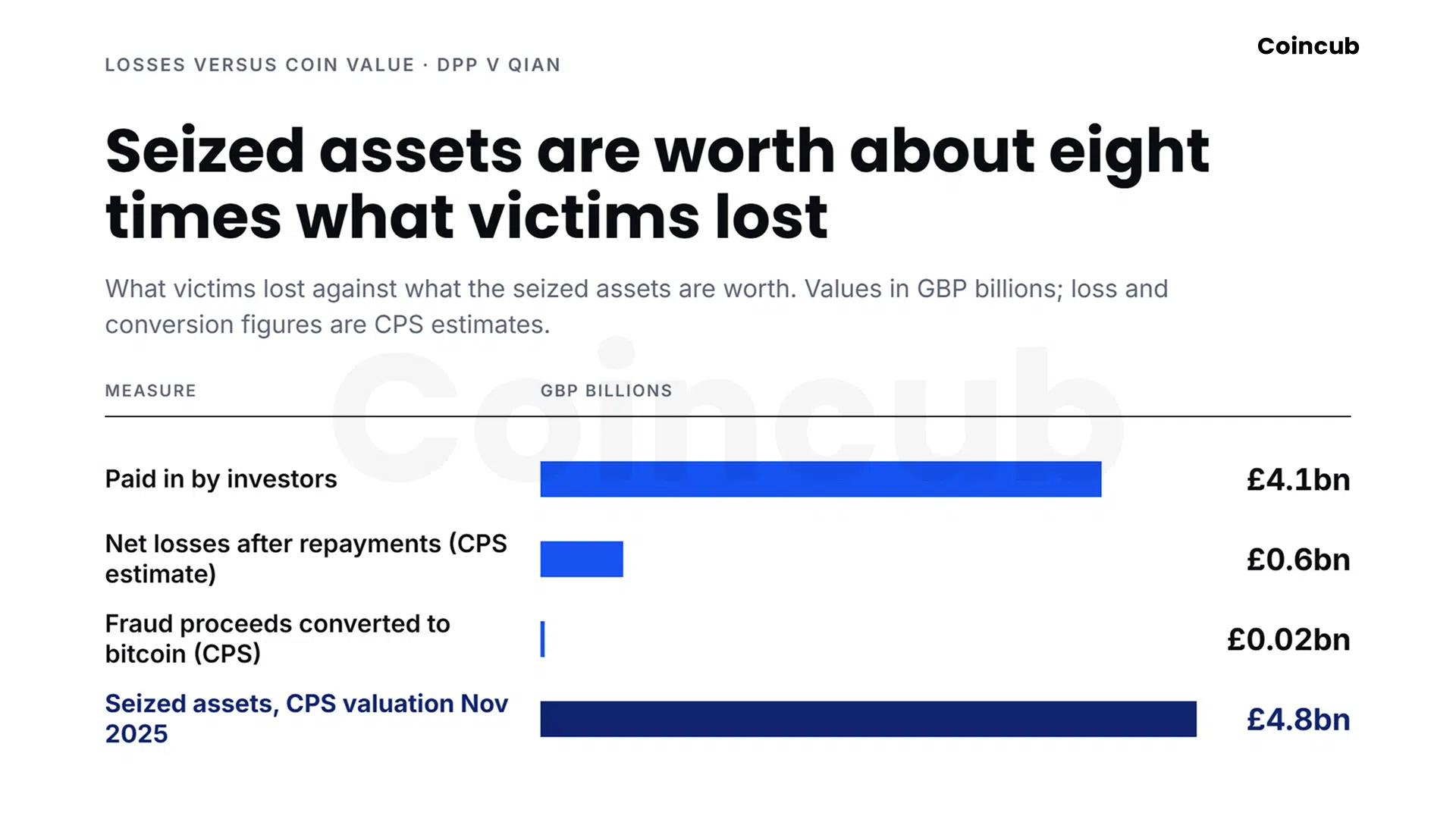
- The coins were worth around £4.8 billion when the CPS last valued them in November 2025, far more than the roughly £600 million in losses the CPS attributes to the underlying fraud.
- On 12 October 2026, the High Court ruled in DPP v Qian that Chinese law governs whether individual victims own any of the bitcoin, a result widely read as favoring the UK state.
- Victims must show a proprietary interest under section 281 of the Proceeds of Crime Act 2002, because a claim for money owed does not qualify.
- Four parties now press claims: individual victims, the litigation receivers of the Chinese company, the Chinese state and the UK prosecution through civil recovery.
- About 16,000 Chinese victims are taking part in the UK proceedings, out of at least 128,409 investment contracts, and victims have been given permission to appeal the governing-law ruling.
- Any Chinese confiscation order would need to be registered by a UK court before it could reach assets held in Britain.
Was the largest crypto seizure in British history legal?
The largest crypto seizure in British history is now the subject of a four-way dispute. The Metropolitan Police took control of more than 61,000 bitcoin linked to Zhimin Qian, a Chinese fugitive who ran a Ponzi scheme in Tianjin between 2014 and 2017 and is now serving 11 years and 8 months in a UK prison for money laundering. Qian’s guilt is settled. Ownership of the coins remains open.
Three developments in October 2026 sharpened the contest. On 12 October, the High Court ruled that Chinese law decides whether victims own any of the bitcoin. Days later, the victims won permission to appeal that ruling. And on 22 October, reports emerged that Chinese prosecutors had asked a Tianjin court to confiscate the same coins, which they count at more than 61,800 BTC.
How 61,800 bitcoin ended up in British custody
The coins trace back to Tianjin Lantian Gerui Electronic Technology, a company Qian founded in 2014. It sold investment products that promised guaranteed principal and unusually high returns, and it operated as a Ponzi scheme, paying earlier investors with money from later ones. According to the agreed facts in the High Court judgment, the scheme took in approximately RMB 40.2 billion (about £4.1 billion) through at least 128,409 investment contracts, and more than 100,000 bitcoin were bought on a Huobi account between mid-June 2014 and 7 June 2017.

Qian’s run from China to the UK
Qian left China on a forged passport in July 2017 and arrived in the United Kingdom that September. The Metropolitan Police began investigating in 2018, after an attempt to buy London property with criminal funds, and seized devices and keys that year, with further assets seized in April 2024. Her assistant, Jian Wen, was sentenced to 6 years and 8 months for money laundering and given a confiscation order of £3,126,572 in January 2025, according to the Crown Prosecution Service.
Qian pleaded guilty at Southwark Crown Court on 29 September 2025 to two offences of acquiring and possessing criminal property, and on 11 November 2025 she was sentenced to 11 years and 8 months. Seng Hok Ling, who converted bitcoin on her behalf, received 4 years and 11 months. The table below sets out the full sequence.
| Date | Event |
|---|---|
| 2014 to July 2017 | Tianjin Lantian Gerui runs its investment schemes in China |
| July and September 2017 | Qian leaves China and arrives in the UK |
| 2018 | Metropolitan Police investigation begins; devices and keys seized |
| April 2024 | Further assets seized |
| September 2024 | DPP launches civil recovery proceedings in the High Court |
| 29 September 2025 | Qian pleads guilty at Southwark Crown Court |
| 15 October 2025 | DPP raises a possible compensation scheme for victims |
| 11 November 2025 | Qian sentenced to 11 years and 8 months |
| 7 to 9 July 2026 | High Court hears arguments on governing law |
| 28 September 2026 | Tianjin No. 2 Intermediate People’s Court accepts a confiscation application |
| 12 October 2026 | High Court rules Chinese law governs victims’ claims |
| October 2026 | Victims granted permission to appeal |
Why the reported bitcoin totals differ?
Two numbers in that history need reconciling. British sources describe the haul as “more than 61,000” or “over 60,000” bitcoin, while the Chinese application, as reported by The Paper and carried by Bitcoin.com News, lists 61,896.41552945 BTC. UK statements use rounded figures while the Chinese application gives an exact count, and both refer to the bitcoin held in Britain; the public record does not explain any gap beyond that rounding.
Why the seized bitcoin is worth far more than the losses
The fight over these coins is really a fight over appreciation. The judgment records that of the RMB 40.2 billion paid in, approximately RMB 34.1 billion was paid back to some victims, as a Ponzi scheme recycles money to earlier investors, and more than RMB 300 million went on operating costs. That leaves net losses of roughly RMB 5.8 billion, consistent with the CPS estimate of about £600 million in losses across roughly 128,000 victims.
Against that, the CPS says Qian converted about £20.2 million of fraud proceeds into bitcoin, bought largely between 2014 and 2017 at a small fraction of today’s prices. By November 2025, the CPS valued the cryptocurrency and other assets it was pursuing at around £4.8 billion, and at mid-October 2026 prices the bitcoin alone was worth about $5 billion, according to Decrypt.
The seized coins are therefore worth several times the victims’ net losses. If victims recover only what they lost, plus interest, billions of pounds of appreciation are left over, and the question of who keeps that surplus drives every party’s position. Legal experts quoted when the compensation idea was first raised said victims were unlikely to share in the bitcoin’s appreciated value, since courts typically return principal and reasonable interest.
Four claimants to the same bitcoin
That surplus explains why four distinct parties now assert rights over the coins, each through a different legal route.
| Claimant | Legal route | What it must establish | Status in October 2026 |
|---|---|---|---|
| Individual Chinese victims | Section 281 of the Proceeds of Crime Act 2002, inside the DPP’s civil recovery case | That specific property belongs to them under the governing law | About 16,000 applicants; permission to appeal the governing-law ruling |
| Litigation receivers of the company | Claims on behalf of the company named in the judgment | That the company has rights in the assets | Left by the judge as a question for another day |
| The Chinese state | Confiscation application before the Tianjin No. 2 Intermediate People’s Court | A Chinese order, then registration by a UK court | Accepted 28 September 2026; six-month notice period |
| The UK state | Civil recovery under Part 5 of the Proceeds of Crime Act 2002 | That the property is recoverable property obtained through unlawful conduct | Proceedings running since September 2024 |
Those routes are not equal in strength. The UK prosecution already controls the coins and has a conviction behind it, so its civil recovery case sets the frame, and every other claimant is effectively asking the High Court to carve property out of it.
The section 281 test and the 12 October ruling
Civil recovery lets the state recover property obtained through unlawful conduct without a further criminal conviction, and section 281 of the Proceeds of Crime Act 2002 lets a third party ask the court to declare that some of that property is theirs. In DPP v Zhimin Qian & Anor [2026] EWHC 2509 (KB), Mr Justice Turner set out what an applicant has to show: that they were deprived of the property by unlawful conduct, that it was not recoverable property immediately before, and that it belongs to them.
The third limb is where most claims will be won or lost. The judgment confirms that a personal claim as a creditor, such as a right to sue the fraudsters for the money paid, is insufficient. An applicant needs a proprietary interest, meaning an ownership right in the specific assets, and this follows the earlier decision in NCA v Robb.
The preliminary question decided on 12 October was which country’s law answers that ownership question. The judge held that Chinese law governs the victims’ substantive claims, whether the issue is analyzed under the Rome I and Rome II regulations or under common-law rules, and rejected arguments for English law or a hybrid. The reasoning turned on geography, with the judge observing that the applicants “parted with their money in China,” where the contracts and representations were also made. Because the bitcoin was bought in China, the court found that tracing in England cannot revive property rights that investors may have lost under Chinese law.
What the ruling did not decide
The ruling did not decide who gets the bitcoin, how much any victim recovers, or what Chinese law actually says, because no evidence of Chinese law had yet been heard. Whether the litigation receivers of the Chinese company have valid claims was expressly left for later, as was whether the court retains any residual discretion under section 281.
Why Chinese law changes the odds for victims
The choice of law matters because English law had looked more promising for the victims. The Financial Times reported that English law was seen as substantially more favorable to them, and England has moved further than most jurisdictions in recognizing crypto as property: the Property (Digital Assets etc) Act 2025, which received Royal Assent on 2 December 2025, confirms that digital assets can be objects of personal property rights, a backdrop covered in our guide to UK crypto regulation.
Chinese law starts from a different place. Mainland China has banned crypto trading and treats digital assets restrictively, and commentary following the ruling argued that Chinese courts tend to support the return of the original investment plus interest in cryptocurrency cases, which would leave the appreciation outside the victims’ reach. That view is commentary, and the content of Chinese law on these facts will be determined by expert evidence at a later hearing.
The victims are contesting the ruling first. Caixin reported, as relayed by BlockBeats on 21 October, that the High Court granted permission to appeal at a hearing four days after the 12 October judgment, and the FT has reported that Fieldfisher, which represents a group of claimants, is pursuing the appeal. If the Court of Appeal upholds the ruling, the case moves to evidence on Chinese law and to each applicant’s proof of a proprietary interest.
China’s confiscation bid for the 61,800 bitcoin
China entered the contest from a separate direction in late September. The Tianjin No. 2 Intermediate People’s Court accepted a confiscation application on 28 September 2026 and gave victims and other interested parties six months to participate, according to reporting carried by TheStreet and Yahoo Finance. The application covers more than 61,800 bitcoin along with Bitcoin Cash, Bitcoin Gold, Bitcoin SV, XRP, Dogecoin, cash, jewelry, bank balances and investment portfolios, and the same reporting puts the number of investors at more than 102,000.
A Chinese order would not move coins on its own. Assets held in the UK can be reached by a foreign confiscation order only if a UK court registers it as an external order under the Proceeds of Crime Act 2002 (External Requests and Orders) Order 2005. Southwark Crown Court has used that route for orders from other countries, including confiscation orders made by a criminal court in Rome, and the Court of Appeal has held in that context that the order must relate to a conviction for the purposes of the 2005 Order.
The Chinese bid also overlaps with the victims’ claims. A Chinese process that gathers investors and distributes recovered assets could offer a route to compensation for the large majority of victims who have not applied in London, and prosecutors in the UK case have said victims could be compensated through a redress scheme run from China, according to Decrypt. How a Chinese confiscation order and a UK civil recovery order would be reconciled has not been tested in court.
The UK state’s civil recovery claim
The Director of Public Prosecutions started civil recovery proceedings in September 2024 and published a notice to Chinese victims on the CPS website the following month. A civil recovery order would transfer the property to a trustee for civil recovery to be realized for the state, subject to any successful section 281 claims, and with the 12 October ruling the prosecution’s position strengthened, since each victim must now prove ownership under a legal system thought to be less favorable to them.
The prosecution has also floated a broader remedy. At a High Court hearing on 15 October 2025, the DPP raised the possibility of a compensation scheme for victims, including those outside the section 281 process, and Martin Evans KC, for the CPS, said it would give adequate protection to victims. The CPS said it had long intended to compensate victims for lost investments to the extent they had not otherwise been compensated. Caixin reported that the scheme remained conceptual, subject to court approval, and might involve a court-appointed trustee to hold, sell and distribute the assets.
The FT reported in 2025 that Treasury officials had privately discussed whether the seized bitcoin could help with a shortfall in public finances, and Yahoo Finance reported in October 2025 that the Treasury had been advised it could not count the seized assets in its fiscal calculations. On current terms, the state’s claim reaches whatever value is left once proved victim claims and any compensation scheme are met, which, given the gap between losses and coin value, could be most of it.
Representation, costs and the victims left out
Participation is a problem in its own right. At least 128,409 investment contracts were signed, yet only a fraction of investors have engaged lawyers in London. In February 2026, Caixin counted at least 8,000 represented claimants, including more than 2,100 with Fieldfisher, more than 5,000 with Yingke and Candey, and several hundred with Duan & Duan, and by October about 16,000 applicants were taking part, according to Caixin’s later reporting.
Costs erode whatever those claimants recover. Caixin reported that litigation funders typically take 20% to 40% of gross recovery and law firms a further 20%, that senior counsel and experts charge £500 to £1,000 an hour, and that the court had considered a single lead firm to limit overlapping fees. The same report cited the Post Office Horizon litigation, where a £57.75 million settlement reportedly left about £11 million for claimants, as a warning.
Those figures explain why the design of any compensation scheme matters more to most victims than the section 281 litigation itself. Claimants who never applied in London depend on the DPP’s proposed scheme or on the Chinese process, and the evidence they can produce linking their payments to the seized coins will shape what any scheme can pay.
What happens next and what it means for crypto fraud victims
The next stages are now visible. The Court of Appeal will consider the governing-law ruling, the High Court will then hear expert evidence on Chinese law and individual proof of ownership, and the Tianjin court’s six-month notice period runs into late March 2027. The CPS has said a further hearing will determine how the law applies, and earlier reporting suggested the case could run into 2027.
For the victims, the difference between recovering their losses and establishing ownership of the bitcoin could be worth billions. The October ruling settled only which law governs their ownership claims. What Chinese law means for those claims still has to be argued, and the proposed compensation scheme has yet to take a final form.
British authorities have held much of the bitcoin since 2018. Eight years later, the coins have been counted and Qian has been convicted, but investors still do not know how much they will receive… or when.
Frequently Asked Questions (FAQ)
Who owns the bitcoin seized from Zhimin Qian? +
Ownership has not been decided. The UK holds more than 61,000 bitcoin and is pursuing civil recovery, while victims claim ownership under section 281 of the Proceeds of Crime Act and Chinese prosecutors seek confiscation in Tianjin. The High Court has so far ruled only on which law applies.
What did the High Court decide on 12 October 2026? +
Mr Justice Turner ruled in DPP v Qian that Chinese law governs whether victims have proprietary rights in the seized bitcoin. The judgment did not decide who receives the coins or how much victims recover, and evidence on Chinese law will be heard later.
Why is the figure sometimes 61,000 and sometimes 61,800 bitcoin? +
UK authorities describe the haul in rounded terms as more than 61,000 bitcoin. The Chinese confiscation application, as reported, lists 61,896.41552945 BTC, which press coverage rounds to more than 61,800. Both refer to the bitcoin held in the UK.
Can victims recover the bitcoin's increase in value? +
That is the central open question. Victims who prove a proprietary interest could claim specific property, but legal experts expect courts to limit recovery to principal and interest, leaving out the appreciation, and the 12 October ruling makes ownership claims depend on Chinese law, which commentators consider less favorable to victims.
What is a section 281 application? +
Section 281 of the Proceeds of Crime Act 2002 lets a person ask the court to declare that property targeted by civil recovery belongs to them. The applicant must show they were deprived of it by unlawful conduct and hold a proprietary interest. Being owed money is not enough.
Can China take the bitcoin from the UK? +
A Chinese confiscation order would not move the coins on its own. It would need to be registered by a UK court as an external order under the Proceeds of Crime Act 2002 (External Requests and Orders) Order 2005, and how it would interact with UK civil recovery is untested.
How many victims are claiming in the UK? +
About 16,000 Chinese victims were taking part in the UK proceedings in October 2026, according to Caixin. The fraud involved at least 128,409 investment contracts and roughly 128,000 victims, so most have not applied, and a proposed compensation scheme could extend to them.