


 Buy a Licensed Company
 Explore VASP Data
 Talk to an Expert


 Dren Hima
 is Head of Research at Coincub, leading research across digital asset regulation, licensing, market structure, tokenization and institutional adoption.
Crypto Options vs Perpetual Futures: Wrong on the Way to Right

- A leveraged long perpetual can lose nearly all its margin on the path even when the month’s closing price proves the view right.
- At Binance’s default funding, a one-bitcoin long at $82,000 pays $738 over 30 days, against $3,879 for a 30-day at-the-money call.
- CME bitcoin put volatility hit 95% in February 2026, double its 2025 average.
- Deribit leads bitcoin options among crypto venues, while IBIT held about 52% of all bitcoin options open interest in January 2026.
- The CFTC approved a US bitcoin perpetual as a futures contract, ESMA says EU perpetuals likely count as CFDs, and Britain bars crypto derivatives for retail.
Every leveraged perpetual future carries a barrier. On Deribit’s USDC-margined bitcoin perpetual, a small position has a maintenance margin of 1.33% of notional. A long funded at 5x leverage, with 20% of notional posted, reaches that line after a fall of about 18.7%, and the exchange closes it there. On Deribit’s current parameters, a 5x long opened at $90,000 hits maintenance near $73,200. Bitcoin passed that level on its way from about $90,000 on 29 January 2026 to about $60,000 on 6 February.
A leveraged long perpetual is a forward with a knock-out attached. The holder pays for gap risk in installments of unknown size, through a funding stream that resets every interval and through a liquidation barrier enforced on the path. An option buyer pays for the same risk once, as a premium fixed on the day of the trade. Fee schedules compare the two products on the smallest line of the bill. A useful comparison prices the barrier, the funding and the premium together, then asks which side of the gap a portfolio can afford to hold.

How perpetual futures and crypto options are built
A perpetual has no expiry, so nothing forces its price back to spot on a fixed date. Exchanges substitute a transfer between longs and shorts. Deribit computes a premium rate from its mark price against its index, applies a damper of plus or minus 0.025%, and caps bitcoin funding at 0.5% per eight hours in either direction. Any premium inside the damper returns a funding rate of zero. Payments accrue continuously and move to the cash balance at the 08:00 UTC daily settlement.
Binance builds the same mechanism around a fixed interest component of 0.01% per eight-hour interval, clamped against its premium index at plus or minus 0.05%. A calm Binance market charges longs that 0.01% three times a day, about 10.95% a year on a simple basis. On Deribit, the same small premium falls inside the damper and costs nothing. The clamp, the caps and the interval changes behind perpetual funding rates differ again by venue.
Contract denomination changes the risk unit. Deribit’s BTC-PERPETUAL is quoted in dollars, with one contract worth $10 of exposure, and settles profit, loss and margin in bitcoin. A trader holding bitcoin collateral against an inverse long loses on the position and on the collateral together when the price falls.
Deribit, OKX and Bybit list European, cash-settled options that settle against a 30-minute index average before expiry. Deribit’s linear BTC_USDC option represents one bitcoin, takes premium and margin in USDC, and settles against the index average between 07:30 and 08:00 UTC. OKX runs coin-margined and USD-margined books and marks both with the Black model. Bybit margins and settles in USDT. Its documentation says buyers avoid liquidation and funding fees, while sellers face potential liquidation.
CME’s standard bitcoin option is a European option on one futures contract representing 5 bitcoin. An in-the-money option expires into a future that cash settles to the CME CF Bitcoin Reference Rate, and no bitcoin moves at any step. CME took its crypto futures and options to 24/7 trading on 29 May 2026, the same day the CFTC approved Kalshi’s bitcoin perpetual.
Crypto derivatives liquidity by venue in 2026
CoinGlass measured $35.08 trillion of crypto derivatives volume in the first half of 2026, down 15.7% from a year earlier. Binance took $9.34 trillion, or 26.6%, ahead of OKX at $4.19 trillion and Bybit at $2.72 trillion. Average daily open interest across the market was $112.7 billion, down 10.0%.
CME handled 4.1% of that volume and 12.0% of average daily open interest, $13.55 billion against Binance’s $24.01 billion. An open interest share roughly three times the volume share fits a book of hedgers, basis traders and longer-dated positions that turn over slowly. CME’s crypto complex averaged 196,000 contracts a day in the third quarter of 2026, worth $7.3 billion in notional.
CoinGlass put bitcoin order-book depth within 1% of mid at $236 million on Binance, $112 million on OKX and $74.36 million on Bybit, with Binance and OKX holding 64.8% of the depth it sampled.
Coinbase bought Deribit for about $2.9 billion, $700 million in cash and 11 million shares, and closed the deal in August 2025. Deribit’s August 2026 turnover came to $85.63 billion, of which $56.13 billion, about two thirds, was bitcoin options and $12.19 billion bitcoin perpetuals and futures.
Market share in options depends on what counts as the market. Checkonchain data cited by CoinDesk on 13 January 2026 put BlackRock’s IBIT at about $33 billion of open interest, a record 52% of the bitcoin options total. Deribit’s share had slipped below 39%, from more than 90% five years earlier. Among crypto venues it still led by a wide margin with about $26 billion, and Bullish had moved into second place at just over $3 billion. Ahead of the September 2026 quarterly expiry, Deribit carried around $43.5 billion of bitcoin options open interest, and $15.9 billion of it expired on 25 September.
Aggregate open interest overstates what a desk can trade in a single line. A perpetual keeps its liquidity in one order book, while options liquidity spreads across strikes and expiries. A $40 billion options book can still be thin at a far out-of-the-money strike three months out.
Funding rate versus option premium
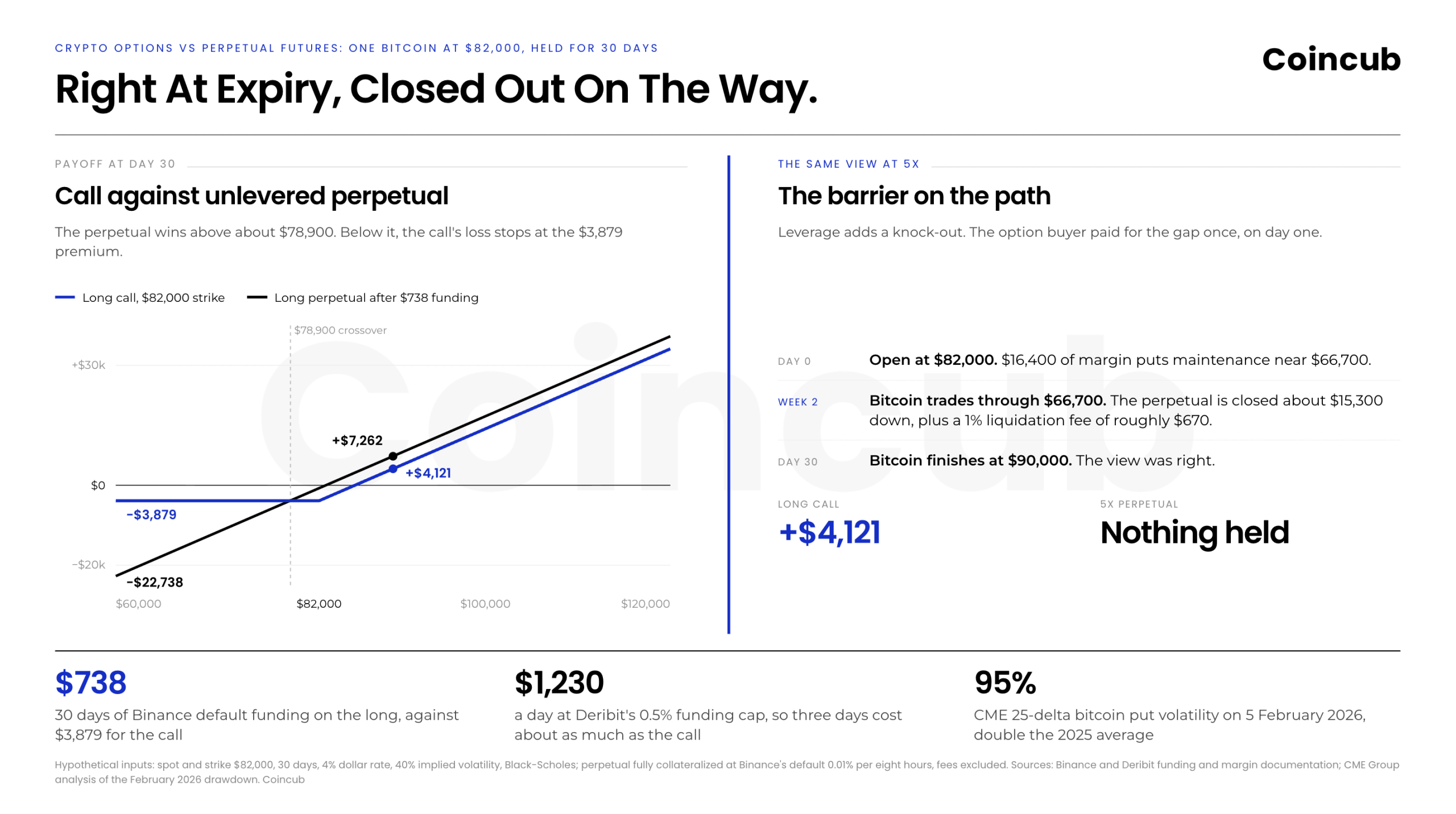
At Binance’s default rate, a one-bitcoin long at $82,000 pays $24.60 a day, or $738 across 30 days. A 30-day at-the-money call on the same bitcoin, priced at 40% implied volatility with a 4% dollar rate, costs $3,879, or 4.7% of spot. On those inputs the perpetual carries for about a fifth of the option’s cost over the month. Trading fees sit well below both numbers. Deribit’s standard perpetual taker rate of 0.035% costs $28.70 on the same position, and its options fee of 0.03% is charged on the underlying and capped at 12.5% of the option’s value.
The comparison holds while funding stays at the default. Deribit’s 0.5% cap equals $410 per eight hours on the same position, or $1,230 a day. Just over three days at the cap cost as much as the whole 30-day call. Funding reaches that range when demand for leverage outruns the capital willing to sit on the other side.
BIS researchers found that crypto futures carry can reach 60% a year. The authors tie it to trend-chasing retail demand for leveraged upside and a scarcity of capital willing to run cash and carry against it. Margin calls and liquidations on the arbitrage side spike during drawdowns, and the paper links that pattern to the frequency of severe crypto crashes.
Ackerer, Hugonnier and Jermann show that for standard funding designs the perpetual price equals the risk-neutral expectation of spot sampled at a random time, with the distribution of that time set by the funding parameters.
Pricing a 30-day bitcoin option against a perpetual
The example uses hypothetical inputs, with spot and strike at $82,000, 30 days to expiry, a 4% dollar rate, no carry adjustment and 40% implied volatility. A standard Black-Scholes calculation gives these values.
| Measure | Value |
| At-the-money call | $3,879 |
| At-the-money put | $3,610 |
| Call delta | 0.534 |
| Gamma | 0.0000423 per $1 move |
| Vega | $93.44 per volatility point |
| Daily time decay | $66.67 |
| Call breakeven at expiry | $85,879 |
Live marks will differ, since venues quote off a skewed surface and bitcoin’s returns carry jumps a single volatility input ignores. Hou, Wang, Chen and Härdle, writing in the Journal of Financial Econometrics, priced bitcoin options under a stochastic volatility model with correlated jumps. They found a sizeable share of price jumps moving opposite to simultaneous jumps in volatility. Sharp falls arrive with volatility spikes, which lifts put prices and hits put sellers on two fronts at once.
The table holds one bitcoin of exposure, with the perpetual fully collateralized, funding at Binance’s default and fees left out.
| Bitcoin at day 30 | Long call | Long perpetual after funding |
| $60,000 | -$3,879 | -$22,738 |
| $70,000 | -$3,879 | -$12,738 |
| $82,000 | -$3,879 | -$738 |
| $90,000 | +$4,121 | +$7,262 |
| $100,000 | +$14,121 | +$17,262 |
| $120,000 | +$34,121 | +$37,262 |
The perpetual beats the call at any finish above about $78,900, and the call wins below it, where its loss stops at the premium. Leverage changes the result. Fund the same long at 5x with $16,400 of margin and maintenance sits near $66,700. If bitcoin trades through that level in the second week and finishes the month at $90,000, the call still pays $4,121. The leveraged perpetual was closed out about $15,300 down, paid Deribit’s total liquidation fee of 1%, roughly $670, and holds nothing at day 30.
Liquidation as a knock-out barrier
Deribit sets initial margin at one divided by leverage and maintenance margin at two thirds of initial margin, both as a share of position size. For its USDC-margined bitcoin perpetual, positions up to 88.45 BTC get 50x leverage, 2.00% initial and 1.33% maintenance. Leverage falls as size grows. A 1,769 BTC position gets 4x, with maintenance at 16.67%.
At maximum leverage, a 0.67% move against the position reaches maintenance. The 1% liquidation fee equals half the initial margin at that leverage, and fee discounts do not apply to it. When an account stays negative after liquidation, Deribit’s insurance fund covers the shortfall. Beyond the fund, the exchange can apply prorated haircuts to members that were profitable in the prior 24-hour cycle.
CoinGlass data cited by CoinGecko put liquidations on 10 and 11 October 2025 at more than $19 billion, across more than 1.6 million accounts, and auto-deleveraging closed profitable short positions during the crash. In the first half of 2026 CoinGlass recorded $73.35 billion of liquidations, $45.63 billion of them longs, or 62.2%. The largest single day was 31 January at $2.588 billion, in the middle of the slide toward $60,000.
In a crash, a short perpetual held against spot is profitable, which places it in the queue the exchange draws from when liquidations and the insurance fund fall short. The hedge can be closed during the move it exists to cover. A fully paid long option has no margin to call and sits outside that queue.
Bitcoin put skew in the February 2026 selloff
Bitcoin corrected about 50% between 6 October 2025 and 6 February 2026, according to CME’s analysis of the drawdown, with the sharpest leg running from roughly $90,000 on 29 January to roughly $60,000 on 6 February. On 5 February, 25-delta implied volatility on CME bitcoin options reached 75% for calls and 95% for puts, the highest readings since 2022 and double the 2025 put average of 46%. The 25-delta risk reversal fell to -19.34.
Volatility at those levels doubles the cost of protection. A 30-day at-the-money put on bitcoin at $70,000 costs about $3,560 at 46% volatility, or 5.1% of spot. At 95% it costs about $7,456, or 10.7%. CME’s data showed the risk reversal had been negative since August 2025, and demand for downside cover was visible for months before the selloff priced it.
Hedging a bitcoin treasury with perpetuals or puts
Take a treasury holding 100 BTC at $82,000, worth $8.2 million. A 100 BTC short perpetual removes almost all of the price exposure. At Binance’s default rate, the short receives about $73,800 over 30 days, and execution costs little given the depth on the largest books.
A rally to $100,000 adds $1.8 million to the spot holding and takes $1.8 million out of the margin account on the short. The two balances usually sit with different custodians, sometimes in different legal entities. If fresh collateral cannot reach the venue in time, the exchange closes the hedge at the top while the offsetting gain stays in cold storage. October 2025 showed the reverse case, with winning shorts closed through auto-deleveraging during the fall.
Puts move the cost to day one. One hundred 30-day at-the-money puts at the example’s inputs cost about $361,000, or 4.4% of the holding. At $60,000 the puts carry $2.2 million of intrinsic value against a $2.2 million loss on the spot, leaving the premium as the month’s cost. At $100,000 the puts expire worthless and the treasury keeps the full $1.8 million gain. Holding them requires no margin headroom and no collateral transfers while bitcoin moves.
Most derivatives desks run both instruments. Options set the tail and volatility exposure of the book, and perpetuals rebalance its changing delta at low cost. A long-gamma desk sells into rallies and buys into falls as it rebalances. Short-gamma books trade the other way, and when that positioning concentrates near a large expiry, their hedging adds to the move.
Selling options for premium income
Covered calls and cash-secured puts collect premium by selling the convexity a buyer pays for. A covered call caps upside at the strike. A cash-secured put commits capital to buy after a fall, and in the jump pattern Hou and his co-authors describe, the fall and the volatility spike arrive together. The seller loses on delta and vega at once. CME’s February data showed out-of-the-money call open interest clustered between $110,000 and $220,000, which its analysts read as possible call overwriting.
Short options on crypto venues are margined, and Bybit warns its sellers of liquidation directly. A liquidated Deribit option position pays a fee capped at 25% of the option’s value. A naked call writer on a USDC-margined book carries uncapped dollar losses on an account that can be closed out in the middle of the move.
Regulation of crypto perpetuals in the US, EU and UK
The United States changed its position on 29 May 2026. The CFTC approved KalshiEX’s BTCPERP contract for listing as a futures contract and issued a policy statement on listing perpetual contracts, recording that the design may not be suitable for all asset classes. The same day, staff in the Market Participants Division said Deribit’s perpetuals may be categorized as foreign futures under Regulation 30.1. They also gave no-action relief for Coinbase Financial Markets to accept customers’ digital assets as margin.
CME sued the Commission in the District of Columbia on 18 June 2026. It argues that a perpetual exchanges funding payments, transfers price risk, conveys no ownership and lacks the set future delivery CME calls the defining feature of a future. CME asks the court to vacate the order and policy statement and declare these contracts swaps. Swap status would bring dealer registration and heavier margin requirements. In early September the CFTC moved to dismiss for lack of standing, calling the case “much ado about nothing.”
On 5 October 2026 the CFTC opened an advance notice of proposed rulemaking on retail crypto asset transactions. It floats a new subcategory of designated contract market, a “crypto asset market,” built for them, with comments due 60 days after Federal Register publication.
Tax follows the classification. The IRS treats digital assets as property, and where a digital-asset position is also a section 1256 contract, gains and losses are generally treated as 60% long-term and 40% short-term. Open section 1256 positions are treated as sold at fair market value on the last business day of the year. An offshore perpetual, a CME option and spot bitcoin can carry the same economic exposure under three different tax treatments. Dechert lists tax among the consequences of the futures-versus-swaps dispute, with section 1256 treatment available to futures.
In the EU, ESMA said on 24 February 2026 that products marketed as perpetual futures are likely to fall within national product intervention measures on CFDs. Where they meet the CFD definition, the requirements include leverage limits, a mandatory risk warning, margin close-out, negative balance protection and a ban on monetary and non-monetary benefits. ESMA also asked firms for narrow target markets and appropriateness assessments on non-advised sales.
Under COBS 22.6.5R, firms may not sell, distribute or market cryptoasset derivatives to retail clients.
Venue and custody risk after FTX
A hedge carries the credit of the venue holding its margin. In August 2024 the CFTC obtained an order requiring FTX to pay $8.7 billion in restitution and $4 billion in disgorgement. FTX had told customers it segregated their assets as a general principle while their funds were commingled and misappropriated.
Due diligence on a derivatives venue starts with the legal entity. Deribit has run its global headquarters from Dubai under VARA supervision since the start of 2025. Deribit FZE added a broker-dealer license from VARA on 13 August 2026. CME positions settle through a clearing house, and futures commission merchants keep customer funds for exchange-traded futures segregated from their own. An omnibus balance at an offshore exchange is a contractual claim, enforceable under the insolvency law of whichever entity holds it. The checks that count are the counterparty entity, the location of collateral, its segregation, and whether close-out netting holds in that jurisdiction.
Choosing between perpetual futures and options
| Objective | Starting instrument | What the holder pays |
| Continuous directional exposure | Perpetual | Funding, plus a liquidation barrier when leveraged |
| Short-dated delta hedge | Short perpetual | Margin headroom and auto-deleveraging exposure, with funding received while positive |
| Hedge under a hard drawdown limit | Long put or put spread | Premium, fixed on day one |
| Crash protection | Long put bought before skew steepens | Premium, which roughly doubles when put volatility does |
| View on volatility or skew | Options | Time decay for long volatility, tail risk for short |
| Premium income | Covered call or cash-secured put | Upside above the strike, or losses on delta and vega together |
| Delta hedging an options book | Perpetual | Funding and execution on each rebalance |
Perpetuals win when the exposure is linear, the horizon is short and funding sits near its default. Options win when the portfolio has to survive a path, carry a known maximum loss or keep its upside through a hedge. The deciding input is usually the price of being wrong on the way to being right.
Frequently Asked Questions (FAQ)
Are crypto options safer than perpetual futures? +
A long option caps the loss at the premium and carries no liquidation or funding exposure. A short option is a margined position that can be liquidated, and a short put loses on price and volatility together in a crash.
How much does it cost to hold a long perpetual for a month? +
At Binance's default funding of 0.01% per eight hours, one bitcoin at $82,000 pays about $738 over 30 days before fees. Funding resets every interval. At Deribit's cap of 0.5% per eight hours, the same position would pay $1,230 a day.
Why hedge with puts when a short perpetual is cheaper? +
A short perpetual hedge needs margin at the venue, and a rally drains it while the offsetting gain sits in custody elsewhere. Auto-deleveraging can also close a profitable short during a crash. Puts cost more up front, about 4.4% of the holding in the worked example, and need no margin afterward.
Which exchange has the most bitcoin options open interest? +
Among crypto venues, Deribit leads by a wide margin and has been owned by Coinbase since August 2025. Counting listed ETF options, BlackRock's IBIT held about 52% of all bitcoin options open interest in January 2026, according to Checkonchain data.
When does a leveraged perpetual get liquidated? +
A position is closed when its equity falls to maintenance margin. On Deribit's USDC-margined bitcoin perpetual, small positions carry 1.33% maintenance, so a 5x long reaches it after a fall of about 18.7% and a 50x long after 0.67%. Deribit then charges a total liquidation fee of 1%.
Are crypto perpetual futures legal in the United States? +
The CFTC approved Kalshi's BTCPERP as a futures contract in May 2026, and staff said Deribit's perpetuals may be categorized as foreign futures. CME has sued to have these contracts declared swaps, and the CFTC has moved to dismiss.
Can retail traders in the EU and UK trade crypto perpetuals? +
ESMA said in February 2026 that perpetual futures are likely to fall within national CFD measures, which bring leverage limits, margin close-out and negative balance protection. In the UK, the FCA prohibits selling, distributing or marketing cryptoasset derivatives to retail clients.
How does US tax treat crypto options and perpetuals? +
The IRS treats digital assets as property. Where a position is also a section 1256 contract, gains and losses are generally split 60% long-term and 40% short-term, with open positions treated as sold at year end. Whether a given perpetual or option qualifies depends on the contract.