



 Buy a Licensed Company
  Explore VASP Data
  Talk to an Expert


Canada MSB License Cost in 2026: $0 to $20 Million

- FINTRAC charges no fee to register or renew a money services business. The registration runs for two years and has to be renewed before it expires.
- Revenu Québec publishes the only MSB fee grid in the country, at $826 per service category for the year to 31 March 2027.
- Quebec’s cryptoasset ATM fee jumped from $266 to $577 a machine while the service categories rose about 3%.
- British Columbia collects nothing today. Its regulator targets 2027/28 for the Money Services Businesses Act.
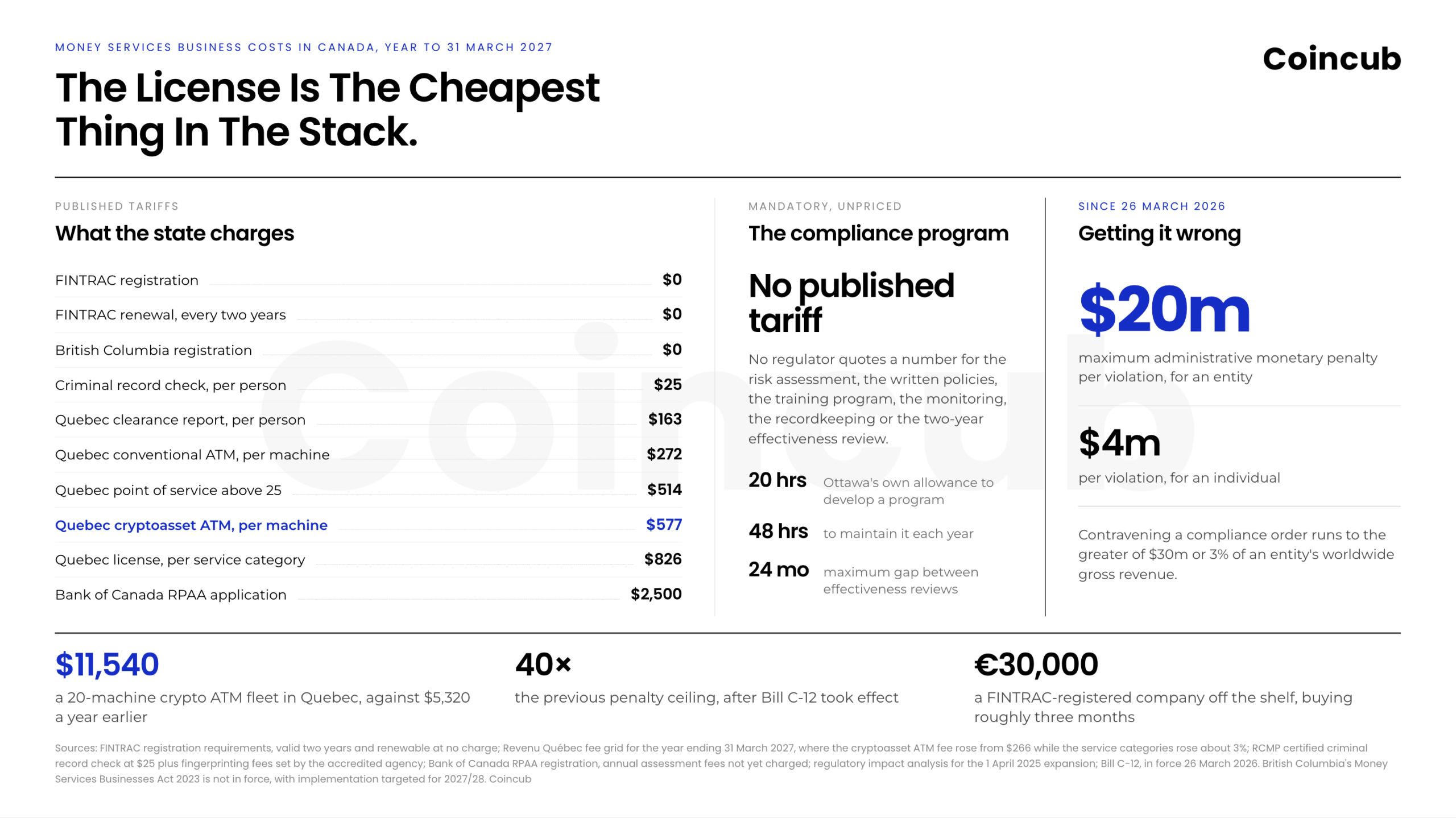
- Ottawa modeled a compliance program at 20 hours of work, then raised the maximum penalty for a deficient one to $20 million per violation for an entity.
Canada charges nothing to register a money services business. FINTRAC does not charge registration fees, the registration runs for two years, and renewal costs nothing either. The only published price list for operating an MSB anywhere in the country belongs to Revenu Québec, and its largest single line is $826.
Everything else in a Canadian MSB budget is a mandatory obligation with no published price. That covers the compliance program, identity verification, transaction monitoring, reporting, recordkeeping and the effectiveness review. No regulator quotes a number for any of it. On 26 March 2026 the ceiling on getting it wrong rose to $20 million per violation for an entity.

What federal registration costs
The registration form is free and the documents behind it are not. FINTRAC wants criminal record checks for the chief executive officer, the president, every director, and anyone owning or controlling 20% or more of the business. Each check has to be issued by a competent authority within six months of the application going in.
The RCMP charges $25 for a certified criminal record check, and the accredited agency taking the fingerprints sets its own fee on top. Turnaround runs from three business days on a clean file to 120 business days where the record matches or needs manual processing. Five people on a founding team is a few hundred dollars and a scheduling problem that can outlast the incorporation.
FINTRAC processes most complete applications within three months. The registration is valid for two years and has to be renewed before it expires, at no charge. Letting it lapse can draw administrative monetary penalties or criminal charges, and the lapse shows on the MSB registry as an Expired status that counterparties read as a red flag.
Quebec’s license fees for 2026-27
Quebec runs the only general provincial MSB regime in operation. Revenu Québec licenses by service category, by machine and by person, on a year that runs from 1 April to 31 March. These are the fees for the year ending 31 March 2027.
| Item | 2026-27 fee | 2025-26 fee |
| Currency exchange license | $826 | $801 |
| Funds transfer license | $826 | $801 |
| Issue or redemption of traveler’s checks, money orders or bank drafts | $826 | $801 |
| Check cashing license | $826 | $801 |
| Automated teller machine, per machine | $272 | $266 |
| Cryptoasset automated teller machine, per machine | $577 | $266 |
| Additional point of service beyond 25, per point | $514 | not listed |
| Security clearance report, per person | $163 | $149 |
The cryptoasset ATM fee more than doubled while the service categories rose about 3%, and the per-point administrative fee above 25 points of service is new for this cycle. A 20-machine crypto fleet now costs $11,540 in permit charges against $5,320 a year earlier. Machines that also dispense legal tender pick up the conventional ATM charge as well, which takes that same fleet to $16,980. Crypto ATM operators carry the sharpest increase in the Canadian fee stack.
The per-point fee only bites businesses in the four non-ATM categories. An FX chain with 40 storefronts pays for 15 points above the threshold, or $7,710, on top of its category fee.
Billing is rigid. Revenu Québec mails a renewal invoice in mid-February and the money is due by 31 March regardless of when the license took effect. Miss it and an advance notice of suspension lands in early April with a 10-day window. Fees are non-refundable, so a business that surrenders a category in May has already paid for the full year.
Security clearance reports move a Quebec budget
The $163 clearance report is the line that scales with an organization, and Quebec’s covered-person list is long. It reaches directors, officers, branch managers, respondents, ultimate beneficial owners and partners. Employees working in Quebec whose duties relate to money services are covered. So is whoever loads cash into the ATMs, whoever handles cash at the cryptoasset machines, mandataries and their responsible officers, and any lender outside the financial institution carve-out.
Work a Montreal remittance and FX operation through it. Two categories is $1,652. Four directors and officers, one respondent and three Quebec staff on money services duties is eight reports at $163, or $1,304. The first-year provincial bill comes to $2,956, and the second year drops to $1,652 plus a report for every new covered person.
Scale the headcount and the arithmetic turns. The same two categories with 30 covered people is $4,890 in clearance reports against $1,652 in license fees. Quebec charges for people, and a licensing decision waits on security clearance reports from the Sûreté du Québec.
British Columbia and the Bank of Canada
British Columbia passed a Money Services Businesses Act in 2023 and has never brought the registration provisions into force. There is no provincial fee to pay today. The BC Financial Services Authority’s 2026/27 to 2028/29 service plan completes implementation readiness in 2026/27 and implements the Act in 2027/28, subject to government direction. Anyone modeling a BC operation past next year should carry a placeholder for registration and a compliance uplift.
A business that also moves retail payments falls under the RPAA and registers separately with the Bank of Canada. That application carries a flat, non-refundable fee of $2,500. Annual assessment fees sit in the statute and the Bank has not started charging them, pending the cost recovery formula and the regulations behind it.
Criminal record checks for agents and mandataries
Since 1 October 2025 an MSB has to verify the eligibility of every agent and mandatary before engaging them, and again within 30 days after every second anniversary. An agent that is an entity brings checks on its chief executive officer, president, directors and 20% owners. An individual agent supplies their own record. Each record has to be issued within six months of review and kept for five years.
Relationships that predate October 2025 have until 1 October 2027 to clear the first round. A 200-agent network is 200 records on a two-year cycle, plus internal review and storage, plus the fingerprinting fees. Getting it wrong is an offense carrying up to $250,000 and two years on summary conviction, or $500,000 and five years on indictment.
What Ottawa budgeted for a compliance program
The federal government published its own costing when it pulled check cashers, factors and finance and leasing businesses into the regime on 1 April 2025. The regulatory impact analysis allowed 20 hours to develop an internal compliance program and 48 hours a year to maintain it. Filing a report took 15 minutes. Setting up reporting systems took 16 hours for a small business and 32 for a large one, with the same 16 or 32 hours to prepare for a FINTRAC examination. Storage came in at $2,500 and $10,000 on the same split. Across 865 new reporting entities the ten-year present value landed at $74.3 million.
Set that against what FINTRAC requires. A compliance program needs an appointed compliance officer, written policies and procedures approved by a senior officer, a documented risk assessment, a written ongoing training program, a training plan, and a two-year effectiveness review plan. The review has to start no later than 24 months from the start of the previous one. Its breadth and depth vary with business complexity, transaction volumes, earlier findings and current risk, and an internal or external auditor carries it out wherever the business has one to call on.
Twenty hours buys a template. It does not buy a risk assessment that survives an examination, and the government’s own file shows how little the state expects the paperwork to cost. Vendor quotes for an outsourced program and an independent effectiveness review circulate in the tens of thousands of dollars a year for a small MSB. High-volume and virtual currency operations run well into six figures. Those are modeled market ranges with no regulator behind them, and they move with transaction volume, agent count, geography and how much of the monitoring is automated.
Penalty exposure changed on 26 March 2026
Bill C-12 took effect on 26 March 2026 and raised the maximum administrative monetary penalties for prescribed violations to $4 million for an individual and $20 million for an entity, up to 40 times the previous limits. Contravening a compliance order runs to the greater of $5 million or 3% of an individual’s worldwide income, and the greater of $30 million or 3% of an entity’s worldwide gross revenue.
The same amendments rewrote the standard. A compliance program now has to be reasonably designed, risk-based and effective, which gives FINTRAC room to assess whether the program works in practice. For any MSB above a trivial size, expected penalty exposure is the largest number in the budget, and it tracks program quality. No fee schedule caps it.
Buying a registered company
The acquisition route prices differently. Coincub lists a FINTRAC-registered Canadian company at €30,000, which buys an incorporated entity with a live registration, corporate records and no trading history. Against a free registration and a three-month wait, the spend buys time and a clean file.
The compliance program has to be built either way, and the effectiveness review clock runs either way. Quebec clearance reports attach to people. New directors and officers file fresh ones at $163 each. MSB registration from scratch and an acquisition land on the same operating cost once the program is running.
Budget summary
| Layer | 2026 cost |
| FINTRAC registration and renewal | $0 |
| Criminal record checks, federal processing | $25 per person, plus fingerprinting fees |
| Quebec license, per service category | $826 a year |
| Quebec security clearance | $163 per covered person |
| Quebec ATMs | $272 conventional, $577 cryptoasset, per machine per year |
| Quebec points of service above 25 | $514 each |
| British Columbia registration | $0 until the Act is in force |
| Bank of Canada RPAA application | $2,500 flat, one time |
| AML compliance program | No published tariff |
| Maximum AMP, entity, per violation | $20 million |
The license is the cheapest thing in the stack. Price the program.
Frequently Asked Questions (FAQ)
How much does it cost to register an MSB with FINTRAC? +
The registration itself is free. FINTRAC does not charge a fee to register a money services business or a foreign money services business. The cash cost of getting registered is the criminal record checks for the chief executive officer, the president, directors and 20% owners, at $25 each in federal processing plus whatever the fingerprinting agency charges.
Does renewing a FINTRAC registration cost anything? +
No. Registration runs for two years and has to be renewed before it expires, at no charge. Letting it expire can draw administrative monetary penalties or criminal charges, and the expired status is visible to counterparties running due diligence.
What does a Quebec MSB license cost in 2026? +
For the year ending 31 March 2027, Revenu Québec charges $826 per service category for currency exchange, funds transfer, traveler's checks and money orders, and check cashing. Add $272 per conventional ATM, $577 per cryptoasset ATM, $514 for each point of service above 25, and $163 per security clearance report.
Why did the Quebec cryptoasset ATM fee more than double? +
Revenu Québec set the 2026-27 cryptoasset ATM fee at $577 per machine against $266 the year before, while the service categories rose about 3%. The province is pricing supervision of crypto kiosks well above cash machines. A machine that dispenses both crypto and legal tender falls into both categories.
Does British Columbia charge an MSB registration fee? +
Not today. British Columbia enacted a Money Services Businesses Act in 2023 and has not brought the registration provisions into force. Its regulator's published service plan targets implementation in 2027/28, so a BC business should budget for registration and a compliance uplift from that year.
Do I have to pay the Bank of Canada as well? +
Only if the business performs retail payment activities and has to register as a payment service provider. That application carries a flat $2,500 fee, non-refundable. The Bank has not begun charging the annual assessment fees the statute allows.
What is the largest line in a Canadian MSB budget? +
The compliance program and the penalty exposure behind it. Since 26 March 2026 the maximum administrative monetary penalty for a prescribed violation is $4 million for an individual and $20 million for an entity, and the program standard requires something reasonably designed, risk-based and effective.
Is buying a registered MSB cheaper than registering one? +
It is not cheaper on paper, since registration is free. A listed FINTRAC-registered Canadian company runs around €30,000 and buys a live registration, corporate records and about three months of saved processing time. The compliance program, the effectiveness review and Quebec's per-person clearance reports cost the same either way.









