

 Buy a Licensed Company
  Explore VASP Data
  Talk to an Expert

 Atis Shala
Atis is a senior analyst and community lead with four years of experience in crypto. He has a bachelor from the Rochester Institute of Technology.
Atis Shala
Atis is a senior analyst and community lead with four years of experience in crypto. He has a bachelor from the Rochester Institute of Technology.
Can an Unlicensed Crypto Company Advertise Through a Licensed Partner?

- The UK lets an unregistered crypto firm advertise to UK consumers if a “section 21 approver” authorized by the Financial Conduct Authority (FCA) signs off its ads. Firms that never apply for authorization, however, must wind down their UK crypto business before 25 October 2027.
- Approval rights can vanish fast, as Binance learned when the FCA stopped its UK approver from approving crypto ads in October 2023.
- In the EU, a partner’s promotion counts as solicitation under the MiCA regulation, and the EU’s markets regulator, ESMA, says this is still a breach when the partner is regulated in the EU.
- Singapore tells even licensed crypto firms to avoid influencers, third-party websites, and joint promotions aimed at the general public.
- Hong Kong’s licensing rules cover platforms that actively market to Hong Kong investors, and influencers were among 16 people charged in the JPEX case.
- Licensed partners carry risk too, because the FCA warns that money from illegal promotions could be criminal property.
Borrowing a License to Reach Customers
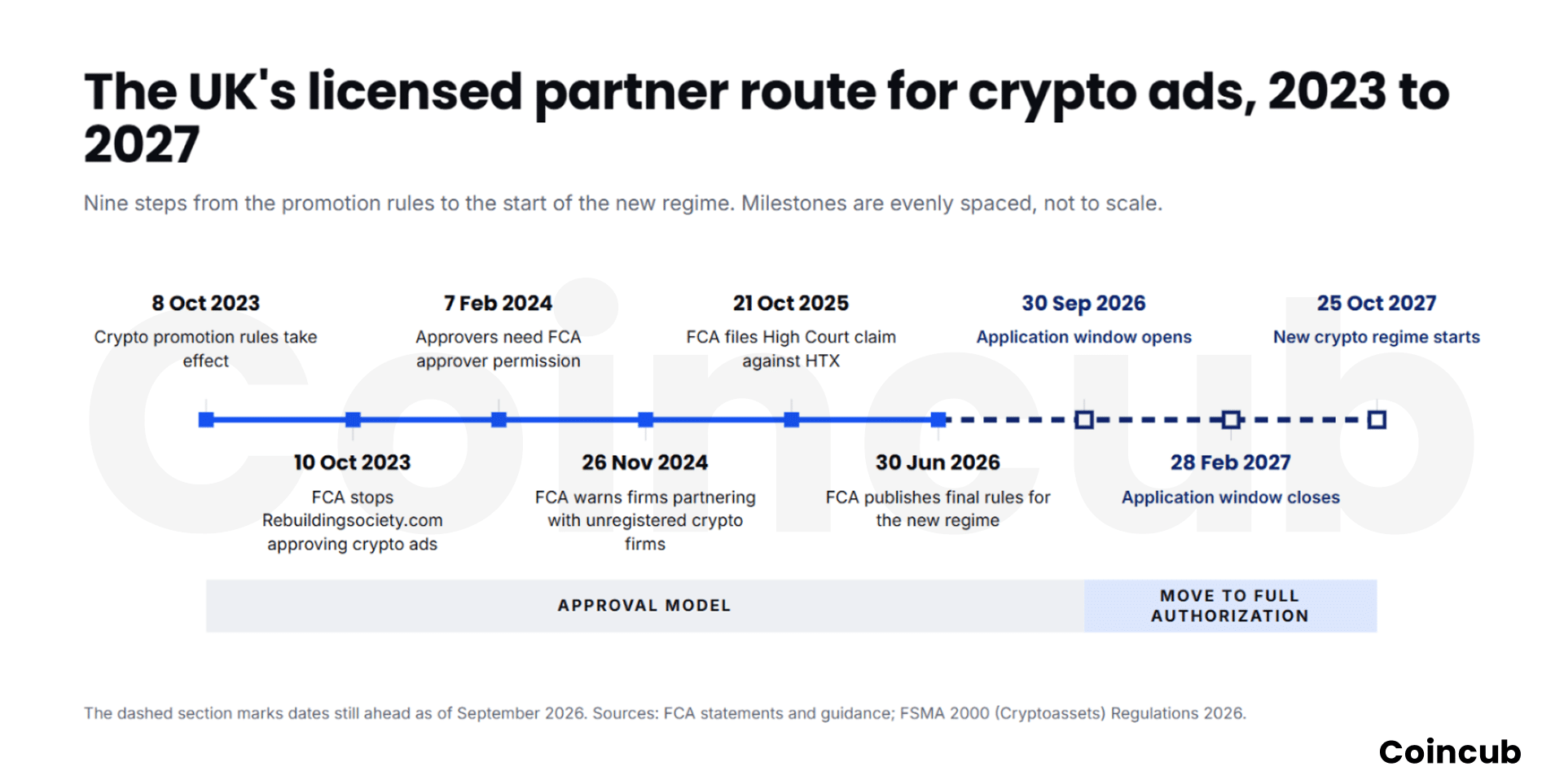
When the UK’s new crypto advertising rules took effect on 8 October 2023, Binance relied on a partner to comply. It had hired Rebuildingsociety.com, a firm authorized by the Financial Conduct Authority (FCA), to check and approve its UK ads. Two days later, the FCA stopped that firm from approving crypto promotions. By 16 October, Binance had stopped accepting new UK users.
That episode raises a question many crypto founders ask: can an unlicensed crypto company advertise through a licensed partner? The short answer is sometimes. It depends on where the customers live and what the partner actually does. The UK currently allows a licensed firm to approve another company’s ads. In the European Union, the same kind of deal usually counts as illegal solicitation, while Singapore, Hong Kong, and Dubai each draw their own lines.
This guide explains those differences in plain English. It defines four common partner set-ups and tests them against the rules in six major markets. It then covers who gets in trouble and how to market legally. Every rule cited comes from official sources, such as regulators, laws, and court and police records.

What It Means to Advertise Through a Licensed Partner
Before comparing countries, it helps to define the key words. A crypto license is official permission from a regulator to offer a crypto service, such as running an exchange. An unlicensed company lacks that permission where its customers live. A licensed partner is a separate firm that does hold it.
Advertising also covers far more than billboards. UK law uses the term “financial promotion,” which means any message that invites or encourages someone to invest. EU law talks about “solicitation,” which means actively approaching possible customers. Either way, regulators judge a message by what it does. A social media post, a sponsored video, a referral link, or a sports sponsorship can all count.
The Four Most Common Partner Set-Ups
With those terms in place, most real deals fit one of four models. The table below shows how each one works and who actually serves the customer.
| Partner model | How it works | Who serves the customer | Where it shows up
|
|---|---|---|---|
| Approval model | A licensed firm checks and signs off the unlicensed firm’s ads | The unlicensed firm | UK section 21 approvers |
| Intermediary model | A licensed firm stands between the unlicensed firm and the customer | The licensed firm | The UK regime from October 2027 |
| Promoter model | Influencers, affiliates, or shops send customers to the unlicensed firm | The unlicensed firm | The JPEX case in Hong Kong |
| Group brand model | A licensed sister company uses a global brand to win local clients | Often an unlicensed group company | The EU’s “legal cover” warning |
The third column matters most, because regulators focus on who is responsible for the customer. A partner that takes on that role gets very different treatment from one that simply lends its name.
The United Kingdom: A Legal Route With an End Date
The UK is the natural place to start, since it has the clearest version of the approval model and its rules are about to change.
Four Legal Routes for Crypto Financial Promotions
Since 8 October 2023, crypto ads aimed at UK consumers have followed the UK’s financial promotion rules. The FCA says a crypto promotion is legal only if it uses one of four routes:
- An FCA-authorized firm communicates it.
- An FCA-authorized firm approves it for an unauthorized firm.
- A crypto business registered with the FCA under the Money Laundering Regulations communicates it.
- It fits an exemption in the Financial Promotion Order.
The second route is the licensed partner route. It is especially useful for overseas firms, which must follow the same rules when they market to UK consumers. Ignoring all four routes is a crime under section 21 of the Financial Services and Markets Act 2000 (FSMA), punishable by up to two years in prison, an unlimited fine, or both. The FCA adds that this includes anyone posting crypto promotions on social media, such as influencers.
How Section 21 Approval Works
A section 21 approver is an FCA-authorized firm that reviews, edits, and signs off another company’s financial promotions. The FCA confirms that crypto firms without FSMA authorization or FCA registration may use one, including firms based overseas.
Since 7 February 2024, however, approvers have needed more than a standard authorization. An approver now needs a separate “approver permission” from the FCA, which it gets only by showing the right skills and expertise. After that, it must keep checking the ads it approved and be ready to withdraw approval. It must also send the FCA regular reports on its approval work.
The ads also have to follow the FCA’s crypto marketing rules in policy statement PS23/6. The main ones are:
- Risk warnings. Every ad must include a warning that begins “Don’t invest unless you’re prepared to lose all the money you invest.”
- No bonuses. Firms cannot offer “refer a friend” or new joiner bonuses to get people to invest.
- A cooling-off period. First-time customers must wait at least 24 hours before they can receive a direct offer to invest.
- Suitability checks. Firms must check that customers have the knowledge and experience to invest.
In short, the approver takes responsibility for the ad, while the unlicensed firm still runs the service behind it.
When a Partner Loses Its Approval Rights
The approval route only works while the partner stays in good standing, as Binance found out. On 10 October 2023, the FCA used its powers under section 55L of FSMA to stop Rebuildingsociety.com from approving crypto promotions. According to Binance, the firm had to withdraw all its existing crypto approvals by 5pm the next day.
The FCA said crypto firms that had relied on those approvals had to stop promoting to UK consumers unless another authorized firm approved them. So Binance paused new UK sign-ups from 16 October 2023 while it looked for a new approver. Existing users kept their current services.
The FCA was watching the wider market too, issuing 146 alerts about crypto promotions on the regime’s first day and 221 by 25 October 2023. It said it expects approvers “to take their regulatory obligations seriously.” The UK country guide covers the wider market these rules apply to.
Why the Licensed Partner Carries Risk Too
The risk also reaches the licensed partner itself. In November 2024, the FCA published guidance for regulated firms that work with unregistered crypto firms. One example is a registered firm whose buy and sell tool sits inside an unregistered exchange’s website as a “widget.” Another is a payment firm that gives such an exchange access to international payments.
The FCA’s message was direct. It warned that benefits from illegal promotions “could be criminal property,” which regulated firms may end up handling. Such relationships could also “call the probity” of those firms “into question,” meaning the FCA may doubt their honesty. As good practice, the FCA lists legal advice, careful checks on partners, section 21 approvers, and geo-blocks, which stop content from reaching users in a certain country.
Enforcement has also reached the courts. In October 2025, the FCA filed a High Court claim against HTX, the exchange formerly called Huobi, and made the case public in February 2026. The FCA says HTX promoted itself to UK users on TikTok, X, Facebook, Instagram, and YouTube. The regulator also asked social media platforms and app stores to block HTX for UK users.
What Changes When the New Regime Starts in October 2027
The approval route is also running out of time. The Financial Services and Markets Act 2000 (Cryptoassets) Regulations 2026 create a full UK licensing regime for crypto, starting on 25 October 2027. Firms can apply through an FCA window that opens on 30 September 2026 and closes on 28 February 2027.
For firms that use an approver, the FCA’s guidance on s.21 approvers sets out three paths:
- Firms that apply in the window. They can keep using their approver until the FCA decides on their application.
- Firms that apply later. They can use their approver until the regime starts, but if no decision has been made by then, they may only communicate promotions linked to existing contracts.
- Firms that never apply. They must wind down their UK crypto business before the regime starts.
The rules for overseas firms change at the same time. From October 2027, firms dealing directly or indirectly with UK consumers will need UK authorization, wherever they are based. HM Treasury’s policy note gives one key exception. An overseas firm needs no UK authorization when a UK-authorized crypto trading platform or dealer stands between it and the consumer. The government is also ending self-approval for firms that are only registered under the Money Laundering Regulations. It says those provisions “were always intended to be temporary.”
In other words, the UK’s partner model is changing shape. Today, a partner can approve the ad, but from October 2027 it will need to stand between an unauthorized overseas firm and its UK customers. The report on the FCA’s UK presence rules covers the wider changes for overseas firms.
The European Union: A Partner’s Marketing Counts as Solicitation
Europe has taken a very different path. Under the Markets in Crypto-Assets Regulation (MiCA), a firm needs authorization as a crypto-asset service provider (CASP) to serve EU customers. National transition periods ended on 1 July 2026 at the latest.
Reverse Solicitation Is a Very Narrow Exception
MiCA leaves one small opening for non-EU firms, called reverse solicitation. This happens when an EU customer contacts a non-EU firm entirely on their own, without being approached first. In that case, Article 61 of MiCA says the firm does not need EU authorization to serve that customer.
The same article, however, shuts that opening for partners. If a non-EU firm solicits EU clients “including through an entity acting on its behalf,” the service no longer counts as the client’s own initiative. This applies “regardless of the means of communication,” and no contract clause or disclaimer can change it. ESMA, the EU’s markets regulator, says genuine reverse solicitation should be understood as “very limited and very narrowly framed.”
What Counts as Solicitation, From Ads to Influencers
ESMA’s guidelines on reverse solicitation, finalized in December 2024, show how wide this net is. Solicitation includes online ads, banners, pop-ups, social media, affiliate campaigns, sponsorship deals, and even broad brand advertising.
The guidelines also explain who counts as acting for a firm. It can be someone working “expressly by virtue of a contract” or “implicitly via an informal agreement,” and influencers are named directly. Warning signs include sending an audience to the firm’s website, offering promo deals, or showing the firm’s logo. Any payment or benefit from the firm “should be a strong indication” that the promoter is acting for it.
Most importantly, paragraph 22 of the guidelines deals with licensed partners directly. It says providing crypto services after solicitation on behalf of a non-EU firm “by a person or entity regulated in the EU should still be regarded as a breach of MiCA.” The annex adds a matching example, in which a non-EU firm uses the website of an EU firm, “be it regulated or not,” to show its logo, link to its site, or promote its services.
When an EU License Becomes “Legal Cover”
ESMA has also warned about a quieter version of the same idea. In a July 2024 opinion, it warned about crypto groups that apply for MiCA authorization only for brokerage but plan to keep a large part of their business outside the EU. ESMA told national regulators to check that such applications do not aim at “obtaining a ‘legal cover’ in the Union for third-country firms.” One red flag is an EU broker that “relies on the reputation and brand of the non-EU exchange to attract business from EU clients.”
That warning matters even more now that MiCA’s transition has ended. On 23 June 2026, ESMA said unauthorized firms must “cease marketing activities and solicitation” and stop onboarding new EU clients. A closer look at the MiCA register and CASP permissions shows which permissions licensed firms actually hold.
France Adds Limits on Crypto Influencers
Some EU countries add their own rules on top of MiCA, and France is one example. Its 2023 influencer law limits what influencers can promote. France’s economy ministry says influencers may promote crypto-assets and crypto services only when the provider is registered or authorized by the AMF, France’s financial markets regulator.
How Other Major Crypto Markets Handle Partner Marketing
Outside Europe, the rules vary even more, yet regulators keep asking the same question: who really serves the customer?
Singapore Keeps Crypto Ads Away From the Public
Singapore limits crypto marketing even for firms that hold a license. On 17 January 2022, the Monetary Authority of Singapore (MAS) issued guidelines for digital payment token (DPT) service providers. They say these firms should not advertise to the general public. That rules out ads on public transport, broadcast media, third-party websites, social media platforms, and public events.
Partners are covered too. Paragraph 2.3 of the MAS guidelines says providers “should also not engage third parties, such as social media influencers or third-party websites,” to promote their services to the public. This includes joint promotional campaigns. Firms may still promote themselves on their own websites, apps, and official social media accounts.
As a result, Singapore leaves very little room for partner marketing, whether or not the firm behind the ad is licensed. A comparison of MiCA, Dubai, and Singapore covers the licensing side in more detail.
Hong Kong Treats Active Marketing as a Licensed Activity
Hong Kong reaches a similar result in a different way. Its licensing regime for crypto trading platforms, in force since 1 June 2023, covers platforms that do business in Hong Kong or actively market to Hong Kong investors. In other words, marketing alone can trigger the need for a license from the Securities and Futures Commission (SFC).
The JPEX case shows why this matters. In September 2023, the SFC warned that JPEX, an unlicensed platform, had been actively promoting its services to the Hong Kong public. It used social media influencers, key opinion leaders, and over-the-counter crypto money changers. The SFC added that no JPEX company held a license or had even applied for one.
The fallout was severe. The Hong Kong Police Force’s review of 2025 counts more than 2,700 victims and losses of over HK$1.6 billion. In November 2025, 16 people were prosecuted for offenses such as conspiracy to defraud and money laundering. For the first time, the charges also included fraudulently or recklessly persuading others to invest in virtual assets. Public broadcaster RTHK reported that social media influencers were among those charged. The Hong Kong country guide explains the city’s rules in more detail.
Dubai’s VARA Lets Licensed Firms Approve Marketing
Dubai’s approach sits closer to the UK’s, with one key limit. Its Virtual Assets Regulatory Authority (VARA) applies its Marketing Regulations to all marketing “in or targeting the UAE.” Under Regulation I.B.3, only a VARA-licensed firm may market a virtual asset activity it is licensed to carry out. Others may market that activity only on the licensed firm’s behalf and with its approval.
Third parties have duties as well. Under Regulation I.C.5, a firm that hires an agency or promoter stays responsible for that marketing at all times. The agency or promoter, in turn, must check that the firm is allowed to market in the UAE and get its approval first, or it can be held liable. VARA also says only firms it licenses may provide virtual asset services in or from Dubai.
VARA enforces these rules. In October 2025, it fined 19 unlicensed firms between AED 100,000 and AED 600,000 for unlicensed activity and marketing breaches. The maximum fine for breaking Regulation I.B.3 is AED 10 million, and a third-party marketing breach can cost up to AED 2 million.
The United States Focuses on Licenses and Disclosure
The United States deals with partner marketing mainly through two questions: does the company providing the service hold the right licenses, and do paid promoters say they are paid? On licensing, 2019 guidance from the Financial Crimes Enforcement Network (FinCEN) says crypto exchangers generally count as money transmitters, which must register with FinCEN.
On disclosure, there have already been high-profile cases. In October 2022, the Securities and Exchange Commission (SEC) charged Kim Kardashian over an Instagram post promoting EthereumMax tokens. She had not disclosed the $250,000 she was paid, which the SEC said broke the “anti-touting provision” of federal securities law. She agreed to pay $1.26 million to settle. Separately, the Federal Trade Commission (FTC) updated its Endorsement Guides in June 2023 with advice on how influencers should disclose ties to brands.
Crypto Advertising Rules Compared by Market
Seen side by side, these markets form a clear pattern. The table below shows whether a licensed partner can make an unlicensed firm’s marketing legal, based on the rules in force in September 2026.
| Market | Main rules | Can a licensed partner make it legal? | Key condition
|
|---|---|---|---|
| United Kingdom, until 25 October 2027 | FSMA section 21 and PS23/6 | Yes, through an approver | The approver needs FCA approver permission |
| United Kingdom, from 25 October 2027 | Cryptoassets Regulations 2026 | Only as an intermediary | A UK-authorized platform or dealer stands between firm and consumer |
| European Union | MiCA Article 61 and ESMA guidelines | No | Solicitation by any partner, even a regulated one, breaches MiCA |
| France | 2023 influencer law, plus MiCA | No | Influencers may only promote AMF-registered or authorized providers |
| Singapore | MAS guidelines PS-G02 | No | Even licensed firms should avoid third-party promoters |
| Hong Kong | SFC licensing regime | No | Actively marketing to Hong Kong investors requires an SFC license |
| Dubai | VARA Marketing Regulations 2024 | Only for the partner’s own licensed activity | A firm licensed for that activity must approve the marketing |
| United States | FinCEN, SEC, FTC, and state rules | Depends on who serves the customer | The provider must be registered, and paid promoters must disclose payment |
Two patterns stand out in that table. First, only the UK and Dubai let a licensed firm approve marketing, and Dubai limits that to activities the licensed firm is allowed to carry out. Second, no market lets a partner lend its name forever, since even the UK’s approver route ends for non-applicants in October 2027.
Who Is Liable When Partner Marketing Goes Wrong
Knowing the rules also means knowing who pays when they are broken, and the fallout rarely stops at one company. Official cases show that three groups can be held responsible:
- The unlicensed firm. Promoting crypto outside the UK’s four routes is a crime, as the HTX case shows, and VARA’s 2025 fines hit unlicensed firms for marketing breaches.
- The licensed partner. The FCA restricted Rebuildingsociety.com and warns partners about handling criminal property. ESMA also treats solicitation by an EU-regulated firm for a non-EU firm as a MiCA breach.
- The promoter. Kim Kardashian paid $1.26 million to settle SEC charges, and influencers were among those charged in the JPEX case. The FCA also reports that a June 2025 week of action on “finfluencers,” who talk about money online, involved 9 international regulators. It led to 3 arrests and 650 social media takedown requests.
Beyond legal liability, advertising platforms add a practical hurdle. Google’s crypto ad policy only allows UK ads for exchanges and wallets if the advertiser is registered with the FCA. EU ads require MiCA authorization, Hong Kong ads need SFC licenses, and UAE ads need a license from VARA or Abu Dhabi’s Financial Services Regulatory Authority (FSRA). US ads need FinCEN registration plus state registration as a money transmitter, unless the advertiser is a chartered bank. So even when a partner’s approval satisfies the law, the unlicensed firm may be unable to run search ads under its own name.
How to Market a Crypto Business Legally Without Your Own License
With those risks in mind, the safest approach for firms still working toward a license is to start with the customer and work backward. These steps follow the official guidance covered above.
- Map where your audience lives. Regulators judge marketing by who it reaches, so local-language websites, country-targeted ads, and national sponsorships can all bring a firm under local rules.
- Decide who will serve the customer. An approval partner leaves the unlicensed firm serving customers, while an intermediary partner takes on that role itself.
- Check the partner’s exact permission. In the UK, confirm that the approver holds approver permission, which the FCA said it expected to show on its public register. In Dubai, confirm that the partner is licensed for the activity being marketed.
- Block markets you cannot serve. ESMA mentions refusing new EU accounts and geo-blocking access, and the FCA lists geo-blocks as good practice.
- Put influencer and affiliate deals in writing. Contracts should require clear payment disclosures, approval before posting, and a ban on promotion in restricted markets.
- Keep records of every campaign. ESMA expects non-EU firms to keep records showing whether a client made first contact.
- Plan for the next rule change. The UK application window opens on 30 September 2026, so firms using an approver should decide soon whether to apply.
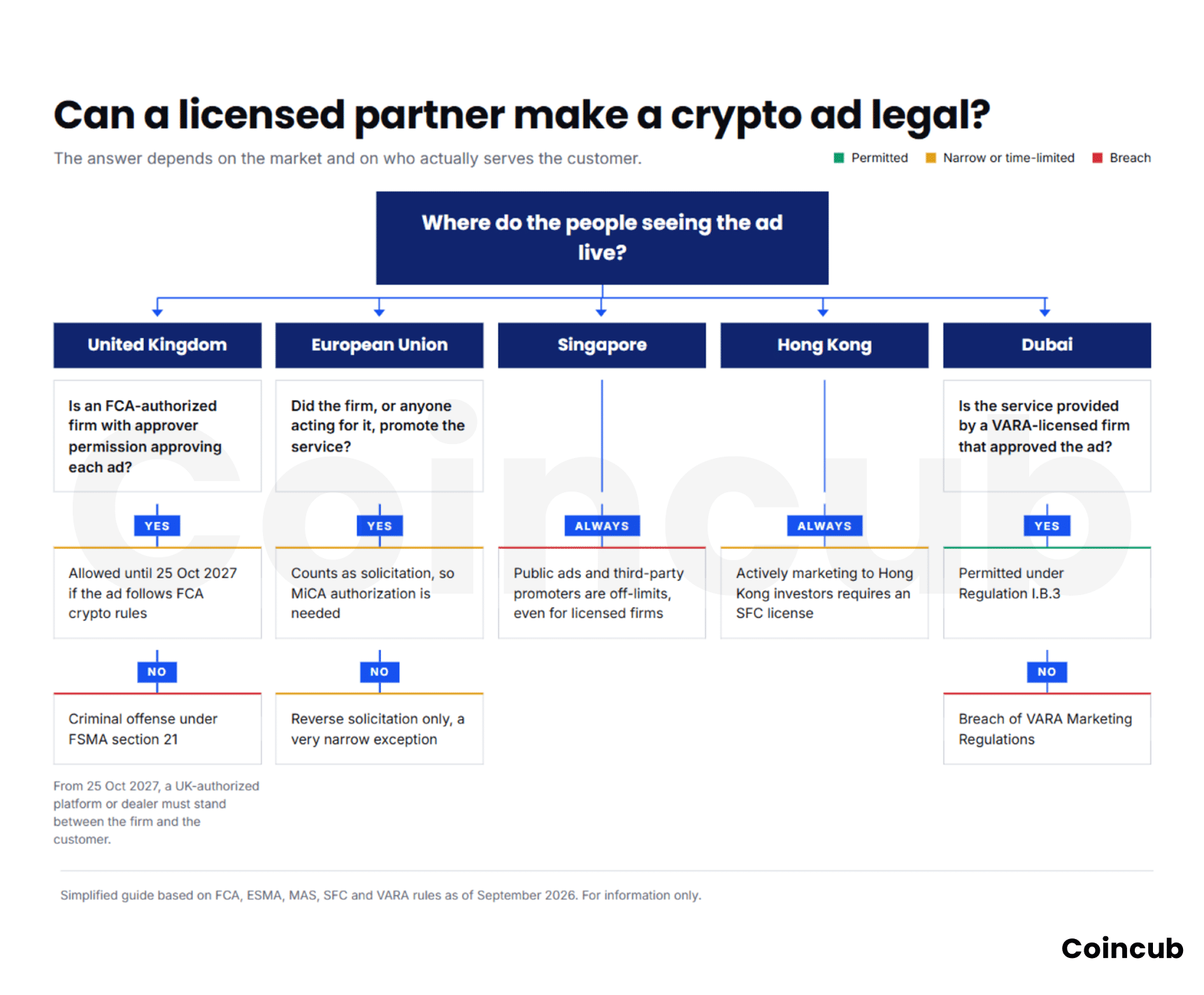
Most of those steps return to one question from the start of this guide: who really serves the customer? The flowchart below turns that question into a quick check.
Final Thoughts
An unlicensed crypto company can sometimes advertise through a licensed partner, but the answer depends on the market. The UK currently allows it through approvers with the right FCA permission, and Dubai lets licensed firms approve marketing for their own licensed activities. The EU, Singapore, and Hong Kong, on the other hand, leave unlicensed firms with no partner route to the public. Everywhere, a licensed partner that gets the deal wrong puts its own standing at risk.
The direction of travel is clear. The UK’s approver route narrows in October 2027, EU regulators are watching for “legal cover” set-ups, and ad platforms check licenses themselves. A partner can buy time, while a license of your own is the lasting fix. When that time comes, the guides on how to get a crypto license, the 2026 crypto license map, and secondary licensing beyond MiCA compare the options. To see who is getting licensed each month, follow the monthly crypto licensing register.
Frequently Asked Questions (FAQ)
Can an unlicensed crypto company advertise in the UK? +
An unlicensed crypto company can currently advertise in the UK if an FCA-authorized firm with approver permission approves its promotions under section 21 of FSMA. The ads must follow FCA crypto rules. Firms that never apply for authorization must wind down their UK crypto business before 25 October 2027.
What is a section 21 approver? +
A section 21 approver is an FCA-authorized firm that reviews and approves financial promotions for unauthorized companies. Since 7 February 2024, approvers have needed a specific approver permission from the FCA. They must also monitor the ads they approve and report their approval activity to the regulator.
Can a MiCA-licensed firm promote a non-EU crypto exchange? +
A MiCA-licensed firm cannot legally solicit EU clients for a non-EU crypto exchange. ESMA's guidelines say that services provided after solicitation by an EU-regulated entity on a non-EU firm's behalf still breach MiCA. Showing the exchange's logo or linking to its website can count as solicitation.
Does reverse solicitation let crypto firms market to EU customers? +
Reverse solicitation lets a non-EU firm serve an EU client only when that client makes contact entirely on their own initiative. It never lets the firm market new types of services to that client. Under MiCA Article 61, solicitation by the firm or its promoters ends the exception.
Can crypto influencers promote unlicensed exchanges? +
Crypto influencers who promote unlicensed exchanges risk breaking the law in several markets. The UK treats unlawful crypto promotions as a criminal offense. ESMA treats paid influencers as acting for the firm, and France only lets influencers promote crypto providers registered or authorized by the AMF.
Can crypto companies advertise in Singapore? +
Crypto companies face tight advertising limits in Singapore. MAS guidelines say DPT service providers should not advertise to the general public or use influencers and third-party websites to promote their services. They may still promote themselves on their own websites, apps, and official social media accounts.
What happens to s21 approvals when the UK crypto regime starts? +
The UK's new crypto regime starts on 25 October 2027. Firms that apply between 30 September 2026 and 28 February 2027 can keep using their approver until the FCA decides. Firms that never apply must wind down their UK crypto business before the regime begins.