


 Buy a Licensed Company
  Explore VASP Data
  Talk to an Expert

 Atis Shala
Atis is a senior analyst and community lead with four years of experience in crypto. He has a bachelor from the Rochester Institute of Technology.
Atis Shala
Atis is a senior analyst and community lead with four years of experience in crypto. He has a bachelor from the Rochester Institute of Technology.
DCM Explained: The Regulatory License Behind Prediction Markets

- A designated contract market (DCM) is an exchange registered with the US Commodity Futures Trading Commission (CFTC) under Section 5 of the Commodity Exchange Act (CEA) and Part 38 of the CFTC’s regulations. It may list futures, options and event contracts, and it may admit retail customers directly.
- Event contracts count as derivatives under federal law, so a venue needs DCM status before it can lawfully offer them to US retail traders, whether it applies for that status or acquires the entity that already holds it.
- DCMs must satisfy 23 statutory core principles on a continuous basis, covering contract design, manipulation prevention, trade surveillance, financial integrity, recordkeeping and self-regulation.
- The licence works only as part of a set. Contracts must clear through a registered derivatives clearing organization (DCO), and customer brokerage generally involves a futures commission merchant (FCM), which makes the framework a three-registration stack.
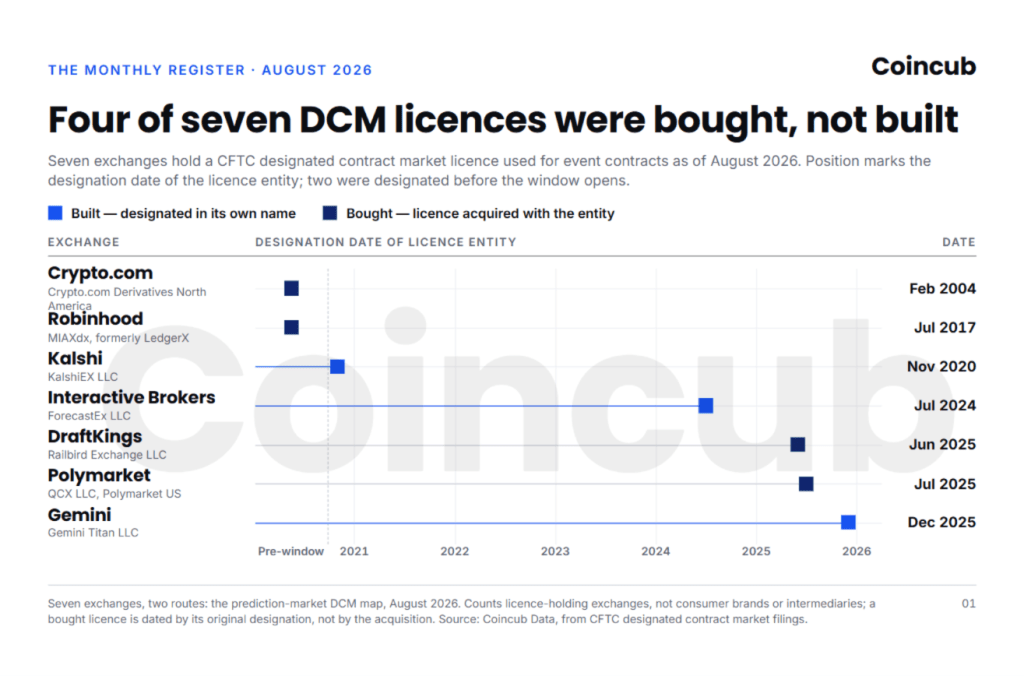
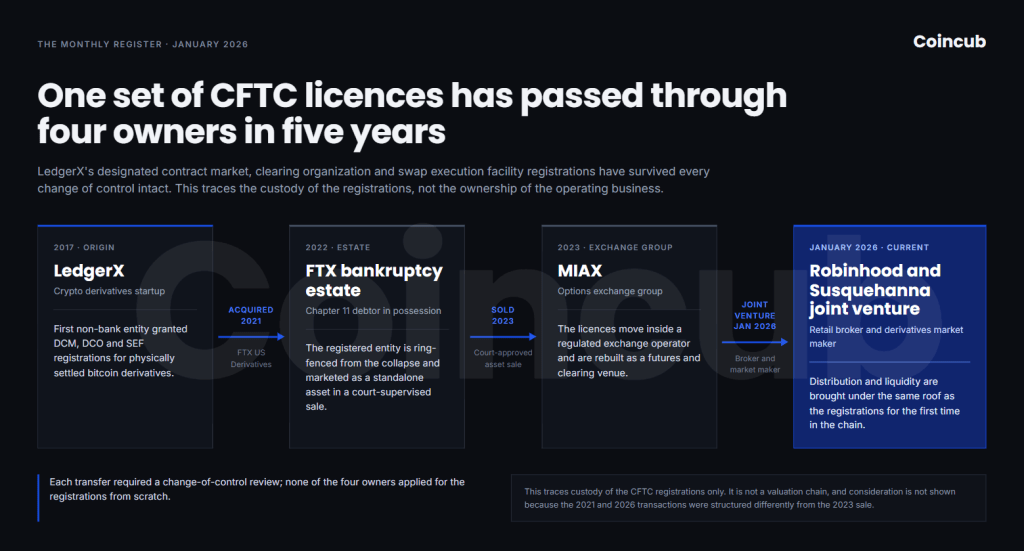
- Because licences transfer with the entity that holds them, the market has shifted from building to buying: Polymarket paid $112 million for QCEX, DraftKings bought Railbird, and a Robinhood and Susquehanna joint venture bought MIAXdx.
- DCM status settles a federal question and leaves state gambling law open, which is why Kalshi holds a CFTC licence and faces injunctions in several states at the same time.
Event Contracts in the United States
Every event contract legally traded in the United States rests on a single federal registration, and it is one that few people outside a compliance department can name. It is called a designated contract market, or DCM, and it began as an exchange licence written into the Commodity Exchange Act for traders of grain and livestock futures. Today it has become the most contested permission slip in the prediction markets industry.
Anyone who has followed Kalshi’s court battles, Polymarket’s $112 million purchase of a small Florida exchange, or Robinhood’s decision to buy a derivatives venue outright has been watching firms compete for this one registration. What follows covers what the licence permits, which obligations come attached to it, who currently holds one, how they got it, and, for anyone with money sitting on a platform, where its protection runs out.
What Is a Designated Contract Market?
A designated contract market is a CFTC-registered exchange, described in the statute’s older phrasing as a “board of trade,” authorised under Section 5 of the Commodity Exchange Act to list derivatives contracts for trading. The operational detail sits in Part 38 of the CFTC’s regulations. Two of its features explain why this particular licence matters so much to prediction markets.

The first is the breadth of what a DCM may list. It can offer futures and options on all types of commodities, and federal law defines “commodity” expansively enough to reach interest rates, indices, digital assets and, critically, the occurrence of future events. A contract on whether a given candidate wins an election, or on whether CPI prints above 3%, sits in the same statutory family as a contract on corn.
The second is the breadth of who may trade there. A DCM can admit every category of participant, including ordinary retail customers, with no wealth or sophistication test applied at the door. Other CFTC venue types work differently: a swap execution facility, for instance, is generally limited to eligible contract participants, meaning institutions and high-net-worth traders. That single difference is why prediction markets pursue this licence rather than a cheaper one, since their entire business depends on retail access.
Designation also carries an ongoing burden rather than a one-time approval. The CFTC’s Division of Market Oversight tests compliance through periodic rule enforcement reviews, which examine whether an exchange actually enforces the rulebook it published.
Why Prediction Markets Specifically Need a DCM
Event contracts are derivatives under US law, and only a registered exchange may list derivatives for retail trading, which makes the DCM a gate rather than a formality.
Before going further, the product itself is worth defining precisely. An event contract is a derivative whose payout turns on whether a stated real-world event occurs. Most are binary, settling at $1 if the event happens and $0 if it does not, so the trading price between those two poles reads as an implied probability. That structure is what pulls the product under federal derivatives law in the first place.
Once the classification is clear, much of the industry’s odd corporate shape starts to make sense. Polymarket began as a purely onchain venue, was pushed out of the American market, and had to buy its way back through a licensed entity. Offshore books that accept US customers on event outcomes are not sitting in a grey area under federal derivatives law, since the registration requirement applies to them just as it does to a domestic venue.
None of this is new law. The CFTC designated the first contract market dedicated to event contracts, HedgeStreet, Inc., later renamed the North American Derivatives Exchange, back in February 2004. What changed since then is scale. The modern era opens with KalshiEX LLC, which received its order of designation on 3 November 2020 and became the first purpose-built prediction market exchange of the current generation.
Volume followed quickly: total trading across CFTC-registered prediction markets exceeded $25 billion in 2025 by the Commission’s own count, applications for DCM registration more than doubled in the year to March 2026, and CFTC staff were reviewing more than a dozen pending applications by mid-2026, most of them from firms interested primarily or exclusively in prediction markets.
The 23 Core Principles: What Does a Actually DCM?
Holding the licence obliges an exchange to comply, at all times, with 23 statutory core principles set out in Section 5(d) of the CEA and implemented through Part 38. Those principles cluster into a handful of practical duties.
| Duty area | What the exchange must do |
|---|---|
| Contract design | List only contracts that are not readily susceptible to manipulation |
| Market surveillance | Monitor trading in real time and after the fact for abuse, including trading on non-public information |
| Self-regulation | Maintain a rulebook and discipline its own customers for breaking it |
| Financial integrity | Ensure contracts clear and that participant funds are protected |
| Position limits | Apply limits or accountability levels where appropriate |
| Recordkeeping and reporting | Retain records and produce them to the Commission on demand |
| Governance | Manage conflicts of interest, including at board level |
| System safeguards | Maintain resilient technology, business continuity and cyber controls |
Event Contracts Resistant to Manipulation
Of that list, Core Principle 3 shapes daily life at a prediction market venue more than any other. It requires an exchange to list only contracts resistant to manipulation and to surveil trading in them once listed. On 12 March 2026, the CFTC’s Division of Market Oversight applied that principle directly to event contracts in Staff Advisory Letter 26-08, addressed to all DCMs. The advisory struck a supportive tone toward the sector while reminding exchanges that they serve as the front-line regulators of their own markets. It pointed them to the Appendix C guidance for listing and surveillance, and it singled out sports contracts as warranting engagement with sports governing bodies on integrity standards, insider trading and investigations.
That obligation explains a set of practices regulated venues publicise and offshore venues ignore. Screening that blocks political candidates from trading their own races, integrity vendors flagging unusual activity around athletes and officials, in-app suspicious-activity reporting: each of these exists because Core Principle 3 requires an exchange to police its own market and document that it did so.
DCM, DCO, FCM: The Three-Licence Stack
A DCM registration on its own still cannot produce a working market, because US derivatives regulation deliberately splits three functions so that no single party brokers, matches and guarantees the same trade.
| Registration | Function | Analogy | Can it list contracts for retail? |
|---|---|---|---|
| DCM, designated contract market | Lists and matches contracts | The exchange | Yes |
| DCO, derivatives clearing organization | Clears and guarantees trades, manages margin and default risk | The clearing house | No |
| FCM, futures commission merchant | Solicits and accepts customer orders, holds customer margin in segregated accounts | The broker | No |
Every contract a DCM lists must clear through a registered DCO, so an exchange without clearing access has a licence it cannot use. That dependency explains why the assets changing hands in this sector are almost always exchange-and-clearinghouse pairs, since buying half the stack leaves the buyer reliant on a competitor for the other half.
The same structure also drains most of the meaning out of the phrase “CFTC-regulated” in a press release. A firm may hold any one of the three registrations, and only the DCM permits listing contracts for retail trading. Four questions cut through the ambiguity of almost any announcement: which registration, held by which legal entity, permitting what activity, and does the group also control clearing?
Who Holds a Prediction-Market DCM In 2026
Applying those four questions to the current field produces a short list of relevant entities, and the routes they took to get there differ sharply.
| Exchange entity | Group / owner | DCM status | Clearing | How it got there |
|---|---|---|---|---|
| KalshiEX LLC | Kalshi | Designated 3 Nov 2020 | Kalshi Klear LLC, registered as a DCO 28 Aug 2024 | Built and litigated |
| QCX LLC (Polymarket US) | Polymarket | Existing DCM acquired | QC Clearing LLC (DCO) | Bought QCEX for $112m, July 2025 |
| Railbird Exchange LLC | DraftKings | Designated 13 Jun 2025 | External DCO, Bitnomial Clearinghouse LLC (per CFTC Letter 26-13) | Built, then acquired by DraftKings, Oct 2025 |
| Gemini Titan LLC | Gemini | Approved 11 Dec 2025 | Gemini Olympus LLC, registered as a DCO 29 Apr 2026 | Applied Mar 2020, roughly a five-year process |
| MIAXdx (formerly LedgerX) | Robinhood and Susquehanna JV (90%), MIAX (10%) | Existing DCM | Paired DCO | Acquisition closed 20 Jan 2026 |
| Crypto.com Derivatives North America | Crypto.com | Existing DCM | Own DCO and FCM | Full three-licence stack |
| ForecastEx LLC | Interactive Brokers | DCM and DCO | Own DCO | Built as an IBKR spinout, 2024 |
Two patterns run through that table. The first is how thin the incumbent advantage turns out to be, since the regulatory standing Kalshi spent years and multiple federal lawsuits securing was available to a well-capitalised buyer as a line item. The second follows from it: distribution, rather than the licence, is what separates these venues. DraftKings, Robinhood and Crypto.com moved into the category because they already held the customers, and the licence supplied the one input they lacked.
How a Firm Gets a DCM: Build or Buy?
The Application Route
Applicants file Form DCM with the Commission and must demonstrate in advance how they will satisfy each of the 23 core principles. That means setting out contract design and why it resists manipulation, surveillance systems and the staff running them, the rulebook and disciplinary process, financial resources, system safeguards, recordkeeping, emergency authority and governance arrangements. The submission amounts to a detailed description of a working exchange, written before the exchange works.
Section 6(a) of the CEA gives the Commission a 180-day clock to approve, deny or approve with conditions, though the clock only starts once an application is materially complete and stops again while any deficiency is cured. The gap between that statutory timeline and actual experience can be wide: Gemini filed for its DCM in March 2020 and received approval in December 2025.
The Acquisition Route
Because a licence attaches to a legal entity, buying the entity conveys the standing, subject to CFTC review of the change of control. Part 38 also provides for dormant contract markets, meaning entities that hold designation but have stopped listing products. A dormant DCM must apply for reinstatement before listing again, although it may rely on previously filed materials that still describe conditions accurately.
That provision underpins the sector’s most instructive transaction. MIAXdx, the entity Robinhood and Susquehanna acquired, is the former LedgerX, which MIAX bought out of FTX’s bankruptcy before selling it on. A licence that passed from a crypto derivatives startup, through a bankruptcy estate, to an options exchange group, and finally to a retail brokerage joint venture demonstrates as clearly as anything could that DCM status behaves like a durable asset with a market price.
What the CFTC Is Changing In 2026
While firms have been assembling licences, the Commission has been reworking the rules those licences run on, through two actions that matter more than anything else on this year’s calendar.
The first came in March 2026, when the Commission published an Advance Notice of Proposed Rulemaking alongside Advisory 26-08, seeking comment on event contract derivatives and citing the surge in DCM applications from prediction market operators as reason to examine the framework as a whole.
The second arrived on 10 June 2026 as a Notice of Proposed Rulemaking titled Prediction Markets; Public Interest Determinations, published in the Federal Register on 12 June 2026 with comments due 27 July 2026. It would establish a three-step framework for assessing whether an event contract “involves” unlawful activity, terrorism, assassination, war or gaming, and if so whether the contract runs contrary to the public interest. It would also define “gaming,” clarify when a contract “involves” one of the listed activities, set out general and activity-specific public interest factors, and formalise how the Commission reviews self-certified contracts.
That final item deserves particular attention from anyone reading industry announcements, because the CFTC never sees most event contracts before they list. A DCM may self-certify a new contract, filing it with a representation that it complies with the CEA, and begin trading it. The Commission’s role starts afterwards, as a power to review and, where the special rule applies, to prohibit. A firm announcing that it has self-certified a contract has therefore announced a filing rather than an approval, and the June rulemaking aims to make the review half of that arrangement more predictable.
Predictability is Urgent
The litigation record shows why predictability has become urgent. The CFTC invoked its public interest authority against Kalshi’s congressional-control contracts in September 2023, Kalshi sued, the DC district court ruled for Kalshi in September 2024, the DC Circuit declined to stay that ruling in October 2024, and the Commission voluntarily dismissed its appeal in May 2025. The proposed rule is an attempt to rebuild that authority on firmer procedural ground.
Where a DCM Licence Stops Working: State Law
Federal rulemaking is only half the picture, because a DCM answers a federal question and leaves a state one open. Designation establishes that a venue may lawfully list derivatives for US retail traders. Whether a given state treats a sports event contract as unlicensed gambling is a separate matter, and several states have concluded that it does, then gone to court to say so.
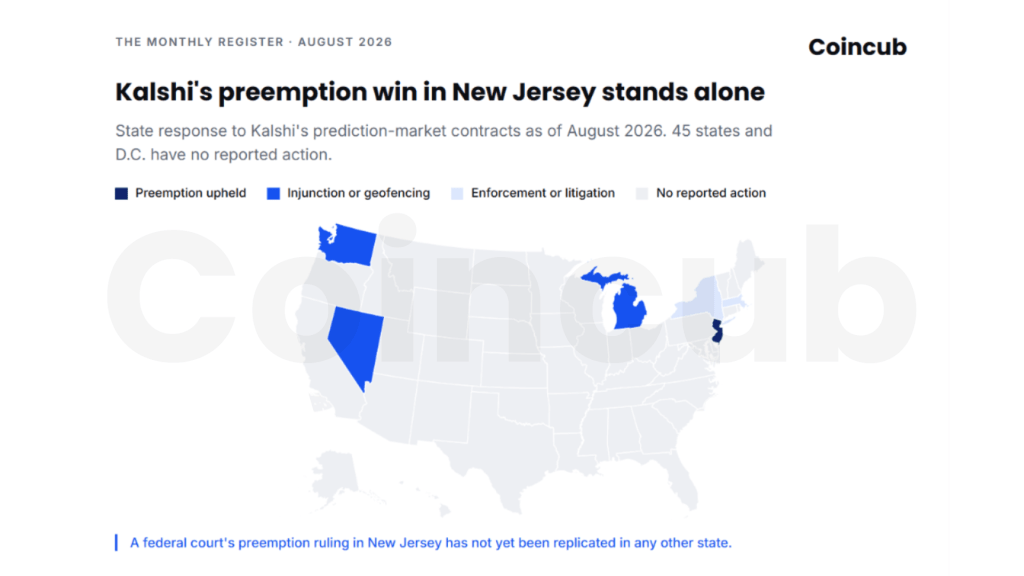
- New Jersey. The Third Circuit upheld Kalshi’s preliminary injunction by 2 votes to 1 on 6 April 2026, treating its sports event contracts as CFTC-regulated instruments subject to exclusive federal jurisdiction and preempting state gambling law.
- Nevada. A preliminary injunction extended in April 2026 bars Kalshi from offering sports, election or entertainment contracts without a state gaming licence.
- Washington. A King County Superior Court judge ruled in July 2026 that Kalshi likely operated an illegal gambling operation and ordered geofencing of the state, with a preliminary version due by 19 August 2026 and full implementation by 2 September 2026.
- Michigan, Massachusetts and New York. Each has taken an enforcement or litigation position against prediction market operators.
- Tribal claims. Multiple tribes, including the Ho-Chunk Nation and several New Mexico and California tribes, have sued under the Indian Gaming Regulatory Act and their state compacts, with at least one trial set for 2027.
The result is a genuinely split map, on which the same federally licensed exchange may lawfully offer a contract in one state while sitting under an injunction in the state next door. For anyone trading, the practical lesson is that a venue’s licence tends to be stable while its product menu remains provisional and subject to change with the next court order.
Outside the US: There Is No DCM
The state-level fragmentation inside America has a parallel abroad, where the licence has no equivalent at all. Because the DCM exists only as a creation of the Commodity Exchange Act, other jurisdictions have reached for whichever domestic framework seemed closest, and their answers diverge sharply.
The European Union has moved in something close to the opposite direction. On 3 July 2026, ESMA issued a public statement taking the position that event contracts whose underlyings fall within MiFID II’s Annex I qualify as financial instruments, which brings them under national binary options prohibitions on marketing, distribution or sale to retail clients. In the United States, classifying these products as derivatives is precisely what opens them to retail traders; in Europe, the same classification closes the door. MiCA offers crypto-native operators a separate route to authorisation as a crypto-asset service provider, though it leaves the binary options problem untouched for contracts that qualify as financial instruments.
European enforcement has already begun. France’s ANJ ordered ISP-level blocking of Polymarket in July 2026, Portugal ordered blocks in March 2026, Spain opened sanction proceedings against both Kalshi and Polymarket in May 2026 for operating without gambling licences, and Belgium and the Netherlands have published formal actions of their own.
Gibraltar chose a third path, issuing what is reported as Europe’s first prediction market licence in April 2026 under its existing gambling regime, a characterisation directly opposed to the CFTC’s. Taken together, these positions leave a clear structural lesson for anyone tracking the sector internationally: the US treats event contracts as derivatives and regulates the exchange, while much of Europe treats them either as prohibited retail derivatives or as gambling and regulates the operator. No firm can passport a DCM anywhere.
What DCM Status Protects, and Where Its Protection Ends
Given how much regulatory weight the licence carries, it helps to be precise about what it delivers to someone with money at risk.
On the protective side, DCM status supplies:
- A federally supervised venue subject to CFTC examination and rule enforcement reviews.
- Contracts cleared through a registered DCO that guarantees performance and manages default risk.
- Customer funds held under the segregation rules that apply to regulated derivatives intermediaries.
- An enforceable exchange rulebook, backed by a surveillance programme a regulator inspects.
- A defined complaint and enforcement path when something goes wrong.
Measured against an unlicensed offshore book, that package represents a substantial difference in kind.
Its limits are equally concrete. DCM status offers no view on whether a contract is a sensible trade, and it provides no protection against losing a staked amount. It carries no guarantee that a market will resolve the way a common-sense reading of events suggests, since resolution turns on the contract’s written criteria and named source. It grants no immunity from the CFTC’s authority to review and prohibit contracts involving enumerated activities, and none from state gaming enforcement, tribal claims, or pending federal legislation that could strip whole product categories from licensed venues.
The distinction worth carrying, then, is between venue and product. Registration establishes that a venue operates lawfully, while the question of whether a particular product remains listed next year stays open, and in this category that is the question actually in play.
Frequently Asked Questions (FAQ)
What does DCM stand for? +
Designated contract market: an exchange registered with the CFTC under Section 5 of the Commodity Exchange Act and Part 38 of the Commission's regulations. DCMs may list futures, options and event contracts on all types of commodities, and they may admit retail customers directly.
Why do prediction markets need a DCM licence? +
Event contracts are derivatives under US federal law, and only a registered exchange may list derivatives for trading by US retail customers. A venue without DCM status cannot lawfully serve American retail traders, which is why every domestic prediction market operates through one, whether obtained directly or acquired.
What are the 23 core principles of DCM? +
Statutory requirements a DCM must satisfy continuously, covering manipulation prevention, contract design, trade surveillance, position limits, financial integrity, participant protection, recordkeeping, governance, system safeguards and self-regulation. The CFTC's Division of Market Oversight verifies compliance through periodic rule enforcement reviews.
What is the difference between a DCM, a DCO and an FCM? +
A DCM is the exchange that lists and matches contracts. A DCO is the clearing house that guarantees them and manages margin and default risk. An FCM is the broker that accepts customer orders and holds customer margin in segregated accounts. Every DCM contract must clear through a registered DCO, so an exchange holding only a DCM licence cannot open for business.
How long does it take to get a DCM licence? +
The CFTC reviews applications on a 180-day statutory clock, which starts only once an application is materially complete and stops while deficiencies are cured. Real-world timelines run far longer. Gemini filed in March 2020 and was approved in December 2025.
Why do companies buy DCMs instead of applying? +
The licence attaches to a legal entity and therefore transfers with it, and applications take years. Polymarket acquired QCEX for $112 million in July 2025, DraftKings acquired Railbird in October 2025, and a Robinhood and Susquehanna joint venture completed its acquisition of MIAXdx, the former LedgerX, in January 2026.
Does the CFTC approve every prediction market contract? +
No. DCMs may self-certify new contracts, filing them with a representation of compliance and listing them without prior approval. The Commission's role is to review and, under the special rule for certain enumerated activities, to prohibit contracts it determines are contrary to the public interest. Its June 2026 proposed rule would formalise that review process.
Does a DCM licence make a platform legal in every US state? +
No. DCM status operates at the federal level. Several states, including Nevada, Washington and Michigan, have obtained orders restricting sports event contracts, while the Third Circuit sided with Kalshi against New Jersey in April 2026 on preemption grounds. Tribal claims under the Indian Gaming Regulatory Act are also pending. Availability varies by state and changes with litigation.
Is trading on a DCM safe? +
Safer in specific and limited ways: a supervised venue, clearinghouse-guaranteed performance, segregated customer funds, an enforceable rulebook, and a regulator with examination authority. Those protections do not extend to losing a staked amount, to a market resolving against expectations, or to a product being delisted while the legal position of the category remains unsettled.