



 Buy a Licensed Company
  Explore VASP Data
  Talk to an Expert

 Atis Shala
Atis is a senior analyst and community lead with four years of experience in crypto. He has a bachelor from the Rochester Institute of Technology.
Atis Shala
Atis is a senior analyst and community lead with four years of experience in crypto. He has a bachelor from the Rochester Institute of Technology.
How Sanctioned Nations Turn to the Blockchain
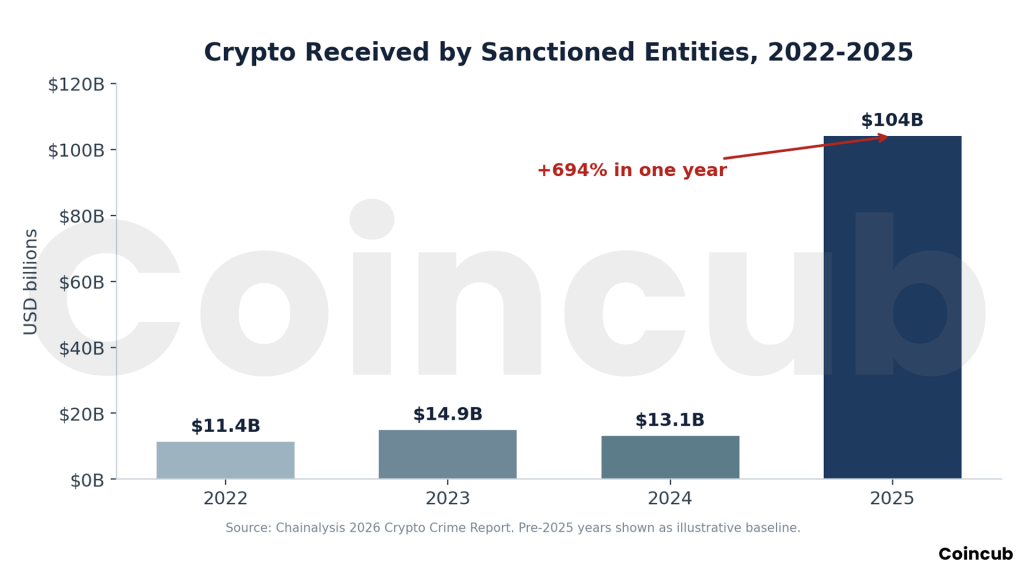
- Sanctioned states moved approximately $104 billion in cryptocurrency through 2025, marking an explosive 694% increase in a single year.
- This rapid surge has made sanctions evasion the largest single category of illicit crypto activity worldwide, surpassing scams, hacks, and ransomware combined.
- Stablecoins account for roughly 84% of this illicit volume because they provide the speed of blockchain transfers without the severe price volatility of traditional tokens like Bitcoin.
- Cryptocurrency allows cut-off regimes to completely sidestep correspondent banking networks and the US dollar, executing cross-border trade settlements in minutes using only wallet addresses and an internet connection.
- Hostile nations utilize tailored strategies, such as Russia deploying its own A7A5 ruble stablecoin for trade, Venezuela accepting USDT for oil, Iran mining Bitcoin, and North Korea executing massive cyber heists.
- Although regimes use mixers and throwaway wallets to hide their tracks, the permanent and public nature of the blockchain enables analytics firms to map out and expose these state-linked financial networks.
- Regulators have shifted their strategy from tracking individual wallets to blocklisting major infrastructural chokepoints, including entire digital asset exchanges and centralized stablecoin issuers.
Sanctioned States Using Blockchain
Sanctioned states moved roughly $104 billion in cryptocurrency through 2025, a 694% jump in a single year, according to Chainalysis. That figure now makes sanctions evasion the single largest category of illicit crypto activity on earth, larger than scams, hacks, and ransomware combined. The blockchain has quietly become the back channel of choice for governments cut off from the dollar, and the trend is accelerating rather than fading.
This shift matters because the tools that were supposed to isolate hostile regimes, mainly the global banking system and the US dollar, are losing their grip. When a country cannot wire money through a bank, it can still send a stablecoin from one wallet to another in seconds. The rest of this article explains who is doing it, how the mechanics work, how much money is involved, and why the people tracking it think the next two years will reshape financial enforcement.
Sanctioned nations bypass banks by converting oil and trade revenue into cryptocurrency, mostly dollar-pegged stablecoins. Russia leans on its A7A5 stablecoin, Iran mines Bitcoin and runs crypto oil payments through the Revolutionary Guard, North Korea steals funds through hacking, and Venezuela settles oil sales in USDT. Blockchain analytics firms and regulators are responding with onchain tracing and fast-moving sanctions designations.

The Numbers Behind a Record Year on Sanctions
The headline comes from the Chainalysis 2026 Crypto Crime Report, which put total illicit crypto transaction volume at around $154 billion for 2025. Of that, $104 billion flowed to or through entities under sanctions. The growth was not gradual. It was a sevenfold leap driven almost entirely by state-linked actors rather than ordinary criminals, which is what makes this period different from earlier crypto crime waves.
One detail explains most of the money. Stablecoins, the dollar or ruble pegged tokens designed to hold a steady value, now account for roughly 84% of all illicit crypto transaction volume. Sanctioned actors do not want the price swings of Bitcoin when they are settling an oil cargo or paying a supplier. They want a digital token that behaves like cash and clears in minutes, and stablecoins give them exactly that.
How the Blockchain Replaces Banks
To understand the appeal, it helps to picture what sanctions actually do. They cut a government off from correspondent banking, the network of intermediary banks that lets money cross borders. Without it, a sanctioned exporter cannot easily get paid in dollars or euros. Crypto sidesteps the whole structure because a blockchain transfer needs no bank to approve it, only two wallet addresses and an internet connection.
In practice the playbook follows a few repeatable steps. A sanctioned entity earns revenue, usually from oil, gas, or arms. It converts that revenue into a stablecoin through a friendly exchange or an over the counter desk. It then moves the tokens to a counterparty, often a buyer in China, India, or a Gulf state, who either holds the crypto or cashes it out into local currency. Mixers, chains of intermediary wallets, and obscure exchanges are layered in to break the trail.
The key advantage is speed paired with reach. A stablecoin transfer settles in minutes regardless of borders, business hours, or which banks are willing to touch it. For a government racing to fund imports before the next round of designations lands, that combination is hard to beat.
It also lowers the cost of doing business in the shadows. Traditional sanctions busting relied on networks of shell companies, front banks, and middlemen who each took a cut and added a point of failure. Every extra human in the chain is someone who can be pressured, prosecuted, or turned by investigators. A blockchain transfer compresses much of that into code, shrinking both the expense and the number of weak links a regime has to protect.
Four Countries, Four Playbooks
No two sanctioned states use the blockchain the same way. Their methods reflect what each country has to sell and how much technical muscle it can bring.
| Country | Primary method | Estimated scale | Preferred asset |
|---|---|---|---|
| Russia | Stablecoin settlement for oil and trade | ~$11B in crypto trade in 2025 | A7A5 ruble stablecoin |
| Iran | Bitcoin mining and crypto oil payments | $7.78B onchain ecosystem in 2025 | Bitcoin and USDT |
| North Korea | Hacking and theft of crypto | $2.02B stolen in 2025 | Ether, then laundered |
| Venezuela | Oil settlement in stablecoins | Oil payments in USDT since 2024 | USDT (Tether) |
Sources: Chainalysis, Elliptic, and OFAC designations, 2025 to 2026.
Russia: building a parallel settlement rail
Russia has gone furthest toward institutionalizing crypto. After years of treating Bitcoin with suspicion, Moscow built a legal experiment that let exporters settle foreign trade in digital assets, and it is set to formalize that regime on July 1, 2026. From that date, Russian exporters gain a legal path to accept Bitcoin and stablecoins from buyers who have been cut off from Western banking.
The centerpiece is A7A5, a ruble-pegged stablecoin. Launched in mid-2024, it crossed $100 billion in cumulative onchain transactions in less than a year and became the largest non-dollar stablecoin in the world. It functions as a dedicated settlement system for sanctioned Russian businesses. Crypto-facilitated international trade out of Russia reached roughly 1 trillion rubles in 2025, about $11 billion, and the country pulled in around 726 million euros a day from fossil fuel exports in May 2026 even without raising export volumes.
Western authorities noticed. In August 2025 the US Treasury and the UK designated entities tied to A7A5 and its affiliated exchange Grinex, and in October the European Union banned transactions in A7A5 outright as part of its 19th sanctions package. The cat and mouse pattern, a new tool followed by a new designation, is the defining rhythm of this whole story.
Iran: mining energy into Bitcoin
Iran turned its cheapest asset, subsidized energy, into crypto. Since 2018 the country has used Bitcoin mining to convert electricity into a tradable asset that sidesteps trade embargoes, generating as much as $1 billion in revenue over time. Elliptic estimates that around 4.5% of all Bitcoin mining takes place inside Iran.
More recently the Islamic Revolutionary Guard Corps moved to the center of the system. IRGC-linked addresses accounted for more than half of all value received by Iranian entities in the fourth quarter of 2025, moving over $3 billion to fund regional militia networks, settle oil sales, and buy dual-use equipment. Iran has even experimented with charging for passage near the Strait of Hormuz in Bitcoin, stablecoins, and yuan, turning the world’s most important oil chokepoint into a crypto tollbooth.
Iran’s total onchain ecosystem reached $7.78 billion in 2025. The enforcement response arrived in June 2026, when the US Treasury sanctioned Nobitex, Iran’s largest digital asset exchange, which handled more than half of the country’s crypto inflows the previous year. Iran and Russia have also reportedly explored settling cross-border trade in stablecoins together, a sign that sanctioned states are starting to cooperate rather than improvise alone.
North Korea: theft as state revenue
North Korea does not trade its way around sanctions. It steals. The Lazarus Group, an elite hacking unit tied to the country’s Reconnaissance General Bureau, treats crypto exchanges and DeFi protocols as a revenue stream for the state. In February 2025 the group pulled off the largest crypto theft in history, draining about $1.5 billion in Ether from the exchange Bybit. Roughly $160 million was laundered through mixers and DeFi platforms within the first 48 hours.
That single heist was part of a bigger haul. DPRK-linked actors stole an estimated $2.02 billion across 2025, a 51% rise year on year, lifting their cumulative total to $6.75 billion. Through early 2026 they accounted for roughly three quarters of all crypto hack value worldwide. For a regime with few legal exports, stolen crypto has become a core funding line for weapons programs.
What sets North Korea apart is the patience of its operations. Lazarus operatives have spent months posing as job candidates, recruiters, and venture investors to win the trust of exchange and protocol staff before striking. Once funds are in hand, they pass through a well-practiced laundering pipeline of cross-chain bridges, coin-swap services, and mixers that pool tokens from many users to blur their origin. The state treats this as infrastructure, not opportunism, which is why the totals keep climbing year after year.
Venezuela: from the petro to plain USDT
Venezuela was an early and clumsy mover. In 2018 the Maduro government launched the petro, a state cryptocurrency it claimed was backed by oil reserves, hoping to settle imports and cut reliance on the dollar. The petro flopped. What replaced it was simpler and far more effective. Since 2024, reports indicate the Venezuelan government has been receiving oil payments in Tether’s USDT, the largest dollar-pegged stablecoin.
The Venezuela case shows the broader lesson of this era. Governments do not need to invent their own coin. The existing stablecoin market, built for traders and ordinary users, already does the job, which is precisely why it is so hard to shut down.
Stablecoins as Sanction Evading Tools
Across all four countries the same instrument keeps appearing. Stablecoins solve the problem that made Bitcoin awkward for state finance, which is volatility. A government settling a multimillion dollar oil shipment cannot afford a 10% price swing between sending and receiving. A dollar-pegged token removes that risk while keeping the speed and borderless reach of crypto.
The numbers make the dominance plain. Stablecoins represent about 84% of illicit transaction volume, and the single largest sanctioned-finance instrument, Russia’s A7A5, processed more than $93 billion on its own. That concentration is a vulnerability as much as a strength, because it gives investigators a smaller set of targets to watch.
How Do Investigators Trace the Money?
Here lies the paradox at the heart of crypto sanctions evasion. The same public ledger that lets a sanctioned state move money without a bank also records every transaction permanently for anyone to read. Blockchain analytics firms such as Chainalysis and Elliptic map wallet clusters, follow funds across hops, and tie addresses back to sanctioned entities. That is how the world knows A7A5 moved $93 billion or that the IRGC controls a specific set of wallets.
Evaders fight back with mixers that pool and shuffle funds, with long chains of throwaway wallets, and with exchanges in friendly jurisdictions that ignore Western requests. The result is a measurable lag rather than a clean catch. Funds get traced, then designated, then routed somewhere new. Each cycle gives enforcement a clearer map even as the money keeps moving.
The Enforcement Response is Speeding Up
Regulators have shifted from chasing individual criminals to targeting infrastructure. Recent moves show the pattern. OFAC and the UK hit A7A5 and Grinex in August 2025, the EU banned A7A5 transactions in October 2025, and the US Treasury sanctioned Iran’s Nobitex exchange in June 2026. The EU’s later sanctions packages explicitly went after what one analysis called the architecture of crypto sanctions evasion, meaning the exchanges, stablecoins, and intermediaries rather than just the end users.
The strategic logic is simple. Designating one wallet accomplishes little when a new one can be created in seconds. Cutting off an exchange that handles half a country’s crypto inflows, or banning the stablecoin that settles its trade, hits a chokepoint that is far harder to replace.
Stablecoin issuers themselves have become part of the enforcement toolkit. Because tokens like USDT are centrally issued, the company behind them can freeze specific wallets when ordered to, something no one can do to Bitcoin. That power cuts both ways. It gives authorities a fast way to lock funds, yet it also pushes the most determined evaders toward decentralized tokens and obscure issuers that will not cooperate. Every tightening of the screws on one rail nudges activity toward the next.
What It Means for the Crypto Industry
For exchanges, wallet providers, and DeFi protocols, the rise of state-level evasion raises the stakes on compliance. Regulators now expect platforms to screen wallet addresses against sanctions lists in real time and to act when funds tied to designated entities appear. A protocol that ignores this risks being designated itself, as the cases of Grinex and Nobitex make clear. The era of treating crypto as a lawless frontier is closing fast.
There is a reputational dimension too. Headlines about a $1.5 billion North Korean heist or a $93 billion sanctioned stablecoin shape how lawmakers view the entire industry, including the vast majority of legitimate users and builders. That is why many compliance teams now argue that strong onchain monitoring is a defense rather than a burden, the thing that lets crypto keep its place in the mainstream financial system rather than being pushed out of it.
Ordinary users are mostly insulated from all this, but not entirely. Compliant platforms can freeze or reject funds that pass through sanctioned mixers or flagged exchanges, even when the holder has nothing to do with the original crime. Checking that an exchange follows recognized compliance standards is no longer just good hygiene. It is a practical way to avoid having clean money caught in a dirty net.
What Comes Next: Crypto Regulations to Stop Sanction Evaders
Two forces are pulling in opposite directions. On one side, sanctioned states are formalizing crypto into national policy, with Russia’s July 2026 legal regime the clearest example and Iran and Russia reportedly exploring cross-border stablecoin settlement together. On the other side, enforcement is getting faster, more coordinated, and more focused on infrastructure.
For everyone else, the practical takeaways are worth holding onto. Stablecoins, not Bitcoin, are the real engine of state-level evasion. The blockchain’s transparency is both the evaders’ enabler and their weakness. And the contest is no longer about whether crypto can be used to dodge sanctions, because it clearly can, but about how quickly regulators can close each new channel before the next one opens.
Frequently asked questions
How much crypto do sanctioned countries actually move?
Sanctioned entities received roughly $104 billion in cryptocurrency during 2025, according to Chainalysis, a 694% increase over the prior year and the largest single category of illicit crypto activity.
Which cryptocurrency do they use most?
Stablecoins, especially dollar-pegged tokens like USDT and Russia’s ruble-pegged A7A5. They account for about 84% of illicit crypto volume because they hold a steady value and settle quickly.
Can blockchain transactions be traced?
Yes. Public blockchains record every transaction permanently. Firms like Chainalysis and Elliptic trace funds, cluster wallets, and link addresses to sanctioned entities, and procude most of these figures.
What are governments doing about it?
Regulators increasingly target infrastructure rather than individuals. Recent examples include US, UK, and EU action against Russia’s A7A5 stablecoin and the US Treasury’s June 2026 sanctioning of Iran’s Nobitex exchange.









