


 Buy a Licensed Company
  Explore VASP Data
  Talk to an Expert

 Atis Shala
Atis is a senior analyst and community lead with four years of experience in crypto. He has a bachelor from the Rochester Institute of Technology.
Atis Shala
Atis is a senior analyst and community lead with four years of experience in crypto. He has a bachelor from the Rochester Institute of Technology.
How European Banks Are Building on Top of MiCA
- European banks are using MiCA as a regulatory foundation for crypto products, especially euro-denominated stablecoins, custody, trading, and tokenization.
- MiCA gives banks a single crypto rulebook across all 27 EU member states, making it easier to launch services across the bloc with one authorization.
- The biggest bank-backed euro stablecoin launches are expected in the second half of 2026, close to the 1 July 2026 MiCA transitional deadline.
- Custody is becoming a key building block for bank crypto services, since trading, stablecoins, and tokenized assets all depend on secure asset handling.
- Challenges remain, including high compliance costs, reserve requirements, uneven national supervision, and the strong dominance of dollar-backed stablecoins.
Some of Europe’s largest banks have stopped watching crypto from the sidelines and started building on it. ING, UniCredit, KBC, CaixaBank, SEB, Danske Bank and others are now developing regulated digital-asset products that sit directly on top of the European Union’s Markets in Crypto-Assets Regulation, known as MiCA. The most visible result so far is a coordinated push toward euro-denominated stablecoins, with several bank-backed launches scheduled for the second half of 2026.
The timing is not a coincidence. MiCA’s transitional window closes on 1 July 2026, the date by which any firm offering crypto services inside the EU must hold a proper MiCA authorization. For banks, that deadline turned a long-running question into a business decision. Rather than treating the rulebook as a constraint, many of them now see it as the missing piece that makes crypto safe to offer to mainstream customers. This article looks at how European banks are using MiCA as a foundation, where they are concentrating their efforts, and what still stands in the way.
What MiCA Is, and Why Banks Care
MiCA is the European Union’s single rulebook for crypto-assets. Before it arrived, a bank that wanted to offer crypto services faced 27 different national interpretations of what was and was not allowed. MiCA replaced that patchwork with one harmonized framework that applies across the entire bloc, which means a license granted in one member state can be passported to the other 26.

The regulation sorts crypto-assets into a few clear categories. E-money tokens, or EMTs, are stablecoins pegged to a single currency such as the euro. Asset-referenced tokens, or ARTs, are backed by a basket of assets. Everything else, including the firms that trade, exchange or hold crypto on behalf of clients, falls under the crypto-asset service provider, or CASP, regime. Each category comes with its own rules on reserves, disclosures and authorization.
The rollout came in stages. The rules for EMTs and ARTs took effect on 30 June 2024, and the full CASP framework followed on 30 December 2024. Firms already operating legally under national law were given a transitional grace period, which ends across the EU on 1 July 2026. For a regulated bank, this structure matters for one simple reason. MiCA gives crypto a legal definition, a supervisor and a set of obligations that look familiar to any institution that already lives inside financial regulation. That familiarity is exactly what banks needed.
Why Banks Are Moving Now
For years, the obstacle was not technology but uncertainty. Banks operate under strict capital, audit and conduct rules, and they could not justify offering a product whose legal status might change overnight. MiCA removed that ambiguity. Once the framework set out precisely what a compliant stablecoin or custody service looks like, the risk of building one dropped sharply.
A second driver is the single-market advantage. Because a MiCA license passports across all 27 member states, a bank that gets authorized in one country can serve clients across the EU without re-applying everywhere. That turns what used to be 27 separate compliance projects into a single one, and it rewards the institutions that move first.
The numbers show how quickly this is happening. By early 2026, more than 40 firms held full crypto-asset service provider authorization across the EU, with Germany and the Netherlands leading on roughly 18 and 14 licenses respectively. Many of the names on that list are banks and broker-banks rather than crypto startups, a clear signal of where the regulated center of gravity now sits.
Client demand and competition complete the picture. Corporate treasurers, asset managers and retail savers increasingly expect access to digital assets, and if their bank cannot provide it, a crypto-native CASP will. European policymakers have also made no secret of their wish to reduce the region’s reliance on dollar-backed stablecoins, which make up close to 99 percent of the roughly 320 billion dollar global supply. A euro stablecoin issued by trusted banks answers both the commercial and the strategic case at once, which helps explain why so many institutions reached the same conclusion at the same time.
Where Banks Are Building: The Four Main Fronts
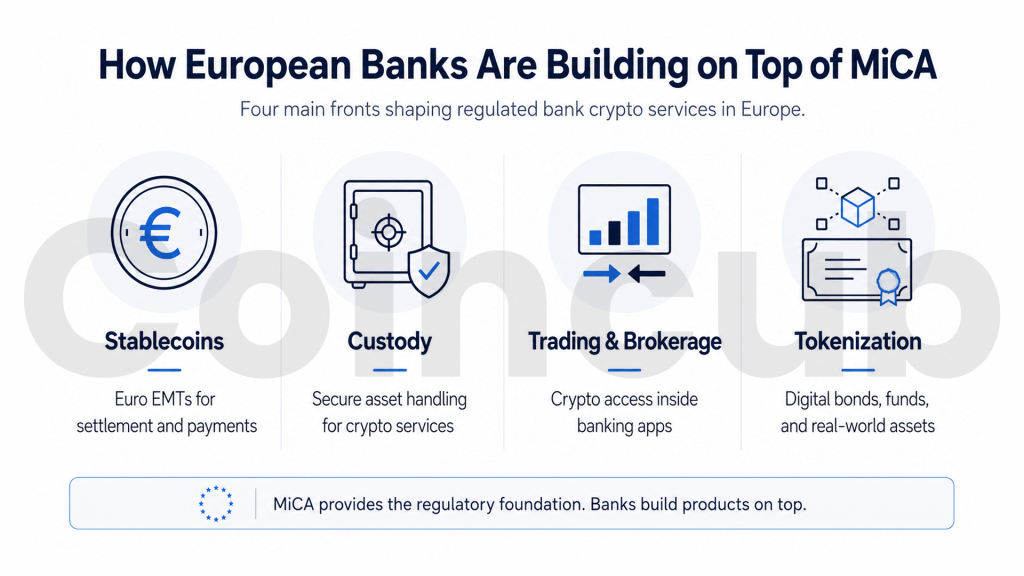
European banks are not entering crypto through a single door. Their activity clusters around four areas, each tied to a specific part of the MiCA framework or its neighboring rules.
The First Front: Stablecoins
The first front is stablecoins. Under MiCA, a euro-pegged stablecoin counts as an e-money token, and only credit institutions or licensed e-money institutions may issue one. That rule effectively hands banks a privileged position. They already hold the licenses, the reserves and the supervisory relationships that EMT issuance demands, which is why the largest stablecoin projects in Europe are now bank-led rather than startup-led.
The Second Front: Custody
The second front is custody. Holding crypto safely on behalf of clients is a regulated service under MiCA, and several banks have moved quickly to claim it. Commerzbank secured a digital-asset custody license from Germany’s regulator BaFin, becoming the first major German bank to do so. Deutsche Bank built its custody capability through partnerships with Bitpanda and Taurus, while Spain’s BBVA tapped Ripple to power custody behind the scenes. Custody is the quiet foundation, because almost every other crypto service depends on it.
The Third Front: Trading & Brokerage
The third front is trading and brokerage, which falls under the broader crypto-asset service provider regime. BBVA opened Bitcoin and Ethereum trading directly inside its Spanish mobile banking app for retail customers, and a wave of German banks and savings institutions have begun offering similar access. For most everyday users, this is the front they will notice first, since it puts crypto next to their current account.
The Fourth Front: Tokenization
The fourth front is tokenization, where the lines blur slightly. Tokenizing crypto-assets sits inside MiCA, but tokenizing bonds, funds or other securities falls under separate rules, mainly the EU’s DLT Pilot Regime and existing securities law, because those instruments are not crypto-assets in MiCA’s sense. Banks such as Societe Generale have issued digital bonds as security tokens, and the wider market for tokenized real-world assets reached around 24 billion dollars in 2025. Some projections put that figure in the trillions by 2030, and banks want a regulated foothold before the market gets there.
MiCA does not govern every part of this activity, but it is the regulatory clarity that made banks comfortable building digital-asset infrastructure at all.
Taken together, these four fronts split neatly between institutional and retail audiences. Stablecoins, custody and tokenization mostly serve corporate treasurers, asset managers and other banks, while in-app trading reaches everyday savers. That spread is deliberate, because it lets a bank reuse the same compliance foundation across very different customers and revenue lines.
| Service area | Governing regime | Core requirement | Example banks |
| Stablecoins (EMTs) | MiCA, Title IV | Credit or e-money license, full 1:1 reserves, published whitepaper | ING, UniCredit, KBC, CaixaBank, SocGen-FORGE |
| Custody | MiCA, CASP regime | Authorization to safeguard client crypto-assets | Commerzbank, Deutsche Bank, BBVA |
| Trading and brokerage | MiCA, CASP regime | CASP authorization with conduct and disclosure rules | BBVA, German savings banks |
| Tokenization of securities | DLT Pilot Regime, MiFID | Securities rules, not MiCA, for financial instruments | Societe Generale |
The Euro Stablecoin Race
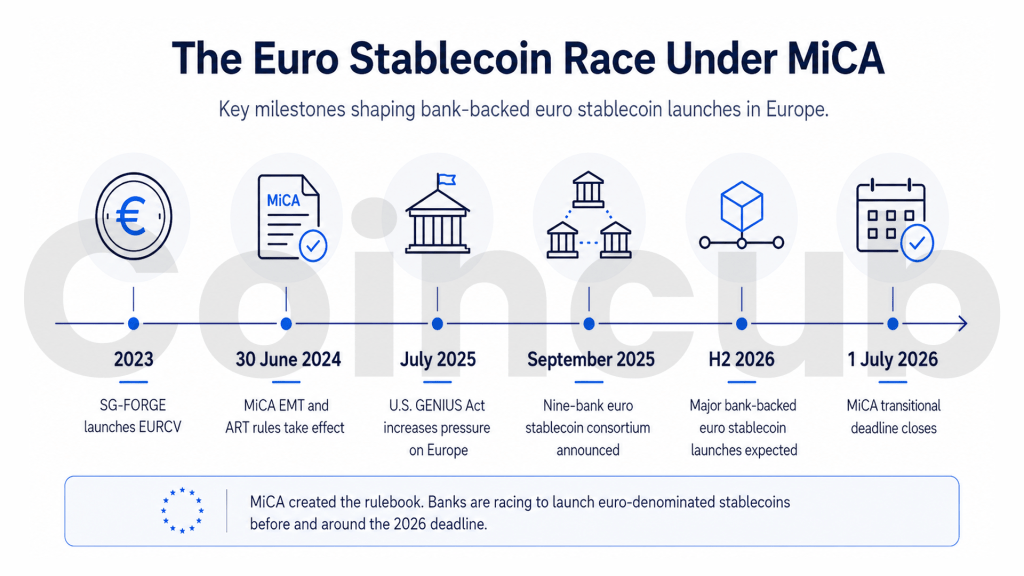
The clearest sign of how seriously banks take MiCA is the race to launch a euro stablecoin. In September 2025, nine major European banks, including ING, UniCredit, KBC, Danske Bank, DekaBank, SEB, CaixaBank, Banca Sella and Raiffeisen Bank International, announced a joint venture to issue a MiCA-compliant euro stablecoin. The group set up a new company in the Netherlands and aims to be supervised by the Dutch central bank as an e-money institution, with first issuance expected in the second half of 2026. Individual member banks will then layer their own services on top, such as wallets and custody.
A second consortium, named Qivalis and founded with backing from Deutsche Bank, brings together twelve banks including BBVA, BNP Paribas and DZ Bank. It partnered with Fireblocks for tokenization, wallet and custody infrastructure and is targeting the same second-half-2026 window for round-the-clock onchain settlement. Société Générale’s SG-FORGE got there earliest, launching its euro stablecoin EURCV back in 2023 and later adding a dollar-denominated token.
What will these tokens actually do? The early use cases are practical rather than speculative. Banks see euro stablecoins as settlement rails for cross-border business payments, instant interbank transfers, and onchain treasury operations that run around the clock instead of stopping at the close of business. Because the issuer is a regulated bank holding full reserves, corporate clients get the speed of a blockchain with the counterparty comfort of a supervised institution, which is the combination earlier private stablecoins could not offer.
Dollar Backed Stablecoins Are Still Leading the Way
The strategic motive is hard to miss. Dollar-backed stablecoins account for close to 99 percent of the global supply, and European institutions want a credible euro alternative for payments and settlement. MiCA tilts the field in the euro’s favor here, because it caps how widely a non-euro stablecoin can be used as a means of payment inside the EU, at one million transactions or 200 million euros in notional value per day. That ceiling gives a compliant euro token room to grow that dollar coins simply do not have. The urgency also runs across the Atlantic, since the United States passed its own federal stablecoin law, the GENIUS Act, in July 2025, giving dollar issuers a clear rulebook of their own and raising the pressure on Europe to field euro alternatives quickly. The diagram below shows the path a bank follows to bring a MiCA-compliant euro stablecoin to market.
What Still Stands in the Way
The build-out is real, but it is not frictionless. The first hurdle is cost. MiCA authorization is demanding, and EMT issuers must hold full one-to-one reserves in safe, liquid assets that earn little or nothing. That ties up capital and squeezes the economics of running a stablecoin, especially against dollar tokens whose issuers earn yield on US Treasury reserves.
Supervision is also less uniform than the single-rulebook promise suggests. Member states applied the transitional period differently, with Germany, Austria and Ireland using twelve-month grandfathering that closed at the end of 2025 while France, Malta and Luxembourg ran the full eighteen months to July 2026. National regulators still vary in speed and interpretation, so a passport is only as smooth as the cooperation behind it.
Then there is the market itself. Dollar-backed stablecoins hold close to a 99 percent share, network effects are strong, and a new euro token has to earn liquidity and acceptance from scratch. Interoperability between bank platforms, blockchains and existing payment rails adds another layer of engineering work. None of these obstacles is fatal, but together they explain why most flagship launches are scheduled rather than already live.
Final Thoughts: How are European Banks Navigating MiCA?
The next eighteen months will decide how much of this momentum turns into working products. The hard deadline is 1 July 2026, when the transitional period ends and any unlicensed crypto service must stop or convert. Expect a cluster of authorizations and launches to land in the months just before and after that date, including the bank-backed euro stablecoins now in preparation.
Consolidation is the likely pattern. Rather than dozens of competing bank tokens, the market may settle around a small number of shared, consortium-issued stablecoins that many institutions plug into, much like existing card and payment networks. The European Central Bank’s parallel work on a digital euro will shape the backdrop, and banks are positioning so that their private stablecoins complement rather than collide with any future public money. The institutions building now are doing so partly to set the standards before that landscape hardens.
MiCA turned crypto from a legal grey zone into regulated territory, and Europe’s banks have responded by building on top of it across four fronts: stablecoins, custody, trading and tokenization. The euro stablecoin race is the headline, but the quieter custody and trading services may reach more customers sooner.
The essentials to remember:
- MiCA gives banks a single, passportable rulebook across all 27 EU states, and only credit or e-money institutions can issue euro stablecoins (EMTs).
- Major launches, including two large bank consortia, target the second half of 2026, just as the 1 July 2026 enforcement deadline takes hold.
- Cost, reserve rules, uneven supervision and entrenched dollar stablecoins remain the main brakes on adoption.
For European banks, MiCA stopped being a question of whether to enter crypto and became a question of how fast they can build.
Frequently Asked Questions (FAQs)
What is MiCA?
MiCA is the European Union’s crypto-assets regulation. It creates one rulebook for crypto services, stablecoins, disclosures, reserves, and authorization across EU member states.
Why do European banks care about MiCA?
European banks care about MiCA because it gives crypto a clear legal framework, reduces regulatory uncertainty, and allows licensed firms to serve clients across the EU.
How are banks using MiCA?
Banks are using MiCA to build regulated crypto services, including euro stablecoins, digital-asset custody, crypto trading, brokerage, and infrastructure for tokenized assets.
When is the MiCA transitional deadline?
The MiCA transitional period ends on 1 July 2026. After that date, firms offering crypto services in the EU need proper MiCA authorization.
Why are euro stablecoins important for European banks?
Euro stablecoins give banks a regulated digital payment tool for settlement, treasury operations, and cross-border transfers while reducing reliance on dollar-backed stablecoins.