

 Buy a Licensed Company
  Explore VASP Data
  Talk to an Expert

 Atis Shala
Atis is a senior analyst and community lead with four years of experience in crypto. He has a bachelor from the Rochester Institute of Technology.
Atis Shala
Atis is a senior analyst and community lead with four years of experience in crypto. He has a bachelor from the Rochester Institute of Technology.
Secondary Licensing: How to Bridge the Gap Between MiCA and Global Markets

- While MiCA provides a powerful harmonized regulatory baseline and passporting capabilities within the EU, its authority and geographic reach completely end at the EU border.
- Expanding into non-EU jurisdictions, such as the UK, US, Singapore, or Dubai, requires secondary licensing specifically tailored to local laws and supervisory expectations.
- True market access often demands activity-based approvals (e.g., payment institution licenses) and product-based permissions (e.g., specific stablecoin regulations) alongside standard crypto licensing.
- Regulatory gaps require active bridging: Because global rules remain heavily fragmented, firms must actively manage strict differences in product classification, marketing restrictions, and operational substance requirements across borders.
- MiCA compliance serves as an excellent foundation for a reusable global framework, provided that operational policies are strictly localized rather than simply copy-pasted into new markets.
- Mature crypto businesses deploy MiCA passporting for pan-European scaling while operating secondary licensing in parallel to lawfully penetrate non-EU markets and launch adjacent financial products.
- Treating MiCA as a global seal of approval, launching marketing campaigns before local licensing is secured, or misusing reverse solicitation are high-risk errors that invite swift regulatory enforcement.
MiCA Solves One Problem Among Many
The Markets in Crypto-Assets Regulation (MiCA) stands as one of the most significant regulatory milestones for crypto firms operating in the European Union. For any business pursuing serious growth in digital assets, MiCA licensing creates a structured pathway to EU market access, supervisory credibility, and harmonized rules across member states. Yet treating MiCA authorization as a global solution can mislead even experienced operators.
A CASP authorized under MiCA gains a stronger regulatory foundation, access to a harmonized European framework, and improved standing with banking partners, institutional clients, and counterparties. However, global expansion still demands local regulatory analysis. Each market outside the EU operates under its own rules, definitions, and supervisory expectations.
The most useful way to frame this challenge involves two layers. MiCA functions as the regulatory base layer, while secondary licensing operates as the expansion layer.

Understanding the distinction between EU passporting and broader global market access shapes how firms allocate resources, design their compliance frameworks, and time their entry into different jurisdictions.
What MiCA Actually Covers and Why It Matters
MiCA as an EU Harmonization Tool
Before MiCA, crypto firms faced fragmented national rules across EU member states. Each country developed its own register, exemption regime, and supervisory approach. MiCA replaces that patchwork with a uniform regulatory framework covering crypto-assets that fall outside existing financial-services legislation. The regulation addresses transparency, disclosure, authorization, supervision, market integrity, and consumer protection in a consistent manner across the bloc.
CASPs and Crypto-Asset Services
Under MiCA, a Crypto-Asset Service Provider (CASP) means a legal person or undertaking providing one or more crypto-asset services to clients on a professional basis. The services include exchange between crypto and fiat, exchange between different crypto-assets, custody and administration, operation of a trading platform, execution of orders, placing of crypto-assets, reception and transmission of orders, advice, and portfolio management. CASP authorization triggers ongoing requirements covering governance, capital, conduct, complaints handling, market abuse, and prudential supervision.
Passporting Inside the EU
Once authorized in a home member state, a CASP can notify its home regulator to provide services cross-border in other EU member states. Guidance from authorities such as the Dutch AFM explains that a CASP providing cross-border services needs a European passport notification under Article 65 of MiCAR. This passporting mechanism allows a single authorization to support pan-EU operations, subject to the firm respecting host-state rules around conduct, marketing, and consumer protection.
Where MiCA Reaches Its Limits Globally
MiCA’s geographic scope ends at the EU border. A CASP serving clients in the United Kingdom, Singapore, Hong Kong, Dubai, the United States, or other non-EU jurisdictions must satisfy each local regime separately. ESMA’s supervisory briefing highlights risk-based scrutiny, governance, substance, outsourcing, AML/CFT, ICT, and business-plan assessment as core themes, though those expectations apply within EU supervision. Global expansion requires the same rigour applied through the lens of each target jurisdiction.
What Is Secondary Licensing?
Secondary licensing describes the process of obtaining additional regulatory permissions after, alongside, or because of a firm’s primary license. For a MiCA-authorized crypto firm, this often means securing separate authorization in non-EU markets, obtaining adjacent financial licenses, or adapting the firm’s operating model to satisfy local requirements.
Secondary licensing takes three primary forms:
- Geographic Secondary Licensing: This category covers licensing required to enter a new country or region outside the EU. A MiCA-authorized exchange seeking to onboard clients in Singapore, for example, would assess whether a Major Payment Institution licence or a Digital Token Service Provider regime applies. Each jurisdiction has its own authorization pathway, capital requirements, and timeline.
- Activity-Based Secondary Licensing: Crypto products often touch adjacent regulated sectors. Payments, e-money, securities, derivatives, investment advice, lending, and custody can each trigger separate regulatory regimes within or beyond the EU. A firm offering fiat on-ramps may require a payment institution licence. A firm tokenizing securities may need investment-services authorization. Activity-based secondary licensing addresses these overlaps.
- Product-Based Secondary Licensing: Specific products attract specific regulatory treatment. Stablecoins, tokenized securities, staking services, lending products, yield offerings, and retail-facing derivatives often need additional approvals or face express restrictions. A token classified as an e-money token under MiCA may receive a different classification elsewhere, with consequences for authorization, disclosure, and marketing.
Secondary licensing rarely involves a literal second licence. It can take the form of a registration, regulatory notification, local exemption, no-objection process, branch approval, entity setup, or partnership structure. The objective involves matching market access, product scope, client base, and operational substance with the correct regulatory permissions. The aim points toward fit-for-purpose authorization rather than licence collecting for its own sake.
The Gap Between MiCA and Global Markets
MiCA standardizes the EU approach, while global crypto regulation remains jurisdiction-specific. The same business model can receive different treatment across markets, which produces gaps that secondary licensing must close.
Jurisdictional Gap
MiCA applies within the EU. A firm targeting customers in other regions must work through the rules of each local market. A passport under MiCA carries no force in jurisdictions such as the UK, Singapore, Hong Kong, Dubai, or the US.
Product-Classification Gap
A crypto-asset under MiCA may receive treatment as a security, commodity, payment token, stored-value product, e-money product, or virtual asset elsewhere. The same token can sit inside different regulatory perimeters depending on the jurisdiction, the issuer, and the rights attached.
Service-Scope Gap
Exchange, custody, brokerage, staking, token issuance, advice, payments, transfer services, and lending can each trigger different permissions. A service that falls inside the MiCA perimeter may sit outside the equivalent perimeter in another jurisdiction, or vice versa.
Marketing Gap
A firm may hold authorization in one place while facing restrictions on advertising, onboarding, or soliciting clients in another market. Marketing rules cover websites, social media, influencer arrangements, sponsored content, and direct outreach. Many regulators treat marketing as a regulated activity in itself.
Operational-Substance Gap
Regulators often require local directors, compliance officers, offices, outsourced-service controls, capital, safeguarding arrangements, internal audit, and local reporting. Operating from one jurisdiction while serving another can fall short of these substance expectations.
Compliance-Standard Gap
AML/CFT, sanctions, the FATF travel rule, cybersecurity, market abuse, client-asset protection, and complaints handling can diverge across regimes. Differences in reporting formats, thresholds, and risk classifications add operational complexity.
ESMA’s supervisory briefing reinforces these themes within the EU through expectations around governance, substance, outsourcing, AML/CFT, ICT, and business-plan assessment. The same disciplines must apply across each market a firm enters, calibrated to local rules.
The Secondary Licensing Process: Step-by-Step
A structured secondary licensing process protects firms from costly missteps. The following nine steps describe a sequence used by mature crypto businesses managing multi-market authorization.
Step 1: Define the Target Market and Commercial Purpose
Every licensing project should start with business strategy. The firm should articulate why a market matters: retail users, institutional clients, liquidity, fiat rails, token issuance, custody mandates, or partnership opportunities. Commercial clarity drives proportionate regulatory effort.
Step 2: Map the Product and Service Perimeter
List every product and service in scope: spot trading, custody, staking, transfer, brokerage, fiat on/off-ramp, stablecoin usage, lending, yield, wallet services, advisory, token listing, and market making. The perimeter map becomes the reference document for every subsequent regulatory analysis.
Step 3: Classify the Regulatory Exposure
For each target market, the firm must ask how local law treats each product. Categories often include crypto-asset, virtual asset, security, derivative, e-money, payment service, commodity interest, stored-value product, and investment product. Classification drives licensing pathway, capital, conduct, and disclosure obligations.
Step 4: Compare the MiCA Baseline with Local Rules
MiCA documentation provides a strong starting point because it already covers governance, capital, conduct, AML/CFT, and ICT expectations. The firm then identifies elements missing or different in the target jurisdiction. VARA, for instance, states that firms carrying on virtual asset activities in or from Dubai, excluding DIFC, have a legal obligation to be licensed before commencing operations. MiCA authorization improves credibility, although it stands separate from VARA authorization for Dubai-facing activities.
Step 5: Choose the Licensing Route
Possible routes include direct license application, local subsidiary, branch, acquisition of a licensed entity, partnership with a regulated firm, white-label arrangement, reverse-solicitation-only approach, or deferred launch. Each route carries different cost, timeline, and risk profiles. Some markets favor direct authorization, while others lend themselves to partnership structures during early entry.
Step 6: Build the Application Pack
Common materials include the business plan, governance chart, ownership structure, policies, AML/CFT framework, risk assessment, safeguarding model, outsourcing register, cybersecurity framework, financial projections, capital plan, key-person fit-and-proper documents, and wind-down plan. Regulators expect coherent documents that align with the firm’s actual operations.
Step 7: Localize Operations
Firms often underestimate the operational work attached to local rules. Requirements can affect directors, MLRO appointment, compliance officer responsibilities, complaints handling, data hosting, client disclosures, marketing approvals, regulatory reporting, and even branding. Localization turns a paper licence into a working business.
Step 8: Launch Under Controls
A controlled launch beats an assumption-driven launch every time. The firm should maintain a launch checklist covering approved services, approved client types, approved tokens, approved marketing channels, approved countries, and approved affiliates. Anything outside the list requires explicit review before going live.
Step 9: Monitor Regulatory Change
Secondary licensing remains a continuous discipline. Markets update rules, expand product scope, revise capital requirements, and adjust supervisory expectations. The UK regime expected for 25 October 2027, evolving SFC frameworks in Hong Kong, and MAS updates to digital token guidance all illustrate the pace of change. A standing monitoring process keeps the licensing portfolio current.
MiCA Passporting vs. Secondary Licensing
The relationship between MiCA passporting and secondary licensing often confuses operators. The following table sets out the practical difference.
| Dimension | MiCA Passporting | Secondary Licensing |
| Geographic reach | EU member states | Non-EU markets and adjacent regulated activities |
| Legal basis | MiCA authorization plus cross-border notification | Local law, local regulator, or local exemption |
| Main purpose | EU-wide service provision | Market-specific authorization |
| Best suited for | EU expansion from one authorized home state | UK, Singapore, Hong Kong, Dubai, US, or other target markets |
| Key question | “Can we passport this service inside the EU?” | “What does this market require before we serve local clients?” |
| Compliance focus | CASP authorization, governance, conduct, disclosures, AML/CFT, passport notification | Local entity, local substance, marketing rules, product classification, client restrictions, reporting |
| Main risk | Assuming passporting covers all EU activity without correct notification | Assuming MiCA credibility equals legal permission abroad |
The two concepts work together. MiCA passporting helps firms scale across Europe using a single authorization plus the relevant Article 65 notification. Secondary licensing translates that European foundation into lawful global market access through local regulatory engagement.
A mature crypto group will often deploy both in parallel. MiCA passporting handles EU growth, while secondary licensing handles new markets, new products, and adjacent regulated activities. Treating them as parts of one operating model keeps strategy coherent. Treating them as substitutes creates legal and commercial risk on both sides.
Key Global Market Pathways After MiCA
This section offers a high-level jurisdictional overview rather than legal advice. Firms should obtain local advice for each market.
United Kingdom
The UK is developing a comprehensive cryptoasset regulatory regime. The FCA has set out that the new regime is expected to come into force on 25 October 2027 and that firms will need FCA authorization once the regime is in place. In the interim, the UK financial promotions regime, anti-money-laundering registration, and existing financial-services rules apply. MiCA firms should monitor the UK roadmap early rather than wait for equivalence determinations.
Singapore
Singapore regulates payment service providers under the Payment Services Act, with MAS issuing licensing guidance for digital token service providers. Firms need to assess whether their activity falls within the digital payment token service category, broader payment services, or the wider Digital Token Service Provider perimeter. Singapore tends to favour applicants with strong governance, capital, and operational substance, and MAS pays close attention to risk management for retail-facing services.
Hong Kong
The SFC publishes lists of licensed virtual asset trading platforms and makes clear that applicants remain unlicensed until formally approved. Hong Kong’s approach distinguishes between licensed platforms, applicants under assessment, and unregulated operators. Platform operators must align their public communications with their actual status to avoid misleading clients about regulatory standing.
Dubai and the UAE
VARA requires licensing for virtual asset activities in or from Dubai, excluding DIFC. The regulator lists activities including advisory, broker-dealer, custody, exchange, lending and borrowing, management and investment, transfer and settlement, and issuance. Dubai can be attractive as a regional hub, although activity-by-activity authorization matters. ADGM and DIFC operate their own regimes under FSRA and DFSA respectively, each with their own crypto-related frameworks.
United States
The US remains highly fragmented. The New York Department of Financial Services states that entities conducting virtual currency business activity in New York can apply for a BitLicense or a New York Banking Law charter. FinCEN guidance treats certain administrators or exchangers of convertible virtual currency as money transmitters under federal rules. Other states maintain their own money transmitter regimes, and federal authorities such as the SEC and CFTC retain jurisdiction over securities, commodities, and derivatives respectively.
US expansion should be treated as a layered federal-plus-state analysis. A single US strategy rarely fits, and many international firms restrict US activity until they have built a clear federal and state authorization plan.
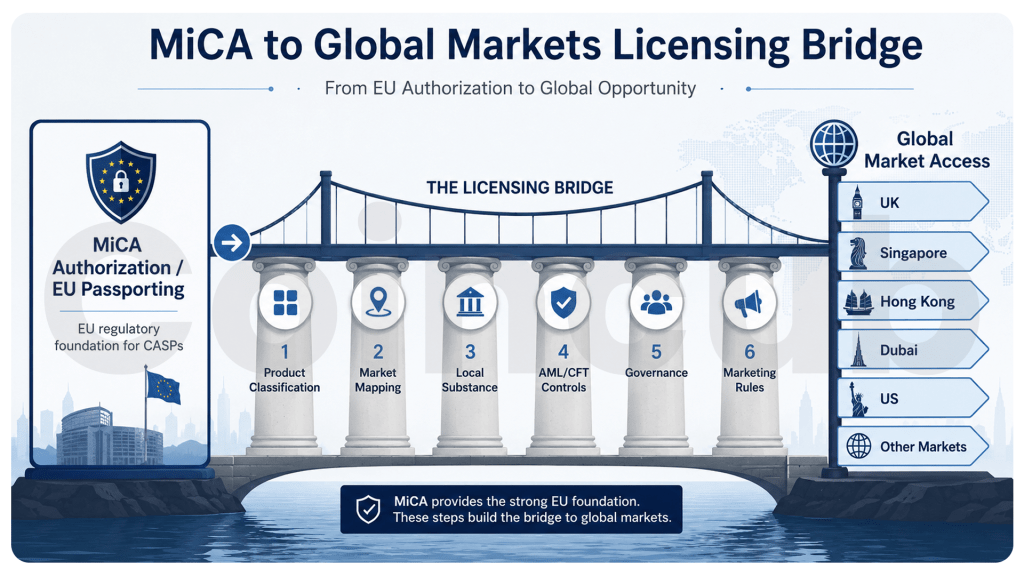
Building a Bridge: The Global Licensing Operating Model
A scalable licensing strategy follows the principle of “build once, localize many times.” MiCA compliance can serve as the foundation for a reusable global compliance framework, provided firms invest in the right operating model.
Global Regulatory Inventory
Maintain a live map of products, services, client types, countries, licences held, restrictions in force, and regulator touchpoints. The inventory becomes the single source of truth for commercial, compliance, and legal teams. Updating it should remain a recurring obligation rather than an ad-hoc project.
Modular Policy Framework
Build core global policies, then add country annexes. Typical examples include AML/CFT, sanctions, custody, market abuse, conflicts of interest, complaints, outsourcing, cybersecurity, and disclosure policies. A modular structure lets the firm adapt to local rules quickly while preserving global consistency.
Licensing Decision Committee
Form a cross-functional group covering legal, compliance, product, finance, operations, risk, treasury, and commercial leadership. This committee approves new market entries, new product launches, and material policy changes. Documented decisions form part of the audit trail regulators expect.
Market-Entry Gates
Every market launch should pass formal gates covering licensing, marketing, token listing, client eligibility, and local operational requirements. Anything outside an approved scope must wait for committee review. Gates protect the firm from commercial pressure to launch before authorizations are in place.
Evidence Discipline
Regulators expect documentation. Board minutes, risk assessments, outsourcing reviews, policy approvals, training logs, incident records, and compliance testing evidence collectively demonstrate that the firm operates as it claims.
Local Accountability
Many regulators expect substance: qualified local personnel, clear reporting lines, and genuine decision-making authority in the local entity. A licence held by a paper company often attracts close scrutiny.
MiCA gives firms a strong governance foundation. The bridge to global markets relies on repeatable licensing operations that turn that foundation into market-by-market execution.
Common Mistakes and Strategic Risks
Several recurring mistakes undermine even well-funded licensing programs.
Mistake 1: Treating MiCA as a Global Seal of Approval
A MiCA authorization improves trust and counterparty standing, although local law still governs market access elsewhere. Firms relying on MiCA outside the European Union expose themselves to enforcement risk.
Mistake 2: Launching Marketing Before Licensing Is Confirmed
Marketing can trigger regulatory exposure long before formal client onboarding begins. Public communications, paid promotions, and influencer arrangements often fall within the local regulatory perimeter on their own.
Mistake 3: Misusing Reverse Solicitation
Reverse solicitation tends to remain narrow under most regimes. Using it as a growth strategy disguised as passive demand invites supervisory and enforcement attention. Genuine reverse solicitation involves client-initiated contact with documented evidence.
Mistake 4: Copy-Pasting MiCA Policies into Other Jurisdictions
Policies require localization. Token classification, client disclosures, safeguarding arrangements, complaint handling, and reporting differ across regimes. Lift-and-shift approaches fail under regulatory examination.
Mistake 5: Ignoring Adjacent Licences
Payments, e-money, securities, derivatives, and investment services can each trigger separate authorization regimes. A crypto licence alone often falls short of covering the full activity perimeter.
Mistake 6: Underestimating Time and Cost
Licensing projects can involve entity setup, hiring, audits, governance redesign, regulatory correspondence, capital planning, and remediation. The best firms treat licensing as infrastructure rather than a final-stage legal hurdle.
Conclusion: From Local Authorization to Global Readiness
MiCA marks a major step toward regulatory clarity for crypto firms operating in the EU, although the licensing journey continues beyond it. For firms with international ambitions, the real challenge involves converting MiCA readiness into global readiness. Secondary licensing remains the process that makes this possible.
A firm that understands its services, client base, target markets, governance model, and compliance obligations can use MiCA as a foundation. Each new market still requires careful classification, local regulatory analysis, and operational adaptation. The work involves time, resources, and disciplined execution, while the payoff includes durable market access and sustainable growth.
The firms that win globally will be the ones that build licensing strategy into the architecture of their business, treating each new authorization as a managed expansion of a coherent compliance framework rather than an isolated project. MiCA opens the door to Europe. Secondary licensing builds the bridge to everywhere else.
Frequently Asked Questions (FAQs)
How much does it cost to get a crypto license in the US?
The US lacks a unified crypto license, making costs highly variable. Businesses must secure federal FinCEN registration and state-by-state licenses, like the New York BitLicense. Total expenses typically exceed hundreds of thousands of dollars due to application and legal fees.
Do 68% of American millionaires own crypto?
While cryptocurrency adoption among wealthy investors is growing, exact figures fluctuate. Various wealth surveys indicate that a significant majority of high-net-worth individuals own or plan to purchase digital assets, viewing them as key instruments for modern portfolio diversification.
How much does a crypto license cost?
Crypto licensing costs vary dramatically depending on the jurisdiction and specific business model. While initial regulatory application fees may seem manageable, the true overall expenses, including mandatory audits, local legal counsel, and operational structuring, frequently surpass hundreds of thousands of dollars.