


 Buy a Licensed Company
  Explore VASP Data
  Talk to an Expert

 Atis Shala
Atis is a senior analyst and community lead with four years of experience in crypto. He has a bachelor from the Rochester Institute of Technology.
Atis Shala
Atis is a senior analyst and community lead with four years of experience in crypto. He has a bachelor from the Rochester Institute of Technology.
Is Vanuatu Still the King of Offshore Crypto Hubs in 2026?

- Vanuatu has completely shifted its positioning. It is no longer a quiet, lightly supervised jurisdiction, but a formal, regulated hub operating under a strict Virtual Asset Service Provider (VASP) framework.
- The 2025 VASP Act structures crypto activities into five specific categories (covering exchanges, transfers, custody, token offerings, and bank-related services) requiring firms to prove real operational substance and secure local personnel.
- By aligning with FATF, IOSCO, and EU standards, Vanuatu has intentionally raised its barriers to entry. Applicants must now meet rigorous AML, Travel Rule, and cybersecurity expectations to weed out bad actors.
- While compliance demands are high, the setup timeline remains a major advantage. A well-prepared VASP application in Vanuatu typically takes two to four months, significantly faster than the lengthy EU MiCA process.
- Vanuatu is now best suited for smaller exchanges, token projects, and custody-adjacent firms that want legitimate offshore flexibility without the premium costs associated with Dubai (VARA) or the Cayman Islands.
- While the regulatory framework is strong on paper, Vanuatu’s ultimate test will be proving its supervisory capacity over time and ensuring its licensees can reliably secure international banking and payment access.
Short Summary On Vanuatu’s Status
Vanuatu is still one of the most interesting offshore crypto jurisdictions in 2026. But calling it the king depends on what kind of crypto business you run.
A few years ago, Vanuatu had a reputation as a low-friction offshore base for crypto firms. That picture has changed. In 2026, Vanuatu operates a formal Virtual Asset Service Provider (VASP) framework. The rules are clearer. The compliance load is heavier. The market is more competitive.
The country now sits in a different category. It works as a regulated offshore option rather than a quiet, lightly supervised one. That shift has improved its credibility. It has also raised the cost and effort needed to launch and run a licensed crypto business there.

The real competition in 2026 includes Seychelles, the Cayman Islands, Dubai through VARA, and EU jurisdictions operating under MiCA. Each one targets a different type of crypto firm. Each one carries different trade-offs.
Why Offshore Crypto Hubs Still Matter in 2026
Offshore crypto hubs have changed, but they still matter. Crypto firms still need places that offer legal clarity, tax efficiency, and cross-border flexibility. The difference in 2026 is that serious offshore hubs no longer market themselves as unregulated.
The trend across credible jurisdictions runs in one direction. AML and counter-terrorism financing rules now apply almost everywhere. Travel Rule expectations are common. Cybersecurity standards are written into licensing frameworks. Fit-and-proper tests cover directors, senior managers, and key technology staff.
Several forces drive this shift:
- The EU’s MiCA regulation has set a high baseline for crypto rules in Europe. It aligns with international standards set by global organizations including FATF, IOSCO, and the OECD.
- Dubai’s VARA has built a brand around regulated crypto activity in the UAE.
- The Cayman Islands has moved from registration to licensing for custody and trading platforms.
- Seychelles, the BVI, and Vanuatu have all introduced or upgraded dedicated VASP frameworks.
That changes what “king” should mean. In 2026, the strongest offshore crypto hub combines:
- Clear licensing classes for different crypto activities
- Credibility with banks, partners, and investors
- Reasonable cost and timeline to license
- Realistic banking and payment access
- A solid international reputation
- Long-term stability in supervision
Cheap setup costs no longer carry a jurisdiction on their own. Banks, payment processors, exchanges, and institutional partners now ask hard questions before doing business with a licensee. A jurisdiction that cannot stand up to those questions will struggle, no matter how friendly it looks on paper.
Why Vanuatu Became Attractive in the First Place
Vanuatu built its reputation as a flexible offshore financial centre long before crypto existed. It had a working international financial services sector, low taxes, and a company structure that suited international owners.
When crypto businesses started looking for friendly homes, Vanuatu fit the brief. Several features made it appealing:
- An offshore business environment with low tax on foreign income
- A working financial services sector and regulator
- Faster company setup than many onshore options
- A government open to fintech and digital asset activity
- A reputation as more accessible than the EU, US, or UK
Founders treated Vanuatu as a way to launch quickly and avoid the heaviest onshore regimes. For a time, that worked.
Is Easy Licensing Still Enough in Vanuatu?
The 2026 question looks different. Crypto firms now need durable reputations, working bank accounts, transaction-monitoring systems, and confidence from regulators in larger markets. A cheap setup with light supervision will not attract serious partners.
Vanuatu’s offering has shifted in response. The country still markets offshore flexibility. But its value sits more in being a regulated offshore platform with clear rules, rather than a place to fly under the radar. That shift matters when comparing it to the rest of the market in 2026.
What Changed: Vanuatu’s 2026 VASP Framework
Vanuatu’s biggest change is its dedicated VASP regime. The Virtual Asset Service Providers Act No. 3 of 2025 was drafted over almost five years in collaboration with the VFSC and two government committees, the Distributed Ledger Technology Task Force and the Virtual Assets Task Force. The Act gave Vanuatu a structured set of rules for crypto activity for the first time.
What a VASP Licence Covers
The VFSC’s January 2026 Revised Application Requirements apply to all applicants for any VASP licence class, and to licensees submitting material changes such as change of control, business model change, or key persons. Applicants must identify the correct licence class for each activity: exchange, transfer, custody and safekeeping, ITO-related activities, and any bank-related permissions.
In practice, the five classes break down as follows:
- D licence covers exchange activity
- D.1 covers transfer services
- D.2 covers custody and safekeeping
- D.3 covers ITO-related financial services
- D.4 covers bank-related crypto activity
What Applicants Need to Prove to Get Licensed in Vanuatu
The Guidelines describe the information, documents, and demonstrations VFSC expects from an applicant seeking a VASP licence, including the licence class, business model, governance, systems, and AML/CFT readiness. Applicants must show real operational substance. The framework requires a physical office in Vanuatu, the appointment of key personnel including a resident director and Chief Technology Officer, and a minimum unimpaired capital level certified by an external auditor.
Travel Rule and AML expectations
Vanuatu has aligned its rules with FATF Travel Rule requirements. VASPs that execute or facilitate virtual asset transfers must collect, verify, and transmit originator and beneficiary information. The rules also cover transfers involving self-hosted wallets, using risk-based measures.
The framework adds credibility. VFSC review typically takes two to four months with a well-prepared application, considerably faster than most EU jurisdictions where licensing often stretches beyond twelve months. Loretta Joseph, who led the drafting work, explained that the lengthy process screens for serious investors because Vanuatu lacks the resources to supervise a large number of licensees.
The trade-off is clear. Vanuatu is more credible than before, but the bar to enter has gone up.
Vanuatu vs Other Crypto Hubs: 2026 Comparison
This is where the comparison becomes useful. Each jurisdiction in 2026 targets a different type of crypto firm.
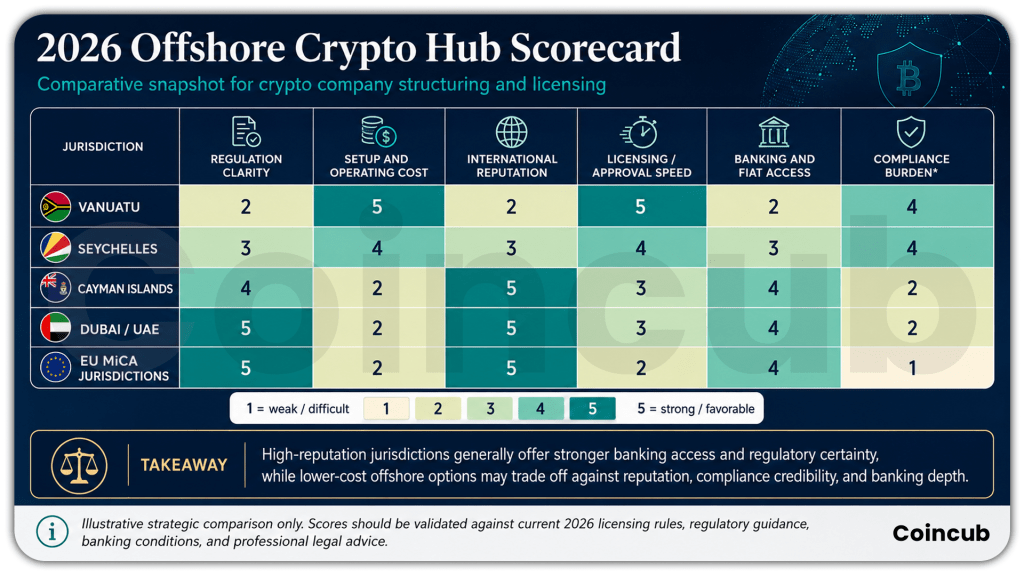
2026 Crypto Hub Comparison Table
| Jurisdiction | 2026 positioning | Best for | Key advantage | Main drawback |
| Vanuatu | Regulated offshore challenger | Smaller exchanges, transfer services, custody-adjacent firms, token projects | Newer dedicated VASP framework with offshore flexibility | Still building market reputation and supervisory capacity |
| Seychelles | Established offshore crypto option | Exchanges, brokers, wallet services, token and NFT offerings | Dedicated VASP Act and recognisable offshore brand | More scrutiny as offshore crypto rules tighten |
| Cayman Islands | Premium offshore financial centre | Custody, funds, institutional structures, trading platforms | Strong financial services reputation | Higher expectations and higher cost |
| Dubai / UAE | Global regulated crypto hub | Large exchanges, institutional platforms, regional expansion | VARA brand, market access, investor confidence | Operationally demanding and more expensive |
| EU MiCA jurisdictions | Regulated market-access play | Firms targeting EU users | Passporting-style EU regulatory clarity | Heavy compliance load and slower setup |
How the Comparison Plays Out
Cayman has moved up the credibility ladder. Under the amended VASP Act, effective 1 April 2025, entities providing virtual asset custody services or operating virtual asset trading platforms must obtain a license from the Cayman Islands Monetary Authority. All VASPs must appoint at least three directors, including one independent director who does not have a vested interest in the VASP. This gives Cayman a strong pitch for institutional crypto businesses.
Dubai runs a different play. VARA regulates the provision, use, and exchange of virtual assets in and from Dubai outside the DIFC. It positions the city as a dedicated virtual-assets regulator with global ambitions. That suits large exchanges and firms with serious regional plans.
Seychelles holds the established offshore crypto position. Its VASP Act framework covers licensing, promotion restrictions, and recordkeeping for licensed firms. Seychelles exited the FATF grey list in 2024, and OKX, Bybit, and eToro were among the first approvals under its framework.
EU MiCA jurisdictions remain the route for firms that want clear access to European users. The compliance load is heavy. The timeline can be long. But the regulatory clarity is real.
Vanuatu sits as a regulated offshore challenger. Its framework aligns with FATF, the Asia Pacific Group on Money Laundering, IOSCO, the OECD, and the EU. That makes it credible. The question is whether it has the supervisory track record and market recognition to match those benchmarks over time.
Where Does Vanuatu Have Advantages?
Vanuatu still competes. The way it competes has changed, but the case for it remains real for the right type of business.
Why Does Vanuatu Still Compete as an Offshore Crypto Hub
A few factors keep Vanuatu in the conversation in 2026:
- Regulatory clarity. The VFSC has published the VASP Act, application requirements, fit and proper guidelines, technology audit guidance, cybersecurity guidance, Travel Rule guidance, and ITO guidance. That gives applicants a structured roadmap.
- Offshore flexibility. Vanuatu retains a tax structure and corporate framework that suits international business models. Many crypto firms still value that.
- A middle ground. For some founders, the heavier costs of Cayman, Dubai, or EU MiCA jurisdictions sit out of reach. Vanuatu can offer real licensing without those higher cost bases.
- Faster timelines than Europe. VFSC review typically takes two to four months with a well-prepared application, considerably faster than most EU jurisdictions where licensing often stretches beyond twelve months.
- Early-mover positioning. Vanuatu is the first Pacific island nation with comprehensive VASP legislation. Firms entering now help shape how the ecosystem develops.
- Alignment with international standards. The VASP Act aligns with international standards set by global organizations including FATF, the Asia Pacific Group on Money Laundering, IOSCO, the OECD, and the EU.
For smaller exchanges, transfer services, custody-adjacent businesses, and token projects with a clear international audience, Vanuatu remains a serious option. It works best for firms ready to operate inside a regulated framework while keeping costs lower than the premium hubs.
What Risks Does Vanuatu Face in Regards to Licensing?
Several issues weigh on the jurisdiction.
- Reputation risk: A new framework takes time to earn global trust. Banks, payment partners, and large counterparties tend to favour jurisdictions with longer track records. Vanuatu has the rules in place. Building the reputation comes next.
- Banking and payments risk: Offshore crypto firms often face friction when opening bank accounts and onboarding with payment processors. A Vanuatu licence helps, but it does not remove the problem. Founders should plan banking strategy early.
- Compliance execution risk: The framework is demanding. Independent assurances of the VASP’s technological infrastructure must be disclosed, including matters such as smart contract defects, the underlying protocol’s ability to scale, interoperability, and code integrity and security. The Act provides regulatory clarity on local economic substance, hiring criteria for managers, expertise and operational status, financial soundness and accounting practices, reporting and filing obligations, handling of complaints, and penalties for regulatory violations. That is real work for any applicant.
- Supervisory capacity: Loretta Joseph noted that Vanuatu does not have the resources to supervise a large number of licensees, which is why the application process is designed to screen applicants carefully at the door. That keeps the pool small, but it also limits scale.
- Competition from better-known hubs: Large exchanges and institutional platforms often choose Dubai, Cayman, Singapore, or EU MiCA jurisdictions. Their compliance teams and investors recognise those names. Vanuatu has to keep proving it belongs on the shortlist.
- The framework looks strong on paper: The next few years will show whether Vanuatu can deliver consistent, predictable supervision in practice.
Which Crypto Businesses Fit Vanuatu Best?
Vanuatu does not suit every crypto firm. The fit depends on the business model.
Who should actually consider Vanuatu in 2026?
| Business model | Fit for Vanuatu | Why |
| Early-stage crypto exchange | Medium to high | Offshore flexibility helps, but the firm must meet VASP controls and capital rules |
| Custody provider | Medium | Possible, but trust, cybersecurity, and capital expectations are demanding |
| Token launch / ITO project | Medium | Vanuatu fits some international token structures, depending on offering rules |
| DeFi protocol team | Low to medium | Treatment depends on control, promotion, and the level of service provided |
| Institutional crypto platform | Low to medium | Cayman, Dubai, or EU structures often offer stronger institutional credibility |
| Global retail exchange | Medium | Needs strong compliance, banking access, and a clear market strategy |
The general rule looks like this. Vanuatu suits crypto firms that value offshore flexibility and want a regulated base, while staying ready to operate like a small financial institution. Founders who want to skip compliance work should look elsewhere. The Vanuatu framework expects governance, AML systems, technology audits, Travel Rule processes, and ongoing reporting.
For firms targeting international markets without a heavy EU focus, Vanuatu offers a sensible middle path. For firms targeting institutional clients, the EU, or large regulated markets, other hubs often work better.
When Another Jurisdiction May Be Better Than Vanuatu
Vanuatu does not win every comparison. A clear decision guide helps founders self-select.
When Vanuatu Is Not the Best Choice
Several scenarios point elsewhere:
- Choose Dubai/UAE when brand credibility, institutional confidence, and regional expansion across the Middle East matter most. VARA carries weight with investors and partners.
- Choose the Cayman Islands when the business focuses on funds, custody, institutional structures, or higher-end offshore finance. Cayman’s framework aligns with international regulatory expectations, particularly FATF, and reinforces its position as a well-regulated jurisdiction for digital asset innovation.
- Choose Seychelles when the business wants a more established offshore crypto-services route with recognisable brand value.
- Choose EU MiCA jurisdictions when access to the European market is the top priority. The compliance load runs higher, but the market access pays back.
- Choose Vanuatu when offshore positioning, faster setup, and a developing regulated ecosystem all line up with the business plan, and the firm can meet VFSC compliance standards.
Final Verdict: Is Vanuatu Still the King of Offshore Crypto Hubs in 2026?
Vanuatu is one of the most interesting regulated offshore crypto challengers in 2026, but it does not hold the crown across every category. It works as a credible option for the right type of business, while losing ground to Cayman, Dubai, and EU MiCA jurisdictions on reputation and institutional fit.
A few points hold up the verdict:
- The framework is stronger than before, with clearer VASP rules and published guidance.
- Setup remains faster than most EU options, even with higher compliance expectations.
- It does not automatically beat Cayman, Seychelles, Dubai, or MiCA jurisdictions on every measure.
- It suits serious crypto firms that want offshore flexibility without operating in a regulatory vacuum.
The honest takeaway for 2026 is simple. Vanuatu’s real strength sits in trying to become a credible offshore crypto hub with formal rules, rather than the cheapest one on the map.
Frequently Asked Questions (FAQs)
Is Vanuatu crypto-friendly in 2026?
Yes, but crypto-friendly now means regulated. The VFSC operates a formal VASP framework with clear application and supervision rules.
Does Vanuatu have a VASP licence?
Yes. The VFSC issues VASP licenses under the Virtual Asset Service Providers Act No. 3 of 2025, with five licence classes covering exchange, transfer, custody, ITO-related financial services, and bank-related activity.
Is Vanuatu better than Seychelles for crypto?
It depends on the business model. Seychelles has a longer offshore crypto track record. Vanuatu may suit firms that want a newer regulated offshore option with structured guidance.
Is Vanuatu good for crypto exchanges?
Possibly, for exchanges ready to meet AML/CFT, Travel Rule, cybersecurity, governance, and banking access requirements. The VASP framework supports exchange activity through the D class licence.
Is Vanuatu still the best offshore crypto hub?
Not universally. It is a strong contender for the right business model rather than a guaranteed winner across the board.