


 Buy a Licensed Company
  Explore VASP Data
  Talk to an Expert

 Atis Shala
Atis is a senior analyst and community lead with four years of experience in crypto. He has a bachelor from the Rochester Institute of Technology.
Atis Shala
Atis is a senior analyst and community lead with four years of experience in crypto. He has a bachelor from the Rochester Institute of Technology.
The MiCA Deadline: Is Your Crypto License Future-Proof?
- By July 1, 2026, all legacy national VASP registrations will expire, meaning any crypto business without a full MiCA authorization must immediately cease its EU operations.
- Securing a MiCA CASP authorization unlocks EU-wide passporting, allowing firms to legally scale and serve all 27 member states from a single regulatory base.
- A future-proof license demands a massive compliance upgrade, including mandatory Travel Rule integration, strict liability for retail asset custody, and DORA-aligned cybersecurity.
- Compliance now extends directly to the assets, requiring issuers and exchanges to ensure all listed tokens have public whitepapers correctly formatted to ESMA’s technical iXBRL standards.
- Because the licensing process takes up to twelve months and regulators are bracing for a massive application backlog, firms must begin their compliance audits today to avoid forced market exclusion.
The “Must-Know” Cliff Edge
July 1, 2026, is approaching fast, and it carries consequences unlike any deadline the European crypto industry has faced before. This date marks the absolute end of the transitional phase under the European Union’s Markets in Crypto-Assets (MiCA) regulation. Every crypto-asset service provider operating in the EU must hold full MiCA authorization by this point. There are no extensions, no second transitional windows, and no grace period beyond what has already been offered.
Understanding what “future-proof” actually means in this context is essential for any founder, operator, or compliance professional working in crypto today. A future-proof license is one that has moved decisively away from fragmented, country-by-country VASP registrations. Instead, it secures a single, unified EU-wide operational standard through a Crypto-Asset Service Provider (CASP) authorization granted under MiCA. This is the only license structure that will remain valid across all 27 EU member states when the clock runs out.
ESMA has been explicit: any entity providing crypto-asset services without a MiCA license after July 1 will be in breach of EU law and must immediately cease operations. The licensing process takes six to twelve months. Any firm that has not yet begun its application is out of runway. Over 1,200 virtual asset service providers are currently operating in the EU and must obtain CASP licenses by July 2026 to continue serving EU clients. That volume of pending applications means national regulators will be under significant pressure. Submitting a complete, well-prepared application early is far safer than gambling on a last-minute filing.

Being future-proof under MiCA does not mean ticking a compliance checklist and moving on. It means building an operational structure that meets the regulation’s highest standards across governance, asset custody, AML controls, and cybersecurity.
The Ultimate Benefit: EU-Wide Passporting
One License to Serve a Continent
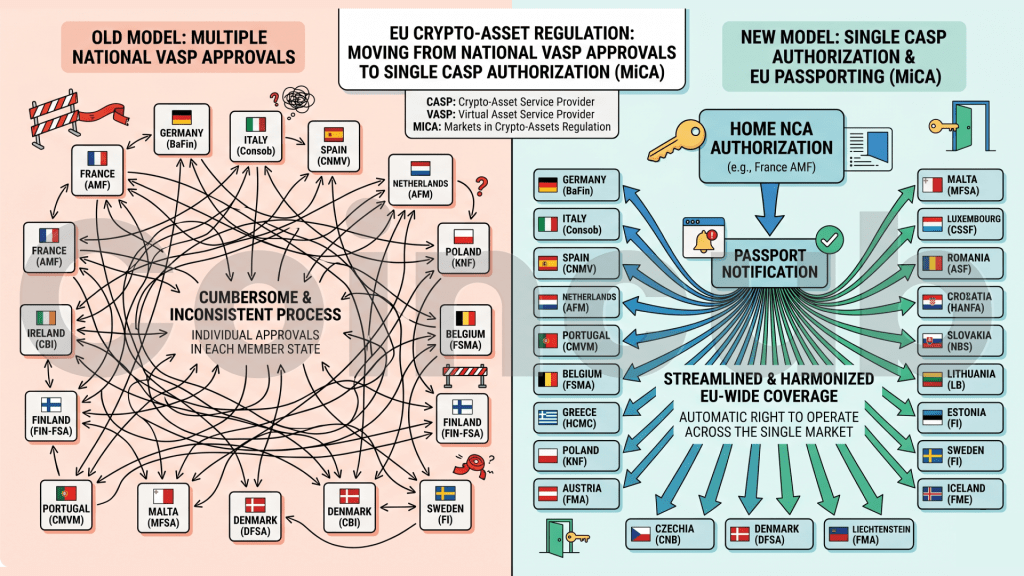
The most transformative feature of MiCA is also the most underappreciated. Under the regulation’s passporting mechanism, a single CASP authorization in any one EU member state gives that firm EU-wide passporting rights, allowing it to operate across all 27 member states. There is no need to apply separately in Germany, France, Poland, or any other country. Authorization from one national competent authority (NCA) unlocks the entire EU single market in one step.
After authorization, the firm notifies its home NCA of the services it intends to offer cross-border, the target member states, and the intended start date. No further regulatory filings are required in each destination country.
Before MiCA, expanding across Europe meant navigating a patchwork of national frameworks- each with its own registration requirements, timelines, and supervisory expectations. Compliance overhead multiplied with every market entered, making EU-wide scale prohibitive for most firms.
Under MiCA, that reality is gone. A firm authorized in, say, Lithuania or Estonia can lawfully serve clients in all 27 member states through a single notification to its home NCA. Compliance resources stay centralized. Legal structures remain contained. The cost of expanding from one country to twenty-seven is dramatically lower than under any previous national regime.
The Anatomy of a Future-Proof CASP
Institutional Resilience: AML and the Travel Rule
The compliance architecture of a future-proof CASP begins with a robust anti-money laundering framework that goes substantially further than the basic AML registration requirements that governed most legacy VASPs. As part of the licensing process, applicants must submit an internal AML and counter-terrorist financing policy detailing risk assessment procedures, customer onboarding processes, transaction monitoring systems, and sanctions screening protocols. Regulators will scrutinize this documentation carefully, and gaps will delay or block authorization.
The Travel Rule adds a second, technically demanding layer to the AML obligations of every authorized CASP. The Transfer of Funds Regulation, which mandates the Travel Rule, requires CASPs to collect data about the originator and beneficiary of transfers, verify and share this information with counterparties, and comply with enhanced due diligence measures for third-country counterpart CASPs. This is an operational obligation, not a policy one. It requires systems integration, data exchange protocols, and continuous monitoring infrastructure.
The Travel Rule became mandatory for all CASPs incorporated in the EU from December 30, 2024, with no transitional grace period. Firms that have not yet built this capability into their infrastructure are technically operating in breach. Any CASP applying for authorization in 2026 will need to demonstrate that Travel Rule compliance is already operational, not merely planned.
The appointment of a dedicated AML compliance officer is also expected. Firms with multiple directors and complex group structures will face additional scrutiny on beneficial ownership, conflicts of interest, and the separation of compliance functions from commercial operations.
DORA Overlap: Operational Resilience as a Baseline
Cybersecurity and digital operational resilience have become non-negotiable components of CASP authorization under MiCA. This is primarily because of the parallel requirements imposed by the Digital Operational Resilience Act, known as DORA. DORA applies from January 17, 2025, to all financial entities regulated under EU law, including crypto firms licensed under MiCA. Compliance with DORA is therefore a baseline requirement, not an optional enhancement.
CASPs must prove they have robust IT systems, cybersecurity protocols, and business continuity plans designed to handle technical failures or cyberattacks. ESMA has specifically called out ICT architecture review, including intragroup dependencies and third-party service providers, as areas requiring particular attention during the authorization process.
DORA also introduces obligations around incident reporting. Major IT incidents must be reported to regulators promptly, along with root cause analysis and remediation plan. Firms must therefore build internal incident response procedures that can be executed quickly and documented clearly for supervisory review.
Data retention obligations are tied closely to DORA compliance. CASPs must retain comprehensive records of all transactions, orders, and client interactions in formats that are searchable and auditable. ESMA has mandated a standardized, machine-readable JSON schema for order book records, with NCAs expected to begin requesting data in this format within six months of its publication in November 2025.
Liability and Custody: Protecting Retail Users
The custody rules under MiCA represent one of the most significant liability upgrades from the legacy VASP era. If a CASP receives client fiat currency other than e-money tokens, it must place those funds with an EU credit institution or a central bank by the end of the next business day, and it may never use client assets for its own account. Segregation, daily reconciliation, and clear custody contracts are required, along with strict liability where a loss is attributable to the CASP.
The rules on asset segregation extend to crypto holdings. A future-proof CASP must maintain a clear separation between client crypto assets and the firm’s own assets at all times. Sloppy custody arrangements, which were common under many legacy national regimes, will no longer pass regulatory scrutiny.
ESMA has also clarified that CASPs cannot outsource or delegate custody functions to entities that are themselves unauthorized under MiCA. CASPs must ensure that all outsourcing and delegation arrangements are fully compliant and do not result in crypto-asset services being provided to EU clients via unauthorized third-country entities. This has direct implications for firms relying on third-party custodians or cloud infrastructure providers located outside the EU.
Legacy VASP vs. Future-Proof MiCA CASP
| Regulatory Area | Legacy VASP (National Framework) | Future-Proof MiCA CASP |
| Market Access | Limited to one specific country of registration | Full access to all 27 EU member states |
| AML Requirements | Basic national registration and localized reporting | Comprehensive AML policy with full Travel Rule compliance |
| Custody Rules | Loosely defined, varying significantly by jurisdiction | Strict liability with daily reconciliation and asset segregation |
| Cybersecurity | Ad hoc or standard corporate IT security | Mandatory ICT risk management fully aligned with DORA |
| Passporting Rights | None; requires separate licensing in each target country | Full EU-wide passport via National Competent Authority (NCA) notification |
| Penalties for Non-Compliance | Varied nationally, often lower-tier fines | Up to €5 million or 5% of total annual turnover |
| Ongoing Supervision | Often light-touch, reactive, or registry-based | Continuous NCA oversight with mandatory incident reporting obligations |
Token Issuance Standards
What the Assets Themselves Must Meet
Future-proofing a crypto business under MiCA requires more than securing the right service provider authorization. It also means ensuring that every crypto asset listed, traded, or offered through a CASP meets the regulation’s disclosure standards. This shifts the compliance burden beyond operational processes into the assets themselves.
MiCA mandates that any entity making a public offering of a crypto asset in the EU must prepare and publish a compliant white paper before that offering takes place. The white paper must detail the issuer’s activities, the rights and obligations attached to the crypto asset, the underlying technology, and the associated risks. The obligation applies to issuers, offerors, and the trading platforms that admit assets to trading. A CASP that lists a non-compliant token on its platform shares exposure to regulatory action.
Whitepaper Compliance: The iXBRL Requirement
The technical bar for compliant white papers rose significantly at the end of 2025. From December 23, 2025, white papers must be submitted in Inline XBRL format, structured as a single XHTML file, and linked to a valid Legal Entity Identifier that is subject to automated verification. PDF-only submissions no longer meet the regulatory requirements.
This iXBRL requirement reflects a broader push by ESMA toward machine-readable, structured disclosures that can be automatically processed, validated, and compared across issuers. To support compliance, ESMA has published its MiCA XBRL taxonomy and made available a set of Excel-based examples covering each type of crypto asset, including EMTs, ARTs, and other crypto assets. Issuers are responsible for ensuring their submissions are correctly tagged against this taxonomy. Structural misalignment or incorrect taxonomy mapping will trigger validation failures even if the underlying disclosures are substantively accurate.
For CASPs that list tokens issued by third parties, the white paper obligation creates a due diligence requirement. Before admitting a crypto asset to trading, a platform must verify that the relevant white paper is publicly available, correctly formatted to ESMA’s iXBRL standard, and has been notified to the appropriate national competent authority. Listing a token whose issuer has not completed this process exposes the platform to direct regulatory risk.
Market Integrity: Transparency as a Structural Requirement
The white paper requirements are just one component of MiCA’s broader market integrity framework. The regulation establishes a crypto-specific market abuse regime that brings insider trading controls, market manipulation prohibitions, and real-time surveillance obligations into the EU crypto sector for the first time.
CASPs must implement communication surveillance systems capable of detecting suspicious trading patterns, insider activity, and coordinated manipulation attempts. Pre-clearance protocols for employee trades, along with documented insider lists, are expected as part of the firm’s internal controls. These are not novel concepts for traditional financial services, but they represent a significant operational upgrade for most crypto-native businesses.
Together, mandatory whitepaper disclosure and active market abuse monitoring give regulators a consistent legal basis to compare disclosures, track offering activity, and act against non-compliant listings across all 27 member states- a structural shift from anything the EU crypto market has seen before.
The Tail: Context, History, and Next Steps for MiCA
How We Got Here: The Grandfathering Era
MiCA did not arrive overnight. The regulation was published in the Official Journal of the European Union on June 9, 2023, and entered into force on June 29, 2023. Its implementation was deliberately phased to give the market time to adapt.
The first phase, covering the rules for issuers of Asset-Referenced Tokens (ARTs) and E-Money Tokens (EMTs), took effect on June 30, 2024. This brought stablecoin issuers under mandatory EU oversight for the first time, with strict reserve requirements and daily transaction limits for widely used tokens. The second and more expansive phase, covering CASP authorization and the full suite of service provider obligations, became mandatory on December 30, 2024.
MiCA includes a transitional regime that allowed firms already legally operating as crypto service providers under national law before December 30, 2024, to continue providing services in their home country until as late as July 2026. Some EU member states, including Poland, Belgium, and Portugal, have not yet finalized their national regulations for MiCA implementation, leaving local crypto businesses uncertain about exact procedures. Critically, the absence of local implementing regulation does not extend the transition period. The July 1 deadline applies universally across all 27 member states, regardless of whether a given country’s domestic framework is fully operational.
Enforcement Reality: What ESMA Expects After the Deadline
ESMA has moved well beyond guidance and into enforcement preparation ahead of the July 1 deadline. The regulator has published detailed expectations for how unauthorized CASPs must conduct their wind-down operations in the event they fail to achieve authorization in time.
Wind-down plans must be operational, credible, and immediately executable. They must be designed in accordance with all relevant EU conduct, prudential, and AML obligations. CASPs must provide existing clients with prior notice before implementing a wind-down plan, including arrangements for the transfer of crypto assets held on their behalf to an authorized CASP or to a self-hosted wallet.
National competent authorities have been directed to verify the existence and adequacy of wind-down plans for unauthorized CASPs in their jurisdictions before the deadline arrives. NCAs are expected to be prepared to act against unauthorized crypto-asset service provision immediately when the transitional period closes. Under MiCA, CASPs operating without authorization can face fines of up to 5 million euros or 5% of annual turnover, cease-and-desist orders, and bans on EU operations. Authorities may also revoke licenses, impose criminal liability, and sanction individual executives.
ESMA expects orderly transitions. Firms that have delayed face both market exclusion and punitive action against their leadership.
Final Call: Audit Your Stack Now
The worst move any crypto founder, builder, or operator can make right now is waiting until June 2026 to begin their compliance review. The application process alone takes six to twelve months from initial preparation to regulatory approval.
The steps are clear. Determine which of MiCA’s ten defined CASP services your business provides. Conduct a gap analysis against MiCA, DORA, and the Travel Rule obligations. Build your AML policy framework, your ICT risk management documentation, and your custody architecture. Appoint fit and proper management with the expertise regulators will expect to see. Select the EU jurisdiction where you intend to file, engage with the NCA, and begin the application process without delay.
The EU crypto market is large, regulated, and open to any operator willing to meet its standards. The July 1, 2026, deadline closes the door for those who are not ready. For those who are, it represents the opening of the only truly passportable, institution-grade crypto market in the world. The time to act is not next month. It is today.
Frequently Asked Questions (FAQs)
What is the last date to apply for Mica?
To continue operating in the EU, legacy crypto firms must obtain full MiCA authorization before the transitional period ends on July 1, 2026. Given the six-to-twelve-month assessment period, firms should submit their applications immediately.
What is the mica regulation in Europe?
The Markets in Crypto-Assets (MiCA) is a landmark European Union regulation establishing a unified legal framework for digital assets. It mandates strict licensing, consumer protection, and operational standards for crypto service providers across all member states.
What are the new rules for crypto in 2026?
In 2026, the EU transitions to full MiCA enforcement. By July 1, all crypto service providers must hold mandatory authorizations, enforce strict asset custody segregation, implement full Travel Rule compliance, and adhere to DORA-aligned cybersecurity measures.
Which cryptos are MiCA compliant?
MiCA compliance heavily targets stablecoins, with tokens like USDC and EURC meeting strict e-money requirements. For other cryptocurrencies, issuers must publish detailed, iXBRL-formatted whitepapers outlining technological functions and market risks to be legally traded on EU platforms.