



 Buy a Licensed Company
  Explore VASP Data
  Talk to an Expert

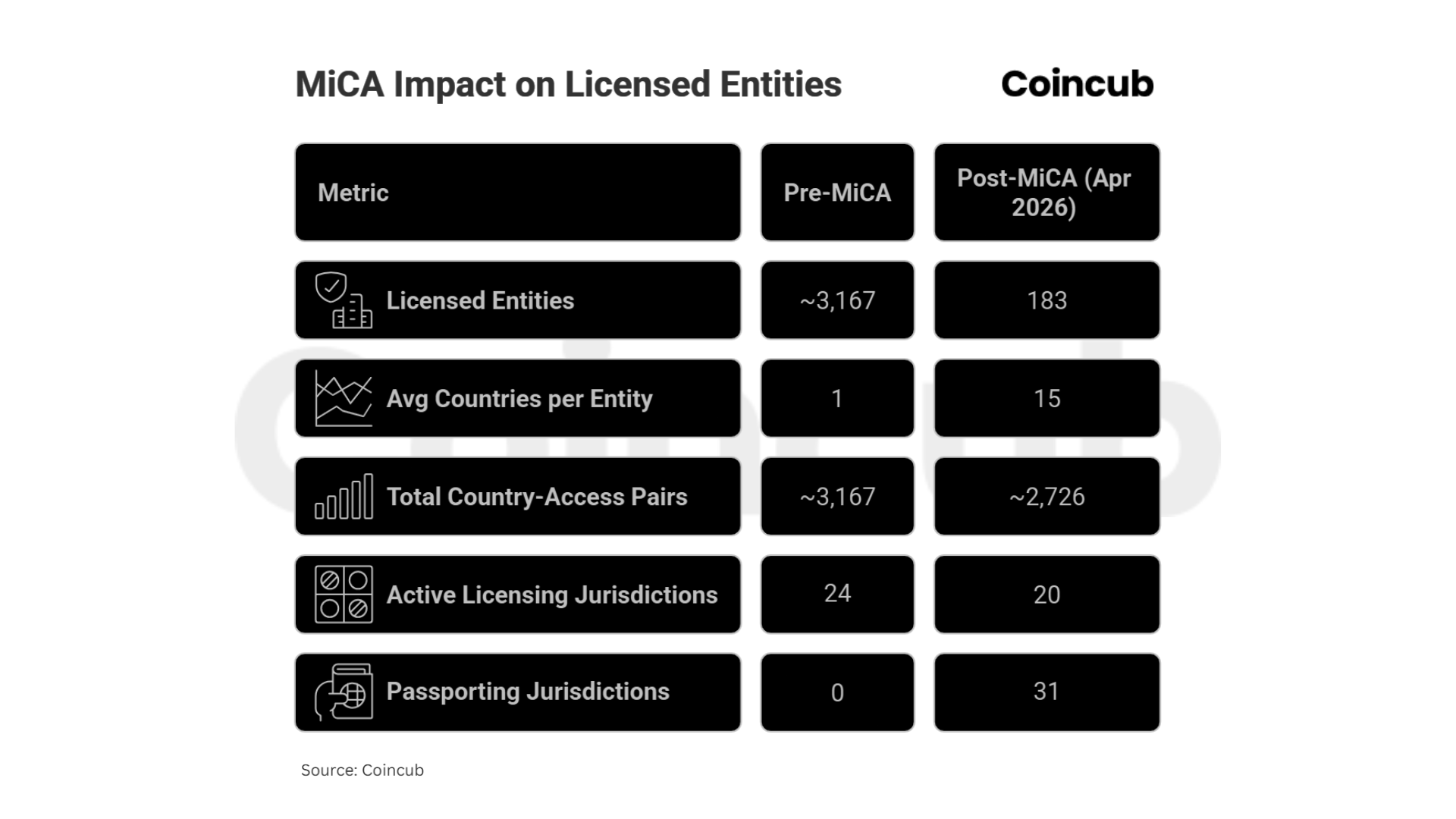
MiCA reduced Europe’s crypto market from 3,167 national VASP registrations to 183 licensed CASPs, while passporting preserved most cross-border access.
Germany leads in authorizations, while Cyprus and Ireland lead in passport reach; offshore firms captured much of the upside.

Introduction
We published our Europe Crypto 2025 Report when there were 12 licensed CASPs in the EU. There are now 183. That’s a 15x increase in 14 months. Some of what we predicted played out, and some of it didn’t. And a few things happened that nobody had on their radar.
- MiCA cut 3,167 VASPs down to 183 CASPs and still preserved about 86% of market access through passporting.
- MiCA split the market into two: domestic banks with narrow coverage, and passport-heavy firms covering almost the whole bloc.
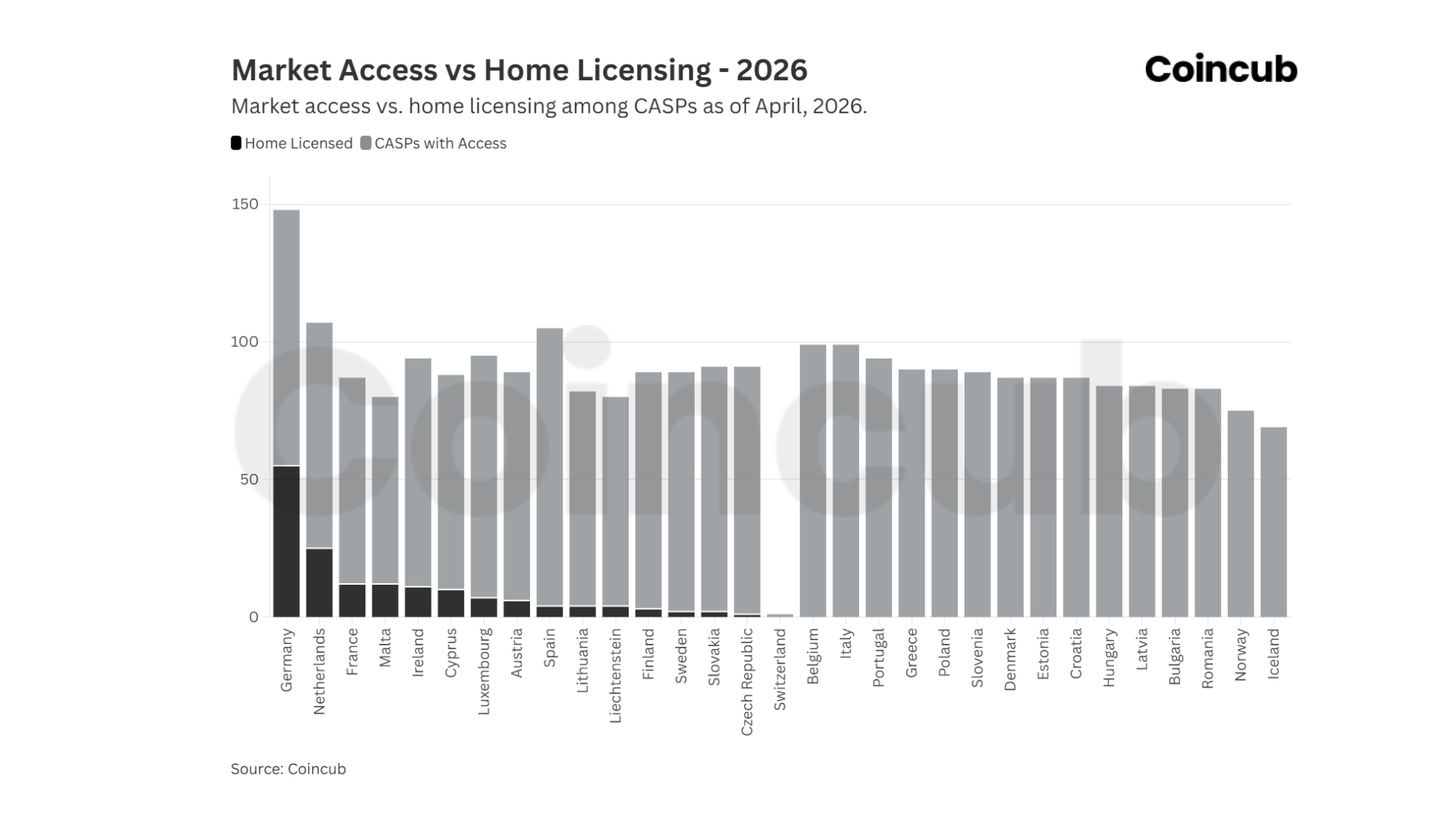
- Germany leads on license count. Cyprus and Ireland lead on passport reach.
- Offshore firms captured the biggest MiCA upside. Binance, Bybit, OKX, Crypto.com, and Revolut sit at the center of the new map.
- Bitpanda stands out as Europe’s clearest native exchange winner. It is the only genuinely EU-native crypto exchange in the upper half of the global top 100.
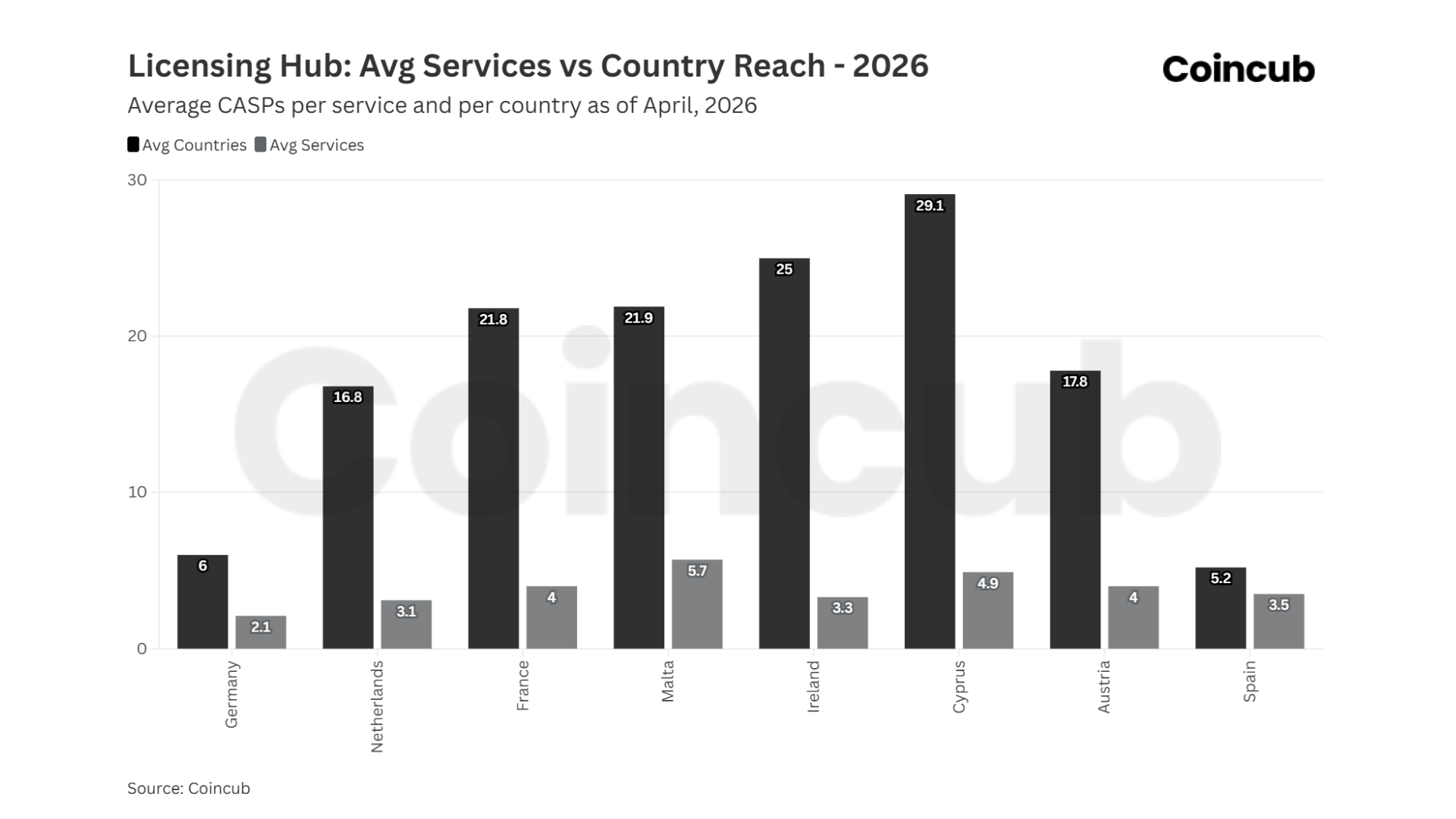
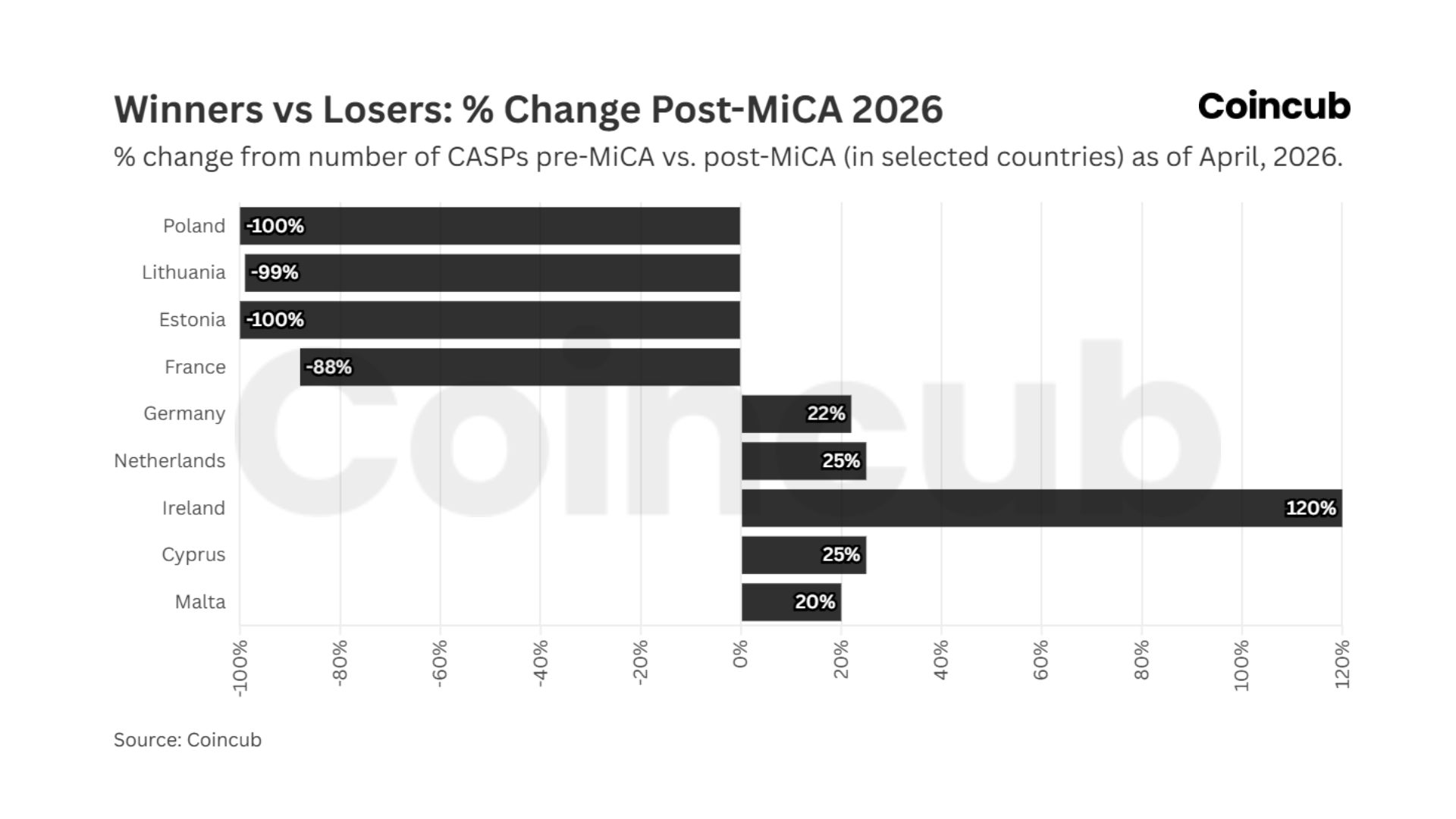
- Lithuania suffered a 99% wipeout. Around 345 registered firms fell to 4 MiCA CASP licenses.
- Poland is stuck in regulatory limbo. More than 1,400 VASPs were built around a regime that expired, and the replacement law still is not in place.
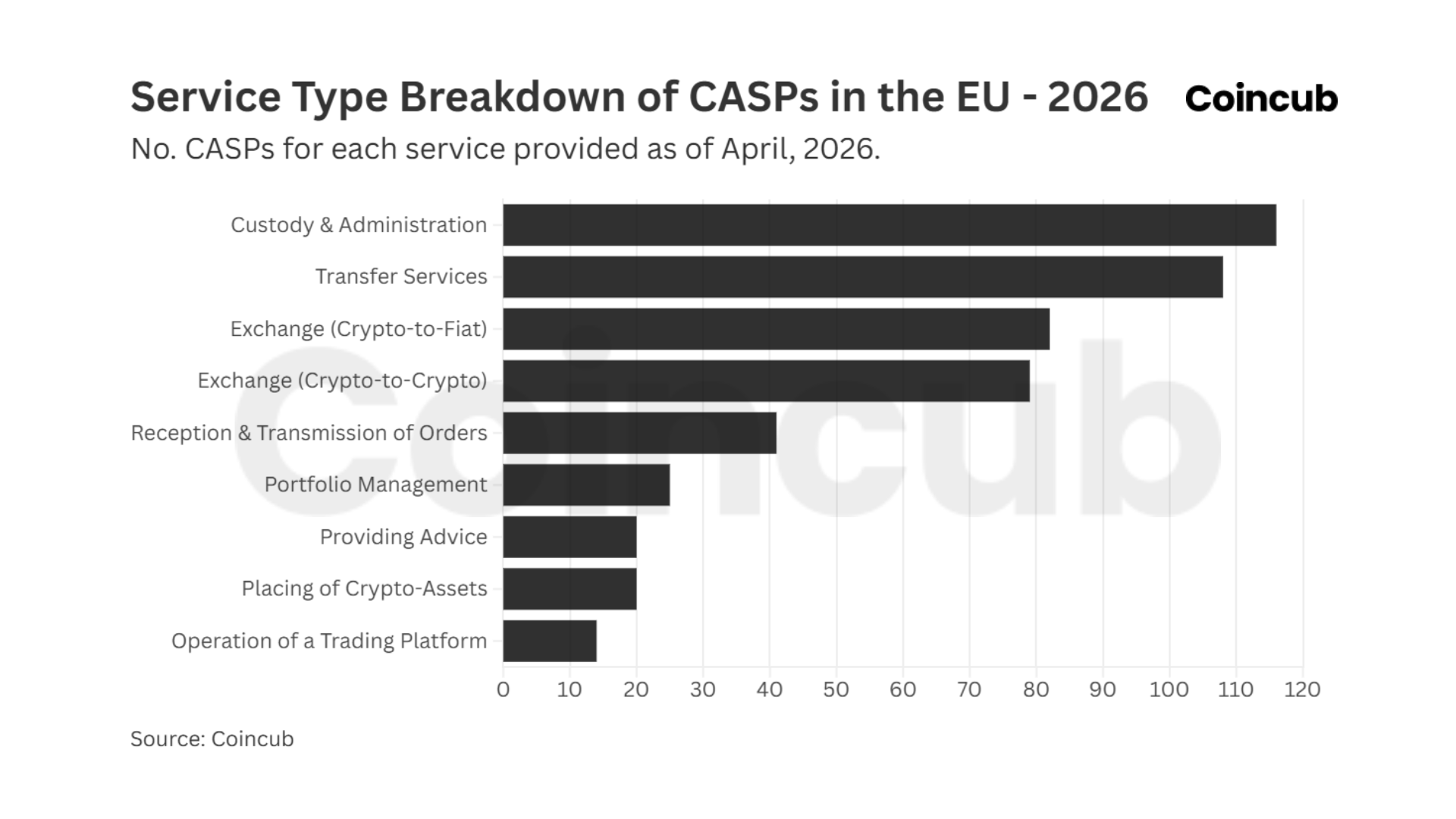
- Europe’s regulated exchange market is tiny. Only 14 of 183 CASPs can run a centralized exchange.
- USDT got pushed off regulated EU venues. Tether kept growing anyway.
- Euro stablecoins are now part of Europe’s sovereignty push.
- For EMT-heavy firms, MiCA often means PSD2 as well.
- July 1, 2026, is a hard cliff for firms still on grandfathering.
- The EU is already moving toward ESMA-led supervision. The first MiCA model is being tightened before the first cycle is over.
- Deutsche Börse buying into Kraken shows where institutional momentum is going.
The Passporting Math
The headline from 2025 was the VASP apocalypse: 3,167 national registrations collapsing to almost nothing. While that did happen, we underestimated how passporting affects the math.
Before MiCA, those 3,167 registrations were single-country and siloed. Under MiCA, 183 licensed CASPs each carry access to 30 EU/EEA markets. When counting the actual country-access pairs, you get 2,726 under MiCA, compared with 3,167 previously. That’s 86% of pre-MiCA market coverage, delivered by a fraction of the entities. The market contracted sharply in entity count and held nearly flat in actual access.
Two Markets
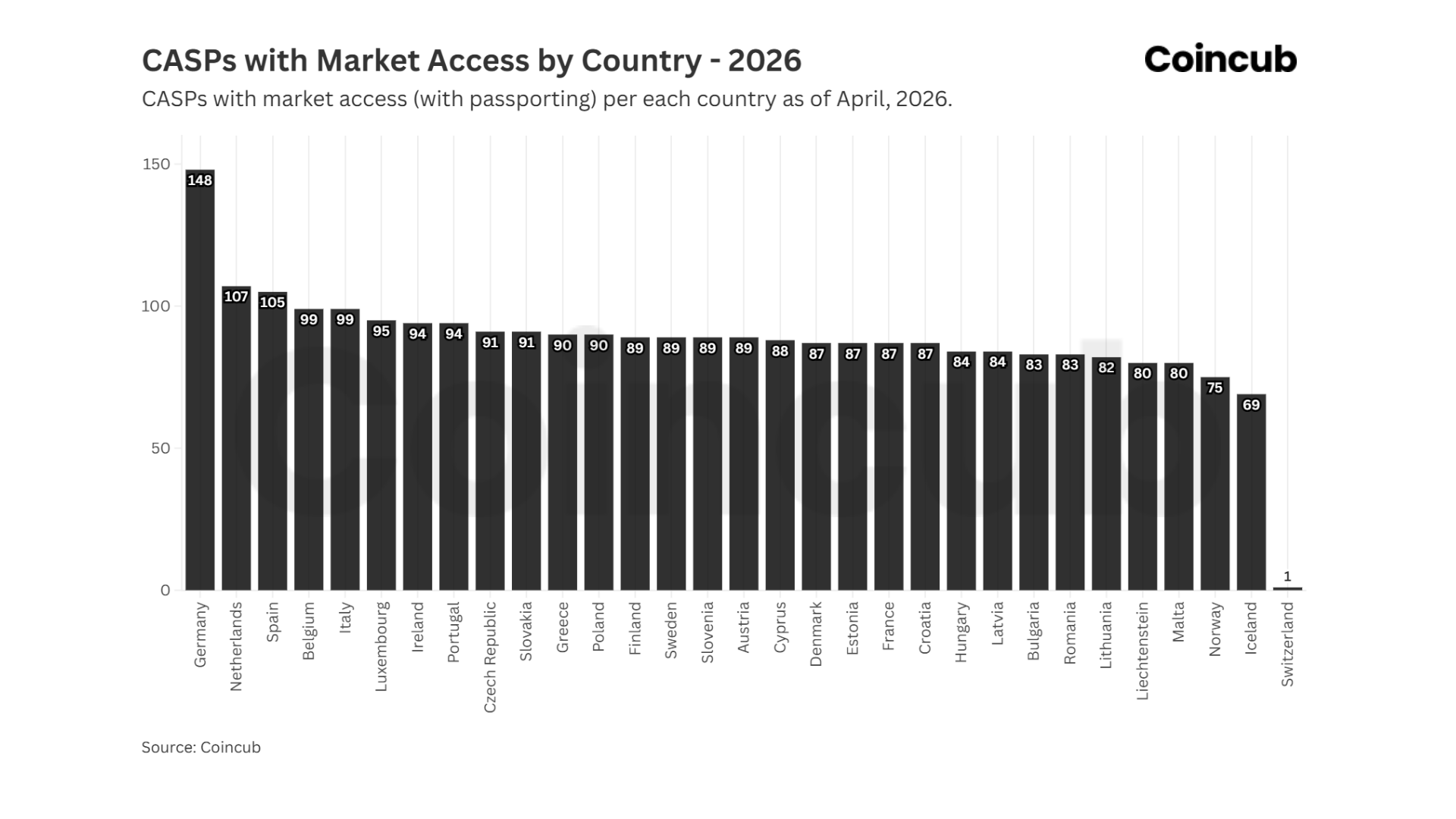
MiCA created two completely separate populations.
78 CASPs (42%) cover just 1 to 5 countries – almost exclusively German banks that added crypto as an incremental service on existing compliance infrastructure. MiCA was a marginal cost for them.
84 CASPs (45%) cover 26 to 30 countries – full EU passport holders, mostly crypto-native firms, and disproportionately offshore-originated entities that hired EU lawyers and passported across the single market.
Only 13 CASPs sit anywhere in between. That is a near-empty middle ground that nobody predicted.
The Real Winners
Germany has 55 CASPs (30% of all authorizations), but only 23 are traditional banks, averaging just 6 countries per license.
Cyprus averages 29.1 countries per CASP, Ireland 25.0. Both ranked below Germany on entity count. Both are the actual passport powerhouses.
The names holding those Cyprus and Ireland licenses include Binance (Cayman Islands), Bybit (UAE), OKX (Seychelles), Crypto.com (Cayman Islands), and Revolut (UK). These are not European companies. MiCA was not designed just to hand its most valuable licenses to offshore giants. But that’s what happened.
Malta is worth noting separately. In July 2025, ESMA’s fast-track peer review of a Malta CASP authorization found that the assessment process should have been more thorough and that material issues remained unresolved at the time of the license grant. It turned a vague suspicion about permissive hubs into a named supervisory problem, and it handed France, Italy, and Austria exactly the political ammunition they needed for centralization.
The Ghost of the Cheap Registration
Lithuania had 345 registered crypto firms at the end of 2024, built on five years of fintech-friendly policy, characterized by fast onboarding, low fees, and minimal substance. It worked exactly as designed, which is why it failed under MiCA. The model attracted companies least able to absorb €50,000-€150,000 in minimum capital, mandatory physical substance requirements, and 3-6-month review timelines.
Today, Lithuania has 4 MiCA CASP licenses. From 345 VASPs, that’s a 99% attrition. Its first MiCA CASP was Robinhood Europe UAB, an American company.
Poland had 1,800+ VASPs and is now the only EU member state that hasn’t implemented MiCA into national law. It’s actually more of a political standoff. Prime Minister Tusk’s bill passed parliament, got vetoed by President Nawrocki, was revised and reintroduced, and vetoed again in February 2026. Parliament tried to override it last week and came up 20 votes short. No legislative timeline exists. Those 1,800+ companies are stateless in regulatory terms, meaning they’re too small for MiCA and too old for the old regime. The value of those companies is close to €0. Additionally, Poland’s largest exchange, Zonda, has been lobbying against the bill while Tusk accuses it of ties to Russian criminal networks, and a disputed $330M wallet connected to a former CEO who disappeared in 2022.
Estonia practically invented EU crypto regulation. It had 37 licenses and was the first to implement MiCA in July 2024, but there are zero CASPs in the public ESMA register today. Though this is a transition in progress. Existing FIU licenses run until July 1, 2026, and the FSA queue is moving. But the country that built the prototype currently has fewer public MiCA authorizations than Luxembourg.
Romania had no crypto infrastructure before MiCA and got the opposite outcome. It moved fast on transitional recognition. Crucially, though, grandfathered Romanian firms did not get passporting rights – ESMA is explicit that transitional entities cannot passport cross-border. What Romania got was registrations and tax presence, while other countries carried the supervisory burden.
The Number That Is Rarely Talked About
The ESMA register lists 183 CASPs. But only 14 are licensed to operate a centralized exchange – a trading platform with an actual order book and matching engine.
Out of 183 licensed entities, 14 can run what most people mean when they say “crypto exchange.” That’s 7% of the total.
That same concentration showed up in stablecoins, where MiCA reshaped market access at the token level as well.
USDT Dead in Europe? Tether Won’t Care
Coinbase Europe delisted USDT in December 2024. Binance followed on March 31, 2025. Kraken, OKX, and Revolut all followed. The world’s largest stablecoin was removed from every regulated EU exchange.
Globally, it made almost no difference. Tether’s $138B market cap held steady. Asian markets absorbed the volume. Daily trading actually increased after European restrictions kicked in. The EU made a point. It mostly redirected liquidity to Singapore and Hong Kong.
Inside the EU, USDC became the dollar stablecoin of choice, and EURC spiked in April 2025 – partly MiCA compliance, partly US tariff policy, making dollar assets less attractive. But while the euro stablecoin ecosystem now exists, it’s still a fraction of USDT’s global position.
The politics around it are shifting into sovereign territory. France’s finance minister has called for more euro-pegged stablecoins and welcomed plans by ING, UniCredit, and BNP Paribas to launch a joint euro stablecoin in H2 2026. So MiCA is yet to answer a question. Can Europe create a Euro alternative that people continuously use?
Who Actually Got MiCA
Coincub’s Crypto Asset Risk Report 2025 put all EU countries 22nd globally in the regulatory ranking. MiCA had created a compliance bottleneck.
The compliance cost floor (€50,000 to €100,000 minimum in legal and setup, plus capital requirements, compliance staff, and banking relationships) is survivable for a Cayman entity backed by $500M in VC. But it’s certainly not survivable for a European pre-seed startup.
Only 8 EU-origin brands appear in the global top 100 exchanges by traffic. Bitpanda is the only genuinely EU-native crypto exchange in the upper half. The compliance jobs created in banks like DekaBank, DZ Bank, and Commerzbank are real, but they’re not innovation jobs. The startups that would have hired engineers instead relocated to Dubai, went offshore, and relied on reverse solicitation, or closed. Europe’s blockchain graduates keep leaving.
MiCA Is Not One License
For EMT-heavy businesses, one license was never enough. The EBA intervened twice on PSD2 overlap, issuing a no-action letter in June 2025 and a follow-up opinion in February 2026, because CASPs transacting e-money tokens can also fall within the payment services territory.
More than 100 CASPs had already approached national authorities before the second opinion. The story for those firms is “get MiCA, then clear PSD2 too.” The same names keep winning because they have the group structure to absorb double compliance that would wipe out a smaller player.
What’s About to Break: July 1
The grandfathering period ends July 1, 2026.
Every entity that hasn’t received MiCA authorization must cease operations. Poland has no path at all. Estonia’s queue is moving but unfinished. Romania’s NCA designation is still “to be announced.”
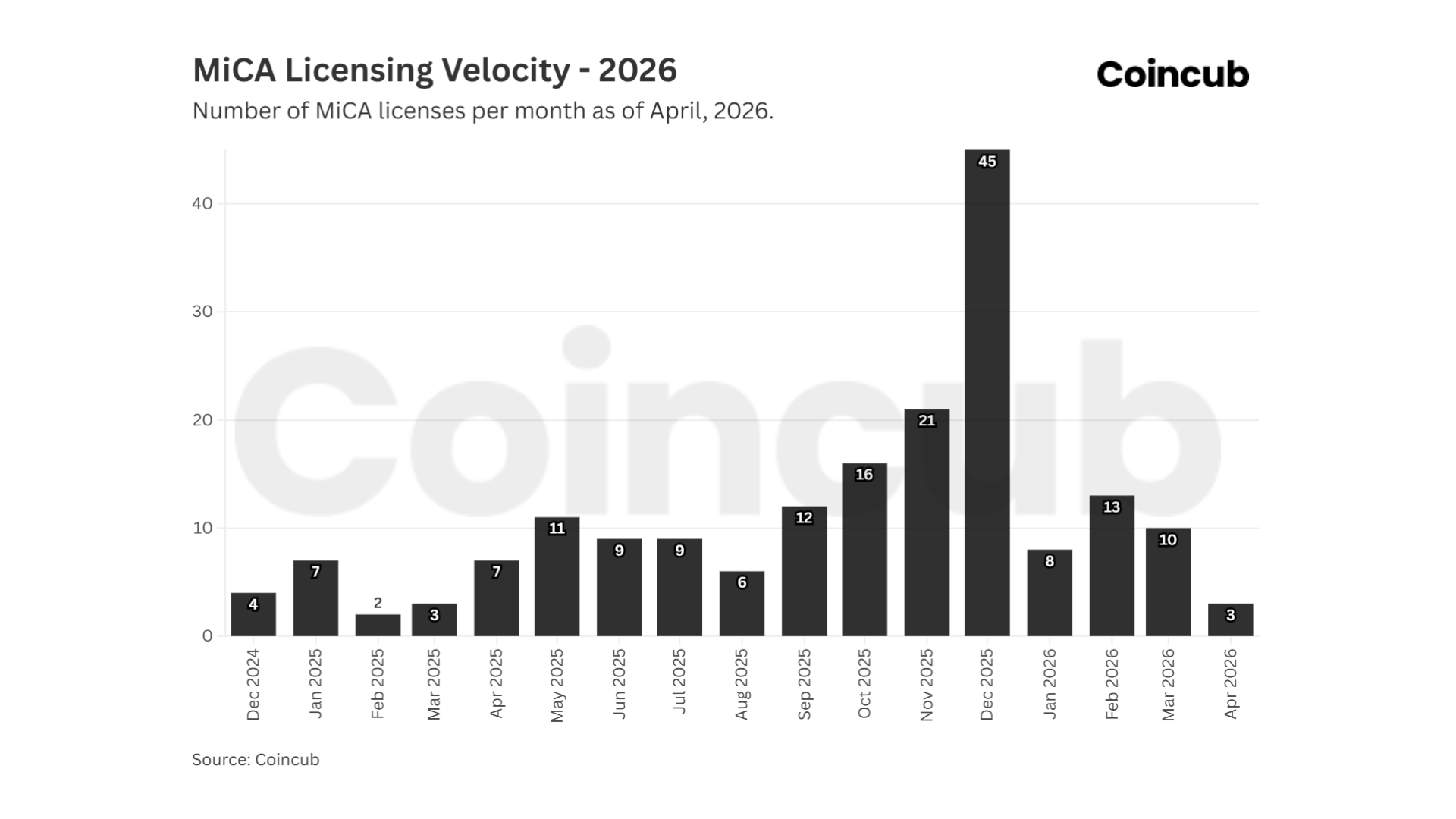
The December 2025 peak of 45 licenses in a single month shows what deadline-driven backlog clearing looks like. That pattern is about to repeat with no extension available this time. Preparation to submission takes 9-18 months. For anyone still on transitional status without an application in progress, the window is practically closed.
ESMA Takes Everything
The European Commission’s Market Integration Package, published in December 2025, would move direct supervision of all CASPs from national authorities to ESMA in Paris, meaning authorization, monitoring, and enforcement.
The ECB backed it formally on April 9, 2026, with France, Italy, and Austria driving it. Countries like Malta are pushing back hard since they built competitive advantages under the hub model and are now being told those advantages are canceled. License-lending and white-labeling models built on permissive hubs are directly threatened.
The ECB opinion is non-binding. Negotiations will take months. But the decentralized model MiCA launched with is already being dismantled before the first version is even finished.
The Institutional Signal
Deutsche Börse bought a 1.5% stake in Kraken for $200 million last week, valuing Kraken at $13.3B. Kraken confirmed a confidential SEC IPO filing the same day. The partnership covers trading, custody, settlement, and tokenized assets.
The institutional adoption story we described as “accelerating, not stalled” in our 2025 predictions review found its clearest expression in Frankfurt, putting real money behind a San Francisco crypto exchange. The TradFi-crypto convergence is happening. The European-born exchange capturing that wave is yet to appear.
The Digital Euro
Our 2025 report mentioned a Digital Euro launch in October 2025. That framing was wrong since there was never a hard launch target for 2025. In October 2025, the ECB closed its preparation phase and moved to the next one. If legislation passes in 2026, a pilot could run from mid-2027. Realistic issuance is 2029.
The project is alive, moving slower than the ECB wants, and increasingly framed as a sovereignty response to US card networks and Chinese payment platforms.
What MiCA Is and Isn’t
MiCA did what it was designed to do, and many critics owe ESMA an apology. MiCA provided legal certainty, consumer protection standards, a public registry of accountable entities, zero expiry dates, a passporting architecture, and service code granularity in the register, all of which are genuinely good regulatory design decisions.
But the unintended consequence is a single crypto market increasingly served by American companies, Asian entities with Cayman mailboxes, and German retail banks adding crypto as a compliance checkbox, rather than by the European-born, EU-native startups that the Digital Finance Strategy nominally exists to cultivate.
So, from one perspective, MiCA is a regulatory architecture triumph, but whether it is an economic policy success may depend heavily on what the next couple of months look like. All in all, the story of European crypto regulation is entering its most consequential chapter.
Appendices
Appendix A. Terms and Abbreviations
MiCA: Markets in Crypto-Assets Regulation, the EU-wide framework for crypto-asset issuers and service providers.
CASP: Crypto-Asset Service Provider under MiCA.
VASP: Virtual Asset Service Provider under pre-MiCA national regimes.
EEA: European Economic Area.
NCA: National Competent Authority, the domestic regulator responsible for supervision.
EMT: Electronic Money Token.
PSD2: Second Payment Services Directive.
Passporting: The ability of a licensed firm to offer services across other EU or EEA markets after notification.
Grandfathering: The transitional period that allowed certain pre-MiCA firms to continue operating temporarily before full MiCA authorization.
Home licensing: The country in which a CASP receives its primary authorization.
Market access: The number of countries in which a CASP can operate through home authorization plus passporting.
Country-access pairs: A measurement used in this report to compare pre-MiCA and post-MiCA reach. One firm operating in one country equals one pair.
Appendix B. Data and Methodology
This report compares the pre-MiCA structure of the European crypto market with the post-MiCA structure as of April 2026.
Pre-MiCA figures refer to national VASP registrations and other country-level licensing or registration counts collected by Coincub from national regimes before MiCA took full effect.
Post-MiCA figures refer to CASPs listed in the ESMA interim MiCA register, including home-licensed entities, country reach through passporting, service authorizations, and licensing activity over time.
Where relevant, the report distinguishes between three separate measures:
- Licensed entities: The number of firms holding a registration or license.
- Home-licensed entities: The number of firms authorized in a given jurisdiction.
- Market access: The number of CASPs able to serve a given country through home licensing or passporting.
These measures are not interchangeable. A lower number of licensed entities can still produce broad market access if passporting is widely used.
The report also uses country-access pairs to compare pre-MiCA and post-MiCA market reach on a like-for-like basis.
Appendix C. Scope and Interpretation Notes
All figures reflect a snapshot as of April 2026 unless otherwise stated.
The ESMA interim register is updated regularly. Totals may change from week to week as new authorizations are granted, amended, or published.
Some visuals compare selected countries rather than the full EU set. In those cases, the chart is intended to illustrate structural changes and country-level divergence, not provide a complete ranking of every jurisdiction.
Pre-MiCA and post-MiCA figures should be read carefully. Pre-MiCA systems were national, fragmented, and often registration-based. Post-MiCA figures reflect a single EU framework built around authorization and passporting. The report compares these systems to show how market structure changed, not to imply that all pre-MiCA registrations were equivalent to MiCA licenses.
Appendix D. Sources
Primary data for this report comes from Coincub’s datasets. Additional interpretation is based on public statements and releases from ESMA, EBA, ECB, national regulators, and company disclosures, alongside selected public reporting used to track policy developments, implementation delays, and market responses.

 Canada
  UAE
UAE 








