Buy a Licensed Company
  Explore VASP Data
  Talk to an Expert

 Atis Shala
Atis is a senior analyst and community lead with four years of experience in crypto. He has a bachelor from the Rochester Institute of Technology.
Atis Shala
Atis is a senior analyst and community lead with four years of experience in crypto. He has a bachelor from the Rochester Institute of Technology.
Render Price Prediction: How High Can RENDER Go?
- Render connects creators and developers who need massive computing power with users worldwide who have idle GPUs, making high-end rendering much more accessible and affordable.
- While originally built for digital art and visual effects, the network has evolved to power resource-heavy workflows in artificial intelligence, machine learning, and spatial computing.
- The ecosystem runs on the RENDER token and uses a Burn-Mint-Equilibrium (BME) model, meaning the token’s circulating supply is directly tied to actual network usage and job volume.
- To ensure faster transaction times and drastically lower fees for artists and node operators, the network successfully migrated its underlying blockchain from Ethereum to Solana.
- Unlike many speculative crypto projects, Render is actively utilized by major industry players, powering high-profile projects like HBO’s Westworld title sequence and Bungie’s Marathon game trailer.
The internet is quickly shifting toward a world filled with AI generated 3D content, products, and even services. From virtual reality and digital art to game development and machine learning, these new applications rely on one thing, and that’s massive amounts of computing power. Specifically, they need GPUs, the hardware that makes complex visuals and fast data processing possible.
Until now, that kind of computing power has mostly come from centralized services or expensive machines. But what if creators could access the same power through a global network, and GPU owners could earn from what they’re not using? That’s the idea behind Render.
Render is a decentralized network that connects people who need GPU power with those who have it. Instead of relying on a few cloud providers, Render creates a global marketplace for rendering. This lets 3D artists, developers, AI builders, and more tap into high-quality, affordable computing – all without needing to buy the hardware themselves.

What Is Render?
Render is a decentralized GPU rendering network that lets users tap into unused computing power from people all over the world. Instead of using a traditional cloud provider, creators can submit rendering jobs to the Render Network, where node operators (in this case, people with spare GPU capacity) process the work in exchange for RENDER tokens.
At its core, Render is trying to solve a growing problem: high-quality rendering is expensive, slow, and limited to people who can afford powerful hardware or cloud access. With the rise of 3D art, virtual production, NFTs, and AI, demand for rendering power is only going up. Render offers a more open and affordable option, while also giving GPU owners a new way to earn from their devices.
The project was launched by Jules Urbach, founder of OTOY, a cloud graphics company known for its OctaneRender software, one of the most advanced rendering tools in the industry. Render builds on OTOY’s experience by combining rendering tech with blockchain to create a trustless, scalable platform.
Every rendering job on the network is encrypted and split into small tasks that can be processed by any approved node. The results are then verified and pieced back together. This keeps quality high while spreading out the workload across the network.
The system is designed for people who need GPU power for everything from animation and visual effects to virtual architecture and AI training. It’s not just about faster rendering- it’s about changing how digital content is produced and delivered.
Render is building the backbone for the next era of visual computing. This era is faster, cheaper, and open to anyone.
How Does Render Work?
Render works by connecting people who need high-performance computing with those who have it. On one side, there are creators and developers who need to render complex graphics or run large-scale visual tasks. On the other, there are users with powerful GPUs that often sit idle. Render brings them together through a blockchain-based system that manages jobs, payments, and quality checks.
When someone needs a render job done, they submit it through the Render Network’s portal. The system then breaks the job into smaller tasks, which are sent to a pool of trusted GPU node operators. These operators run the tasks on their hardware and send the completed results back. The network automatically verifies the output to make sure everything is accurate and up to standard.
Once verified, the creator receives their finished work and the GPU operator is paid in RENDER tokens. This process allows rendering to happen quickly and at lower cost, without needing to go through centralized providers like Amazon Web Services or Google Cloud.
Render uses smart contracts to manage the job queue, track progress, and handle payments. Everything is transparent and secured on the blockchain, so users can trust that work will be completed fairly and efficiently.
One of the key benefits of this setup is flexibility. Whether you’re an artist working on a single project or a studio rendering multiple jobs at once, you can scale your computing power up or down as needed. And because Render pulls from a global pool of GPUs, the network can handle a wide range of tasks, from basic animations to advanced 3D environments and AI workloads.
What is RENDER? The Token Behind Render
RENDER is the native cryptocurrency of the Render Network. It’s used to pay for rendering jobs and reward the people who provide the computing power. Every time a user submits a task to the network, they use RENDER tokens to pay for the processing. Once the task is complete and verified, those tokens are sent to the GPU operator who did the work.
This creates a simple but powerful cycle. Creators get access to affordable computing, and hardware owners get paid for sharing their unused power. The RENDER token keeps everything running smoothly in the background.
Token Use Cases
RENDER isn’t just a payment token. It also helps coordinate the network and make sure jobs are handled properly. Here are the main roles it plays:
- Payment: Users pay in RENDER to submit rendering jobs
- Incentives: Node operators earn RENDER for completing tasks
- Staking: In the future, Render plans to introduce a staking system that helps select and secure trusted nodes
- Governance: RENDER may be used in future voting systems to guide the direction of the network
RENDER Tokenomics
RENDER has a fixed total supply, which helps prevent inflation and creates long-term scarcity. The project launched with an initial allocation of tokens that were distributed across users, developers, advisors, and reserve funds. Here’s a basic breakdown of how the tokens were allocated:
- Initial token supply: 536,870,912 RENDER
- Public sale: A portion was sold during early fundraising rounds
- Team and advisors: Allocated to support long-term development
- Reserve: Held for network growth and future needs
- Node operator rewards: Set aside to pay GPU providers for rendering work
This structure is meant to keep the ecosystem balanced while rewarding contributors over time.
- Market cap: $1,050,000,000
- Total supply: 533,570,912 RENDER
- Circulating supply: 518,740,000 RENDER
- 24h trading volume: $70,300,000
- All-time high: $13.60
- Current price: $2.03
Render’s Ecosystem and Use Cases
Render Network is more than just a decentralized rendering service. It’s a comprehensive ecosystem that connects creators, developers, and GPU providers, enabling a wide range of applications across various industries.
Render Use Cases
3D Art and Animation
Independent artists and studios use Render to produce high-quality 3D visuals without investing in expensive hardware. By accessing a global network of GPUs, they can render complex scenes more efficiently and cost-effectively.
Virtual Production for Film and TV
Filmmakers integrate Render into their workflows to combine live-action footage with large-scale rendered environments. This approach allows for unlimited creative possibilities and streamlines the production process.
Gaming and Augmented Reality (AR)
Game developers and AR creators utilize Render’s GPU pre-rendering and real-time streaming capabilities to deliver immersive experiences. This technology supports the development of high-fidelity gaming and AR applications.
Artificial Intelligence (AI) and Machine Learning
AI researchers and developers tap into Render’s computing power for training complex models. The network’s scalability makes it suitable for various AI applications, from image recognition to natural language processing.
Architectural Visualization
Architects and designers employ Render to create detailed visualizations of buildings and spaces. The ability to render high-resolution images quickly aids in client presentations and design iterations.
Non-Fungible Tokens (NFTs) and Virtual Assets
Digital artists mint NFTs and create virtual assets using Render’s platform. The network supports the rendering of intricate 3D models, enhancing the quality and uniqueness of digital collectibles.
Metaverse Development
As the metaverse evolves, Render provides the infrastructure needed to build expansive virtual worlds. Developers rely on the network to render environments that are both visually stunning and interactive.
Is Anyone Actually Using Render?
Raoul Marks: Title Sequences for Westworld Season 4
Emmy-winning motion designer Raoul Marks leveraged the Render Network to create the intricate opening title sequence for HBO’s Westworld Season 4. By utilizing decentralized GPU rendering, Marks achieved high-quality visuals efficiently, demonstrating the network’s capability to handle complex, cinematic projects.
Beeple: Digital Art Creation
Digital artist Beeple, renowned for his $69 million NFT sale, employs the Render Network to produce his detailed 3D artworks. The network’s decentralized GPU resources enable him to render complex scenes more quickly and cost-effectively, supporting his high-volume creative process.
Bungie: Marathon Game Trailer
Game developer Bungie utilized the Render Network to render the trailer for their upcoming game, Marathon. The network’s scalable GPU power facilitated the creation of high-fidelity visuals, contributing to the trailer’s success, which garnered over 18 million views in its first week.
Render Roadmap Highlights
The Render Network has seen major upgrades over the past year as it expands its core services and prepares for broader use beyond 3D rendering. One of the biggest changes is the rollout of the Burn-Mint-Equilibrium (BME) model, which links network activity with token emissions. This system helps control supply by burning tokens when work is done and minting new ones for future rewards. It’s now fully active and is being used to guide funding across different areas of the network.
A major technical upgrade involved the migration from Ethereum (RNDR) to Solana (RENDER). Over 367 million tokens have been upgraded to the new standard, and all network voting now takes place using the Solana-based token. This change helps lower fees and supports faster transactions, which makes it easier for artists, developers, and node operators to take part.
Looking ahead, several roadmap items are worth watching. In Year 2 of BME, the network will allocate 5.9 million RENDER to support artists, compute clients, node operators, and protocol growth. Artist grants are being scaled up with more funding going toward creators who push the limits of the platform. A new AI Scouts program has also launched to bring in projects from fields like healthcare, finance, and marketing.
The Render Foundation is also focused on expanding real-world use cases. This includes supporting virtual production, onboarding more GPU partners, and funding projects in decentralized computing. All key proposals and technical changes will continue to go through the RNP process, with votes held through Snapshot and tracked on GitHub.
Render vs Other Rendering Solutions
While Render is one of the leading crypto projects focused on decentralized GPU rendering, it’s not the only one exploring this space. A few other blockchain-based platforms also aim to share computing power across a distributed network. However, Render stands out for its specialized focus, real-world adoption, and strong creator ecosystem.
Two notable alternatives are Golem (GLM) and iExec (RLC). Golem was one of the first decentralized computing projects and supports general-purpose tasks like scientific research and app hosting. iExec focuses more on cloud computing and offchain data processing, offering support for confidential computing and data marketplaces.
Render, in contrast, is designed specifically for high-performance GPU workloads such as 3D rendering, virtual production, and AI model training. It also has a built-in reward system for artists and supports rendering pipelines used in professional tools like OctaneRender. Real-world projects on Render include trailers, VR films, and immersive NFT art, which is not something the others highlight.
| Feature | Render (RENDER) | Golem (GLM) | iExec (RLC) |
| Focus | GPU rendering and AI compute | General-purpose computing | Offchain computing, data sharing |
| Target users | 3D artists, studios, AI builders | Developers, researchers | Enterprises, dApp developers |
| Real-world creative use | Yes (TV, film, art) | Limited | Limited |
| Token utility | Job payments, rewards | Compute tasks, staking | App execution, data access |
| Network maturity | Active with grant programs | Early-stage refresh ongoing | Enterprise-focused partnerships |
| Blockchain | Solana (migrated from Ethereum) | Ethereum | Ethereum |
Render leads when it comes to purpose-built design for creative industries. It has an active community, working products, and strong support for both GPU node operators and content creators.
RENDER Token Price History
The RENDER token has experienced several major price swings since it launched. Like many crypto projects, its price has followed broader market trends but also reacts to project updates, network usage, and platform migrations.
RENDER first gained attention during the 2021 bull run, when demand for GPU-related projects and Web3 infrastructure was growing fast. It reached an all-time high of around $8.76 in November 2021, during peak market optimism and a broader wave of interest in metaverse and rendering technologies.
In 2022, RENDER dropped sharply during the overall crypto market decline. Despite strong project fundamentals, its price fell below $1 as investors exited riskier assets. This was in line with what happened across most Layer 1 and infrastructure tokens during the bear market.
Interest began to return in late 2023 and into 2024, helped by the token’s migration from Ethereum to Solana and the growing use of the Burn-Mint-Equilibrium (BME) model. The token’s upgrade rewards also created renewed interest, as over 367 million RENDER were successfully converted to RENDER.
Since then, the token has traded with more stability. It remains highly responsive to news about AI demand, network growth, and artist grant activity. As Render expands into new markets like machine learning and real-time 3D environments, RENDER continues to be seen as one of the few tokens directly linked to GPU infrastructure.
If you’re looking at long-term trends, RENDER’s price tends to rise during periods of high activity on the network or major ecosystem updates. Upcoming releases and emissions plans may influence future performance
RENDER Price Prediction 2026-2030
Predicting the future price of any crypto asset is never certain, but we can look at key trends and network developments to make educated guesses. RENDER’s value depends heavily on how widely the Render Network is used and how well the token is integrated into real-world rendering and AI workflows.
RENDER Price Prediction for 2026
In 2026, RENDER could benefit from several ongoing trends:
- Global “Compute Crunch”: Persistent shortages in centralized GPU supply as AI inference and LLM training demand continue to scale.
- Operational Maturity of “Dispersed”: Full-scale enterprise adoption of the Dispersed subnet, specializing in decentralized machine learning and AI workloads.
- Economic Deflationary Pressure: Increased token burns via the Burn-and-Mint Equilibrium (BME) model as network job volume hits new quarterly records.
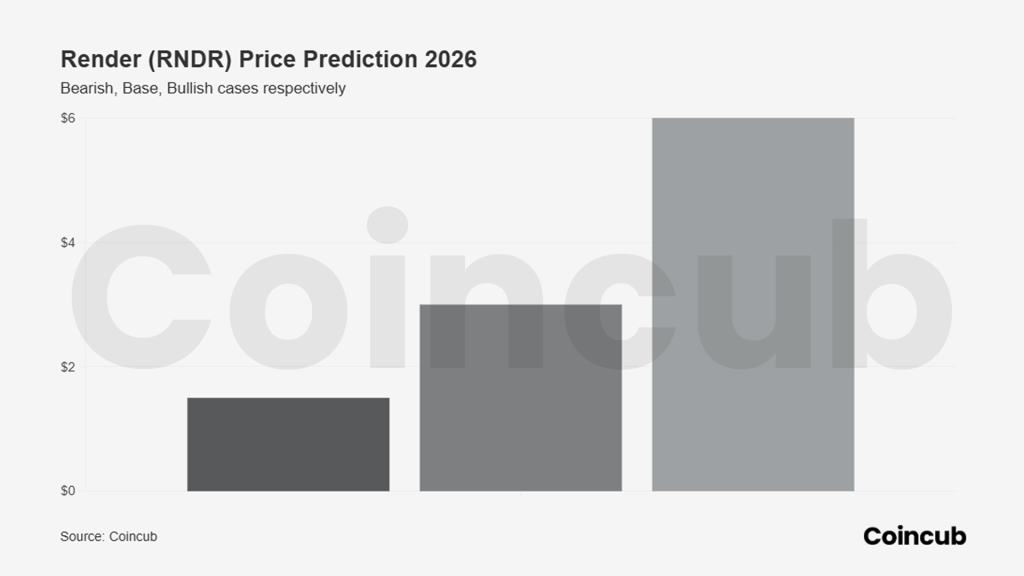
If network usage keeps growing as planned, RENDER could return to a range between $4 to $8, reclaiming its 2024 levels. This would reflect a successful transition from a 3D rendering niche to a foundational AI infrastructure play, bolstered by high-volume utility and a contracting circulating supply.
A more conservative scenario places RENDER around $2 to $5, assuming steady growth and successful integration of new GPU providers but lacking a massive retail-driven breakout. This might happen if the network maintains its current trajectory while navigating broader macro-economic shifts in the tech sector.
In a weaker case, if adoption slows or competition from centralized cloud providers intensifies, RENDER could stay around $1.20 to $1.80. Ongoing delays in global regulatory clarity for DePIN protocols or a general cooling of the AI narrative could keep the price consolidated near its current support levels.
RENDER Price Prediction for 2030
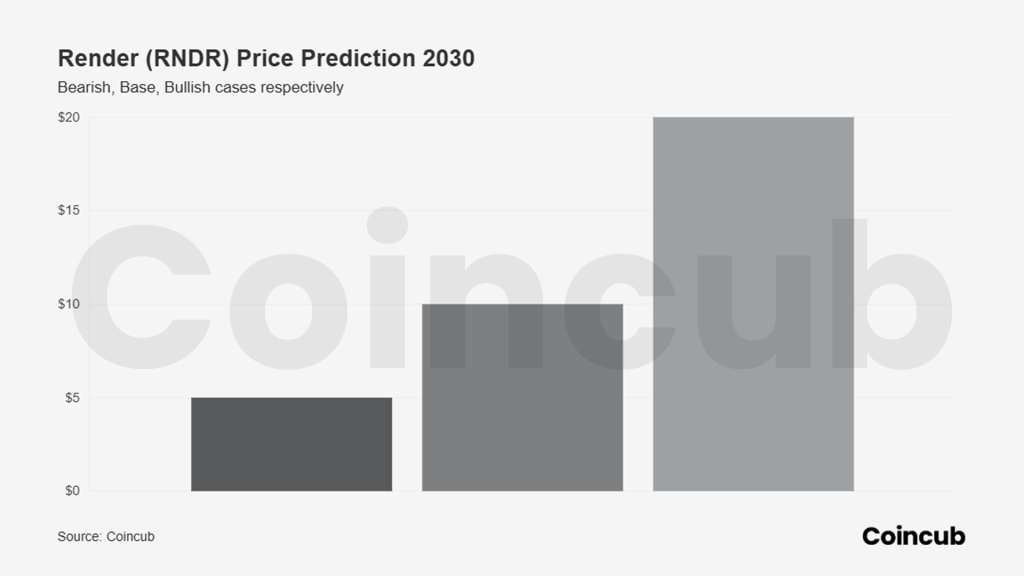
By 2030, RENDER’s price depends on whether Render becomes core infrastructure for GPU-heavy workloads. If the network scales into AI, gaming, and global creative pipelines, RENDER could reach $10 to $20 or higher. This would assume wide integration into mainstream tools and steady token burns through high job volume.
A mid-range outlook puts RENDER between $5 to $10, supported by consistent usage and a growing base of render clients and compute partners.
If Render faces heavy competition or slows its network expansion, RENDER might stay in the $3 to $5 range.
What Factors Could Influence RENDER’s Price?
Several factors can influence the price of RENDER over time. Some relate to the overall crypto market, while others depend on how well the Render Network grows and delivers on its roadmap.
Network Usage
The more jobs are processed on the Render Network, the more RENDER is used and burned. High demand for GPU power- especially from AI, film, and 3D production- can lead to more activity, which supports the token’s price.
Artist and Compute Grant Programs
A large portion of RENDER emissions is set aside to fund artists, AI projects, and compute node operators. If these grants lead to strong use cases and visible results, they could drive more attention to the platform and the token.
Token Burn and Mint System (BME)
The Burn-Mint-Equilibrium model helps manage supply. When RENDER is burned for jobs and fewer tokens are minted, this can reduce circulating supply. A healthy burn rate over time can support long-term price growth.
Integration With Creative Tools
If Render continues to integrate with major 3D software like Blender, Cinema4D, or Redshift, it becomes easier for artists to adopt. This could expand the user base and increase demand for RENDER.
Competition and Market Shifts
Other decentralized computing networks or large cloud providers may compete with Render. If alternatives offer lower costs or better performance, it could affect demand for RENDER.
Is RENDER a Good Investment?
Like all tokens, RENDDER is influenced by macro trends. If GPU demand grows globally, or if crypto sees wider adoption, RENDER could benefit. On the flip side, a weak market or regulatory change could limit upside in the short term.
Render has positioned itself as a leader in decentralized GPU computing, with a real use case and a growing base of creators and developers. Whether RENDER is a good investment depends on how you view its long-term role in the future of digital content, AI, and visual computing.
RENDER is tied to real activity. When someone pays to process a job on the network, RENDER is used. The more creators and AI teams rely on Render, the more demand there is for the token. The Burn-Mint-Equilibrium model also adds a unique supply mechanic, with tokens being burned for work and new ones issued based on emissions rules.
The project has clear goals, strong leadership, and an expanding roadmap. Over 90 artist grants have already been funded. The team is also working to bring in AI projects, studios, and new compute partners. Migration to Solana has improved speed and cost, and the shift away from Ethereum may open up more use cases.
RENDER is still a utility token in a competitive market. Its value depends on how many people actually use the network. If Render adoption grows slowly or if centralized platforms become cheaper or more flexible, the token may struggle to maintain long-term price gains.
If you believe GPU rendering, virtual production, and AI computing will shift toward decentralized models, RENDER is one of the few tokens tied directly to that space. Just keep in mind that crypto is risky and this token is no exception.
Final Thoughts on Render: Is It Fundamentally a Runner?
Render is one of the few crypto projects with a clear real-world use case. It connects creators and developers to GPU power in a way that is simple, scalable, and built for the future. Whether it’s used for 3D rendering, AI training, or virtual production, the network is solving a growing need for affordable, high-performance computing.
The RENDER token plays a central role in this system. It’s used to pay for jobs, reward node operators, and support the network’s ongoing growth through grants and emissions. With the Burn-Mint-Equilibrium model now active, the token has a direct link to network activity, which makes its value easier to track over time.
As the network expands into AI and brings on more tools, artists, and commercial partners, RENDER could become even more important. That said, like any crypto project, it still faces competition, market risks, and the challenge of scaling fast enough to meet rising demand.
If you’re interested in infrastructure projects that support real work and offer long-term potential, Render is worth watching. Its blend of utility, innovation, and community support gives it a strong foundation to build on in the years ahead.
Frequently Asked Questions (FAQs)
What does RENDER do?
RENDER is the utility token used on the Render Network. It’s used to pay for rendering jobs, reward GPU node operators, and support activity on the network. Every time a user submits a task, they use RENDER to pay. The token is also burned during this process as part of the network’s supply system.
Who uses RENDER coin?
RENDER (formerly RNDR on Ethereum, now native to Solana) is used by 3D artists, game developers, AI researchers, and content studios. It powers real rendering work and supports people who need access to high-end GPU processing without buying their own hardware.
Is Render an AI crypto?
Yes, partly. While Render started with a focus on 3D and visual content, it now supports AI workloads as well. The network provides GPU power for tasks like model training and AI compute jobs. It has launched an AI Scouts program to bring more AI projects into the ecosystem.
Is Render a gaming crypto?
Not exactly, but it is used in game development. Render helps game studios and creators process high-quality visuals and environments. It’s not limited to gaming but supports the GPU needs of developers in that space.
Is Render on Ethereum or Solana?
Render started on Ethereum using the RNDR token. In 2024, the network migrated to Solana. The new token, called RENDER, is now used for payments, rewards, and voting. Most activity has moved to Solana because of lower costs and faster speed.