Buy a Licensed Company
  Explore VASP Data
  Talk to an Expert

 Dren Hima
Rochester Institute of Technology (RIT) graduate.
Crypto Analyst, Market Researcher and Editor.
Dren Hima
Rochester Institute of Technology (RIT) graduate.
Crypto Analyst, Market Researcher and Editor.
AI-Powered Proof of Reserves: zk-SNARKs, LLMs, zkML

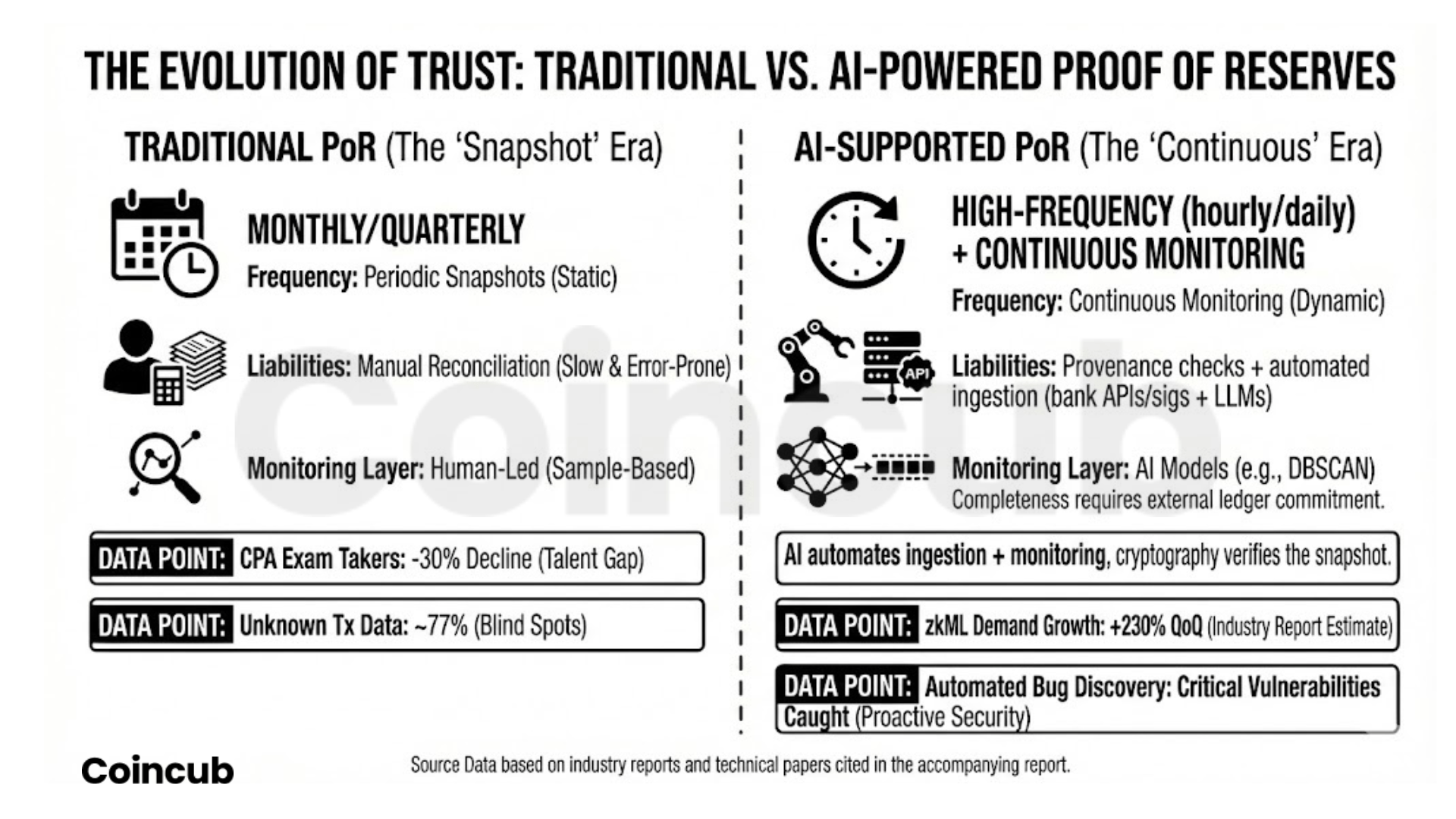
- Proof of Reserves became a baseline after the 2022 exchange blowups, but snapshot PoR leaves a gap between attestations, during which positions can shift quickly.
- Merkle trees commit to the liability dataset and enable user inclusion proofs, zk-SNARKs prove the math and constraints, completeness still depends on an external commitment to “all accounts.”
- LLMs automate off-chain statement extraction and reduce parsing fragility. Provenance checks and ledger reconciliation determine whether the pipeline is trustworthy.
- Window dressing stays a real PoR weakness; continuous monitoring and time-weighted observation make temporary borrowing patterns harder to hide.
- Unsupervised ML flags abnormal flows, agentic AI runs reconciliation workflows and logs actions, and zkML can add verifiable inference. Governance and 2026 compliance requirements shape what’s deployable.
The digital asset ecosystem has historically struggled with a lack of transparency regarding the custodial management of user funds. Following several high-profile insolvencies of centralized exchanges in 2022, the industry faced the limitations of legacy financial auditing methodologies. Traditional quarterly audits and static cryptographic snapshots proved insufficient to prevent the commingling of user deposits or to detect fractional reserve practices.
In response, the sector accelerated the adoption of Proof of Reserves (PoR), a cryptographic verification framework designed to demonstrate that a cryptocurrency trading platform holds sufficient on-chain assets to cover its corresponding off-chain user liabilities. However, static cryptographic PoR faces operational challenges. The modern digital asset landscape operates continuously. Manual data ingestion and the static nature of standard Merkle tree snapshots create a “gap problem” or operational periods between periodic audits during which shifts in financial positions can go undetected.
To address this, artificial intelligence (AI) and machine learning (ML) are being integrated into the PoR infrastructure. It is critical to distinguish between automation and verification: AI does not cryptographically prove solvency. Instead, AI enables continuous monitoring, accelerates data extraction pipelines, and runs predictive risk analytics, while the underlying cryptographic proofs verify the dataset.

This comprehensive piece explores the technical architecture, operational mechanisms, and regulatory implications of AI-supported Proof of Reserves. It examines cryptographic primitives, machine learning algorithms for anomaly detection, the integration of agentic AI and Zero-Knowledge Machine Learning (zkML), and the regulatory frameworks shaping the digital asset economy.
Cryptographic Foundations: Merkle Trees and zk-SNARKs
PoR starts with two primitives. Modern PoR systems rely on a combination of Merkle trees and zero-knowledge proofs to establish computational integrity.
Merkle Tree Liability Aggregation
A Merkle tree is an efficient cryptographic data structure used to summarize and verify the integrity of large datasets. In the context of a cryptocurrency exchange, the platform captures an anonymized snapshot of all user account balances at a specific moment. Each user’s balance set constitutes a “leaf node” at the base of the tree. These leaf nodes are iteratively hashed together in pairs, moving up the tree structure until a single cryptographic hash (the Merkle root) is produced. This singular root serves as a cryptographic commitment to the full liability dataset, and the sum of these liabilities can then be proven in zero-knowledge.
The primary architectural advantage of the Merkle tree is user-level inclusion proofing. By receiving a specific, lightweight cryptographic proof path from the exchange, an individual user can mathematically confirm that their account balance was accurately included in the calculation of total net account balances, without requiring access to any other user’s balances.
However, a Merkle tree deployed in isolation presents trust vulnerabilities. Because custodial account lists are inherently private to protect user data, the Merkle root alone cannot assure external auditors that the underlying dataset was constructed fairly. An exchange could intentionally omit certain high-value accounts, fabricate fictitious accounts, or inject manipulated negative balances to artificially suppress the total liability sum, thereby projecting an illusion of full backing.
Zero-Knowledge Proof Integration (zk-SNARKs)
To address the vulnerabilities inherent in isolated Merkle trees, advanced PoR implementations integrate Zero-Knowledge Succinct Non-Interactive Arguments of Knowledge (zk-SNARKs). Zero-knowledge proofs (ZKPs) allow one party to mathematically prove to another that a specific statement is true without revealing the underlying data.
By pairing a Merkle tree with a zk-SNARK circuit, a custodian proves that, for a specific list of accounts, the dataset satisfies strict correctness constraints. However, proving completeness (that the list actually includes all users) requires an external commitment, such as an auditor attestation of the customer ledger, a signed internal database snapshot with access controls, or regulatory checks.
Typical mathematical constraints hardcoded into a zk-SNARK circuit include:
- Global Total Contribution: Verifying that every single user record actively contributed to the computed global liability total.
- Root Integrity Assurance: Ensuring that any dynamic updates to a specific leaf node strictly produce the claimed corresponding change in the Merkle root.
- Non-Negativity Verification: Enforcing a rule that a user’s net balance cannot be negative. It is important to note that non-negativity is primarily effective for spot-only liabilities. For exchanges that offer margin, lending, or derivatives, legitimate negative balances can occur. In these cases, enforcing strict non-negativity would misrepresent liabilities; instead, the circuit definition must be adjusted to account for net equity, collateralized debt, and liquidation thresholds.
While zk-SNARKs enforce strict rules on the dataset, they remain agnostic to the extraction and ingestion of off-chain data.
Automating Off-Chain Ingestion with Large Language Models
The broader decentralized finance ecosystem relies heavily on off-chain assets. Stablecoin issuers, platforms engaged in real-world asset (RWA) tokenization, and exchanges managing fiat treasuries must routinely prove that their on-chain tokens are backed by corresponding assets held in traditional bank accounts.
Historically, the ingestion of custodial documents for PoR was a manual process reliant on rule-based Optical Character Recognition (OCR). If a traditional custodial bank subtly altered the layout of a monthly statement, these parsing systems would fail, requiring engineering intervention. To automate this ingestion, auditing platforms deploy AI-powered PDF parsing systems utilizing Large Language Models (LLMs).
LLM parsing drastically reduces manual extraction efforts because the models adapt to formatting differences without requiring rigid coordinate mapping. In enterprise platforms like LedgerLens, a “Triple-LLM Consensus” mechanism is utilized to reduce extraction errors and formatting fragility. The system passes the custodial PDF to three independent LLMs, requiring a unanimous consensus on the extracted balance before the data is accepted.
However, this automation introduces a core conceptual issue: the system is only as trustworthy as the data it is fed. AI can parse a PDF, but it cannot determine whether a malicious internal actor forged it. The weakest link remains the control of the off-chain attestations. Therefore, while LLMs automate extraction, true verification requires strict controls over provenance.
A resilient, automated PoR pipeline operates through a concrete sequence: a custodial statement arrives via a secure channel, its provenance is cryptographically checked (e.g., via bank APIs or digital signatures), the data is extracted by the LLMs, a human auditor performs a periodic or one-time setup verification, the data is reconciled against internal ledgers, it is pushed to a decentralized oracle, the PoR circuit is updated, and alerts are fired if the delta exceeds predefined thresholds.
The Vulnerability of “Window Dressing”
Furthermore, snapshot-style PoR is vulnerable to “window dressing.” An exchange could temporarily borrow assets right before a snapshot to project false solvency, and return them immediately after. Continuous monitoring and time-weighted proofs reduce this vulnerability by detecting unusual inflows and outflows around attestation windows, making it significantly harder for an insolvent platform to execute temporary funding schemes safely.
Unsupervised Machine Learning for Anomaly Detection
As transaction volumes scale, manual monitoring of capital flows becomes impossible. To maintain the integrity of a PoR system, an exchange must dynamically ensure that its verified assets are not being siphoned off through exploits.
Legacy financial systems rely on statistical models such as ARIMA and GARCH for anomaly detection. However, these models rely on assumptions of data normality and market stationarity, making them ill-suited for the highly volatile, high-frequency realities of cryptocurrency trading.
A primary challenge in blockchain anomaly detection is the lack of comprehensively labeled data. In datasets commonly used for illicit detection research, the vast majority of transactions (often over 75%) remain unlabeled or pseudonymous. Supervised learning models, which require massive datasets of pre-labeled “normal” and “fraudulent” transactions, struggle in this environment. Consequently, enterprise auditing platforms use unsupervised machine learning models that isolate outliers without prior categorization.
Empirical research evaluating high-frequency cryptocurrency data has identified unsupervised techniques that excel in continuous blockchain monitoring:
- Density-Based Spatial Clustering of Applications with Noise (DBSCAN): Groups densely packed data points together while isolating outliers that fall into low-density spatial regions. Research indicates that DBSCAN achieves high precision (up to 79.7%) with a low false-positive rate, making it highly effective for continuous supervisory monitoring of reserve outflows.
- One-Class Support Vector Machine (OC-SVM): A kernel-based algorithm that defines a mathematical boundary separating normal instances from anomalous ones. While effective at establishing baselines, it can suffer from elevated false-positive rates during periods of legitimate macroeconomic shock.
- Isolation Forest (iForest): Identifies anomalies by randomly selecting a feature and a split value. Anomalies are isolated faster (requiring shorter decision-tree paths) than normal transactions, enabling rapid triage of unusual volume spikes.
By deploying algorithms such as DBSCAN, auditing platforms can maintain continuous, algorithmic monitoring of exchange cold storage wallets and decentralized liquidity pools.
Agentic AI: The Evolution of Continuous Monitoring
The financial technology sector is transitioning toward Agentic AI workflows. While generative AI relies on prompting to create static content, Agentic AI systems pursue goals autonomously. In the context of auditing, these agents run reconciliations, fetch balances, compare sources, log everything, and escalate exceptions.
The implementation of agentic workflows helps offset severe accounting workforce shortages, with reports indicating an exodus of over 300,000 professionals and a 30% drop in CPA exam takers.
Continuous monitoring, facilitated by agentic AI, supplements traditional year-end procedures with perpetual risk assessment. These autonomous agents navigate audit integrations, handle data entry and continuous transaction reconciliation, and maintain comprehensive audit trails. By automating these processes, experienced human auditors can focus on complex procedural reviews rather than manual data aggregation.
Securing Autonomous Systems with zkML
Delegating financial monitoring to AI introduces a regulatory challenge: the “black box” problem. If an AI agent evaluates a tokenized asset’s risk exposure, stakeholders must be certain that the AI model was correctly executed and not secretly altered to project false solvency.
To mitigate risks associated with data forgery or model tampering, Zero-Knowledge Machine Learning (zkML) operates as a cryptographic trust primitive. zkML enables mathematical proof that a specific AI model was correctly executed on a dataset to produce a given output, without requiring the verifier to re-run the computationally intensive model or exposing the AI model’s proprietary weights.
The integration of zkML into decentralized finance allows platforms to generate cryptographic proofs of their AI’s operations directly on-chain. This technology fundamentally upgrades PoR from a static compliance report into a continuous, underwritable verification system, lowering information asymmetry and reducing counterparty premiums.
Runtime Controls and Predictive Liquidity Analytics
The entire cryptographic architecture of a PoR system is ultimately implemented as smart contracts. If the underlying code contains logical vulnerabilities or access control flaws, the system can be manipulated to project false solvency, or the underlying reserves can be drained.
Defenses are moving from relying solely on pre-deployment static reviews to implementing continuous runtime controls and AI-driven defense-in-depth strategies. Custom-tuned AI models provide automated analysis of codebases. For example, AI auditors are now capable of flagging critical logic errors, such as microscopic mathematical rounding mistakes in withdrawal functions, just before deployment, preventing scenarios where an automated loop could drain a reserve pool without ever posting collateral.
Post-deployment security solutions provide 24/7 on-chain monitoring to detect exploits as they occur. These systems power AI-fed circuit breakers. If machine learning models detect a highly anomalous withdrawal sequence, the circuit breaker instantly pauses the smart contract, attempting to halt unauthorized outflows at the block level rather than waiting for human intervention hours later. However, auto-pause capabilities introduce significant governance risks; false positives can freeze legitimate withdrawals, and attackers may intentionally trigger pauses as a Denial-of-Service (DoS) vector. Therefore, AI-fed circuit breakers must be implemented with strict human override policies, rate limits, and clearly defined triggers.
Predictive Liquidity Stress Testing
Beyond security, assessing true solvency requires distinguishing between the mere existence of assets and the actual liquidity profile of those assets. An exchange may offer 1-to-1 backing of user deposits, but if those reserves are heavily concentrated in volatile, illiquid altcoins, the platform remains vulnerable to cascading market panics.
Organizations use AI predictive analytics to run advanced simulations of severe market stress events. These models forecast how long it would take to exit a specific position and the associated slippage cost during a sharp downturn. By analyzing historical price data, order book depth, and market sentiment, AI helps portfolio managers anticipate volatility and proactively rebalance reserve assets to maintain stability.
The Regulatory Landscape and Compliance Outlook
The technological updates in AI and blockchain auditing are occurring alongside the tightening of global regulatory frameworks.
The EU AI Act
The European Union’s AI Act is the most comprehensive regulatory framework governing artificial intelligence globally. Under this legislation, AI systems deployed in critical sectors, specifically finance, risk assessment, and automated decision-making, are classified as “High-Risk AI Systems”.
August 2, 2026, is the main applicability date for high-risk AI systems to adhere to core requirements. However, specific carve-outs grant longer transition periods (up to August 2027) for AI systems embedded in regulated products such as medical devices or machinery. Financial institutions utilizing AI for Proof of Reserves or automated auditing must implement:
- Continuous Risk Management: A documented, lifecycle-long risk assessment and mitigation system.
- Strict Data Governance: Procedures ensuring that all training, validation, and testing datasets are representative and carefully managed to minimize discriminatory outcomes.
- Traceability and Transparency: Comprehensive logging of all AI activity to ensure traceability of results, alongside detailed technical documentation.
Global Regulatory Convergence
In the United States, the rescission of SEC Staff Accounting Bulletin (SAB) 121 via SAB 122 in January 2025 shifted the accounting framework for custodied crypto assets. This regulatory shift removes a significant historical roadblock, paving the way for a broader trend of traditional banks expanding into digital asset custody services, which, in turn, drives demand for institutional-grade PoR infrastructure.
Globally, the EU’s Markets in Crypto-Assets (MiCA) regulation has entered supervisory enforcement, mandating that authorized entities maintain robust transaction monitoring. In Africa, some jurisdictions, including Nigeria, have signaled a risk-based approach that gives authorities the power to mandate licenses and annual impact assessments for high-risk financial AI systems, mirroring the EU’s approach.
Risks, Limitations, and the Need for AI Governance
Integrating artificial intelligence into financial auditing introduces specific risks. The probabilistic nature of LLMs presents a unique challenge that requires human oversight and aggressive mitigation.
AI Hallucinations
Artificial intelligence models function by predicting the next most likely token in a statistical sequence, making them susceptible to “hallucinations,” instances where the AI generates outputs that appear credible but are factually incorrect. Research conducted by Stanford in 2024 found that general-purpose chatbots exhibited hallucination rates of 58%-82% on specialized legal queries, while a separate medical study reported a near 29% error rate in generating citations.
In the context of financial auditing, an AI hallucination could be highly damaging. To counteract this, systems must deploy stringent cryptographic constraints and mechanisms such as Triple-LLM Consensus. Furthermore, a human-in-the-loop verification step remains critical to ensure the AI’s initial extraction logic aligns with reality before automation takes over.
Data Poisoning and Governance
The efficacy of an AI anomaly detection model is entirely dependent on the integrity of the data it consumes. If a threat actor injects subtle malicious transactional patterns into the AI’s training data, the model’s baseline parameters can be compromised. An attacker could feed the AI poisoned data, training the algorithm to accept highly anomalous liquidity drains as normal market behavior.
To defend against these vectors, the industry relies on dedicated AI Governance platforms. These tools act as an identity and data loss prevention layer for artificial intelligence, enforcing strict policies around AI usage, tracking model behavior, and maintaining immutable audit trails of dataset lineages to detect poisoning attempts early.
Frequently Asked Questions (FAQ)
What is the difference between AI monitoring and cryptographic verification in PoR?
Proof of Reserves relies on cryptography (Merkle trees and zk-SNARKs) to mathematically verify that a specific dataset adheres to strict rules and that assets match liabilities. AI does not verify solvency. Instead, AI provides continuous monitoring, automates the extraction of off-chain data from bank statements, and detects transaction anomalies.
How do you handle negative balances in zk-SNARK PoR systems?
While simple spot-exchanges use zk-SNARKs to enforce a strict “non-negativity” rule (ensuring no user has a balance below zero to fake solvency), this approach is inadequate for complex exchanges. For platforms that offer margin, lending, or derivatives, legitimate negative balances are possible. The circuit definitions must be adjusted to calculate net equity and collateralized debt rather than simple non-negativity.
What is Agentic AI, and how is it used in auditing?
Unlike generative AI, which simply answers prompts, Agentic AI operates autonomously. In auditing, an AI agent can autonomously execute database queries, cross-reference API balances, run reconciliations, and escalate exceptions. This helps offset industry-wide staff shortages by automating mundane reconciliation tasks and maintaining complete audit logs.
What role does zkML play in AI-powered monitoring?
Zero-Knowledge Machine Learning (zkML) solves the “black box” problem in AI by enabling platforms to mathematically prove that a specific AI model was correctly executed on a dataset to produce a given output. This ensures that autonomous AI agents haven’t been secretly altered, allowing the AI’s operations to be verified without exposing proprietary code.
How do 2026 regulations like the EU AI Act impact crypto auditing software?
The EU AI Act classifies AI systems utilized in financial services and risk assessment as “High-Risk”. By August 2026 (the main applicability date), platforms utilizing high-risk AI must comply with strict mandates regarding data governance, continuous risk mitigation, and comprehensive activity logging.
What are the risks of using AI in crypto audit tools?
The primary risks are AI hallucinations (where the model confidently generates false data) and data poisoning (where malicious actors corrupt the AI’s training data to bypass security alerts). Mitigating these threats requires multi-model consensus, continuous data cleanliness checks, human oversight for verification, and dedicated AI governance platforms.