Buy a Licensed Company
  Explore VASP Data
  Talk to an Expert


Venice Token (VVV) Price Prediction 2026-2030

- VVV trades at around $32 after recently reaching an all-time high of $34.51.
- Venice AI connects VVV directly to its product through staking, AI compute access and DIEM.
- VVV emissions have fallen to 3 million tokens per year, while Venice continues buying and burning tokens.
- Our base case puts VVV between $25 and $38 by the end of 2026 and between $32 and $60 in 2030.
- The biggest factors to watch are Venice’s user growth, API demand, revenue, token burns and competition in the AI market.
Venice Token (VVV) trades at about $32 as of 22 September 2026, giving it a market capitalisation of roughly $1.54 billion, according to CoinMarketCap. The token set an all-time high of $34.51 the day before, after rising about 39.5% in a week, according to CoinGecko, which makes timing central to any Venice Token price prediction.
VVV is the token of Venice AI, a privacy-focused platform for private, uncensored text, image and code generation. Unlike most crypto assets, its value connects directly to a working product: holders stake VVV for access to AI compute, and Venice uses part of its revenue to buy and burn the token. VVV’s future price therefore depends on four variables, namely platform usage, revenue-funded burns, staking demand and the annual emission rate. Every VVV price forecast below is a scenario range, and none of them is a guaranteed outcome.
VVV Price Prediction at a Glance
Before looking at each year, the snapshot below shows where VVV stands today, combining live market data with Venice’s own figures.

| Metric | Value |
|---|---|
| Current price (22 September 2026) | About $32 |
| Market capitalisation | About $1.54 billion |
| Circulating supply | About 48.4 million VVV |
| Total supply | About 81 million VVV, with no fixed maximum |
| Annual emissions | 3 million VVV (since 1 July 2026) |
| All-time low | $0.5133 (27 January 2025) |
Those figures describe a token near its peak after an extraordinary run. Because a large share of supply sits outside circulation, our scenarios value VVV on total supply, which we assume stays near 80 million as burns roughly offset emissions.
| Year | Assumed total supply | Bear case | Base case | Bull case |
|---|---|---|---|---|
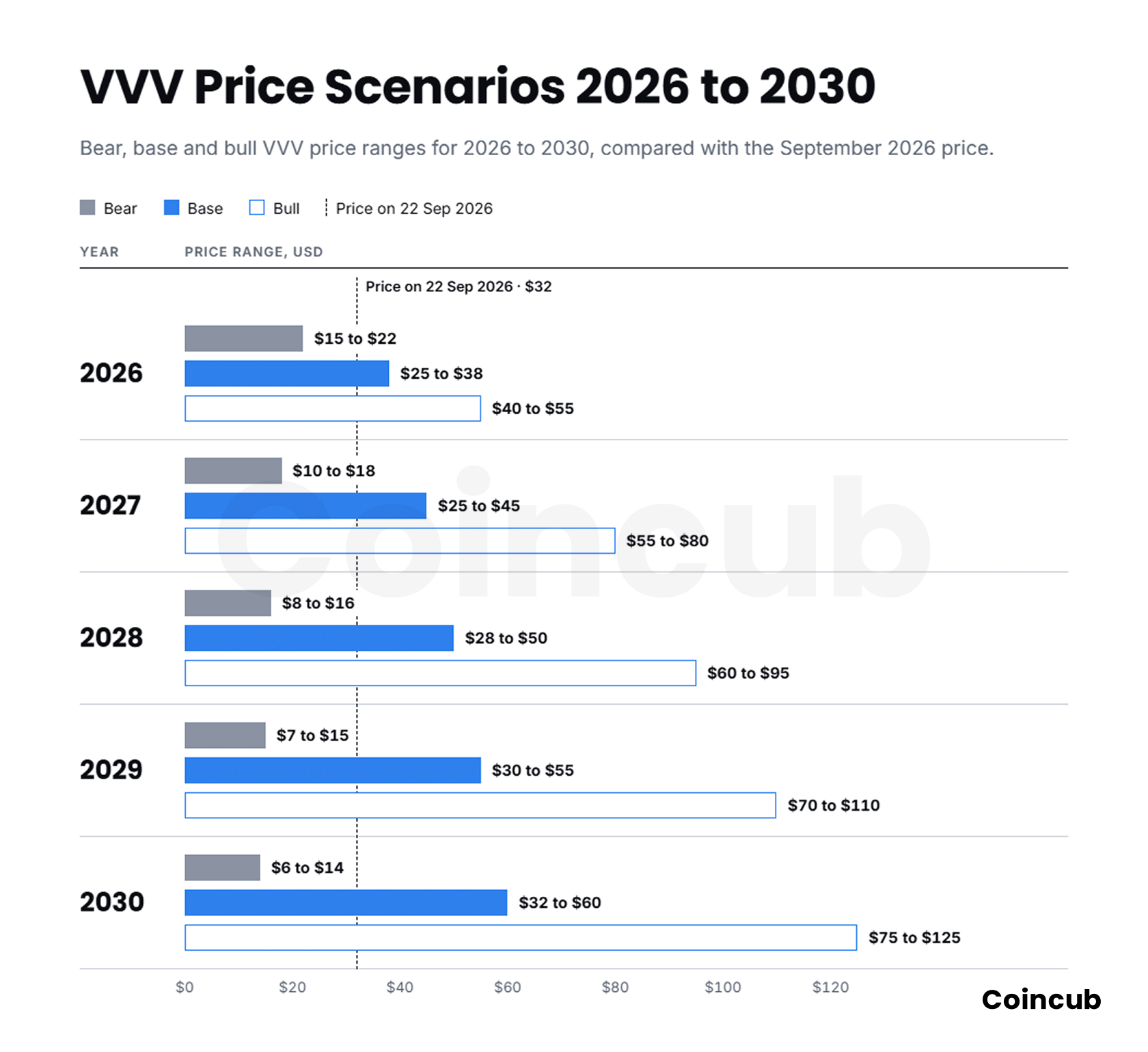
| 2026 (year end) | 81M VVV | $15 to $22 | $25 to $38 | $40 to $55 |
| 2027 | 81M VVV | $10 to $18 | $25 to $45 | $55 to $80 |
| 2028 | 80M VVV | $8 to $16 | $28 to $50 | $60 to $95 |
| 2029 | 80M VVV | $7 to $15 | $30 to $55 | $70 to $110 |
| 2030 | 80M VVV | $6 to $14 | $32 to $60 | $75 to $125 |
What Is Venice Token (VVV)?
To understand those ranges, it helps to understand the product behind them. Venice AI launched in May 2024 and, according to the Venice Series A announcement, had 3.5 million registered users by July 2026, processed 1.3 trillion AI tokens a month and handled about 2 million API calls a day.
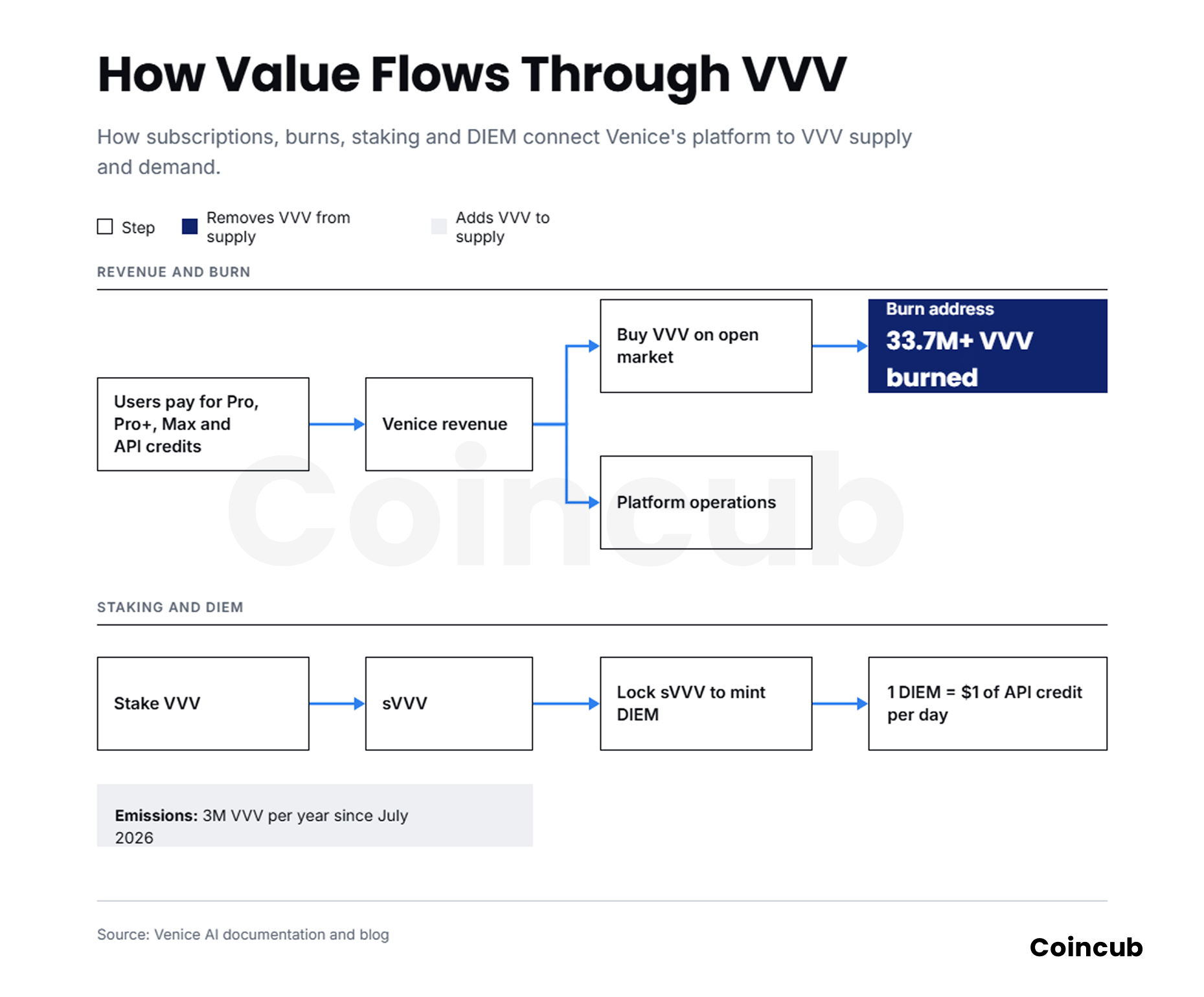
VVV, the Venice AI token, launched on the Base network on 27 January 2025 and works as the platform’s capital asset. Holders can stake it to earn yield, and the VVV token page explains that staking 100 VVV unlocks Venice Pro. Stakers receive sVVV, a receipt token they can lock to mint DIEM. According to the Venice API documentation on VVV and DIEM, each staked DIEM provides $1 of API credit every day, so VVV effectively becomes a claim on AI compute. Developers building AI agents and smart contracts can use that capacity without paying per request.
VVV Price Prediction for 2026
With the token at a fresh high, the VVV price prediction for 2026 depends mainly on whether momentum holds. Daily trading volume near $150 million shows deep interest, yet a move of more than 60 times from the all-time low leaves room for sharp pullbacks. The AI narrative is strong, and Venice’s $65 million Series A in July 2026, led by Dragonfly at a $1 billion valuation, added credibility.
Platform adoption supports the token directly. Venice buys and burns VVV for every new Pro, Pro+ and Max subscription, at $2, $5 and $10 respectively, as set out in its programmatic buy-and-burn announcement. Meanwhile, emissions fell to 3 million VVV a year on 1 July 2026, so burns now offset a much larger share of new supply.
Taking these together, our bear case of $15 to $22 assumes a correction after the rally, the base case of $25 to $38 assumes consolidation near current levels, and the bull case of $40 to $55 requires continued AI-sector momentum.
VVV Price Prediction for 2027
Looking further out, 2027 depends on whether Venice keeps growing users and API demand. Our base case assumes steady growth in registered users and API calls, with agent developers using DIEM for predictable compute costs. DIEM adoption matters because every DIEM requires locked sVVV, and the mint rate rises as DIEM supply grows, so each new unit locks more VVV.
On the supply side, low emissions and ongoing burns should keep total supply roughly flat. Accordingly, our 2027 bear case sits at $10 to $18, the base case at $25 to $45 and the bull case at $55 to $80.
VVV Price Prediction 2030
By 2030, the VVV price depends on how large private AI becomes and how much of Venice’s revenue reaches the token. Our base case assumes that the AI market keeps expanding, that Venice remains a leading privacy-focused provider and that DIEM becomes a standard way for agents to pay for inference. The bull case assumes Venice becomes a major API provider, with burns steadily shrinking supply.
On valuation, we assume about 80 million VVV in total supply. That gives a VVV price in 2030 of $6 to $14 in the bear case, $32 to $60 in the base case and $75 to $125 in the bull case, which implies a fully diluted value of $6 billion to $10 billion.
VVV Tokenomics Explained
Because supply mechanics drive so much of this outlook, VVV’s tokenomics deserve a closer look. According to Venice’s tokenomics FAQ, the initial supply was 100 million VVV, allocated 50% to users and the AI community through an airdrop, 35% to Venice, 10% to an incentive fund and 5% to liquidity.
Emissions, Burns and DIEM
Emissions have fallen sharply since launch. Venice’s DIEM technical breakdown shows annual issuance cut from 14 million to 10 million VVV in August 2025, and the FAQ records later cuts to 8 million and then 6 million in February 2026. Venice then announced monthly cuts that took it to 3 million by July 2026.
Burns work in the opposite direction. Venice says more than 33.7 million VVV has been burned, equal to roughly 42% of today’s total supply, including unclaimed airdrop tokens destroyed in March 2025. As a result, dilution is now modest, and revenue growth could make supply shrink.
What Could Drive VVV Higher?
Given those mechanics, the upside depends mostly on growth at Venice itself. User growth and AI demand come first, since every new paid subscription triggers a burn. Revenue growth therefore feeds directly into the buy-and-burn mechanism, which Venice has used since November 2025.
Beyond that, staking demand rises as users stake for Pro access and yield, and DIEM adoption locks more VVV as its mint rate climbs. How crypto staking works matters here, because staked tokens are removed from trading supply.
What Could Push VVV Lower?
Every driver has a counterweight. AI-token competition is intense, and projects covered in the Render price prediction compete for the same investor attention. Platform adoption could also slow if larger AI providers improve their privacy offerings.
Tokenomics carry risks too. Emissions could exceed burns if revenue weakens, and Venice’s 35% allocation plus the incentive fund concentrates a large share of supply, which can pressure liquidity. Finally, crypto market volatility hits recent outperformers hardest, and VVV’s token FDV already exceeds the $1 billion valuation of Venice’s Series A.
VVV Price Prediction Methodology
Given how closely VVV follows the business, our VVV forecast uses market-cap scenarios based on total supply. We assume emissions of about 3 million VVV a year, offset by burns that grow with revenue, leaving total supply near 80 million to 81 million.
User-growth and revenue assumptions then set each scenario’s valuation. The bear case assumes slowing growth and an AI-sector correction, the base case assumes steady expansion, and the bull case assumes Venice scales into a major API provider with rising burns.
Is VVV a Good Investment?
Whether VVV fits a portfolio depends on your goals and risk tolerance, so this article gives no buy or sell verdict. Instead, investors would need to separate utility from speculation: Venice has real users and revenue, yet the token has also benefited from AI-sector enthusiasm.
Beyond that, VVV concentrates exposure in the AI sector, depends on one company’s execution and carries tokenomics risk if burns fail to keep pace. If you are comparing options, please review the best crypto to buy in 2026 or compare other crypto price predictions.
Frequently Asked Questions (FAQ)
Can VVV reach $10? +
VVV already trades far above $10, at about $32 in September 2026. A return to $10 would require a decline of roughly 70%, which falls within our bear cases for 2027 to 2030 if AI demand or Venice's growth disappoints.
Can VVV reach $50? +
VVV reaching $50 would imply a fully diluted value of about $4 billion on 80 million tokens. That sits within our base case for 2028 to 2030, provided Venice keeps growing users, revenue and burns.
Can VVV reach $100? +
A $100 VVV would imply a fully diluted value of about $8 billion, roughly three times its September 2026 level. Only our 2029 and 2030 bull cases reach that price, which would require Venice to become a major AI API provider.
What will VVV be worth in 2030? +
Our 2030 base case places VVV between $32 and $60, with a bear case of $6 to $14 and a bull case of $75 to $125. These ranges assume about 80 million VVV in total supply and may differ widely from actual prices.
Does VVV have a maximum supply? +
VVV has no fixed maximum supply. It launched with 100 million tokens, and new VVV is still emitted at 3 million a year. However, Venice has burned more than 33.7 million VVV, and total supply now stands near 81 million.
How does VVV staking work? +
Holders stake VVV to earn yield and receive sVVV in return. Staking 100 VVV unlocks Venice Pro, and sVVV can be locked to mint DIEM, which gives $1 of Venice API credit per day while staked.