Buy a Licensed Company
  Explore VASP Data
  Talk to an Expert
 Buy a registered Canadian MSB

Learn about Januar’s B2B crypto-fiat platform, covering fees, IBAN accounts, custody, RFQ trading, and whether it suits EEA crypto businesses in 2026.
| Founded | 2021 |
| Headquarters | Denmark |
| Website | https://www.januar.com/ |
| Target clients | B2B, Crypto exchanges, VASPs, institutional investors, Web3 startups |
| Employees | 11 - 50 |
| Market cap | Not applicable (privately held) |
| Daily volume trading | Not publicly disclosed |
| Revenue | Not publicly disclosed |
| Fiat supported | EUR, DKK, USD |
| Cryptocurrencies | BTC, ETH, SOL, TRX, USDC, EURC |
| Pricing Plans | €1,500 onboarding and €600 monthly for EUR accounts; USD accounts require an additional €1,000 onboarding and €1,000 monthly fee |
| Cryptocurrency Fees | 0.10% for stablecoin trades; tiered volume-based fees for other cryptos starting at 0.20% (buy) and 0.28% (sell) |
| Tokenization services | |
| Offers Bitcoin ETF | |
| Staking services | |
| Interest on savings | N/A |
| Crypto Custody | |
| Crypto Trading |
| Invoicing service | |
| Payments Services | |
| Cards | |
| API | |
| Insurance Coverage | |
| Interest on savings | N/A |
| Crypto licenses VASP | Regulated by the Danish Financial Supervisory Authority to handle compliant crypto operations and custody. Crypto services are offered under MiCA grandfathering; Januar states CASP authorisation is in progress |
| Banking licenses | Not a licensed bank; operates as an authorized Payment Institution |
| Money Transmitter or E-Money Licences | Holds a Payment Institute License (FTID: 21230) from the Danish FSA, passported across the European Economic Area (EEA) |
The intersection of traditional banking and the digital asset economy remains a complex operational challenge for businesses. Due to strict Anti-Money Laundering (AML) requirements and a general lack of blockchain forensics expertise, many incumbent commercial banks routinely decline to service companies that engage in cryptocurrency-related activities. This dynamic frequently forces fully compliant Virtual Asset Service Providers (VASPs) to operate without stable fiat banking rails.
Januar is a Copenhagen-based financial infrastructure provider that was established to address this specific gap in the European market. Operating under a Payment Institute License granted by the Danish Financial Supervisory Authority (Finanstilsynet), Januar provides operational International Bank Account Numbers (IBANs), digital asset custody, and integrated fiat-to-crypto trading services. The platform is built exclusively for Business-to-Business (B2B) clients within the European Economic Area (EEA).
Januar was founded in 2021 by a team of blockchain compliance specialists, former traditional bankers, and financial technology engineers. The founding team, including Chief Strategy Officer Simon Ousager and Chief Risk & Compliance Officer Marcus Mølleskov, recognized a persistent structural issue in the European financial sector: compliant crypto-native businesses were frequently denied basic operational bank accounts.
Legacy banks, equipped with traditional risk models, often found it difficult or too costly to underwrite the specific AML risks associated with digital asset transaction flows. This resulted in high startup costs and operational instability for European crypto firms.
Januar was established to act as a regulated intermediary. By securing a Payment Institute License from the Danish Financial Supervisory Authority, Januar positioned itself to provide fully compliant fiat-to-crypto payment rails. Backed by a historic €6 million seed round (the largest in Danish history at the time) and a subsequent €1.5 million extension, the company built an infrastructure stack designed to serve as a reliable foundation for Web3 companies navigating the European regulatory landscape.
Januar categorizes its core services into four primary pillars, designed to provide a unified environment for managing both traditional fiat currencies and digital assets.
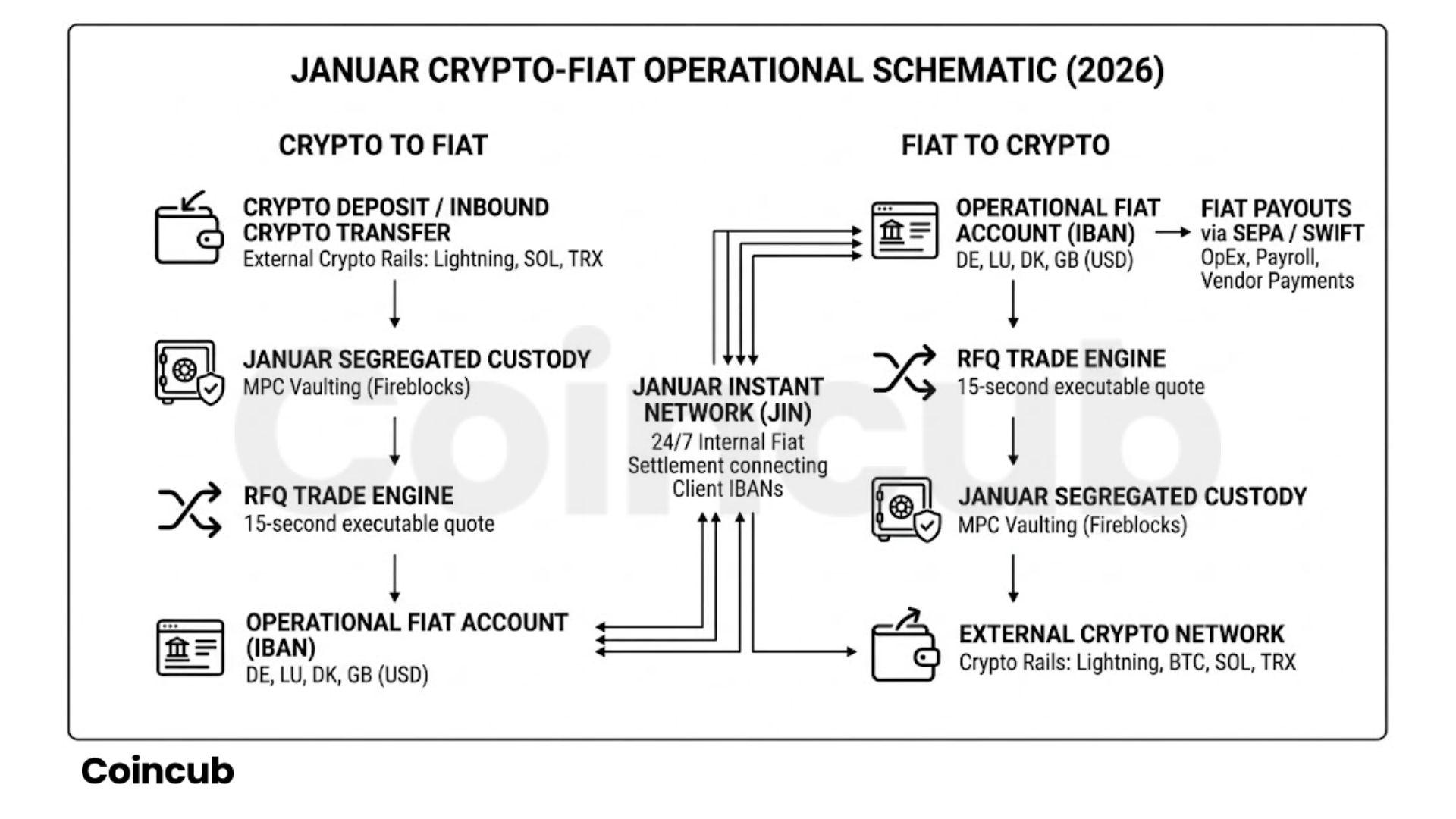
The Januar Account provides corporate clients with localized European IBANs registered under their own legal company name. This infrastructure is necessary for standard business operations, including processing payroll, paying vendors, and managing fiat deposits from customers.
Depending on the currency and payment rail required, accounts come with specific regional identifiers:
It is important to note Januar’s specific regulatory status. They operate as a Payment Institute. According to their Terms of Service, fiat accounts must be utilized for active operational payment flows. They are legally restricted from serving as passive, yield-bearing storage facilities for idle corporate cash reserves.
For digital asset storage, Januar provides an institutional-grade custody solution. Rather than building proprietary ledger storage, Januar integrated Fireblocks, an industry-standard infrastructure provider utilizing Multi-Party Computation (MPC) cryptography.
This segregated vault infrastructure ensures that private keys are never centralized in a single location, reducing the risk of a single point of failure. The wallet supports a curated selection of major assets: BTC, ETH, SOL, TRX, USDC, and EURC. Januar does not charge setup or maintenance fees for wallet storage, a pricing decision that encourages businesses to consolidate their crypto holdings within the Januar ecosystem.
Januar Trade is the platform’s proprietary Over-The-Counter (OTC) execution desk designed for corporate fiat-to-crypto conversions. The system utilizes a Request for Quote (RFQ) model.
When a client queries a trade, the engine aggregates liquidity across approved venues and locks the execution price for 15 seconds. This locked window protects corporate treasurers from intraday market slippage during the execution of large block trades. Assets purchased are settled directly into the client’s connected Januar Wallet.
Traditional fiat settlement networks like SEPA and SWIFT operate on standard business hours and are unavailable during weekends and public holidays. This creates a liquidity mismatch for crypto trading firms that operate 24/7.
To address this, Januar launched the Januar Instant Network (JIN). JIN functions as an internal, closed-loop ledger system that allows authenticated Januar clients to transfer fiat currency to each other instantly, at any time of day.
Additionally, Januar integrated support for the Bitcoin Lightning Network. This Layer-2 scaling solution allows businesses to process high-frequency, low-cost Bitcoin micro-transactions, bypassing the standard confirmation times and variable network fees associated with the main Bitcoin blockchain.
⚡ NEW: Bitcoin Lightning Payments — Now Live on Januar ⚡
We’re excited to announce that Bitcoin Lightning support is now available directly through your Januar Business Account — enabling your business to send and receive BTC instantly, reliably, and under full EU compliance.… pic.twitter.com/Vutg9hh6nZ
— Januar (@januar) June 19, 2025
Beyond serving individual corporate accounts, Januar provides B2B2B infrastructure products designed to help other financial platforms scale their operations.
Januar Embedded allows crypto platforms, such as retail exchanges, custody providers, and payment gateways, to offer dedicated EUR IBANs directly to their end users.
By integrating Januar’s API, an exchange can generate unique Virtual IBANs (VBANs) for individual retail customers. When a user deposits fiat, the API automatically reconciles the payment to their specific profile, streamlining accounting processes. Under this model, the client platform defines its own pricing and manages the customer relationship, while Januar handles the underlying regulatory compliance, transaction monitoring, and European passporting.
Januar Flow is a specialized service tailored for traditional, legacy banks that wish to serve crypto-curious clients but lack the internal risk models to do so safely.
When a traditional bank utilizes Januar Flow, Januar acts as the single, regulated counterparty for all crypto-related fiat transactions. Instead of the legacy bank managing flows from dozens of offshore exchanges, all activity is routed through Januar. Januar then provides the traditional bank with comprehensive risk reporting, including flow-of-funds graphs, counterparty risk analyses, and thorough CDD/KYC reviews, allowing the legacy institution to mitigate its compliance exposure.
For technical platforms requiring automated, high-frequency transactions, Januar offers comprehensive RESTful API access. The API is built to give developers programmatic control over account management, crypto conversions, and payout triggers.
Security protocols for the API are rigorous. Every HTTP request requires an Authorization header utilizing a specific JanuarAPI scheme. Developers must authenticate using three components:
Januar provides a dedicated User Acceptance Testing (UAT) environment (api.test.januar.com) for developers to build and test their integrations before deploying to the live production environment. The API relies entirely on JSON payloads for requests and responses. Notably, monetary amounts are encoded as strings (e.g., “203.10”) rather than floats to prevent precision errors during programmatic calculation.
To facilitate real-time reconciliation, the API supports comprehensive webhooks. Client systems can subscribe to specific events, prompting Januar to send automated POST requests the moment a transaction status changes. This allows a company’s internal ERP or accounting software to automatically update ledgers when a SEPA deposit clears or a Lightning Network invoice is settled.
A crypto bank’s regulatory framework is a critical factor for institutional clients evaluating counterparty risk. Januar’s adherence to European financial law is a core component of its business model.
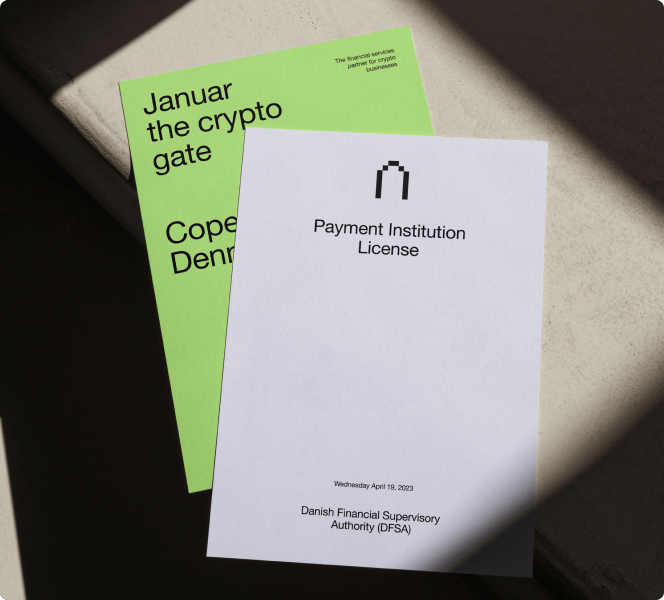
Januar operates as an authorized Payment Institute under the supervision of Finanstilsynet (the Danish Financial Supervisory Authority). Maintaining this license requires strict adherence to the Danish Anti-Money Laundering Act. In December 2024, Januar published an update referencing an inspection by the Danish Financial Supervisory Authority (Finanstilsynet) focused on its AML controls.
To protect corporate treasuries, Januar employs strict safeguarding measures in accordance with the Danish Payment Act. Client fiat balances are never held directly on Januar’s corporate balance sheet. Instead, funds are pooled in segregated custodial accounts at tier-one European credit institutions. This legal structure renders client funds bankruptcy-remote; in the event of Januar’s insolvency, client assets are protected from corporate creditors.
The European regulatory landscape is shifting under the Markets in Crypto-Assets (MiCA) regulation. While the framework allows a maximum transitional “grandfathering” period for existing crypto-asset service providers until July 2026, individual EU member states can shorten this window or opt out entirely. Because Januar built its foundation on strict Danish compliance standards, it is well-positioned for this fragmented transition.
Additionally, following European Banking Authority (EBA) guidelines on stablecoins, Januar halted trading in Tether (USDT) for EU customers in early 2025 to comply with MiCA and ESMA standards. Clients retain full wallet support to hold, deposit, and withdraw their existing USDT balances, but trading is routed to compliant alternatives such as USDC and EURC.
Januar’s pricing schedule is structured for established corporate entities. The presence of substantial onboarding and monthly fees acts as a commercial filter, indicating that the service is tailored for scale-ups and institutional players rather than early-stage startups.
Execution fees via the RFQ engine are calculated on a 30-day rolling volume basis and adjusted daily, rewarding higher institutional flow with reduced rates:
| 30-Day Rolling Volume | Buy Fee | Sell Fee |
| €0 + | 0.20% | 0.28% |
| €10,000 + | 0.17% | 0.25% |
| €50,000 + | 0.15% | 0.23% |
| €100,000 + | 0.13% | 0.21% |
| €250,000 + | 0.11% | 0.19% |
| €500,000 + | 0.10% | 0.18% |
The European B2B crypto banking sector features several distinct approaches to bridging fiat and digital assets. Evaluating Januar requires benchmarking it against key regional competitors.
BCB Group operates a multi-jurisdictional model, regulated by the UK Financial Conduct Authority (FCA), while maintaining Swiss and EU entities. Both firms offer robust fiat account functionality, OTC trading, and proprietary instant settlement networks (Januar’s JIN serves a similar function to BCB’s established BLINC network).
BCB Group is highly tailored to global institutional liquidity providers and prime brokers that require cross-border capabilities spanning the UK, Switzerland, and the EU. Januar provides a more localized, native experience for companies that primarily require seamless integration within the Eurozone’s SEPA system, avoiding post-Brexit regulatory complexities.
AMINA operates as a fully licensed, FINMA-regulated Swiss bank. While Januar operates under a Payment Institute license restricted to payment routing and custody, AMINA provides a broader suite of traditional banking products, including corporate credit cards, flexible fiat overdrafts, and Lombard loans.
AMINA is highly aggressive in courting early-stage companies, offering a “Zero-Fee Web3 Startup Package” that waives onboarding and monthly fees for eligible projects. This makes AMINA highly attractive for seed-stage startups or mature firms needing credit lines. Januar, conversely, is highly optimized for technical platforms looking to embed API-driven payment rails deeply into their own software architecture.
Bank Frick is a traditional universal bank with a long history of early crypto adoption and is regulated within the EEA. A core feature of Bank Frick is its established Virtual IBAN (VBAN) API, which enables crypto exchanges to automatically allocate incoming user deposits.
Both institutions compete heavily in the B2B2B infrastructure space. While Bank Frick offers secure cold storage and direct market access to a sophisticated institutional clientele, it utilizes highly granular fee structures (including charges for specific regulatory reporting, such as EMIR). Januar’s embedded account solutions offer a more modernized, Tuum-backed API interface with a simplified, flat monthly fee structure for basic operational flow.
Because Januar operates strictly in the B2B space, performance is measured by operational continuity, API uptime, and compliance efficiency rather than retail consumer reviews.
Strengths:
Limitations:
Januar provides a highly specialized infrastructure solution designed to solve a specific operational bottleneck for European digital asset companies. By foregoing retail services and limiting jurisdictional exposure strictly to the EEA, the company has built a stable environment tailored for the MiCA era.
Januar is built for EEA-based crypto businesses that need named IBANs, API-led payments, custody, and RFQ conversions in one place. The pricing and EEA-only scope make it a poor fit for early-stage teams or for groups that need global coverage. If the use case is operational banking rails with compliance-first onboarding, Januar is one of the cleaner options in Europe.
No. Januar’s licensing and terms of service strictly dictate that they only service business entities legally registered and operating within the European Economic Area (EEA).
No. Januar is an authorized Payment Institute under the Danish Financial Supervisory Authority. They provide operational IBANs, payment routing, and crypto custody, but they do not offer credit cards, business loans, or fiat overdraft facilities.
Yes. In compliance with the Danish Payment Act, Januar practices strict safeguards for client funds. Fiat balances are pooled in custodial accounts at tier-one banks and remain legally bankruptcy-remote from Januar’s corporate liabilities.
JIN is an internal ledger system that allows authenticated Januar corporate clients to instantly transfer fiat currency to one another 24/7, bypassing the standard settlement delays and weekend closures of the SEPA and SWIFT networks.
Januar utilizes Fireblocks’ Multi-Party Computation (MPC) technology for institutional custody. Januar manages the cryptographic infrastructure on behalf of the client, utilizing segregated vaults, while clients control access via multi-factor authentication and secure API keys.
No. Januar’s Terms of Service explicitly prohibit using fiat Payment Accounts as passive, yield-bearing storage or long-term deposit accounts. The accounts are designed strictly for active operational payment routing.
Januar supports trading and custody for MiCA-compliant stablecoins, including USDC and EURC. However, to align with European ESMA regulations, Januar halted all trading functions for Tether (USDT) in early 2025, though clients can still hold, deposit, and withdraw USDT via their wallets.
Visit JanuarSubscribe to our newsletter, you are in very good company











 Canada
  Malaysia