


 Buy a Licensed Company
 Explore VASP Data
 Talk to an Expert

Utah Drops 14 Kalshi Charges but Will Refile if Kalshi Returns
Utah prosecutors dropped 14 criminal charges against Kalshi after it blocked new trading in the state, but the dismissal lets Utah refile if trading resumes. A civil suit and federal disputes continue.

Prosecutors in Utah dropped all 14 criminal charges against Kalshi, a US prediction market, after the company agreed to block users in the state. A state judge dismissed the case without prejudice on Nov. 24, and Utah said the charges will come back if Kalshi does.
- Kalshi agreed to geofence Utah and monitor for Utah-based IP addresses trying to reach its site.
- Utah’s attorney general moved to dismiss on Nov. 23, and Third District Judge Todd Hilbig granted the motion the next day.
- Utah’s civil case against Kalshi and the CFTC’s lawsuit against Utah are still open.
Why Utah dropped the criminal case
The Utah attorney general’s office opened its investigation in September and filed the charges on Oct. 28. After the filing, Kalshi said it would block access to its site from Utah and monitor for Utah-based IP addresses. The office then moved to dismiss the case against the company and co-founders Tarek Mansour and Luana Lopes Lara.
Judge Hilbig granted the motion on Nov. 24 and canceled the co-founders’ initial court appearance. “Kalshi has pulled out of Utah, and if it returns, so will the charges,” Attorney General Derek Brown said. He also said, “Utah does not allow gambling, and prediction markets are gambling.”
The office said seven companies, including Kalshi, have agreed to stop operating in Utah. It has also sent cease-and-desist letters to several of Kalshi’s competitors.
Kalshi spokesperson Jacki McGavick told The Salt Lake Tribune that the company paused new trading after a federal court ruled Utah could enforce its gambling laws against Kalshi.
The civil and federal cases still open
Prediction markets let users trade contracts on whether future events will happen. Kalshi runs its market as an exchange registered with the Commodity Futures Trading Commission (CFTC), the US derivatives regulator.
Kalshi sued Utah officials in federal court in February. It argued that federal commodities law overrides Utah’s gambling laws. US District Judge Robert Shelby ruled against Kalshi on Aug. 4.
Kalshi appealed the next day. On Sept. 8, the US Court of Appeals for the Tenth Circuit declined to block Utah’s enforcement while the appeal proceeds. Utah filed a civil enforcement action against Kalshi in state court on Oct. 20.
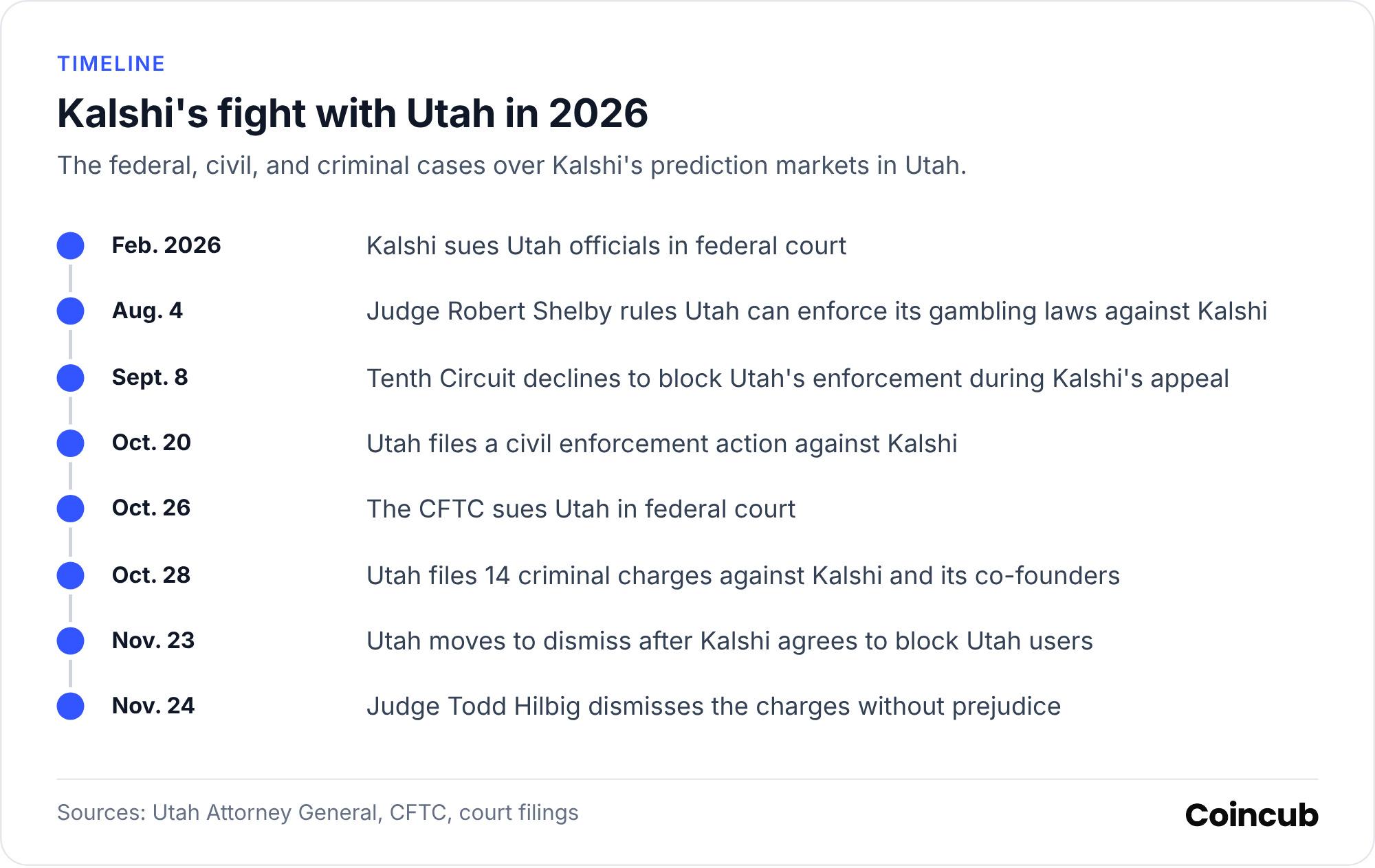
The CFTC sued Utah in federal court on Oct. 26, making Utah the 10th state the agency has challenged over prediction markets. The agency’s chief has also criticized states over the Kalshi criminal charges.